

TL;DR:
- Incorporating mystery elements into children's stories enhances engagement by activating curiosity, suspense, and active problem-solving. These stories promote inference skills and sustained attention, which significantly improve reading comprehension and cognitive development. Age-appropriate mysteries, whether visual or textual, can be seamlessly integrated across all reading levels to foster skill-building and a love for stories.
Mystery isn't just a genre for adults curled up with a detective novel on a rainy afternoon. The moment a child hears "something is hidden," their brain lights up in ways that pure adventure or comedy simply cannot match. Including mystery elements in children's books increases engagement by creating suspense and a sense of active problem-solving. For parents and educators looking for a genuine edge in reading motivation and critical thinking, mystery might be the most underused tool in the literary toolkit. This article lays out the evidence, the practical steps, and the fresh thinking you need.
Table of Contents
- How mystery hooks young minds: The science of curiosity and suspense
- Cognitive growth unlocked: Building inference and comprehension skills
- Fair, fun, and age-appropriate: Best practices for child-friendly mysteries
- Moving from genre to skill-building: What the research really says
- A fresh perspective: Why every children's story deserves a touch of mystery
- Discover more: Bringing mystery and excitement to your child's library
- Frequently asked questions
Key Takeaways
| Point | Details |
|---|---|
| Boosts engagement | Mystery elements capture children’s attention and spark curiosity for deeper reading. |
| Builds inference skills | Solving mysteries helps children practice critical thinking and reading comprehension. |
| Age-appropriate puzzles matter | Ensuring clues and suspense are suited to a child's age keeps reading both safe and rewarding. |
| Not just a genre | Using mystery techniques in any story, not only genre fiction, can improve learning and enjoyment. |
How mystery hooks young minds: The science of curiosity and suspense
Children are natural detectives. Watch a toddler figure out how a toy works and you'll see pure, unfiltered curiosity in action. Mystery-driven stories tap directly into that instinct, giving it a narrative frame that is hard to put down.
The brain on suspense
When a child encounters an unresolved puzzle in a story, the brain releases dopamine in anticipation of a solution. This neurological reward system is the same one that lights up during games and problem-solving activities. In storytelling, that chemical response keeps pages turning because the reader genuinely needs the answer. The science of scares reveals that even mild tension and the unknown can create a powerful neurological pull for young readers, making them more attentive and emotionally invested in the outcome.
The "aha!" moment matters just as much as the suspense itself. When the solution finally arrives and it fits all the clues, there is a satisfying neurological payoff. That reward teaches children, even subconsciously, that sustained attention and careful thinking produce results. This is a far richer lesson than a story that simply delivers answers without effort.
Why mystery outperforms other genres for attention
Action stories thrill in the moment. Funny books produce laughter. But mystery creates something different: sustained engagement. A child does not just want to see what happens next. They want to figure it out before anyone tells them. That active participation shifts reading from passive reception to genuine mental exercise.
Research reinforces this point. Engagement through suspense and active problem-solving consistently outperforms passive storytelling formats when it comes to keeping young readers focused. The educational value of scary stories follows a similar pattern: measured tension and uncertainty push children to think rather than simply absorb.
- Mystery activates anticipatory thinking before the answer arrives
- Suspense increases emotional investment in characters and outcomes
- Puzzle-solving rewards attention with neurological satisfaction
- Active inference-making sharpens focus across the entire reading session
"Curiosity is not just a feeling. It is a cognitive state that prepares the brain for learning." This is exactly what a well-crafted mystery delivers page after page.
Pro Tip: Adjust suspense intensity for your child's age. Younger readers (ages 4 to 7) respond best to visual clues and short, clear puzzles. Older children (ages 8 and up) can handle layered plot twists and red herrings without feeling overwhelmed.
Cognitive growth unlocked: Building inference and comprehension skills
Understanding the pull of mystery, it is important to see how this approach goes beyond engagement to build foundational thinking and reading skills.
Inference-making as the core skill
Inference is the ability to use existing knowledge and textual clues to arrive at a conclusion the text does not state outright. It is, arguably, the single most important reading comprehension skill a child can develop. Mystery stories are inference engines. Every clue, every suspicious character, every unexplained event asks the reader to bridge the gap between what is written and what is true.
Research shows that a research-backed route from mystery-like reading demands to outcomes is strengthened inference-making and deeper comprehension. When children practice reading texts that require them to fill in gaps and connect dots, their overall reading comprehension improves measurably. This is not a theory. It is a documented outcome.
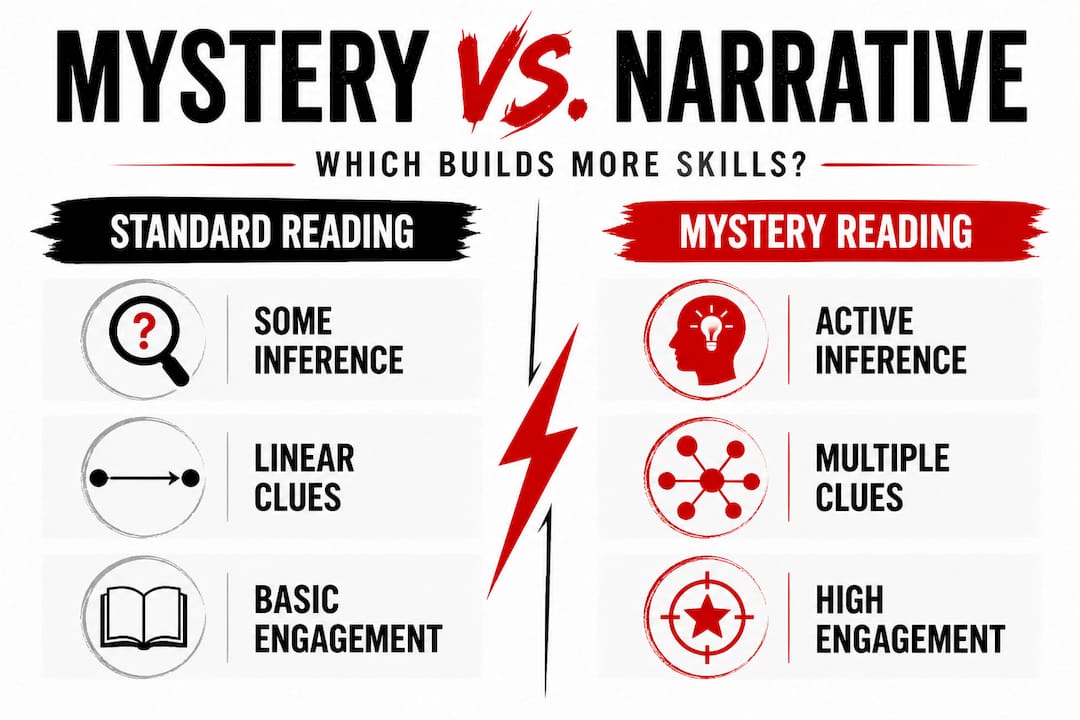
How mystery reading builds comprehension: A comparison
| Skill area | Standard narrative reading | Mystery-driven reading |
|---|---|---|
| Inference-making | Occasional | Constant |
| Attention to detail | Moderate | High |
| Emotional engagement | Variable | Consistently high |
| Vocabulary in context | Present | Reinforced through clue-spotting |
| Critical questioning | Low | Built into every chapter |
The contrast is vivid. Mystery demands more from the reader at every level, which means it gives more back in terms of skill development. The benefits of ghost stories echo the same principle: stories that create mild uncertainty strengthen comprehension in ways comfort-zone narratives cannot.
Steps for using mystery to teach inference
Use these steps at home or in the classroom to turn any mystery read into a skill-building session:
- Choose the right mystery. Pick a story with clues that are visible in the text, not hidden in subtext beyond the child's reading level. A guide to spooky stories can help you find age-matched titles with the right balance of challenge and accessibility.
- Pause at key clue moments. Stop reading when a major clue appears and ask "What do you think this means?" Do not provide the answer. Let the child sit with the uncertainty for a moment.
- Keep a simple clue log. Even a handwritten sticky note list of "things we noticed" builds the habit of tracking evidence. This practice transfers directly to academic reading tasks.
- Compare predictions at the end. Before revealing or finishing the ending, ask the child to state their best guess. Then read to the conclusion together. Was the prediction right? What clue led them there, or what did they miss?
- Discuss the solution together. The conversation after reading is where the deepest comprehension gains happen.
Pro Tip: Discuss the clues together after finishing the story, not during. Mid-read interruptions can break the emotional spell of the mystery. Save the analysis for when the full picture is revealed.
Fair, fun, and age-appropriate: Best practices for child-friendly mysteries
Building on the cognitive benefits, it is crucial to apply age-appropriate guidelines to keep mysteries both fun and safe for all readers.
Age-by-age mystery framework
Mystery reading can be implemented with classroom methods that keep puzzles fair and age-appropriate. Here is a practical breakdown:
| Age group | Mystery complexity | Puzzle type | Safety check |
|---|---|---|---|
| Ages 4 to 6 | Very simple, one clue | Visual, picture-based | No scary elements, friendly tone |
| Ages 7 to 9 | Two to three clues | Situational, logical | Mild tension only, always resolved |
| Ages 10 to 12 | Multiple clues, light misdirection | Text-based inference | Age-check for themes, no graphic content |
| Ages 13 and up | Complex plots, red herrings | Multi-layered reasoning | Parental guidance for intense themes |
Key elements of a fair mystery for children
Not every mystery is created equal. A mystery that frustrates rather than engages loses the reader fast. When selecting or writing mystery stories for children, look for these qualities:
- Solvable clues. Every clue must be present in the story before the solution is revealed. No surprise information at the end.
- Logical conclusions. The ending must follow naturally from the evidence. Children quickly spot when an ending feels unfair or random.
- Low fear factor for younger readers. Tension should feel like excitement, not threat. The safe horror curiosity framework applies here: the unknown should feel thrilling, not traumatic.
- Relatable protagonists. Children engage more when the detective or problem-solver is their age or a character they can identify with.
- Clear resolution. Mystery for adults can afford an ambiguous ending. Mystery for children works best when the puzzle is solved cleanly, delivering that satisfying neurological reward discussed earlier.
Pro Tip: Invite children to create their own mysteries. Ask them to hide a clue somewhere in the house or classroom and write a note describing what to look for. Creating a mystery requires even deeper thinking than solving one, and it is wildly engaging. More early readers tips can help you structure this activity for different learning stages.
Moving from genre to skill-building: What the research really says
Many parents and educators wonder if "mystery" must be a genre. Let's clarify what the research actually recommends.
The honest answer is that the cognitive benefits of mystery reading are not locked inside the mystery genre specifically. Empirical literature supports mechanisms adjacent to mystery, such as inference-making and curiosity-driven engagement, rather than isolating the mystery genre specifically. This is a liberating finding for educators. You do not need to stock shelves exclusively with detective stories.
What actually drives the benefit is the presence of uncertainty combined with solvable evidence. Any children's story can include a small subplot, a hidden object, a character's unexplained behavior, or a question left open for a chapter before being answered. These elements trigger the same cognitive engagement as a formal mystery narrative.
"The genre is just the vehicle. The skill-building comes from the mechanism: open questions, evidence weighing, and the reward of resolution."
Ways to leverage mystery mechanics across any children's narrative
- Pause before a reveal and ask "Why do you think the character did that?"
- Use picture books with visual details that foreshadow events, then return to the page after the event happens
- Read a chapter book and invite the child to predict one thing that will happen in the next chapter
- After any story, ask "Was there anything that surprised you? Did the author leave any clues?"
- Introduce the concept of "red herrings" once a child is ready, showing them how authors play fair and not-so-fair
The connection between mystery mechanics and moral reasoning is also worth noting. Stories where children weigh evidence and question assumptions naturally connect to discussions about fairness and right and wrong. Villains in children's books follow this same logic: complex, questionable characters give children the chance to practice moral thinking within the safe space of fiction.
A fresh perspective: Why every children's story deserves a touch of mystery
Here is the take that most reading guides miss entirely. Mystery is not a genre. It is a technique. And it belongs in every children's story, not just the ones shelved under detective fiction.
Conventional wisdom treats mystery as a category. Parents browse the mystery section when they want a puzzle story. Educators pull mystery titles for a specific unit. But the research and the neurological evidence both point to the same conclusion: the mechanism, not the label, is what changes a reading experience.
Even a picture book for a three-year-old can hold a mystery. A simple page where the rabbit is hiding, and the reader has to spot the ears before the turn of the page, that is mystery at work. It is not scary. It is not complex. But it creates that same anticipatory tension, that same reward when the answer arrives.
The most memorable stories for children often have one thing in common: something the reader did not fully understand until the last page. Think about the stories you loved as a kid. Chances are, at least one kept you guessing. That experience of not knowing, then knowing, is one of the most purely satisfying things a story can deliver.
Parents and educators do not need to overhaul their reading lists. Start small. Next time you read aloud, stop before a key moment and ask "What do you think is behind that door?" Watch what happens to a child's attention. It sharpens immediately. That moment of fun and fear in learning is where genuine engagement lives.
The goal is not to create anxiety. It is to create investment. A child who is slightly unsure what comes next is a child who is fully present in the story. That presence is where learning happens.
Discover more: Bringing mystery and excitement to your child's library
Now that you have the strategies and the research, here is where you can find stories that put it all into practice.

At Mark Watson Books, we have curated a collection of children's titles built around exactly these principles: age-appropriate tension, solvable puzzles, and stories that keep young readers genuinely hooked. Whether you are looking for your child's first gentle mystery or something with a bit more edge for an older reader, the children's mystery books collection has options for every age and mood. Browse by reading level, explore standout titles, and find the story that will make your young reader beg for one more chapter. Visit the full book catalog to see everything available, and sign up for updates on new releases delivered straight to your inbox.
Frequently asked questions
What age should children start reading mysteries?
Children can start with simple mysteries as early as kindergarten, using visual clues and gentle puzzles suited to their age. Age-appropriate mystery methods can be introduced in classroom settings even before formal reading begins.
Does reading mysteries make children better problem-solvers?
Yes, mysteries encourage children to make inferences, connect clues, and practice critical thinking while reading. Strengthened inference-making and deeper comprehension are documented outcomes of mystery-style reading practice.
How can I ensure a mystery story is safe for my child?
Look for solvable clues, logical endings, and low scare levels to ensure stories remain age-appropriate. Fair mystery methods used in classroom settings are a reliable standard to apply at home as well.
Do mysteries only help older children or advanced readers?
Mysteries can be tailored for all levels, even for pre-reading kids, by focusing on visual or situational clues over text complexity. Classroom-ready mystery approaches confirm that the benefits scale down effectively to the youngest readers when the format is adjusted appropriately.