
TL;DR:
- Villains in children's stories promote moral growth, empathy, and critical thinking.
- Complex villains help children aged 6 to 8 understand moral nuances and Gray areas.
- Guided discussions with villains build emotional intelligence, self-esteem, and courage in children.
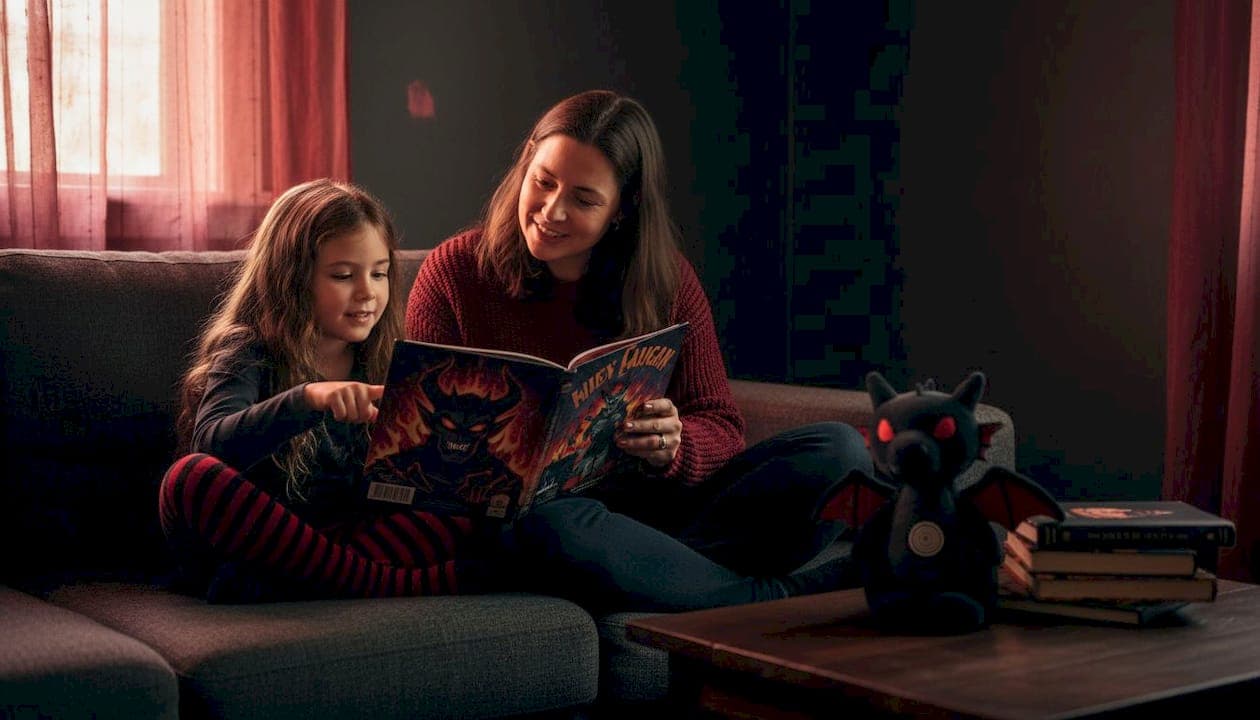
Most parents instinctively want to shield their kids from scary, menacing characters. That impulse makes sense. But here's the surprising truth: the villain lurking in the pages of a children's book might be one of the most powerful teachers your child will ever encounter. Far from simply frightening young readers, villains spark genuine moral growth, build empathy, and sharpen critical thinking in ways that purely wholesome stories simply cannot. This article reveals exactly how villains work their magic on developing minds, and how you can use them intentionally to raise thoughtful, resilient kids.
Table of Contents
- Why villains matter: Building blocks of moral understanding
- Classic evil vs. complex villains: Which develop moral thinking best?
- Villains in action: Teaching empathy, self-esteem, and courage
- Navigating the limits: Over-identification, age, and guidance
- A fresh take: Why we need to embrace villains in children's reading
- Discover stories that spark growth and imagination
- Frequently asked questions
Key Takeaways
| Point | Details |
|---|---|
| Villains boost moral growth | Well-written villains help children learn right from wrong and build mature moral thinking. |
| Classic vs. complex matters | Traditional evil villains and modern ambiguous antagonists each shape empathy and judgment differently. |
| Teaching with villains | Addressing villains can improve self-esteem, resilience, and emotional intelligence when guided thoughtfully. |
| Guidance is essential | Parental and educator support ensures that villainous characters foster healthy, positive development. |
Why villains matter: Building blocks of moral understanding
Having set the stage about the complexity of villains, let's dig into what exactly makes a villain so central in shaping how kids see the world.
Children are natural moral detectives. From the moment they can follow a story, they are constantly sorting the world into categories: fair and unfair, kind and cruel, right and wrong. Villains give them rich, emotionally charged material to practice that sorting. Without a credible threat or a genuinely bad actor in a story, the hero's choices carry far less weight. The villain is the pressure that tests the hero, and by extension, tests the reader.
"Stories are the original moral laboratories. A child who watches a villain scheme, fail, and face consequences has run an experiment in ethics without leaving the safety of their bedroom."
Research confirms what great storytellers have always known. Neuroimaging shows antagonists engage brain regions tied to moral reasoning, including the default mode network, the medial prefrontal cortex, and the anterior cingulate cortex. These regions handle ethical judgment and cognitive conflict. In plain terms, reading about a villain literally activates the parts of the brain that weigh right from wrong. That is not passive entertainment. That is active moral exercise.
Children's capacity for this exercise grows with age. An empirical study of 4 to 8 year olds found that while even the youngest children can tell good from bad, kids aged 6 to 8 are significantly better at recognizing moral gray areas. They start to ask the harder questions: Why did the villain do that? Could things have been different? Those questions are the seeds of genuine ethical thinking.
Here is what villains specifically bring to the table for young readers:
- Safe exposure to fear and conflict. Stories create a controlled environment where children can feel the tension of danger without real-world consequences.
- A clear catalyst for the hero's journey. The hero only grows because the villain forces them to. Children internalize that growth is born from challenge.
- Moral contrast. Seeing cruelty in a character makes kindness in another character vivid and meaningful.
- Emotional vocabulary. Villains help children name feelings like dread, injustice, and anger, which builds emotional intelligence.
The fact that monsters spark imagination is well established, and that imaginative engagement is directly linked to growth and resilience in young readers. Villains are not the problem. They are part of the solution.
Classic evil vs. complex villains: Which develop moral thinking best?
With the basics of moral development established, let's look at how different types of villains guide children differently.
Not all villains are created equal, and that matters enormously for how children learn from them. There are two broad categories worth understanding: classic villains who are purely evil, and complex or morally ambiguous antagonists who blur the lines.
Classic villains like the Evil Queen in Snow White or the Big Bad Wolf serve a critical purpose for younger children. They are uncomplicated. Their motives are selfish, their actions are harmful, and their defeat is satisfying. This clarity gives children a firm moral foundation. They learn that cruelty has consequences and that goodness is worth defending. For children under 6, this kind of storytelling is exactly right.
Complex villains operate differently. Think of characters who were wronged before they turned cruel, or antagonists whose logic almost makes sense even as their actions cause harm. These characters ask more of the reader. They demand empathy, critical analysis, and the ability to hold two ideas at once: this character did something terrible AND this character had understandable pain. That is sophisticated thinking.
| Villain type | Best age group | Key moral lesson | Risk to watch for |
|---|---|---|---|
| Pure evil (classic) | Under 6 | Clear right vs. wrong | Oversimplification of real people |
| Morally ambiguous | 6 to 8 years | Empathy, nuance, gray areas | Confusion without adult guidance |
| Anti-hero | 8 years and up | Complex ethics, perspective-taking | Excusing harmful behavior |
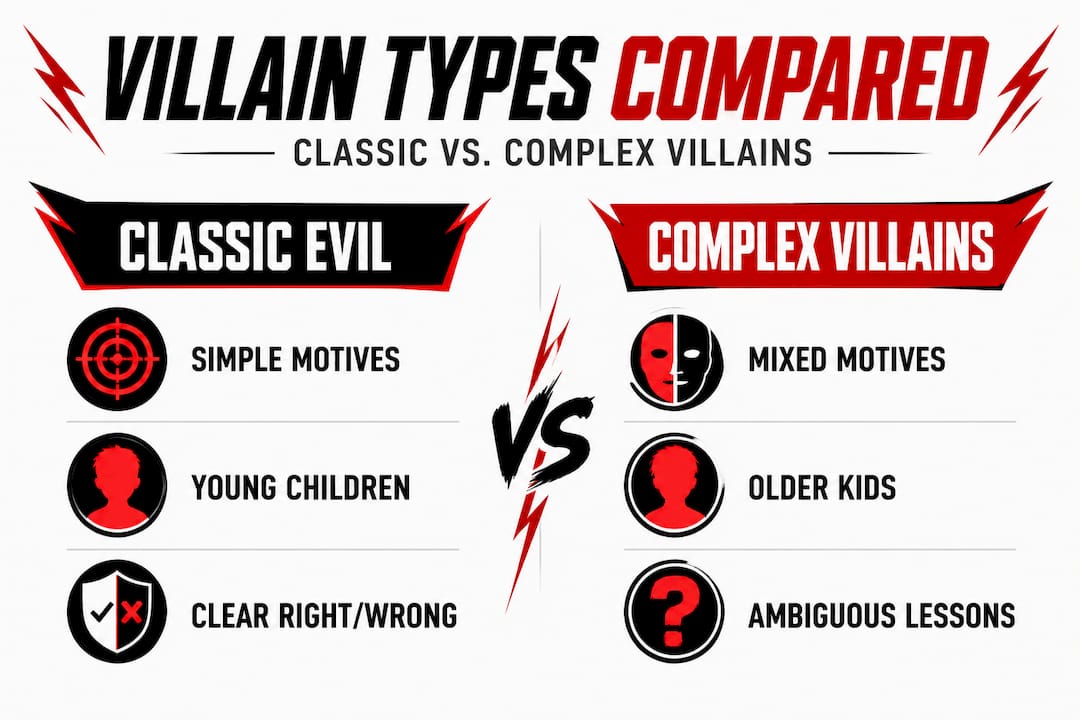
The same empirical research that tracked children's moral reasoning found that morally ambiguous villains are better suited for children aged 6 and up, while pure evil characters lay the necessary groundwork for the youngest readers. Rushing complexity before a child is ready can backfire. Anti-heroes, in particular, carry a real risk: if a child identifies strongly with a villain who uses trauma as a justification for cruelty, they may unconsciously absorb the idea that bad behavior is acceptable under the right circumstances. That is a conversation worth having out loud.
Pro Tip: Before introducing a morally complex villain, test the waters by asking your child what they think about a classic villain's choices. If they can articulate why those choices were wrong and show some curiosity about why the villain made them, they are probably ready for more nuance.
For parents exploring age-appropriate options, classic horror for kids offers a thoughtful starting point, and monster horror for kids explores how even frightening characters can be used constructively.
Villains in action: Teaching empathy, self-esteem, and courage
Now that we've contrasted villain types, let's see what happens when children actively engage with villains in learning environments.
The classroom is where the real magic happens. When teachers bring villains into structured discussions, the results go far beyond literary analysis. They touch self-worth, emotional regulation, and the ability to understand people who are very different from us.
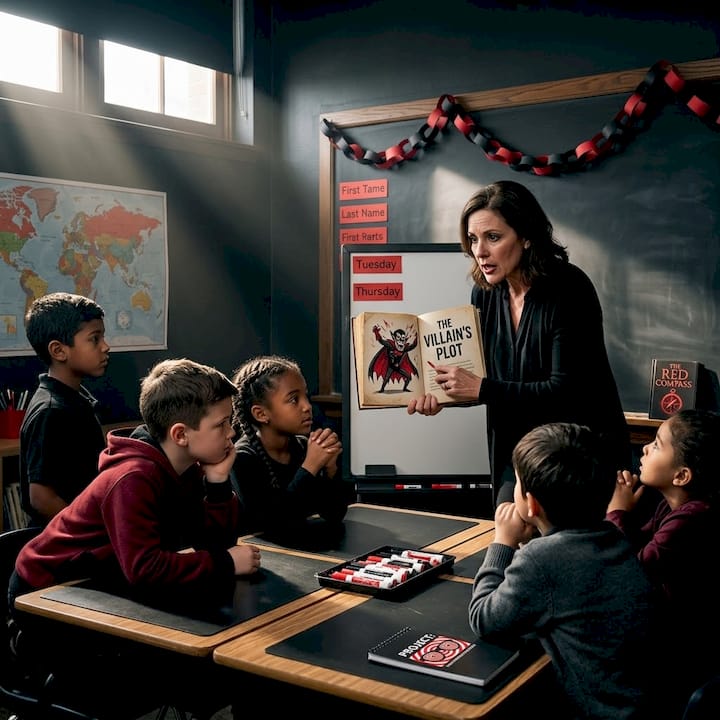
One striking example comes from a study using Disney villains in English as an Additional Language education. Disney villains improved self-esteem significantly in primary students, moving average scores on the Rosenberg Self-Esteem Scale into the high range. How? By using the villains' own insecurities as conversation starters. Characters like Ursula or Maleficent are often driven by feelings of rejection, jealousy, and a desperate need for validation. Sound familiar? Children recognize those feelings in themselves. Talking about a villain's pain in a safe, fictional context helps kids process their own.
Here is a practical sequence educators can use when reading a villain-centered story:
- Read and observe. Let children experience the story without interruption. Let the tension build.
- Identify the villain's actions. Ask: What did this character do? What happened because of it?
- Explore the villain's motives. Ask: Why do you think they made those choices? What were they feeling?
- Connect to real life. Ask: Have you ever felt that way? What did you do differently?
- Discuss consequences. Ask: Was the villain's outcome fair? What could have changed it?
This sequence builds empathy by asking children to step inside a character's experience without endorsing that character's choices. That distinction is crucial and powerful.
| Learning outcome | How villains support it | Example discussion prompt |
|---|---|---|
| Empathy | Exploring villain backstories | "Why do you think they felt that way?" |
| Self-esteem | Recognizing shared insecurities | "Have you ever felt left out like this character?" |
| Courage | Watching heroes face villains | "What would you have done in the hero's place?" |
| Critical thinking | Analyzing motives and consequences | "Was the villain's plan ever going to work? Why not?" |
Pro Tip: Use a villain's backstory as a conversation starter about managing emotions. Ask your child: "If this character had talked to someone about how they felt, do you think things would have turned out differently?" This builds emotional literacy without excusing the villain's behavior.
Exploring empathy and inclusion through literature is a proven approach, and villain-centered stories add a uniquely powerful dimension to that work. For children who need an extra push toward bravery, courage through scary stories explains the direct link between facing fictional fear and building real-world confidence.
Navigating the limits: Over-identification, age, and guidance
Understanding the power of villains also means knowing how to set boundaries. Here's how parents and educators can support healthy engagement.
Villains are powerful tools, but like any powerful tool, they require careful handling. The goal is never to expose children to darkness for its own sake. The goal is to use that darkness intentionally, with conversation and context.
The most important boundary to maintain is the difference between understanding a villain and identifying with one. Children naturally experiment with different perspectives during reading, and that is healthy. But if a child starts consistently defending a villain's cruelty, dismissing victims, or expressing admiration for harmful power, that is a signal to pause and talk.
Here are key practices for keeping villain engagement positive:
- Always discuss after reading. Never let a disturbing villain moment pass without a conversation about choices and consequences.
- Choose stories with clear resolutions for younger children. The villain should face meaningful consequences. Open-ended moral ambiguity is for older readers.
- Ask open-ended questions. "What do you think about what that character did?" opens more honest dialogue than "That was bad, right?"
- Watch for over-identification. If a child repeatedly plays as the villain in imaginative play and expresses genuine hostility toward "hero" characters, explore what that might reflect.
- Prioritize clear morals before introducing ambiguity. Teaching character types effectively means building a strong moral foundation first.
Research adds a reassuring note here. Young children judge harmful actions as wrong even when those actions are directed at a villain. In other words, children naturally recognize that cruelty is undesirable regardless of who receives it. Their moral instincts are already working. Your job as a parent or educator is to sharpen those instincts, not install them from scratch.
"Children don't need to be protected from every shadow in a story. They need a trusted adult to help them understand what the shadow means."
The educational value of scary stories is well documented, and the key variable in every positive outcome is guided engagement. The story is the spark. The conversation is the fire.
A fresh take: Why we need to embrace villains in children's reading
Here is the uncomfortable truth that most parenting advice skips over: over-protecting children from fictional villains may actually leave them less equipped to handle real-world moral complexity.
Think about what a child raised on only gentle, conflict-free stories learns. They learn that the world is safe and kind. They learn that problems resolve themselves. They learn that bad people are easy to spot and easy to defeat. None of that is true. And when reality eventually delivers its first real villain, whether that is a bully, a manipulative friend, or a genuinely harmful situation, a child with no practice reading moral complexity is genuinely unprepared.
Villains in fiction are a rehearsal space. They let children practice outrage, fear, moral judgment, and empathy in a setting where the stakes are not real. A child who has worked through the unsettling tension of a truly frightening antagonist and come out the other side with the hero has already built something important: the knowledge that they can face darkness and survive it.
This is not an argument for throwing terrifying content at toddlers. It is an argument for trusting children's capacity to engage with difficulty when it is age-appropriate and guided. The insight and imagination that great storytelling unlocks are not luxuries. They are preparation for life.
Embrace the villain. Choose wisely, read together, and talk about what you find. That combination is one of the most powerful educational tools available to any parent or educator.
Discover stories that spark growth and imagination
Ready to put these insights into practice? The right books make all the difference, and finding stories where villains genuinely teach rather than simply frighten is easier when you know where to look.

Mark Watson Books offers a carefully curated range of titles designed to engage young readers with exactly the kind of vivid, purposeful storytelling this article describes. From characters who challenge young minds to stories that build courage and empathy page by page, the children's books collection is a fantastic starting point for parents and educators ready to use literature as a genuine growth tool. Browse the full collection to discover titles across every reading level and theme. The next great villain your child learns from is waiting on the shelf.
Frequently asked questions
What age is appropriate to introduce morally complex villains?
Children around 6 to 8 years old can begin to understand morally ambiguous characters, as research confirms that this age group is significantly better at recognizing moral gray areas than younger children. Kids under 6 benefit most from clear-cut villains with obvious consequences.
Can villains in children's books negatively affect self-esteem?
When discussed openly, villains actually improve self-esteem rather than harm it. A classroom study found that using Disney villains in education moved students' self-esteem scores from average to high by prompting reflection on shared insecurities and the importance of acceptance.
How can parents guide children in understanding villainous behavior?
Discuss the villain's motivations, the consequences of their choices, and how those situations might mirror real life. Effective character teaching prioritizes clear moral frameworks first, then builds toward complexity, always monitoring for unhealthy over-identification.
Do children naturally judge villains' actions as bad?
Yes. Even very young children recognize harmful actions as wrong, and research shows that children judge helping behaviors positively and harmful behaviors negatively regardless of whether the target is a hero or a villain. Their moral instincts are naturally sound.