
TL;DR:
- Haunted stories help children develop emotional resilience, imagination, and curiosity about the unknown.
- When supported by adult guidance, age-appropriate horror provides safe opportunities for emotional growth and stress management.
Most parents assume that haunted stories are purely a problem to be managed. Keep the scary stuff away from kids, and everything will be fine. But that assumption is wrong, and it might be costing young readers something genuinely valuable. Haunted themes, ghost stories, and supernatural narratives do more than frighten. They build emotional muscle, spark imagination, and teach kids how to face the unknown with curiosity instead of panic. This article unpacks the psychology, the cultural forces, and the real developmental rewards hiding inside those spine-tingling pages.
Table of Contents
- What draws young readers to hauntings?
- The role of development, culture, and media
- Safety, support, and the 'adjust and support' method
- Emotional growth and practical benefits from haunted stories
- What most guides miss about haunted stories for kids
- Explore haunting stories for young readers
- Frequently asked questions
Key Takeaways
| Point | Details |
|---|---|
| Safe engagement with fear | Haunted stories let young readers explore and master fears in a controlled environment. |
| Social and cultural influence | Children are shaped by culture, media, and social narratives, which affect their interest in hauntings. |
| Role of adult support | Parents and educators can enhance safety and positive growth by co-viewing and mediating scary content. |
| Emotional and cognitive benefits | Reading hauntings promotes emotional resilience, problem-solving, and imaginative growth. |
| Curated safe collections | Age-appropriate haunted stories can be found in specialized collections for young readers. |
What draws young readers to hauntings?
Young readers are not drawn to haunted stories because they want to be terrified. They are drawn in because fear, when it is safe, feels thrillingly alive. There is a rush that comes from reading about a creaking floorboard at midnight or a shadow that moves when nothing should. That rush is exciting, and kids know the difference between story fear and real danger. That contrast is exactly what makes haunted tales so compelling.
Understanding why horror appeals to kids starts with recognizing that children are wired to test limits. Haunted stories let them push into emotionally intense territory without any actual risk. They can feel the fear, close the book, and walk away with a small sense of triumph. That is a powerful emotional experience for a young person who spends most of the day being told what to do.
Here is what really drives the fascination:
- Safe thrill: Fear in fiction is controlled. The reader holds all the power.
- Mastery: Finishing a scary story builds confidence. Kids think, "I faced that and survived."
- Curiosity about the unknown: Ghosts and hauntings ask big questions about death, the afterlife, and what lies beyond the visible world.
- Emotional rehearsal: Scary scenarios let young readers practice managing strong feelings before they face them in real life.
- Social connection: Sharing a ghost story creates instant bonding with friends and classmates.
The science of spooky tales confirms that the brain processes fictional fear differently from real fear, which is why the experience feels fun rather than traumatic for most children. The body gets a small adrenaline hit, but the prefrontal cortex knows there is no actual danger. The result is pure, safe excitement.
"Age-appropriate horror can function as a safe way for young readers to engage with fear, letting them explore it without real-world harm." — BookTrust
This is the foundation of everything. Once you accept that fear can be a safe playground rather than a danger zone, the value of haunted stories becomes obvious.
The role of development, culture, and media
Having established what captivates kids, let's look at how their environment and development affect this fascination. Not all children respond to haunted stories the same way, and that is not random. Age, cultural background, and media exposure all shape how a child experiences and interprets a ghost story.
Younger children, roughly ages five to eight, tend to see ghosts as literal and scary. Their imaginations are vivid but their ability to separate fantasy from reality is still developing. By ages nine to twelve, most kids have a firmer grip on what is real and what is not, making haunted stories more exciting than distressing. Teenagers layer in social meaning. For them, ghost stories often become about identity, mortality, and the limits of what adults can explain. Research into adolescent perceptions of ghosts shows that kid and teen engagement with supernatural narratives is shaped by development, culture, and social media, suggesting hauntings fascinate for social-cognitive reasons that go far beyond raw fear.
Cultural beliefs add another rich layer. In some traditions, ancestors stay close to the living. In others, ghosts are purely malevolent. A child who grows up hearing that spirits protect the family will experience a haunted story very differently from a child raised to fear any supernatural presence. This means two kids reading the same ghost story might land in completely different emotional places. Understanding the benefits of ghost stories requires appreciating this cultural diversity rather than flattening it.
Here is a quick comparison of how different ages and cultural contexts typically shape the haunting experience:
| Factor | Younger children (5-8) | Older children (9-12) | Teenagers (13+) |
|---|---|---|---|
| Reality distinction | Still forming | Mostly clear | Well established |
| Primary emotion | Anxiety or excitement | Thrill and curiosity | Intellectual fascination |
| Cultural influence | Strong (parental beliefs) | Moderate | Peer-driven and personal |
| Social media impact | Low | Growing | Very high |
| Story preference | Simple, resolved endings | Mysteries with tension | Complex, open-ended |
Social media and peer culture have also dramatically amplified the appeal of haunted content for older kids. Creepypasta stories, paranormal YouTube channels, and viral ghost challenges circulate through friend groups at lightning speed. This peer-driven sharing turns haunted content into a social experience, not just a solo reading activity. Children's horror anthologies tap into this same social energy by giving kids shareable stories that feel culturally current.
Key cultural and developmental influences to keep in mind:
- Family storytelling traditions set the emotional tone for how ghosts are perceived.
- Peer groups amplify interest in supernatural content through shared media experiences.
- Religious and spiritual backgrounds directly shape whether hauntings feel threatening or meaningful.
- Access to age-appropriate horror through books and anthologies creates healthier engagement than unfiltered digital content.
The educational value of scary stories grows significantly when adults acknowledge these individual differences and choose content that meets kids where they are developmentally and culturally.
Safety, support, and the 'adjust and support' method
Now that we've examined social and cultural influences, here's how adults can nurture and protect young readers during their haunting explorations. The goal is not to gatekeep every scary story. The goal is to create a safe container so that when kids encounter fear in fiction, they have the support they need to process it well.
The "adjust and support" method is a practical framework that pediatric health experts recommend. It centers on a few core ideas: watch with your child when possible, read the room for signs of distress, and be ready to pause or stop if the content is clearly causing harm rather than healthy excitement. Parental co-viewing of scary media is one of the most effective safety cues available, because it transforms a potentially overwhelming experience into a shared one.
Here is a practical step-by-step guide for applying this method:
- Preview content first. Before handing a haunted book to your child, read a chapter yourself. Know what is inside so you are never caught off guard.
- Read together or nearby. Co-reading makes kids feel safe. Your physical presence signals that everything is under control.
- Ask open-ended questions. After a scary scene, ask "What do you think happened there?" or "How did that make you feel?" This turns passive reading into active emotional processing.
- Watch for distress signals. Trouble sleeping, refusing to be alone in a room, or avoiding the book entirely are signs that the content may be too intense for now.
- Turn off or put down without shame. If a story is too much, stop. Make it clear that choosing to stop is brave, not weak. This builds self-awareness.
- Circle back later. A book that felt too scary at age eight might be perfect at age ten. Check in periodically and offer it again when the child is ready.
Pro Tip: The most powerful thing you can do after a haunted story is ask your child to explain what scared them most and then problem-solve it together. "What would you do if you saw a ghost?" turns fear into creative thinking and gives kids a genuine sense of control over scary scenarios.
The parent's guide to spooky stories offers curated recommendations organized by age group, making it much easier to find stories that thrill without overwhelming. Choosing the right content at the right time is one of the simplest forms of support any adult can offer.
Emotional growth and practical benefits from haunted stories
With safety strategies in place, it's important to highlight the real-life benefits young readers gain from these supernatural narratives. Haunted stories are not just entertainment. They are emotional gyms where kids strengthen skills they will use for the rest of their lives.
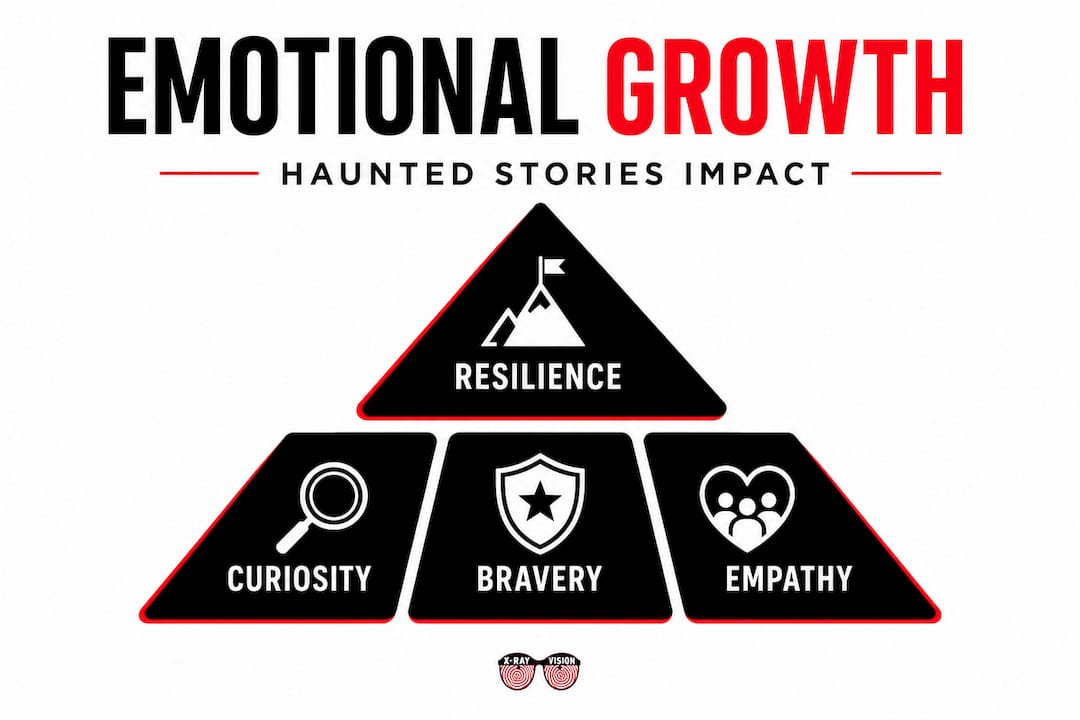
Think of a haunting narrative as an emotional rehearsal. When a young reader follows a child protagonist through a terrifying haunted house, they experience fear, problem-solving, courage, and relief in sequence. They do it without any real-world consequences. That is a remarkable gift. The connection between horror and resilience is well documented: readers who regularly engage with age-appropriate scary content tend to develop more flexible coping strategies for real stress.
Here are the core emotional and practical benefits in action:
- Resilience building: Finishing a scary story teaches kids that discomfort is survivable. This is one of the most transferable life skills there is.
- Empathy development: Haunted stories often feature characters in crisis. Readers who follow their journeys become more attuned to other people's fear and pain.
- Imagination expansion: Supernatural settings stretch creative thinking in ways that realistic fiction simply cannot.
- Improved reading engagement: Kids who choose their own scary books read more and read longer. Pleasure-driven reading accelerates literacy development.
- Emotional vocabulary: Navigating intense emotions through story gives kids words for feelings they may not yet be able to express directly.
| Benefit | How haunted stories deliver it | Real-life impact |
|---|---|---|
| Resilience | Readers survive story fear repeatedly | Better stress tolerance |
| Empathy | Protagonists face fear and loss | Stronger social awareness |
| Problem-solving | Characters must outwit threats | Creative thinking skills |
| Emotional literacy | Vivid scenes generate strong feelings | Better self-expression |
| Reading motivation | Suspense drives page-turning | Higher reading frequency |
Monster horror in kids' books takes this even further by using fantastical creatures as stand-ins for real-world anxieties like bullying, loss, or change. Kids process these heavy topics through the safer lens of a monster story, which gives them emotional distance and creative freedom at the same time.
Even the illustrations in children's horror contribute meaningfully to emotional growth. Visual storytelling in scary books teaches young readers how to read facial expressions, body language, and atmospheric cues, skills that translate directly into sharper emotional intelligence in real life.
The evidence points in one clear direction: when haunted stories are age-appropriate and supported by caring adults, they are one of the most emotionally rich genres a young person can explore.
What most guides miss about haunted stories for kids
Most guides about kids and scary content default to one piece of advice: be cautious. And yes, caution has a place. But the obsessive focus on risk misses something enormous. Guided engagement, not avoidance, is where the real growth lives.
Here is the uncomfortable truth. When adults shut down a child's fascination with hauntings without explanation, they do not make that fascination go away. They make it go underground. Kids find the content elsewhere, usually in places with no safety net and no conversation afterward. The fear then becomes isolated and unprocessed rather than shared and explored. That is the actual risk adults should be worried about.
Most guides also treat every child as identical. They do not account for the fact that a child from a cultural background where ancestor spirits are honored will experience a ghost story very differently from a child with no such tradition. Individuality matters enormously here, and cookie-cutter advice ignores it entirely.
What we believe at Mark Watson Books is that curiosity should lead the way, but adults should walk alongside, not behind. Let a child choose the haunted book that pulls them in, then read it with them, ask questions, and watch for emotional signals along the way. The link between fear and resilience in horror is strongest when curiosity is honored and supported, not squeezed into a one-size-fits-all risk management plan.
The most empowered young readers are not the ones who were protected from every scary story. They are the ones whose adults trusted them enough to explore fear together.
Explore haunting stories for young readers
If this article has sparked your own curiosity, you are in exactly the right place. Mark Watson Books offers a carefully curated range of horror, haunted, and supernatural titles designed with young readers in mind.

Whether you are a parent looking for a safe but thrilling read-aloud or a young reader ready to experience the chilling rush of a ghost story told right, markwatsonbooks.com has something waiting for you. From internet horror anthologies rooted in Creepypasta tradition to age-appropriate children's horror that balances fright with heart, the collections here are built to entertain, excite, and grow young imaginations. Don't wait. The haunted house is open.
Frequently asked questions
Are haunted stories harmful to young readers?
When age-appropriate and supported by adult guidance, haunted stories are not harmful. Research shows that age-appropriate horror actually helps young readers engage with fear in a safe, manageable way.
How can parents make ghost stories safer for kids?
Parents should co-read or co-view scary content and watch for signs of distress. Following an "adjust and support" approach that includes open conversation after scary scenes is one of the most effective strategies available.
Why do some kids love haunted stories more than others?
Each child's engagement with hauntings is shaped by their age, cultural background, and media experience. As adolescent ghost research confirms, fascination with the supernatural has as much to do with social and cognitive development as it does with personality.
Can haunted books help kids grow emotionally?
Absolutely. Haunted stories work as emotional rehearsals, letting kids build resilience, empathy, and problem-solving skills. The safe exploration of fear through fiction is one of the most effective tools for building emotional intelligence in young readers.