
Scary stories aren't just about cheap thrills or making someone jump. They're one of the most psychologically rich, emotionally complex, and creatively rewarding forms of writing you can explore. Whether you're drawn to adult horror or children's spooky tales, the act of writing fear is a craft with real depth. Horror stories allow authors to explore deep fears, human psychology, and societal issues through safe confrontation of terror, providing catharsis for both writers and readers. This guide unpacks why authors write scary stories, the core mechanics behind their impact, and how you can harness these techniques for both adult and children's audiences.
Table of Contents
- The hidden power of scary stories
- Core techniques behind effective scary stories
- Why write scary stories for children?
- The risks and responsible approach to writing scary stories
- From theory to practice: Harnessing scary stories in your writing journey
- Explore and share your own scary stories
- Frequently asked questions
Key Takeaways
| Point | Details |
|---|---|
| Scary stories build resilience | They help both children and adults safely face fears, fostering courage and emotional coping skills. |
| Unique writing techniques matter | Effective horror relies on skilled pacing, atmosphere, and relatable characters to deeply engage audiences. |
| Kids benefit from safe scares | Age-appropriate scary stories can strengthen children's imagination, empathy, and sense of empowerment. |
| Risks are rare but real | A small percentage of readers may be distressed, making responsible storytelling essential. |
| Creative growth for writers | Writing scary stories hones core creative skills and offers new ways to connect with readers. |
The hidden power of scary stories
Scary stories do something remarkable. They let us face what terrifies us without real-world consequences. That's not a small thing. That's a psychological gift.
Horror stories provide catharsis for writers and readers by creating a safe space to explore fears. Writers who tackle horror often find themselves processing personal trauma, confronting societal anxieties, and building empathy for characters in impossible situations. The genre becomes a mirror for the human condition.
And the data backs this up. Horror fans show higher resilience and emotional clarity compared to non-fans. That's not what most people expect. The assumption is that horror makes people more anxious. The reality is the opposite.
"The horror story, in the end, is one of the ways we wrestle with the darkness, and it's one of the most honest forms of storytelling we have." — Stephen King, via Rise Reads
For children, the benefits for readers and kids are equally compelling. Threat simulation theory suggests that experiencing fear in a safe, fictional context helps young readers build coping skills for real challenges. Scary stories develop courage in children by letting them practice emotional regulation in a low-stakes environment.
Here's a quick look at the core benefits:
- Emotional processing: Writers and readers work through real fears in a controlled space
- Empathy building: Horror forces you to inhabit vulnerable, frightened characters
- Resilience training: Repeated safe exposure to fear builds emotional toughness
- Creative freedom: The genre rewards bold, unconventional storytelling choices
- Societal reflection: Scary stories often expose cultural anxieties and moral questions
Core techniques behind effective scary stories
Now that you understand why scary stories matter, how do writers actually craft tales that linger with readers, young and old?
Key mechanics include building atmosphere with sensory details, slow pacing from unease to dread, relatable flawed characters, unreliable narrators, and symbolism. These aren't just stylistic choices. They're the engine that makes fear feel real. You can also explore horror fiction methods to see how published authors apply these tools in practice.
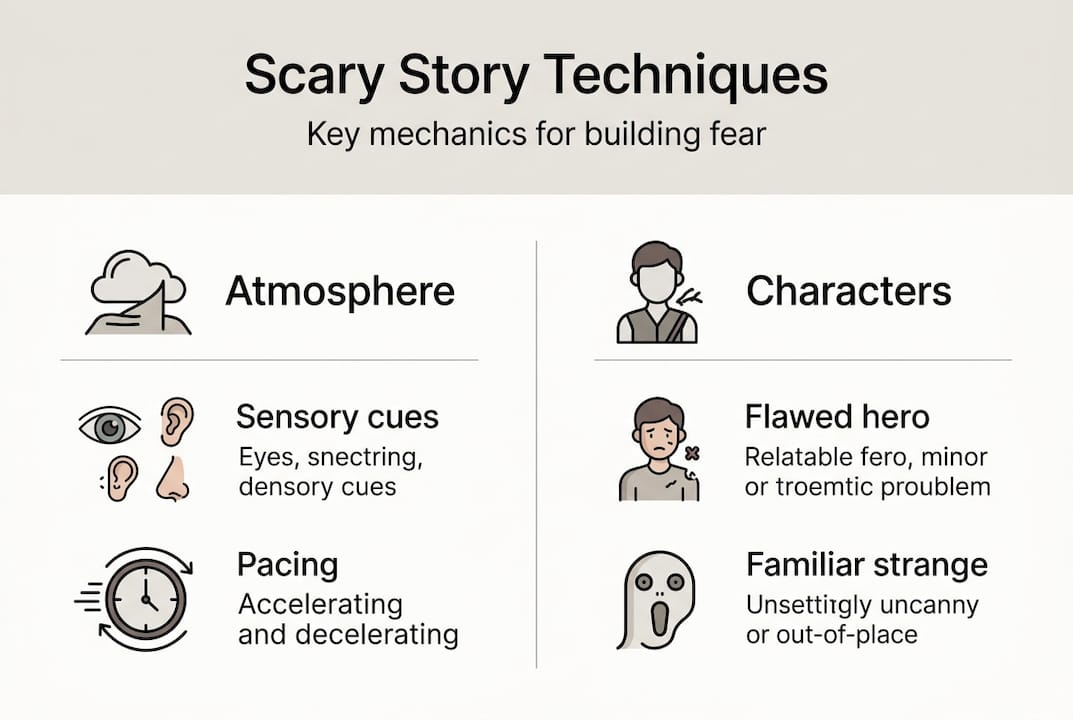
Here's how adult and children's horror differ in technique:
| Technique | Adult horror | Children's horror |
|---|---|---|
| Tone | Dark, ambiguous, unresolved | Suspenseful but reassuring |
| Endings | Open-ended or tragic | Clear resolution, safety restored |
| Characters | Morally complex, flawed | Relatable, empowered protagonists |
| Fear source | Psychological, existential | Monsters, the unknown, the dark |
| Pacing | Slow burn, mounting dread | Brisk, with moments of relief |
Want a step-by-step framework? Here's how effective scary stories are built:
- Set the atmosphere using sensory details. Let readers smell the damp earth, feel the cold air, hear the creak of a floorboard.
- Escalate tension gradually. Move from mild unease to genuine dread. Don't rush the scare.
- Use relatable characters so readers feel invested. Fear only lands when you care about who's afraid.
- Foreshadow fear with subtle clues. Plant seeds early that bloom into dread later.
- Resolve or allow catharsis. Give readers an emotional release, whether through survival, understanding, or acceptance.
You can find more on themes and elements for readers to deepen your understanding of how these mechanics play out across different story types.
Pro Tip: Most writers forget the "familiar made strange" technique. Take something ordinary, a childhood bedroom, a family dinner, a friendly neighbor, and introduce one unsettling detail. That contrast is where real dread lives. A monster in a dark forest is expected. A monster sitting at your kitchen table is unforgettable.
Why write scary stories for children?
Let's focus specifically on children's literature and the unique developmental role of writing scary stories for kids.
Scary stories build emotional resilience, courage, and coping skills via safe fear simulation, threat mastery, and positive resolutions. When a child reads about a character who faces a monster and survives, they're rehearsing bravery. That's powerful.
Children's horror requires balance, combining scariness with empowerment to hit the right developmental benchmarks. Here's how that plays out across key benefits:
| Developmental benefit | Example story outcome |
|---|---|
| Resilience | Child protagonist overcomes fear through action |
| Imagination | Monsters spark creative thinking and world-building |
| Agency | Young hero solves the problem independently |
| Emotional vocabulary | Story names and validates complex feelings |
| Coping skills | Character models healthy responses to fear |
Parents sometimes worry. Here are the most common objections and what the evidence actually says:
- "Will this traumatize my child?" Research shows most children benefit from age-appropriate scary stories. Trauma risk is low when stories include resolution and safety.
- "My child already has anxiety." Controlled fictional fear can actually reduce anxiety by building confidence through safe exposure.
- "These stories are too dark." Children's scary stories are designed to empower, not overwhelm. The darkness always has a light at the end.
You can explore a guide to spooky stories for children to find age-appropriate examples, and see how monsters and imagination work together to spark creativity in young readers. Stories that develop courage in children are among the most impactful you can write.
Pro Tip: Children's scary stories should always offer a path to safety. Never leave a young reader in unresolved fear. The scare is the journey. The resolution is the reward.
The risks and responsible approach to writing scary stories
Understanding the positives doesn't mean we ignore potential drawbacks. Here's how to approach scary stories with care and responsibility.
The risks are real but rare. Here's what to watch for:
- Overexposure: Too much horror without resolution can desensitize readers or increase anxiety over time
- Sensitive audiences: Some readers, especially those with existing anxiety disorders, may find horror content distressing
- Rare trauma responses: In extreme cases, graphic or unresolved horror can trigger genuine psychological distress
But here's the reassuring data. Only 13 out of 677 participants showed distress from horror movies in a major study. That's less than 2%. The vast majority of readers benefit. You can also review this empirical study on horror for a deeper look at the psychological research.
Responsible authors manage these risks with clear strategies. Include resolution so readers aren't left in unresolved dread. Match tone to your audience, what works for adults can overwhelm children. Add content warnings when your story explores particularly intense themes. And always read your work through the lens of your most sensitive potential reader.
A guide to horror fiction can help you understand where your story sits on the intensity spectrum and how to calibrate accordingly.
From theory to practice: Harnessing scary stories in your writing journey
Armed with a clear understanding of why and how scary stories matter, here are actionable steps to bring those lessons to your writing practice.
Horror writing hones pacing, empathy, and thematic depth, and empirical evidence supports the value of threat simulation as a creative and developmental tool. Here's how to put that into action:
- Start with personal fears or themes. The most vivid horror comes from what genuinely unsettles you. Authenticity is felt on the page.
- Test the "familiar turned strange" technique. Take a setting or character your audience knows well and introduce one wrong detail. Watch the tension build.
- Adjust intensity to your audience. A story for adults can sit in ambiguity. A story for children needs a clear path through the dark.
- Ritualize safe resolutions. Make it a habit to ask: where does my reader land emotionally at the end? Give them solid ground.
- Revise for psychological depth and empathy. After your first draft, go back and ask whether your characters feel real, whether the fear feels earned, and whether the emotional arc is complete.
Experimenting with different horror genres will sharpen your instincts fast. And when you're ready to reach readers, understanding how to market horror books is just as important as the craft itself. For a broader view of what makes stories unforgettable, mastering storytelling is the foundation everything else builds on.
Explore and share your own scary stories
When you're ready to turn your scary story ideas into reality, or simply want to see strong examples, there's a vibrant library waiting for you.

Mark Watson Books offers a rich collection of horror and children's titles that show exactly how these techniques come alive on the page. Whether you want to study the craft, find inspiration, or share your own work, this is your starting point. Explore horror books that push the genre forward, browse creepypasta books for a modern twist on digital horror storytelling, or discover children's scary stories that balance fear with empowerment. Every title is a masterclass in what great scary storytelling looks like. Don't just read about the craft. See it in action.
Frequently asked questions
What are the main benefits of writing scary stories?
Horror stories provide catharsis by creating a safe space to explore fears, helping authors and readers build resilience and emotional connection through controlled, fictional tension.
Are scary stories appropriate for children?
Yes, when balanced with positive resolutions. Scary stories build emotional resilience and coping skills in children by letting them safely rehearse courage and face fear in a fictional setting.
Can scary stories have negative effects?
Rarely. Only 13 of 677 participants showed distress in a major study, meaning the benefits outweigh the risks for the overwhelming majority of readers.
What makes a scary story effective?
Effective scary stories build atmosphere through sensory details, relatable characters, and earned tension, then resolve fear in a way that leaves readers with emotional clarity rather than lingering dread.