
Horror is not just haunted houses and slasher villains. The genre stretches across psychological nightmares, science fiction terrors, gothic atmospheres, and even cozy scares designed for kids. Whether you are a lifelong horror fan or a parent searching for age-appropriate thrills, understanding the full map of horror genres changes how you read, watch, and recommend stories. The core distinction in horror separates psychological dread from supernatural threats, but that is only the beginning of a much richer landscape.
Table of Contents
- What defines a horror genre?
- Major horror genres and their core features
- Subgenres and hybrids: Exploring horror in depth
- Children's horror and age-appropriate thrills
- How to choose the right horror genre for you
- Explore horror books and stories
- Frequently asked questions
Key Takeaways
| Point | Details |
|---|---|
| Many horror genres | Horror includes psychological, supernatural, science fiction, body, gothic, and survival genres. |
| Subgenres overlap | Horror subgenres often blend, creating hybrids like sci-fi horror and survival horror. |
| Children's horror is safe | Defanged horror for kids focuses on safe scares and positive outcomes without gore. |
| Choosing your genre | Identify the right horror genre by matching the content to your taste and age-appropriateness. |
What defines a horror genre?
A genre is a category of storytelling defined by shared themes, conventions, and emotional goals. Horror's goal is simple: provoke fear, dread, or unease in the reader or viewer. But how it achieves that goal varies enormously depending on the subgenre.
The two foundational pillars of horror are psychological vs. supernatural horror. Psychological horror lives inside the mind, using paranoia, guilt, and unreliable perception to unsettle you. Supernatural horror brings in external forces: ghosts, demons, cursed objects, or ancient evil.
Beyond those two pillars, every horror story relies on a toolkit of classic elements:
- Suspense: The slow build of tension before something terrible happens
- Dread: A persistent feeling that something is deeply wrong
- Jump scares: Sudden shocks designed to trigger a physical reaction
- Atmosphere: Setting, tone, and sensory detail that make a world feel unsafe
- The unknown: What you cannot see is almost always scarier than what you can
"The oldest and strongest emotion of mankind is fear, and the oldest and strongest kind of fear is fear of the unknown." — H.P. Lovecraft
For a broader overview of horror genres, these elements combine in different ratios depending on the subgenre. A ghost story leans on atmosphere and dread. A slasher leans on suspense and shock. Understanding this toolkit helps you identify what kind of horror experience you are actually looking for. You can also explore the themes and elements of scary stories to go deeper on how these building blocks work together.
Major horror genres and their core features
Once you understand the foundations, the major genres start to feel distinct rather than interchangeable. Each one targets a different fear response and uses a different set of storytelling tools.
Here is a breakdown of the six most recognized horror genres:
- Psychological horror: Internal terror, unreliable narrators, mental deterioration. Think The Shining or Black Swan.
- Supernatural horror: Ghosts, demons, curses, and forces beyond human understanding. Think The Haunting of Hill House.
- Science fiction horror: Technology, aliens, and scientific experimentation gone wrong. Think Alien or The Fly.
- Body horror: Physical transformation, mutation, and the violation of bodily integrity. Think The Fly or Clive Barker's work.
- Gothic horror: Decay, aristocratic settings, doomed romance, and brooding atmosphere. Think Dracula or Rebecca.
- Survival horror: Isolation, scarce resources, and the primal fight to stay alive. Think The Road or Bird Box.
| Genre | Main threat | Typical setting | Degree of realism |
|---|---|---|---|
| Psychological | Internal/mental | Anywhere | High |
| Supernatural | Ghosts/demons | Old houses, graveyards | Low |
| Science fiction | Tech/aliens | Space, labs, future cities | Medium |
| Body horror | Physical mutation | Medical, industrial | Medium |
| Gothic | Decay, fate | Castles, estates, moors | Low to medium |
| Survival | Environment/humans | Wilderness, post-apocalypse | High |
Genres rarely stay in their lanes. Subgenres overlap constantly: sci-fi horror combines technology fears with alien threats, while survival horror layers isolation and scarcity on top of almost any other genre. A story can be gothic and supernatural, or psychological and survival, without losing coherence.
Pro Tip: If you are new to horror, start with psychological or gothic horror. Both tend to rely more on atmosphere than graphic content, making them accessible entry points before you move into more intense territory.
For real-world examples of how these genres play out on the page, check out these classic horror book examples. If the science fiction crossover interests you, the science fiction horror collection is worth exploring.
Subgenres and hybrids: Exploring horror in depth
Beyond the major genres, horror fractures into dozens of subgenres, each with its own devoted fanbase and distinct flavor. These are not just marketing labels. They signal specific emotional experiences and storytelling conventions.
Here are the most popular subgenres you should know:
- Monster horror: Creatures, beasts, and things that should not exist. Frankenstein's monster, werewolves, and Lovecraftian entities all live here.
- Ghost stories: Spirits tied to places, people, or unfinished business. One of the oldest horror traditions in every culture.
- Slasher: A killer stalks and eliminates victims, often with a signature weapon or method. Halloween and Friday the 13th define this space.
- Creepypasta: Internet-born horror stories designed to feel like real accounts. Slender Man is the most famous example.
- Folk horror: Rural communities, ancient rituals, and the terror of isolated traditions. Midsommar and The Wicker Man are landmarks.
- Cosmic horror: Humanity is insignificant against vast, indifferent forces. Lovecraft pioneered this, and it remains deeply influential.
Hybrid genres push horror even further:
- Sci-fi horror uses tech fears and alien threats to create dread rooted in scientific possibility.
- Comedy horror plays fear and humor against each other, like Shaun of the Dead or Tucker and Dale vs. Evil.
- Survival horror strips characters down to their most primal instincts, removing safety nets and support systems.
| Subgenre | Format popularity | Notable examples |
|---|---|---|
| Ghost stories | Books, film, TV | The Turn of the Screw, The Haunting |
| Slasher | Film-dominant | Halloween, Scream |
| Creepypasta | Online stories | Slender Man, Candle Cove |
| Folk horror | Film, books | Midsommar, The Wicker Man |
| Cosmic horror | Books, games | Lovecraft, Annihilation |
| Monster horror | All formats | Frankenstein, The Thing |
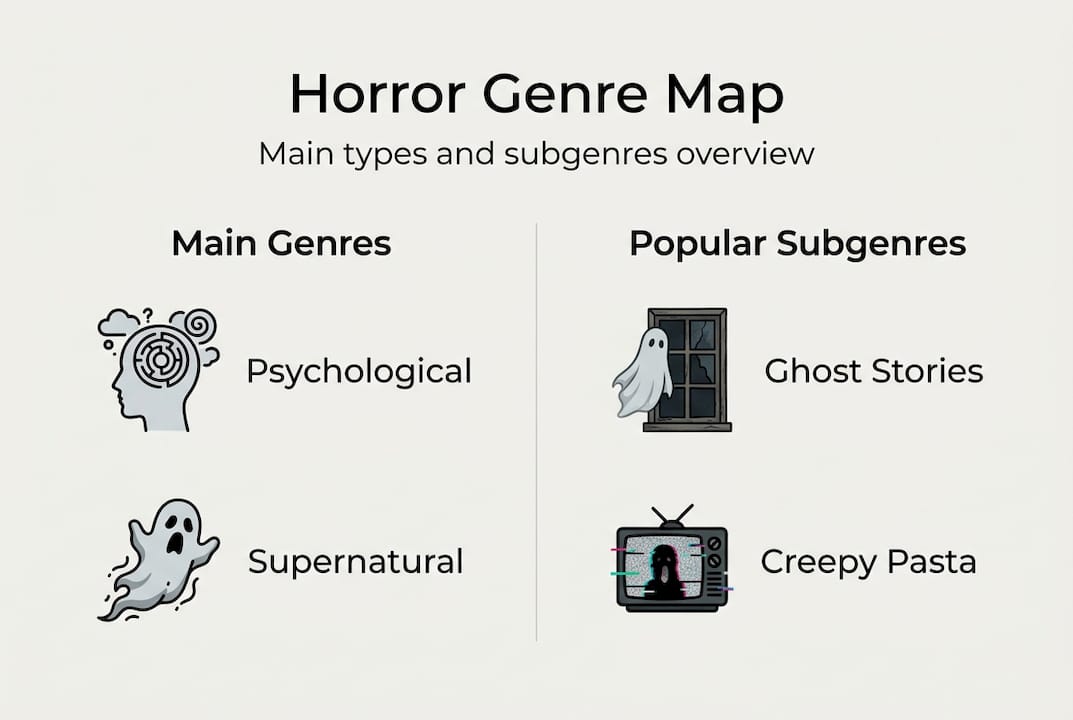
Pro Tip: Creepypasta is a fantastic gateway for reluctant horror readers, especially teens. The short format and conversational tone lower the barrier to entry while still delivering genuine chills.
If you are navigating horror choices for younger readers, the parent's guide to children's horror is a practical starting point. And if you want to understand why monsters resonate so deeply with kids, the piece on monsters in children's literature offers a compelling perspective.
Children's horror and age-appropriate thrills
Here is something that surprises many people: horror has always had a place in children's literature. From fairy tales to Goosebumps, scaring kids safely is a long and respected tradition.
What makes horror work for children is a concept sometimes called "defanged horror." Children's defanged horror focuses on toned-down scares that target child-specific anxieties, like not being believed by adults, dealing with bullies, or feeling powerless, while always delivering a safe resolution. The monster gets defeated. The child survives. Order is restored.
Classic examples include:
- Goosebumps by R.L. Stine: Episodic scares with humor and age-appropriate stakes
- Coraline by Neil Gaiman: A deeply unsettling story about a parallel world and a false mother
- The Graveyard Book by Neil Gaiman: A boy raised by ghosts navigates childhood in a cemetery
These stories work because they give children a controlled environment to experience fear. Age-appropriate horror uses PG-rated gateways, books with happy endings, and avoids gore entirely, letting kids build emotional resilience without overwhelming them.
"Fairy tales do not tell children that dragons exist. Children already know that dragons exist. Fairy tales tell children that dragons can be killed." — G.K. Chesterton
The benefits are real. Horror helps children process fears in a safe, fictional space. It builds courage, expands imagination, and teaches kids that scary things can be faced and overcome. For more on this, the article on developing courage in young readers breaks it down beautifully. You can also browse the full children's book collection for curated recommendations.
How to choose the right horror genre for you
Knowing the genres is one thing. Picking the right one for your mood, tolerance, or your child's reading level is another. Here is a practical framework to make that choice easier.
- Identify your fear tolerance. Do you want to be deeply unsettled or mildly creeped out? Psychological and gothic horror sit at the milder end. Body horror and extreme survival horror sit at the intense end.
- Consider your subject matter preferences. Are you drawn to the paranormal, science gone wrong, ancient rituals, or internet legends? Each preference maps to a specific genre or subgenre.
- Think about format. Some subgenres thrive in short stories (creepypasta, ghost stories). Others need a novel's space to build properly (gothic, cosmic horror).
- For children, match the age to the intensity. Age-appropriate horror avoids gore and delivers safe resolutions. Ages 8 to 12 are well-served by Goosebumps-style horror. Teens can handle more complex psychological or folk horror.
- Start with a known classic. Classics exist because they work. A proven entry point reduces the risk of picking something that puts you off the genre entirely.
Pro Tip: Read one book from a genre before committing to a full collection. A single short story from a subgenre like creepypasta or folk horror tells you quickly whether the flavor suits you.
For curated starting points, the children's horror recommendations and classic horror recommendations are both excellent resources. If creepypasta caught your attention, the creepypasta horror collection is a great place to start reading.
Explore horror books and stories
Now that you have a clear map of the horror landscape, the next step is finding stories that match your interests. Mark Watson Books offers curated collections across the full spectrum of horror, from spine-chilling adult reads to age-appropriate adventures for younger readers.

Whether you are looking for the full horror book collection to satisfy a serious fright craving, the children's book collection for younger readers ready to explore safe scares, or the creepypasta book collection for internet-era horror that feels uncomfortably real, there is something here for every kind of horror fan. Start with one book, one story, or one subgenre, and let the fear take you somewhere new.
Frequently asked questions
What is the difference between psychological and supernatural horror?
Psychological horror uses internal fears, paranoia, and mental dread to terrify, while supernatural horror relies on external forces like ghosts, demons, or cursed entities. The first lives in your head; the second comes from outside it.
Can horror be suitable for children?
Absolutely. Children's defanged horror tones down the scares to focus on relatable child anxieties and always delivers a safe resolution, avoiding gore entirely. It builds imagination and helps kids process fear in a controlled, fictional setting.
What is a horror subgenre?
A horror subgenre is a specific branch of the broader genre with its own conventions and fear targets. Sci-fi horror combines technology fears with alien threats, while folk horror draws on rural traditions and ancient rituals for its dread.
How can I choose the best horror genre for me or my child?
Match the genre's intensity and themes to your comfort level and interests. For children, age-appropriate horror means happy endings, no gore, and scares that feel manageable rather than overwhelming.