
TL;DR:
- Urban legends are fear-driven stories rooted in everyday life that reflect societal anxieties.
- Digital platforms accelerate the spread and mutation of legends through sharing, remixing, and parody.
- These stories reinforce social norms, process collective fears, and serve as cultural truths disguised as fiction.
Most urban legends are not really about truth. They are about fear. They grab you, shake you, and refuse to let go even after you know they are made up. Modern folklore narratives like these thrive on macabre elements, stranger danger, and supernatural dread, presenting themselves as real events that happened to a friend of a friend. They mirror the anxieties of the society that creates them. In this article, we will trace how urban legends are born, how they mutate in the digital age, why certain horror tales become cultural landmarks, and what they reveal about the fears we carry every day.
Table of Contents
- What are urban legends? Origins and mechanics
- Evolution: From oral tales to digital horror
- Famous horror urban legends and their impact
- Function and purpose: Why urban legends persist
- Urban legends: What most horror fans miss
- Discover more horror stories and legends
- Frequently asked questions
Key Takeaways
| Point | Details |
|---|---|
| Mirror for anxieties | Urban legends reveal and amplify cultural fears, making horror believable and relevant. |
| Evolution speeds up | Digital platforms accelerate legend mutation, creating new horror narratives rapidly. |
| Emotional truth matters | Urban legends persist because they provide social and emotional resonance, not factual accuracy. |
| Genre inspires horror | Famous legends and motifs influence horror literature, creepypasta, and media. |
What are urban legends? Origins and mechanics
Urban legends occupy a strange space between fact and fiction. They feel real enough to repeat but wild enough to thrill. Unlike myths tied to gods or ancient cosmologies, urban legends are rooted in the everyday. They happen in parking lots, on highways, in suburban homes. That familiarity is exactly what makes them so unsettling.
Folklorist Jan Harold Brunvand describes them as "too good to be true" stories built on suspense, dark humor, and a moral lesson lurking underneath. He also notes that debunking rarely kills them. If anything, exposure seems to make them stronger. People keep sharing them because the emotional punch matters more than the facts.
What makes a story qualify as an urban legend? Here are the core features:
- Contemporary setting: The story happens now, in a place you recognize.
- Plausible framing: It is always told as something that really happened.
- Moral undertone: Someone usually pays a price for ignoring a warning.
- Variation in retelling: Names, cities, and details shift, but the core plot survives.
- Emotional resonance: Fear, disgust, or dark humor keeps it alive.
These modern folklore narratives involve fears like crime, contamination, and supernatural threats, always framed as true stories happening to ordinary people. That framing is deliberate. It collapses the distance between the listener and the horror.
"Urban legends are the campfire stories of modern civilization. They do not need flames or forests. A break room, a text message, or a Reddit thread will do just fine."
The oral tradition behind these stories stretches back centuries. Cautionary tales about strangers, cursed objects, and dangerous places existed long before the internet. What changed is the speed and scale of transmission. The structure, though, remains remarkably consistent.
Evolution: From oral tales to digital horror
Having explored the roots, let's see how urban legends adapt and evolve in today's digital landscape.
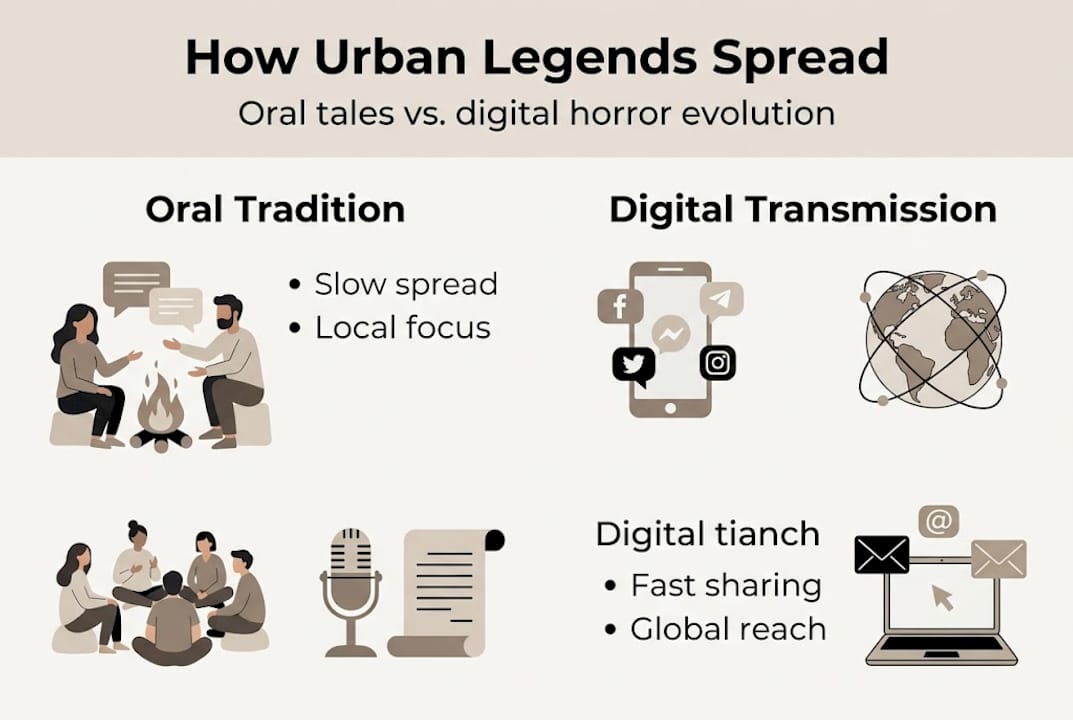
For most of human history, legends spread slowly. A story mutated over decades as it passed from village to village, each teller adding a local twist. Today, that same process happens in days. Digital platforms are the new campfires, and they burn much hotter.
Oral-to-digital transmission accelerates legend evolution through upvotes, shares, and comment threads. A story posted on a creepypasta forum can be remixed, illustrated, and turned into a YouTube video within a week. The core plot survives while the details get polished or distorted depending on what gets the most engagement.
Here is a direct comparison of how legends evolve across these two modes:
| Feature | Oral tradition | Digital transmission |
|---|---|---|
| Speed of spread | Decades | Days or weeks |
| Geographic reach | Local or regional | Global instantly |
| Variation control | Gradual drift | Rapid, intentional remixing |
| Credibility signals | Community trust | Upvotes, shares, screenshots |
| Irony and parody | Rare | Common and fast |
One of the most striking findings in recent folklore research: ATU Index motifs show a 70% overlap between modern legends like Slenderman and ancient folklore archetypes. The monster in the woods is still the monster in the woods. Only the woods have changed to a dark website.
You can trace this pattern in the history of horror literature, where ancient fears keep resurfacing in new costumes. The same themes appear in scary story structures that horror writers use today.
How do new legends emerge online? Watch for these signals:
- A story spreads with the phrase "this actually happened" or "my cousin saw this."
- Details are vague enough to feel universal but specific enough to feel local.
- The story triggers a strong emotional reaction, fear, disgust, or dark laughter.
- Variations appear quickly, each claiming to be the original.
Pro Tip: When you spot a story circulating on social media that feels too perfectly scary, check for urban legend motifs from the ATU Index. Chances are high that the "new" legend is actually an ancient fear wearing a digital mask.
Famous horror urban legends and their impact
With a grasp on how legends spread, let's examine how certain tales continue to define horror.
Some legends refuse to die. They become cultural touchstones, referenced in films, books, and conversations across generations. Their staying power is not accidental. It is structural.
Famous horror urban legends like the Choking Doberman, the Bell Witch, Kuchisake-onna, and The Call from Inside the House each tap into a specific, primal fear. Here is a breakdown of their core themes and cultural reach:
| Legend | Core theme | Cultural region | Impact |
|---|---|---|---|
| Choking Doberman | Home invasion, hidden danger | North America | Sparked real security anxiety |
| Bell Witch | Supernatural vengeance | American South | Inspired films and novels |
| Kuchisake-onna | Disfigurement, stranger danger | Japan | Caused school closures in 1979 |
| The Call from Inside the House | Domestic threat, betrayal | Global | Defined slasher film tropes |
What do these legends share? They reflect and amplify societal fears, enforce social norms, and build cultural identity. Kuchisake-onna is not just a scary story. It is a warning about vanity, about strangers, about the violence hiding behind a polite question.
The fear is never random. It is always pointed at something real.
- Stranger danger: The threat always comes from someone who looks normal.
- Domestic vulnerability: Home is supposed to be safe. Legends love to shatter that.
- Technology and contamination: Modern legends often involve phones, needles, or chemicals.
- Punishment for transgression: Characters who break rules rarely survive.
Statistic spotlight: ATU motifs reveal that over 70% of modern horror legends share structural DNA with pre-industrial folklore. The fears evolve. The architecture does not.
These themes connect directly to what horror books explore at their best, and why horror story themes keep returning to the same emotional territory across cultures and centuries.
Function and purpose: Why urban legends persist
Understanding the impact of horror legends leads us to the reasons they endure despite skepticism and debunking.
Urban legends are not just entertainment. They are social technology. They do work. They teach, warn, bind communities together, and help people process fears that feel too big or too vague to name directly.
They reflect and amplify societal fears around things like stranger danger and technology, enforce social norms, build group identity, and provide emotional truth even when the facts are completely fabricated. That last point is crucial. A legend does not need to be true to be true.
Here is what urban legends actually do for the people who share them:
- Process anxiety: Giving a shapeless fear a narrative form makes it manageable.
- Reinforce group norms: "This is what happens when you break the rules."
- Create shared identity: Knowing the same legends signals belonging to a community.
- Transmit warnings: Especially to children and newcomers about real social dangers.
Scholarship on the subject is divided. Some folklorists treat urban legends as analytical tools for studying culture, while others see them as vernacular genres, frames for falsehood, or even metonyms for misinformation. The debate itself reveals how loaded these stories are.
"The legend is not a lie. It is a cultural truth dressed in fictional clothes."
Pro Tip: Urban legends, rumors, and memes are not the same thing. A rumor is unverified information about a real event. A meme is a cultural unit spread for humor or identity. An urban legend combines both, adding narrative structure and emotional stakes. Knowing the difference sharpens your reading of how horror affects readers and why monster stories in children's books use similar mechanics.
Urban legends: What most horror fans miss
Here is the uncomfortable truth. Most horror fans love urban legends for the scare. Few stop to notice what the legend is actually about.
The real power is not in the monster or the twist. It is in the mirror. Every legend reflects the specific anxieties of the culture that created it. Kuchisake-onna emerged from postwar Japan's fears about beauty and violence. The Call from Inside the House exploded during a period of intense domestic anxiety in America. These are not coincidences.
Digital mutation adds another layer. Qualitative studies show that online transmission accelerates spread but also adds irony and meme layers that can hollow out the original emotional truth. A legend that once genuinely frightened people becomes a joke format. The fear gets defused through repetition and parody.
What horror fans miss is that this hollowing out is also meaningful. It tells you when a society has processed a fear enough to laugh at it. And it tells you which fears are still too raw to mock, because those legends stay serious.
The comparative mythology analysis of ATU motifs confirms that the deepest legends, the ones that survive every debunking, are the ones touching fears that never fully resolve. If you want to write horror that lasts, study what the legends are actually saying. Start with scary storytelling fundamentals and then look at how to craft chilling tales that tap those same primal veins.
Discover more horror stories and legends
Urban legends are the raw material of the best horror. They carry centuries of fear, culture, and human truth inside deceptively simple stories. If reading this has sparked that familiar chill, that urge to look over your shoulder, you are ready for more.

Mark Watson Books brings that same unsettling energy to modern horror fiction and creepypasta-inspired stories. Whether you are hunting for your next sleepless night or looking to understand the legends that shaped the genre, the horror book collection is the place to start. For fans of digital horror and internet folklore, the creepypasta story books collection goes even deeper into the myths that haunt modern screens. Do not wait. The next legend is already spreading.
Frequently asked questions
What is the main purpose of urban legends in horror?
Urban legends reflect and amplify societal fears, enforcing social norms and building cultural identity while delivering emotional truth even when the facts are invented.
Why do urban legends change so rapidly online?
Digital platforms allow instant retellings and meme mutations, with oral-to-digital transmission compressing decades of legend evolution into days through upvotes and shares.
Are urban legends always based on true events?
Most urban legends blend fact and fiction rather than reporting real events. Some, like the Amityville Horror, are inspired by real occurrences but are heavily embellished and reshaped by retelling.
How do urban legends influence modern horror books and media?
They supply recurring motifs and cultural anxieties that shape horror literature and digital stories, with ATU Index motifs showing 70% structural overlap between modern legends and ancient folklore archetypes.
Recommended
- History of horror literature: From folklore to fiction
- Why horror books matter: insight, impact, imagination
- Horror movies guide: Genre, classics & literary roots
- What is horror fiction? A guide for modern readers
- Role of Mythology in Goth Art – Why It Matters – GothMarket
- The Carnival of Venice: a centuries-old mystery between masks and dreams - Mino Di Vita