
TL;DR:
- Horror's roots date back thousands of years in myth and folklore as a primal expression of fear.
- The genre evolved through Gothic fiction and psychological horror, mirroring societal anxieties across eras.
- Contemporary horror reflects diverse voices, addressing issues like climate change, identity, and technology.
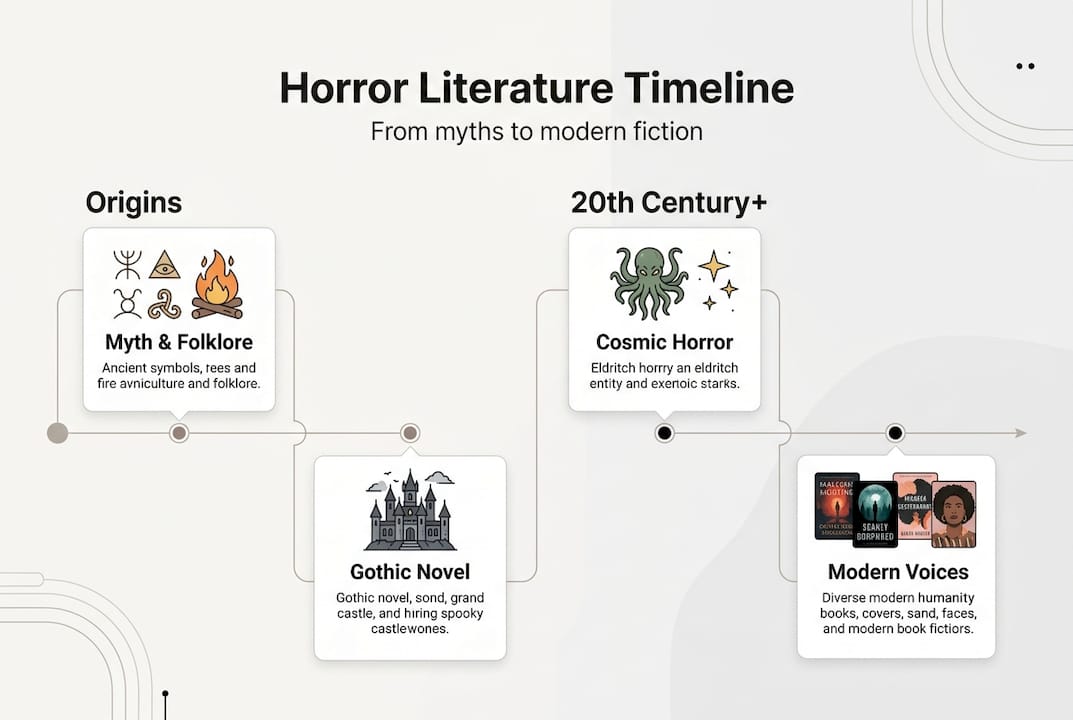
Horror is not a modern invention. Long before paperback thrillers lined bookstore shelves, ancient storytellers were crafting terrifying tales of monsters, curses, and the unknown. Horror fiction has roots stretching back thousands of years, woven into epics like Beowulf and The Epic of Gilgamesh. If you think horror began with Stephen King or even Mary Shelley, you're in for a thrilling surprise. This journey through horror's history will take you from ancient myth to Gothic castles, through the psychological terrors of the 19th century, and all the way to today's bold, boundary-pushing voices reshaping the genre.
Table of Contents
- From myth to Gothic: The beginnings of horror literature
- The golden age: Nineteenth-century Gothic and psychological horror
- Horror diversifies: Twentieth-century innovation and global impact
- Contemporary horror: New voices and cultural resonance
- Themes, mechanics, and the evolving impact of horror
- Why the history of horror literature matters more than ever
- Ready to explore horror yourself?
- Frequently asked questions
Key Takeaways
| Point | Details |
|---|---|
| Ancient origins | Horror literature began with ancient myths and epics, not just modern fiction. |
| Ongoing evolution | Each era reshapes horror to reflect new fears and anxieties. |
| Signature mechanics | Atmosphere, unreliable narrators, and the uncanny define the genre's lasting impact. |
| Cultural reflection | Horror acts as a mirror to social issues, offering catharsis and critique. |
From myth to Gothic: The beginnings of horror literature
Horror has always lived inside humanity's oldest stories. Ancient cultures used terrifying narratives to explain the unexplainable, warn against danger, and confront the darkness lurking beyond the firelight. The monster Grendel in Beowulf, the underworld journeys in Mesopotamian myth, the vengeful gods of Greek tragedy. These weren't just entertainment. They were primal expressions of fear.
The origins of horror literature reveal a genre deeply tied to folklore, oral tradition, and cultural anxiety. Every civilization had its demons, its cursed landscapes, its forbidden knowledge. Horror was the language used to process what couldn't be controlled.
The shift from oral folklore to formal literary horror came in the 18th century. The Castle of Otranto (1764) by Horace Walpole is widely considered the first Gothic novel, launching a tradition that would define literary terror for centuries. Walpole's story combined supernatural events, a brooding castle, and a sense of dread that felt genuinely new for its time.
Early Gothic fiction had a very specific flavor. Think crumbling architecture, mysterious ancestry, supernatural visitations, and what literary scholars call "the sublime," that feeling of awe mixed with terror when confronting something vast and unknowable. These elements weren't decorative. They were carefully engineered to unsettle.
Notable early works and their major themes:
- The Castle of Otranto (1764): Prophecy, tyranny, and the supernatural
- The Mysteries of Udolpho (1794): Female vulnerability, suspense, and the explained supernatural
- The Monk (1796): Religious corruption, lust, and genuine supernatural horror
- Vathek (1786): Orientalist fantasy, forbidden desire, and demonic consequence
- Wieland (1798): Early American Gothic, religious mania, and psychological terror
"The Gothic novel emerged as a reaction against Enlightenment rationalism, giving literary form to everything reason tried to suppress: the irrational, the supernatural, and the emotionally overwhelming."
For readers curious about how these early chills translate to younger audiences, classic horror for children offers a fascinating lens on how the genre adapts across generations.
The golden age: Nineteenth-century Gothic and psychological horror
With the Gothic tradition firmly rooted, the 19th century cracked the genre wide open. This era gave us some of the most iconic horror texts ever written, and more importantly, it introduced a new obsession: the horror that lives inside the human mind.
Mary Shelley's Frankenstein, Edgar Allan Poe's tales, and Bram Stoker's Dracula didn't just thrill readers. They reshaped what horror could do, blending psychological complexity with supernatural dread in ways that still feel electric today.
The Gothic novel evolution during this century reflected real social anxieties. Industrialization, scientific discovery, colonialism, and shifting gender roles all fed directly into the genre's themes. Horror became a mirror.
Psychological horror vs. supernatural horror in the 19th century:
| Feature | Psychological horror | Supernatural horror |
|---|---|---|
| Source of fear | The human mind | Monsters, ghosts, the occult |
| Key authors | Poe, Gilman, James | Stoker, Walpole, Le Fanu |
| Example text | The Tell-Tale Heart | Dracula |
| Central tension | Sanity vs. madness | Natural vs. supernatural |
| Emotional effect | Paranoia, dread | Terror, awe |
Key breakthroughs in the genre's development during this era:
- Frankenstein (1818) introduced science as a source of horror, not just the supernatural
- Poe formalized the short horror story as a precise, psychological art form
- The Strange Case of Dr. Jekyll and Mr. Hyde (1886) explored the duality of human nature
- Dracula (1897) codified the vampire myth and introduced epistolary horror
- Charlotte Perkins Gilman's The Yellow Wallpaper (1892) used horror to critique patriarchal oppression
Pro Tip: When reading classic horror, watch for unreliable narrators. If the narrator insists everything is fine while describing clearly disturbing events, that tension between what's said and what's shown is psychological horror doing its job.
Want to see how these classic horror books stack up and which ones deserve a spot on your reading list? The canon is richer than most people realize.
Horror diversifies: Twentieth-century innovation and global impact
The genre, now well-established, underwent radical transformations as it entered a rapidly changing world. Two world wars, the atomic age, the Cold War, and the rise of mass media all left vivid marks on horror fiction.
H.P. Lovecraft's cosmic horror, Stephen King's 1970s boom, and shifts toward psychological and social horror redefined what the genre could achieve. Lovecraft introduced the idea that the universe itself was indifferent and terrifying, a concept called cosmic horror that still echoes through contemporary fiction.
Major 20th-century horror works and their contributions:
| Work | Author | Year | Contribution |
|---|---|---|---|
| The Call of Cthulhu | H.P. Lovecraft | 1928 | Cosmic horror, unknowable evil |
| Psycho | Robert Bloch | 1960 | Psychological thriller crossover |
| Rosemary's Baby | Ira Levin | 1967 | Paranoia, domestic horror |
| The Shining | Stephen King | 1977 | Mainstream horror, family terror |
| Interview with the Vampire | Anne Rice | 1976 | Sympathetic monsters, Gothic revival |
Influences from world events that shaped 20th-century horror:
- World War I and II trauma fed into body horror and existential dread
- Cold War paranoia inspired alien invasion and conspiracy narratives
- Civil rights struggles influenced social horror and racial allegory
- Technology anxiety produced science fiction horror hybrids
- The Vietnam War era sparked anti-authority, counterculture horror themes
Pro Tip: Cosmic horror and personal horror operate on opposite ends of the fear spectrum. Cosmic horror makes you feel insignificant against vast, unknowable forces. Personal horror makes the threat intimate and inescapable. The most powerful horror fiction often uses both simultaneously.
Understanding why horror books matter goes deeper than entertainment. And if you want to navigate the full landscape, a solid guide to horror genres can help you find exactly the kind of fright you're looking for.
Contemporary horror: New voices and cultural resonance
From tradition and transformation, we move to today's landscape, where horror reflects an ever-diversifying world. The 21st century has seen an explosion of voices that were historically pushed to the margins of the genre, and the results are extraordinary.
Contemporary horror literature incorporates postcolonial, feminist, and eco-Gothic elements, reflecting issues like identity, climate anxiety, and technology. Authors like Silvia Moreno-Garcia (Mexican Gothic) and Stephen Graham Jones (The Only Good Indians) are crafting horror that feels urgent, specific, and deeply resonant.
Notable recent genre blends reshaping horror today:
- Eco-horror: Environmental collapse and nature's revenge (The Troop, The Ruins)
- Postcolonial horror: Colonial trauma and cultural identity (Mexican Gothic, My Heart Is a Chainsaw)
- Afrofuturist horror: Race, history, and speculative dread (Ring Shout by P. Djèlí Clark)
- Feminist horror: Body autonomy, systemic violence, and reclaimed agency (Plain Bad Heroines)
- Tech horror: AI, surveillance, and digital identity (The Grip of It, Followers)
Horror's influence on mainstream entertainment has never been stronger. Prestige television, blockbuster films, and viral online fiction all draw heavily from the genre's toolkit. Horror is no longer a niche. It's a cultural force.
"Horror's enduring power lies in its willingness to go where other genres won't: into the uncomfortable, the taboo, and the terrifying truths about what it means to be human in an unpredictable world."
For readers ready to step into modern horror fiction, the contemporary landscape offers something for every kind of fear.
Themes, mechanics, and the evolving impact of horror
As contemporary voices define new directions, it's worth seeing what unites the genre across every era: its essential tools and cultural power. Horror doesn't just happen. It's engineered.
Key mechanics include atmosphere, unreliable narrators, the sublime, abjection, and the fantastic, each working together to produce a specific emotional response in the reader. Understanding these tools changes how you read every horror story.
Key literary mechanics that define horror:
- Atmosphere: Setting, tone, and sensory detail that create dread before anything frightening happens
- The unreliable narrator: A perspective you can't fully trust, forcing readers to question reality
- The sublime: Confronting something so vast or powerful that it overwhelms rational thought
- Abjection: The horror of bodily transgression, decay, and the breakdown of self
- The fantastic: The deliberate ambiguity between natural and supernatural explanations
- Foreshadowing: Subtle signals that build tension without revealing the threat
Statistic callout: Horror fiction consistently ranks among the top-selling genres globally, with genre popularity showing no signs of slowing as readers seek emotionally intense, culturally reflective storytelling.
Horror reflects societal fears and has shaped pop culture across film, television, gaming, and online media, providing both catharsis and sharp social critique. When you read a horror story, you're not just being scared. You're processing something real.
Pro Tip: To analyze a horror scene more deeply, ask yourself: what real-world fear is this monster or situation representing? The answer almost always connects to the era in which the story was written.
Diving into the themes and elements of horror gives you the analytical tools to read the genre with fresh eyes and a sharper appreciation for what makes it so enduringly powerful.
Why the history of horror literature matters more than ever
Here's a perspective worth sitting with: most people treat horror's history as background noise. A quick mention of Poe, a nod to King, and then straight to the latest release. That's a mistake.
Horror literature evolves by mirroring era-specific anxieties, using ambiguity and the uncanny to make readers confront what they'd rather avoid. When you understand that history, every horror story you read becomes richer. You start seeing the conversation the author is having with every writer who came before.
Common wisdom reduces horror to cheap thrills. Jump scares, gore, and shock value. But the genre's real work is deeper. It's always been about cultural reckoning. Gothic fiction processed Enlightenment anxiety. Victorian horror wrestled with science and sexuality. 20th-century horror absorbed war trauma and Cold War paranoia. Today's horror tackles race, climate, and identity.
Reading the canon isn't just academic. It's the key to understanding why horror books matter as literature, not just entertainment. Every era's fears feed the next wave of innovation. Knowing that history makes you a sharper, more emotionally engaged reader.
Ready to explore horror yourself?
You've just traveled through thousands of years of fear, from ancient myth to Gothic castles, through psychological terror and cosmic dread, all the way to today's most exciting new voices. That's a lot of ground to cover, and it's just the beginning.

Mark Watson Books is your next stop. Whether you're hunting for genre-defining classics or the boldest contemporary horror, discover horror books that will keep you reading with the lights on. Craving something with that viral, unsettling edge? The creepypasta books collection delivers exactly that. Visit Mark Watson Books and find your next obsession. Don't wait. Your next favorite horror read is already out there.
Frequently asked questions
What was the first horror novel?
The Castle of Otranto (1764) by Horace Walpole is widely considered the first Gothic, or horror, novel, establishing the genre's foundational conventions of supernatural dread and atmospheric setting.
How has horror literature changed over time?
Horror has evolved from folklore to Gothic tales, then to psychological, cosmic, and socially conscious works, with each era reshaping the genre to reflect its own specific cultural fears and anxieties.
What themes are common in horror literature?
Common themes include fear, the uncanny, forbidden knowledge, and social anxiety, all built on key mechanics like atmosphere, unreliable narrators, the sublime, and the fantastic that create genuine dread.
Why is horror literature culturally important?
Horror reflects societal fears and helps readers safely explore taboo subjects, offering catharsis, social critique, and a way to process collective anxieties that other genres often avoid.