

TL;DR:
- Understanding the target age group is essential for creating engaging children's stories.
- Building clear characters, settings, and simple plots leads to memorable, emotional stories.
- Authenticity and genuine emotion are key factors that resonate with young readers and sparking imagination.
Every aspiring children's author faces the same electric challenge: how do you hold the attention of a young reader long enough to make your story matter? Kids are vivid, restless, and brilliantly unforgiving. They'll close a book the second it stops sparking wonder. The truth is, the best children's stories don't happen by accident. They're built with intention, shaped by clear planning, and fired up by a deep understanding of the young readers they're meant to reach. This guide walks you through every essential step, from knowing your audience to avoiding the pitfalls that trip up even passionate writers.
Table of Contents
- Understanding your audience and purpose
- Building your story framework: characters, setting, and plot
- Step-by-step process for planning your story
- Common pitfalls and how to avoid them
- What most guides miss about children's story planning
- Explore inspiring children's stories and resources
- Frequently asked questions
Key Takeaways
| Point | Details |
|---|---|
| Know your audience | Understanding the age and interests of your readers shapes every story choice. |
| Build strong foundations | Memorable characters, clear settings, and a simple plot are the backbone of good children's stories. |
| Outline methodically | A structured planning process ensures every story flows well and keeps kids engaged. |
| Avoid common pitfalls | Stay sensitive to age-appropriate themes and keep your cast and language simple. |
Understanding your audience and purpose
With the challenge introduced, let's discuss the crucial first step: knowing who you're writing for.
Before you write a single sentence, you need to know your reader. Not vaguely. Specifically. Are you writing for a four-year-old who loves animals and needs simple, rhythmic language? Or for a ten-year-old hungry for adventure and slightly scary mysteries? The difference is enormous, and getting it right is everything.
Age categories matter more than most new writers realize. Here's a quick breakdown of common children's reading groups and what they typically need:
- Board books (ages 0 to 2): Simple shapes, colors, single words. No plot required.
- Picture books (ages 3 to 6): Short sentences, vivid illustrations, one clear theme like kindness or bravery.
- Early readers (ages 6 to 8): Simple chapter structures, relatable characters, familiar scenarios like school or family life.
- Middle grade (ages 8 to 12): More complex plots, emotional depth, longer chapters, and themes of identity or friendship.
Knowing which category you're targeting shapes every decision you make, from word choice to story length to how dark or light your themes should be. As children's stories that resonate are built on clear knowledge of the audience, jumping into story planning without first nailing this is like setting off on a road trip without a destination in mind.
Once you've locked in your age group, think about purpose. What do you want your story to do? Teach? Comfort? Thrill? Make a child laugh so hard they spill their juice? The most powerful children's books do all of these at once, but they always anchor to one clear message or emotional experience.
"The best children's authors don't write down to their readers. They write straight to them, eye level, heart to heart."
Tone and language must match your reader's world. For younger children, short sentences and playful sounds win every time. For older kids, richer vocabulary and more nuanced emotional situations start to feel rewarding. Explore writing captivating children's books to get a deeper feel for how language shifts across age groups.
Pro Tip: Read ten books in your target age category before you write a single word of your own story. Notice the sentence length, the pacing, and the emotional beats. Let them teach you what clicks.
You should also explore children's book themes to get a clear picture of which themes resonate most strongly with different age groups. Themes like friendship, overcoming fear, or discovering something magical tend to work across many age ranges, but the way you handle them must shift dramatically depending on who's reading.
Building your story framework: characters, setting, and plot
Once you understand your audience and goals, you can begin building the bones of your story.
Memorable characters and vivid settings are key to lasting children's stories, and this isn't just good advice. It's the core of every children's book that has ever made a child gasp, laugh, or beg for one more chapter.
Choosing your characters is one of the most exciting parts of the process. Your main character needs to be someone young readers can see themselves in. They should want something badly, face a real obstacle, and change in some way by the end. Supporting characters add texture, but keep the cast tight. Too many characters confuse young readers fast.

Here's a simple framework for building your main character:
| Element | Question to answer |
|---|---|
| Desire | What does your character desperately want? |
| Flaw | What is holding them back from getting it? |
| Voice | How do they talk, think, and see the world? |
| Change | How are they different by the end? |
Your setting is just as important as your characters. For younger readers, settings should feel magical but grounded enough to understand. A forest that glows at night. A school where the library books come to life. For older middle grade readers, you can afford more complexity, like a city built on cloud layers, each with its own rules and dangers. When you're thinking about illustrating children's books, you'll see how setting becomes almost a character itself when paired with strong visuals.
Plot structure doesn't need to be complicated. In fact, for children's stories, simpler is smarter. Use the classic three-part structure:
- Beginning: Introduce your character and their world. Plant the problem or desire clearly.
- Middle: Let the conflict grow. Your character tries, fails, and tries again. Raise the stakes.
- End: Deliver a satisfying resolution. The character achieves their goal or learns something meaningful.
Children need emotional closure. Stories that end ambiguously or without resolution leave young readers feeling unsettled rather than excited. Balance the conflict carefully. For picture books, a single, simple conflict is ideal. For middle grade stories, you can layer in subplots involving family themes in storytelling, friendships, or personal growth.
Pro Tip: Write your ending before your beginning. Knowing exactly where your story lands makes every scene feel purposeful and keeps your plot tight and focused.
Step-by-step process for planning your story
With your story's skeleton ready, dive into the process of planning scene by scene.
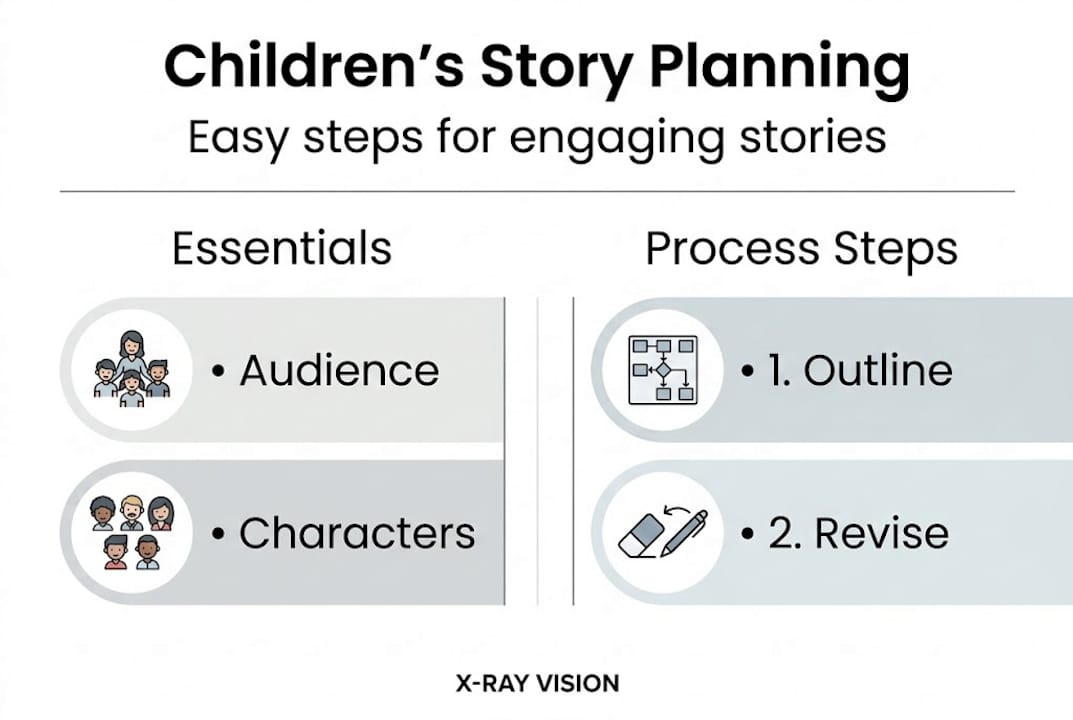
Planning and outlining shapes the story before writing begins, and that's not just a writing cliché. Authors who outline consistently produce tighter, more engaging stories. Here's how to do it step by step:
- Brainstorm freely. Spend 20 minutes writing down every idea you have without judging any of them. Wild ideas are welcome here. You can filter later.
- Identify your core idea. What is the one sentence that captures your story? This is your anchor. Everything in your outline should support it.
- Build your scene list. Write a brief description of each scene, just two or three sentences. What happens? Who is there? What changes by the end of the scene?
- Create a story arc. Map your scenes onto a simple arc: setup, rising action, climax, falling action, resolution.
- Use visual tools. Story maps are fantastic for children's writers. Draw your arc on paper, color-code emotional beats, or use sticky notes to rearrange scenes. The visual approach reveals gaps in logic that pure writing often hides.
- Gather feedback early. Share your outline with a teacher, parent, or even a child in your target age group. Ask them: Does this make sense? Does anything feel boring or confusing?
Here's a comparison of two common planning approaches to help you decide which method suits your style:
| Planning method | Best for | Key strength | Watch out for |
|---|---|---|---|
| Detailed scene outline | Chapter books, middle grade | Keeps plot tight and intentional | Can feel rigid if overdone |
| Loose story map | Picture books, early readers | Allows creative flexibility | May lead to plot gaps |
Visual tools are especially powerful when you're thinking about the power of illustrations in storytelling. Children's books are a visual medium. When you plan your scenes, think simultaneously about what a reader will see on the page.
Pro Tip: After completing your outline, read it aloud as if telling the story to a child. If you stumble or hesitate, that's your signal that a scene needs work before you write a single full paragraph.
Revision is part of planning, not an afterthought. Expect your outline to change at least three times before you commit to a full draft. That's not failure. That's the process working exactly as it should.
Common pitfalls and how to avoid them
Now that you have a solid process, it's vital to know the common missteps that can sideline a powerful story.
Even passionate, talented writers make predictable mistakes when writing for children. Spotting them early saves you months of frustration. Here are the most common pitfalls and how to sidestep them:
- Themes that are too complex or mature. Stories can falter when themes are unclear or not age-appropriate. A picture book exploring grief or political injustice without careful, age-calibrated handling will lose young readers instantly.
- Forgetting the emotional journey. Your character must feel things clearly. Children are emotional readers. If your main character seems detached or emotionless, young readers disengage fast.
- Passive main characters. Children love characters who DO things. A hero who waits around for things to happen is frustrating to read. Make your protagonist active, even when they're scared.
- Overloading with subplots. One or two subplots can enrich a middle grade story. Five subplots will sink it. Simplify ruthlessly.
- Ignoring cultural sensitivity. Today's young readers are wonderfully diverse. Stereotypes, whether cultural, racial, or gender-based, damage trust and shrink your readership.
- Choosing shock over substance. Elements like monsters in children's literature can be incredibly effective tools for exploring fear and courage. But shock for its own sake, without a meaningful purpose, leaves children feeling anxious rather than delighted.
"A children's story is not a smaller version of an adult story. It's a different creature entirely, with its own instincts and rhythms."
One of the sneakiest pitfalls is writing a story YOU would have loved as a child without checking whether today's young readers feel the same way. Culture shifts. Interests evolve. Test your ideas on real children whenever possible. Even exploring monster horror in kids' books shows how carefully calibrated fear can be both fun and educational when handled with skill and intention.
Inclusive storytelling isn't optional. It's essential. Make sure your characters reflect a range of backgrounds, abilities, and experiences. Young readers who see themselves in stories grow into passionate, lifelong readers. That's the whole point.
What most guides miss about children's story planning
Most planning guides focus on formula, and formula has its place. But here's what they rarely tell you: the most unforgettable children's stories are built on authenticity, not just structure. Kids have a radar for fake emotion. They can feel when an author is going through the motions versus when a writer genuinely cares about their world and their readers.
Real children's writing is messy and surprising. The unexpected detail, the silly joke tucked into a serious moment, the villain who turns out to have a heartbreaking reason for being cruel. These elements don't come from a formula. They come from an author who is genuinely listening to the story as it unfolds, not just executing a plan.
Spark creativity by letting yourself explore explained themes and elements in unconventional ways. Even genres you might not expect, like horror or suspense, can teach children's writers a great deal about pacing, tension, and the power of a single, perfectly timed reveal. The most magical children's books have an undercurrent of suspense. Will the character make it? Will they find what they're looking for? That quiet tension is what keeps little hands turning pages long past bedtime.
Trust your instincts. Plan with intention. But always leave room for the story to surprise you.
Explore inspiring children's stories and resources
Ready to put these steps into action? You can access curated examples and resources tailored for aspiring children's authors right now.

Seeing strong examples of published children's stories is one of the fastest ways to sharpen your own instincts as a writer. Browse a curated collection of inspiring children's books to discover how skilled authors balance character, theme, and voice across different age groups. Each title offers a real-world blueprint for the principles covered in this guide. You can also browse all books to find broader storytelling inspiration across genres. Studying diverse story styles builds a richer creative toolkit and gives you a wider range of techniques to draw from when you're planning and writing your own children's story.
Frequently asked questions
What is the ideal length for a children's story?
The ideal length depends on the age group, but picture books are often 500 to 1,000 words, while chapter books may be 3,000 to 10,000 words. Always prioritize pacing and engagement over hitting a specific word count.
How many characters should be in a children's story?
Aim for a small cast of 2 to 4 main characters to keep young readers engaged and avoid confusion. As children's stories that resonate are built on clear knowledge of the audience, keeping the cast focused helps young readers invest deeply in fewer, more vivid characters.
How important are pictures in children's books?
Pictures are extremely important for early readers, providing context clues, fostering imagination, and helping explain the story. Memorable characters and vivid settings come alive through illustration, making visual storytelling a critical part of the children's book experience.
How do I choose an age-appropriate theme?
Choose simple, relatable themes such as friendship, bravery, or family for younger children, ensuring content is developmentally suitable. Stories can falter when themes are unclear or not age-appropriate, so always test your theme with real readers in your target group.
What is the most common mistake new children's authors make?
The most common mistake is using language or themes that are too complicated or mature for children. Stories can falter when they don't match the developmental stage of the reader, so always anchor your writing to your specific age category first.