

Writing a chapter book that truly captivates young readers can feel overwhelming. You might wonder how to structure chapters, what vocabulary to use, or how to keep kids turning pages. Many aspiring authors struggle with balancing educational value and entertainment, unsure where to start or how to refine their work. This guide walks you through preparation, writing, and revision steps that transform your ideas into engaging chapter books. You'll learn practical techniques to understand your audience, craft compelling chapters, and polish your manuscript into a story young readers can't put down.
Table of Contents
- Key takeaways
- Understanding your audience and planning your chapter book
- Writing engaging chapters with progressive storytelling techniques
- Reviewing, revising, and polishing your chapter book
- Explore children's chapter books and resources at Mark Watson Books
- Frequently asked questions
Key Takeaways
| Point | Details |
|---|---|
| Know your audience | Identify the target age range and reading level to tailor chapter length vocabulary and themes. |
| Plan with a clear arc | Ensure a beginning middle and end with predictable structure and engaging surprises. |
| Chapter length guidance | Aim for 800 to 1500 words per chapter to balance pacing and readability. |
| Character driven themes | Develop relatable protagonists who face age appropriate challenges and demonstrate growth. |
Understanding your audience and planning your chapter book
Successful chapter books start with deep knowledge of who will read them. Understanding early reader preferences helps tailor chapter length, vocabulary, and themes effectively. Your target age group determines everything from sentence complexity to plot sophistication.
Identify the specific age range within the 7 to 10 year bracket. A seven year old has different capabilities than a ten year old. Research reading levels like Lexile scores or guided reading levels to match your content appropriately. Visit libraries and bookstores to examine successful chapter books in your target range, noting vocabulary choices and sentence structures.
Your story needs a clear arc with beginning, middle, and end. Young readers appreciate predictable structure even as they crave surprises within that framework. The beginning introduces characters and conflict, the middle develops challenges and growth, and the end resolves the story satisfyingly. This structure provides security while delivering excitement.
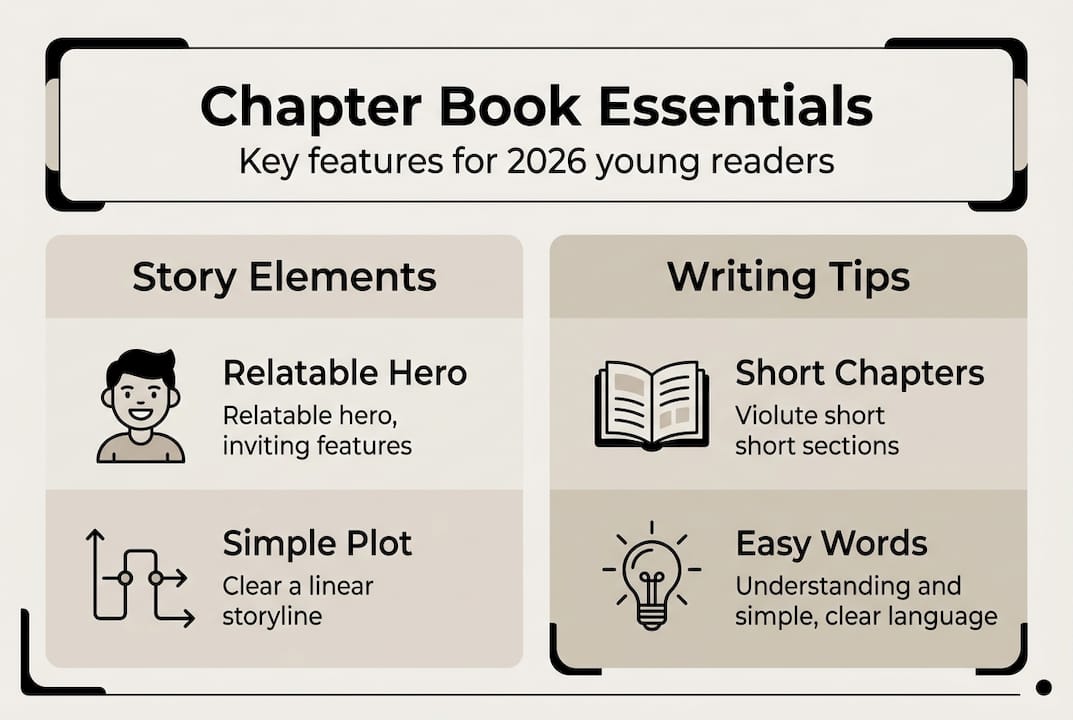
Chapter length matters tremendously for young readers. Too long and you lose their attention. Too short and you interrupt flow unnecessarily. Most successful chapter books for this age group contain chapters between 800 and 1,500 words, providing natural stopping points without fragmenting the narrative.
Develop characters young readers can relate to and root for. Children connect with protagonists facing age appropriate challenges like making friends, dealing with siblings, or navigating school situations. Your main character should demonstrate growth throughout the story, modeling problem solving and resilience.
Themes should resonate with young readers' experiences and concerns. Friendship, courage, honesty, and perseverance work well. Avoid heavy handed lessons. Instead, weave values naturally through character actions and consequences.
Use a planning table to organize your book structure before writing. This prevents plot holes and ensures balanced pacing.
| Chapter | Key Events | Character Development | Learning Outcome |
|---|---|---|---|
| 1 | Introduce protagonist, establish normal world, hint at conflict | Show character's starting point and personality | Set up story world |
| 2 | Present main problem or challenge | Character reacts to conflict | Establish stakes |
| 3 | First attempt to solve problem fails | Character learns from mistake | Show growth process |
| 4 | Character tries new approach with partial success | Gains confidence and skills | Demonstrate perseverance |
| 5 | Final confrontation with main challenge | Character applies lessons learned | Resolve conflict |
| 6 | Show new normal, reflect on growth | Character demonstrates change | Reinforce themes |
This framework keeps your story focused while allowing creative flexibility within each chapter.
Pro Tip: Create character sheets with details about personality, fears, goals, and quirks before writing. Refer to these sheets to maintain consistency and depth throughout your manuscript.
Outline each chapter with bullet points before drafting. Include the chapter's purpose, key events, and emotional tone. This roadmap speeds up writing and maintains narrative momentum.
Writing engaging chapters with progressive storytelling techniques
Once you've planned your book, the actual writing requires specific techniques to keep young readers hooked. Each chapter needs a clear objective that advances the plot or develops characters. Before writing a chapter, ask yourself what readers should know, feel, or understand by the end.

Start each chapter with a hook that pulls readers in immediately. This might be an intriguing question, a moment of action, or an emotional situation. Avoid long descriptive passages at chapter openings. Jump into the story and weave in necessary details as you go.
End chapters with mild cliffhangers or questions that make readers want to continue. This doesn't mean every chapter needs dramatic suspense. Sometimes a character's decision, an unanswered question, or anticipation of what comes next provides enough pull to turn the page.
Using stepwise plot development and age appropriate language maintains engagement in children's chapter books. Progress vocabulary complexity gradually throughout your book. Early chapters can use simpler words while later chapters introduce more challenging vocabulary through context clues.
Your sentences should vary in length and structure. Mix short, punchy sentences with longer, flowing ones. This rhythm mimics natural speech and prevents monotony. Read your work aloud to catch awkward phrasing or repetitive patterns.
Descriptive language enriches your story but keep it simple and sensory. Instead of saying a character felt nervous, show trembling hands or a racing heart. Young readers understand concrete details better than abstract concepts.
Dialog moves stories forward and reveals character. Write dialog that sounds like real kids talking, but slightly more focused and purposeful. Avoid slang that will date quickly. Use dialog tags like "said" and "asked" most of the time, adding action beats to show emotion.
Pacing determines whether readers stay engaged or lose interest. Action scenes need shorter sentences and paragraphs. Reflective moments can slow down slightly. Balance fast and slow sections throughout your book to create rhythm.
Follow this checklist for writing each chapter:
- Review your chapter outline and objective before starting
- Write a strong opening hook that grabs attention immediately
- Develop the chapter's main events with clear cause and effect
- Include sensory details that bring scenes to life
- Write authentic dialog that reveals character and advances plot
- Vary sentence length and structure for natural rhythm
- End with a reason for readers to continue to the next chapter
- Read the chapter aloud to catch awkward phrasing
- Check that vocabulary matches your target reading level
- Ensure the chapter advances the overall story arc
This systematic approach keeps your writing focused and effective.
Pro Tip: Set a daily word count goal that feels achievable, even if it's just 300 words. Consistent progress beats sporadic bursts of productivity and helps you maintain story continuity.
Show rather than tell whenever possible. Instead of stating a character is brave, show them facing a fear. Instead of explaining someone is kind, demonstrate kindness through actions. This technique creates more engaging, memorable stories.
Incorporate surprises and twists appropriate for young readers. These don't need to be shocking plot reversals. Small unexpected moments like a character's unusual talent or a creative solution to a problem delight young readers and keep them invested.
Reviewing, revising, and polishing your chapter book
Your first draft is just the beginning. Multiple rounds of revision with peer feedback enhance chapter books' quality and reader appeal. Professional authors often revise five to ten times before publication.
Start with a big picture revision focusing on plot consistency and character development. Read your entire manuscript without stopping to edit details. Note sections that drag, plot holes, or character inconsistencies. Does your story arc work? Do characters grow believably? Does each chapter serve the overall narrative?
Create a revision tracking table to organize feedback and changes systematically.
| Chapter | Issue Identified | Revision Needed | Status | Priority |
|---|---|---|---|---|
| 2 | Pacing too slow | Cut 200 words, add action | Complete | High |
| 4 | Character motivation unclear | Add internal dialog | In progress | High |
| 7 | Vocabulary too advanced | Simplify three paragraphs | Not started | Medium |
| 9 | Weak chapter ending | Rewrite final paragraph | Complete | High |
This systematic approach ensures you address all issues without overlooking problems.
Seek feedback from multiple sources. Beta readers in your target age range provide invaluable insights. Their reactions show whether your story truly engages young readers. Educators and librarians offer professional perspectives on age appropriateness and educational value. Fellow writers catch technical issues and suggest improvements.
When gathering feedback, ask specific questions:
- Which parts kept you most engaged?
- Where did your attention wander?
- Which characters did you connect with?
- Was any vocabulary confusing?
- Did the ending satisfy you?
Specific questions yield actionable feedback rather than vague praise or criticism.
Conduct a focused revision for language and readability. Check that vocabulary matches your target reading level using tools like the Flesch Kincaid Grade Level or online readability calculators. Simplify complex sentences without dumbing down your content. Replace weak verbs with stronger, more specific ones.
Proofread multiple times for grammar, spelling, and punctuation errors. Read backward sentence by sentence to catch typos your brain might skip when reading forward. Use grammar checking software but don't rely on it exclusively. These tools miss context specific errors.
Pay attention to formatting consistency. Chapter titles should follow the same style. Paragraph breaks should occur at logical points. If you're including illustrations, coordinate with your illustrator to ensure text and images complement each other effectively.
Consider these revision focus areas:
- Plot consistency and logical cause and effect
- Character voice consistency throughout the book
- Appropriate vocabulary for target age group
- Varied sentence structure and length
- Clear transitions between scenes and chapters
- Elimination of unnecessary words and repetition
- Strong chapter openings and endings
- Authentic dialog that sounds like real children
Address each area in separate revision passes rather than trying to fix everything at once.
Read your manuscript aloud one final time before considering it complete. This reveals awkward phrasing, repetitive words, and pacing issues you might miss when reading silently. If possible, have someone else read it aloud to you. Hearing your words in another voice provides fresh perspective.
Remember that revision improves your work. Every successful author revises extensively. Embrace the process as an opportunity to strengthen your story and better serve your young readers.
Explore children's chapter books and resources at Mark Watson Books
Writing compelling chapter books requires both craft and inspiration. Studying successful examples accelerates your learning and sparks creativity. Mark Watson Books offers an extensive children's books collection featuring diverse genres and styles tailored for young readers.

Explore chapter books that demonstrate effective storytelling techniques, character development, and age appropriate themes. Analyzing published works helps you understand what engages young readers and what publishers seek. Browse the books selection to find titles that align with your writing goals and target audience. Whether you're crafting adventure stories, mysteries, or realistic fiction, you'll discover examples that illustrate successful approaches to chapter book writing.
Frequently asked questions
What age range do chapter books typically target?
Chapter books generally target children aged 7 to 10 years, bridging the gap between picture books and middle grade novels. This age range encompasses early elementary readers who have developed basic reading skills and are ready for longer narratives. Content complexity, vocabulary, and chapter length are carefully calibrated to match the developmental abilities and interests of readers in this age group.
How long should each chapter be in a children's chapter book?
Chapters typically range between 800 and 1,500 words to suit young readers' attention spans. Shorter chapters help maintain engagement and provide natural stopping points for readers who may not finish an entire book in one sitting. The specific length depends on your target age within the 7 to 10 range, with younger readers benefiting from shorter chapters around 800 to 1,000 words.
What are common mistakes to avoid when writing chapter books?
Common errors include overly complex vocabulary, inconsistent pacing, and lack of relatable characters. Using language too difficult for the age group frustrates young readers and diminishes their enjoyment. Inconsistent pacing with long descriptive passages or uneven action distribution causes readers to lose interest. Characters must be likable and relatable, facing challenges that resonate with young readers' experiences and emotions.
How many chapters should a children's chapter book contain?
Most chapter books for young readers contain between 8 and 15 chapters, resulting in total word counts of 10,000 to 15,000 words. This length provides enough substance for a satisfying story without overwhelming young readers. The exact number depends on your story's complexity and pacing needs, but aim for a length that allows complete character development and plot resolution while respecting young readers' stamina.
Should I include illustrations in my chapter book manuscript?
Chapter books typically include occasional black and white illustrations, unlike picture books which feature illustrations on every page. When submitting to publishers, focus on your manuscript rather than providing finished illustrations unless you're also a professional illustrator. Publishers usually pair authors with illustrators whose style matches the story. If self publishing, budget for professional illustrations that enhance rather than distract from your text, placing them strategically at chapter beginnings or key story moments.