

TL;DR:
- Humor and horror share a psychological mechanism that builds tension and demands release through fear or laughter. Skilled writers use this connection by placing comedic moments strategically to amplify suspense and create emotional depth. Embracing humor in horror enhances audience engagement and reflects authentic human responses to fear, strengthening the genre's emotional complexity.
Horror and laughter feel like opposites. One grips your chest. The other loosens it. Yet the role of humor in scary stories is far more deliberate and powerful than most readers or writers realize. Both emotions hijack the same psychological machinery, building tension and then demanding release. When a writer understands this connection, they stop seeing humor as a threat to the atmosphere they have worked so hard to create. They start seeing it as the sharpest tool in the kit.
Table of Contents
- The psychological mechanics behind humor in horror
- Benign violation theory: why humor and fear are two sides of the same coin
- Humor's social and contagious role in horror storytelling
- Genre engineering: how humor strategically shapes fear pacing
- Practical tips for balancing humor and horror in your writing
- Why embracing humor in scary stories is a vital evolution, not a genre dilution
- Explore chilling and witty horror with Mark Watson Books
- Frequently asked questions
Key Takeaways
| Point | Details |
|---|---|
| Shared tension mechanism | Both horror and humor rely on building tension that releases through fear or laughter, making them natural companions in storytelling. |
| Benign violation balance | Humor in horror works best when threatening violations feel safe, maintaining a delicate balance for audience engagement. |
| Authentic delivery matters | Humor is more effective and contagious when characters deliver it genuinely and in-character. |
| Strategic pacing tool | Humor can be used deliberately to modulate fear pacing, softening audiences before intense scare moments. |
| Practical writing tips | Anchoring jokes and scares around the same tension source avoids tonal whiplash and improves story flow. |
The psychological mechanics behind humor in horror
To understand how humor can thrive in scary stories, we must first explore the underlying psychological mechanics they share.
Horror and comedy look nothing alike on the surface. But structurally, they are twins. A horror story builds dread. A joke builds a setup. Both are heading toward the same cliff edge: a moment of psychological release. The only difference is whether you scream or laugh when you go over.
Both horror and comedy build psychological pressure that resolves into fear or laughter, sharing a similar mechanism at the neurological level. This means a well-timed joke inside a horror story is not a break from the tension. It is a redirect of it. The nervous energy your reader built up watching a character creep toward that basement door does not disappear when someone cracks a joke. It transforms.
Here is what this looks like in practice:
- Threat anticipation primes the body for a fear response, elevating heart rate and sharpening focus.
- Comedic misdirection catches the brain mid-alert, converting alarm signals into surprised relief.
- Laughter as a release valve dissipates built-up nervous energy without fully resolving the underlying threat.
- Renewed tension sets in almost immediately after the laugh, often stronger because the body is still primed.
"Horror-comedy lives in the fine space between a threat that is genuinely frightening and one that tips into absurdity. The moment you lose control of that edge, you lose either the scares or the laughs."
Writers who master engaging horror readers know that comedic beats placed at the right moment do not deflate fear. They amplify it on the rebound. The laugh lowers the guard. What comes next lands harder.
Benign violation theory: why humor and fear are two sides of the same coin
With the psychological basis established, we can see how the benign violation framework explains humor's coexistence with fear in scary stories.
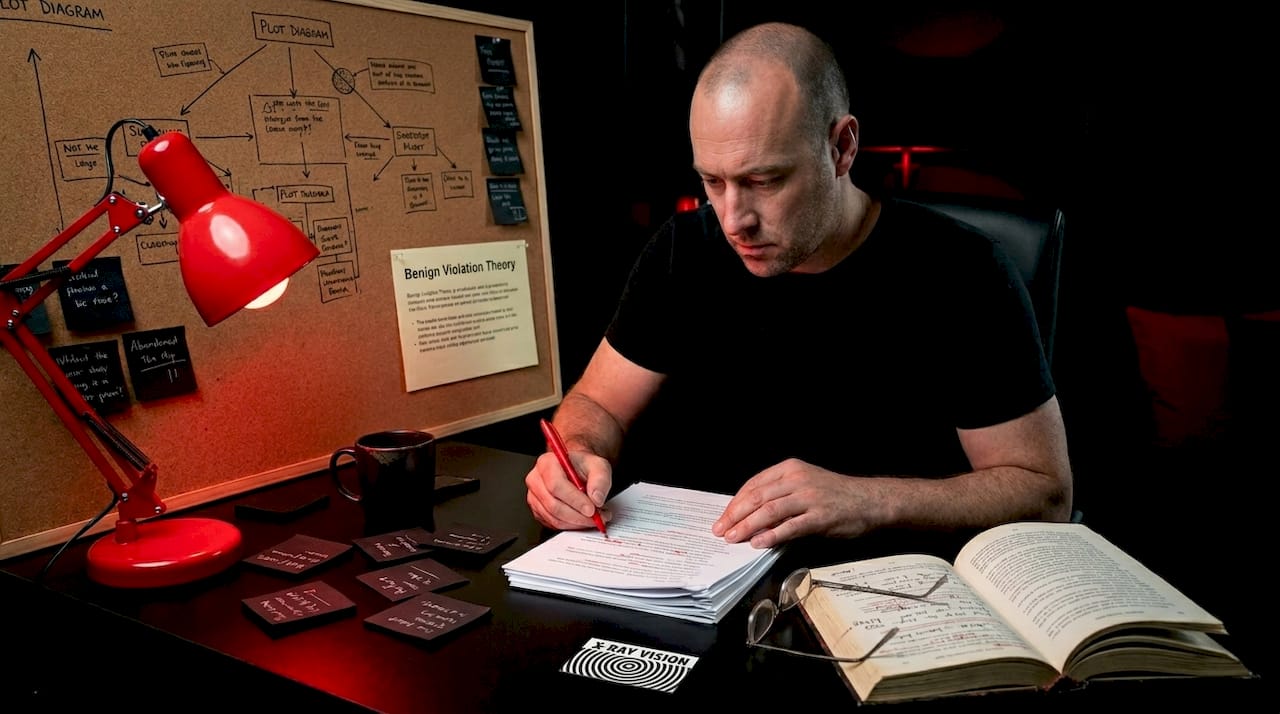
Benign violation theory is one of the most useful concepts a horror writer can internalize. The idea is clean and actionable: humor occurs when a violation feels threatening but is simultaneously appraised as safe or benign within context. Something goes wrong in a way that matters, but the audience feels protected from real consequences.
Think about a ghost story where the apparition is undeniably menacing, but it keeps knocking over the same lamp in exasperation. The violation is real. The threat is present. But the absurdity of the repeated lamp incident signals safety. The audience laughs. And then, crucially, the ghost does something that removes that safety signal entirely.
Here is how writers can apply this framework in four deliberate steps:
- Establish a genuine threat so the audience understands stakes are real.
- Frame the violation benignly through exaggeration, character reaction, or absurd juxtaposition.
- Use genre signals like over-the-top sound effects or a character's knowing smirk to reinforce that the benign framing is intentional.
- Remove the benign framing at the moment of maximum vulnerability to convert laughter into genuine dread.
Pro Tip: If your comedic moment gets a laugh but kills the scene's momentum, check whether your benign framing has lingered too long. The window between funny and immune to fear is shorter than you think.
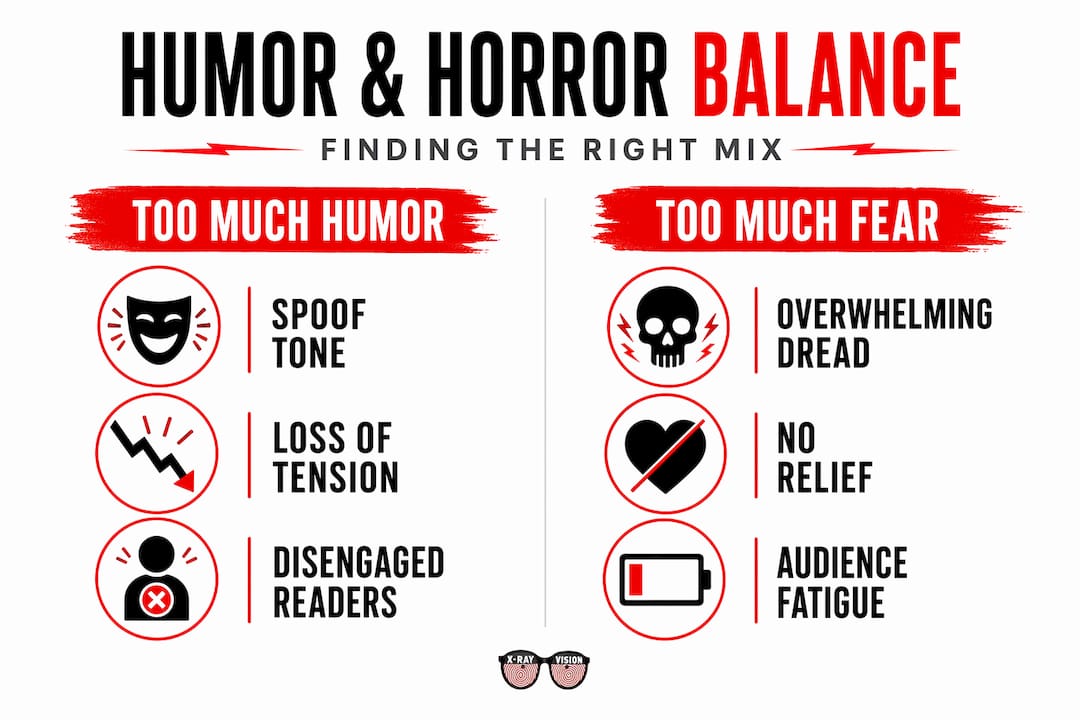
The benign violation balance must be calibrated carefully. Push too far toward the benign and you have a spoof. Stay too close to pure threat and the humor evaporates. The craft of writing gripping horror stories is knowing exactly how far to push each variable before pulling back.
Humor's social and contagious role in horror storytelling
Beyond the psychological, humor's social dynamics strongly impact its effectiveness in scary stories.
Laughter is not a solo activity. It is a social one. And that social dimension matters enormously in fiction, because readers align emotionally with characters they recognize as genuine. Laughter contagiously spreads and varies by delivery authenticity, meaning a forced or out-of-character joke lands differently than one that feels true to who that person is.
Consider comedy in scary tales that features a group of characters. When one character nervously jokes about a situation the reader already finds terrifying, that joke does double work. It signals that the character is human and relatable. And it gives the reader permission to briefly exhale, sharing the same nervous laughter. That shared exhale builds connection, which is exactly what you need before you break that character's heart.
Here is what separates effective comedic relief from tonal whiplash:
- In-character humor: The joke emerges from who this person actually is, not from a writer needing a break.
- Situational grounding: The humor is connected to the specific threat in the scene, not imported from somewhere else.
- Authentic delivery: The character's timing and tone feel believable given their emotional state.
- Absence of deflection: The humor does not pretend the threat is not real. It acknowledges the threat and laughs anyway.
Pro Tip: Read your comedic scene aloud and ask yourself honestly whether this character would say this right now. If you have to convince yourself, the audience will not be convinced either.
Funny elements in ghost stories work best when the humor feels earned. A skeptic who cracks wise about whether the poltergeist has a property tax bill is funny because it sounds like something a real person would say to cope. A character who stops being scared just so the writer can insert a one-liner breaks the spell entirely. Writers looking to craft chilling tales must treat comedic relief as a character moment, not a narrative pause.
Genre engineering: how humor strategically shapes fear pacing
Understanding genre engineering helps apply humor as a powerful tool to pace fear in scary stories.
Modern horror-comedy is not accidental. It is engineered. The balance of humor and horror in top-tier genre work follows a structural logic: comedy softens, then horror strikes. Recent horror-comedy productions use comedy to soften audiences before delivering intense horror, managing fear pacing effectively. Widow's Bay is a sharp example, using folk horror's rural strangeness alongside genuinely funny character dynamics before escalating into something that lingers.
The contrast below shows the difference between unstructured genre mixing and deliberate pacing:
| Approach | Effect on audience | Fear impact |
|---|---|---|
| Random humor drops | Confused, tonally unsettled | Diminished, inconsistent |
| Humor after scare | Deflates tension prematurely | Weakened follow-through |
| Humor before scare | Lowers guard, raises contrast | Amplified fear spike |
| Humor tied to threat source | Maintains focus on danger | Strongest sustained dread |
The structured escalation model looks like this in practice:
- Open with a comedic scene that establishes character personality and a low-stakes version of the story's central threat.
- Introduce a genuinely frightening moment that reframes the earlier comedy as naive or misguided.
- Allow brief humor as characters process the escalating threat, keeping relatability intact.
- Strip humor away entirely as the climax approaches, leaving the audience with no release valve.
Writers who want to master marketing horror books understand that this pacing structure is also a selling point. "A story that makes you laugh and then terrifies you" is a specific and compelling promise.
Practical tips for balancing humor and horror in your writing
Having explored theory and examples, here are practical steps to weave humor naturally into your horror writing.
The theory only matters if you can execute it on the page. Here is what actually works, drawn from the mechanics explored above.
- Connect comedy and scares to the same tension source. Keeping comedic and scary beats connected by the same tension source avoids tonal whiplash. If your monster is a source of fear, it should also be the source of the absurdity, not some unrelated side business.
- Use exaggerated reactions as containment signals. The benign violation must feel mechanically and morally safe via clear containment signals like exaggerated reactions or genre literacy. A character who dramatically overreacts to a minor scare signals to the audience that they can laugh here.
- Anchor humor in character, not plot. Story logistics are rarely funny. Characters coping with story logistics can be hilarious.
- Track your tension baseline. Before every horror beat, know whether your audience's tension level is high or low. Use humor to lower it intentionally before delivering your next scare.
"The joke is not a distraction from the horror. Done right, it is the horror's best setup man."
Pro Tip: Map your story's emotional beats on a simple scale before drafting. Mark every scene H (high tension), M (medium), or L (low). Your comedic moments should cluster before your most intense H scenes, not scattered randomly throughout.
Writers exploring creative techniques for scary stories will find that humor is rarely the problem when tone breaks down. The problem is almost always disconnected humor, jokes that share no DNA with the threat at the center of the story. When outlining horror short stories, plan your comedic beats at the outline stage so they are structurally intentional from the start.
Why embracing humor in scary stories is a vital evolution, not a genre dilution
Here is the uncomfortable truth most purist horror writers do not want to hear: the genre's resistance to humor has always been a kind of fragility. The assumption that laughter destroys fear reveals an anxiety that the fear was not robust enough to survive it.
Modern audiences use comedy as a defense against deep fears, making horror-comedy a mirror of contemporary anxieties. We live in an era saturated with genuine threat, from global instability to daily existential news cycles. Audiences have learned, collectively, to laugh at things that scare them. Horror that ignores this is horror that misreads its own audience.
Humor in horror fiction does not soften fear. It reflects the way real people actually experience it. We joke at funerals. We laugh during near-misses. We meme about things that terrify us. Fiction that captures this is not diluting horror. It is maturing it.
Well-placed humor also deepens emotional investment. A character who makes us laugh is a character we care about losing. When the horror finally drops that character into genuine danger, the fear is not abstract. It is personal. The comedy did not get in the way of that connection. It built it.
The writers shaping horror collections that resonate right now understand this instinctively. They are not writing dark comedies or watered-down scares. They are writing stories that earn both reactions fully and make each one more powerful because of the other.
Explore chilling and witty horror with Mark Watson Books
If you want to experience the balance of humor and horror done right, Mark Watson Books offers collections that put these principles to work.

Explore the horror collection for stories that know exactly how to make you laugh before pulling the floor out from under you. For fans of internet horror, the creepypasta books blend unsettling tension with the darkly absurd moments that make the genre so addictive. Browse the full range across Mark Watson's books and discover genre-blending storytelling that treats humor and fear as partners, not opponents. These are the books readers come back to, share, and talk about.
Frequently asked questions
Why does humor work well in scary stories?
Humor works well because it shares a similar psychological mechanism with horror, building tension and releasing it as either fear or laughter, creating a uniquely engaging emotional experience that keeps audiences off-balance in the best way.
What is Benign Violation Theory in the context of horror humor?
It is the concept that humor arises when something violates expectations in a threatening but simultaneously safe way, allowing a scary moment to trigger laughter rather than pure dread when the right contextual signals are in place.
How does character delivery affect humor in horror stories?
Characters who deliver humor authentically and in line with their established personality help audiences share relief and connect emotionally, because delivery authenticity influences contagious laughter and shapes how well a comedic beat lands in high-tension scenes.
Can humor make scary moments more frightening?
Yes. Humor softens audiences before horror setpieces by lowering their tension baseline, which means the subsequent fear spike lands with greater contrast and more visceral impact than it would after sustained dread.
Are there mental health benefits related to humor and laughter?
Laughter-based interventions have real measurable effects: laughter yoga significantly lowered anxiety and depression scores in clinical trials, which helps explain why horror-comedy audiences often report the genre as oddly cathartic and not just entertaining.