
Most horror stories don't actually scare anyone. They pile on monsters, jump scares, and gore, yet somehow leave readers completely unmoved. The real problem isn't a lack of imagination. It's a lack of craft. Writing horror that genuinely unsettles people requires understanding fear at a psychological level, building tension with precision, and knowing exactly when to strike. This guide gives you practical, field-tested techniques to write horror that sticks with readers long after they've turned the last page. Get ready to make them afraid of the dark again.
Table of Contents
- Understand the core of horror storytelling
- Prepare: Essential habits and planning for horror writers
- Tools and materials: What you need before you write
- Step-by-step: Writing your horror story
- Sharpen your prose: Editing for maximum fear
- Testing and feedback: Making your horror truly scary
- Avoiding common pitfalls in horror writing
- Take your horror writing further with Mark Watson Books
- Frequently asked questions
Key Takeaways
| Point | Details |
|---|---|
| Start with real fear | Base your story on unsettling emotions you genuinely feel for more impactful horror. |
| Edit for tension | Sharpen your prose by removing weak words and focusing on vivid, forceful language. |
| Use feedback wisely | Test your story’s fear factor on readers and revise to amplify emotional impact. |
| Structure increases suspense | Effective horror escalates gradually and delivers its biggest shock near the end. |
Understand the core of horror storytelling
Horror isn't just about what's frightening. It's about what's deeply unsettling. The best horror stories target specific emotional responses: dread, paranoia, helplessness, and the creeping sense that something is very wrong. Understanding the key elements of scary stories gives you a map for where to aim emotionally.
Horror spans a wide spectrum. Psychological horror, supernatural terror, body horror, and cosmic dread all work differently on readers. Exploring the full range of different horror genres helps you choose the right emotional weapon for your story. Each subgenre has its own rules, rhythms, and reader expectations.
Emotional manipulation is your core tool. You're not just telling a story. You're engineering a feeling. Common horror emotions to target include:
- Dread: The slow build of knowing something terrible is coming
- Paranoia: The sense that no one and nothing can be trusted
- Helplessness: Characters (and readers) stripped of control
- Disgust: Visceral reactions that bypass rational thought
- Isolation: The terror of being utterly alone
Strong engaging horror readers means hitting these emotions with precision, not randomly.
"Cutting passive voice, adverbs, and extraneous words tightens prose to heighten tension and sharpen emotional impact."
Prepare: Essential habits and planning for horror writers
Once you understand horror's emotional landscape, you need to prepare yourself as a writer. Craft is built through daily practice, not occasional inspiration. Stephen King's famous rule of 2,000 words per day isn't just discipline. It's how you train your instincts to recognize what works and what falls flat.

Reading widely matters just as much as writing. Study classic horror books to understand how masters of the genre build atmosphere and sustain dread across hundreds of pages. Read outside horror too. Literary fiction teaches you character depth. Thrillers teach pacing. Both sharpen your horror writing.
Must-have habits for horror writers:
- Keep a fear journal. Write down nightmares, unsettling thoughts, and real-life moments that made your skin crawl
- Read at least one horror story or novel per month
- Write every single day, even if it's just 300 words
- Study films and TV for visual tension techniques you can translate to prose
- Set a dedicated writing space that puts you in the right headspace
Pro Tip: Your own fears are your most powerful raw material. What genuinely terrifies you? Write toward that feeling. Readers can sense authentic dread. It's impossible to fake.
Tools and materials: What you need before you write
With your mindset and habits in place, make sure you're equipped with the essentials to start your story strong. You don't need expensive software. You need the right approach.
Essential tools include a reliable word processor (Scrivener or Google Docs work well), a dedicated notebook for ideas, and a solid reference library. Browse a curated horror book collection to stock your shelves with stories worth studying.
One of the biggest decisions you'll face is how to plan your story. Here's a quick comparison:
| Method | How it works | Best for | Risk |
|---|---|---|---|
| Outlining | Map every scene before writing | Writers who need structure | Can feel rigid |
| Mind-mapping | Visual web of ideas and connections | Visual thinkers and plotters | Can sprawl without focus |
| Pantsing | Write without a plan, follow instinct | Writers who love discovery | Easy to lose momentum |
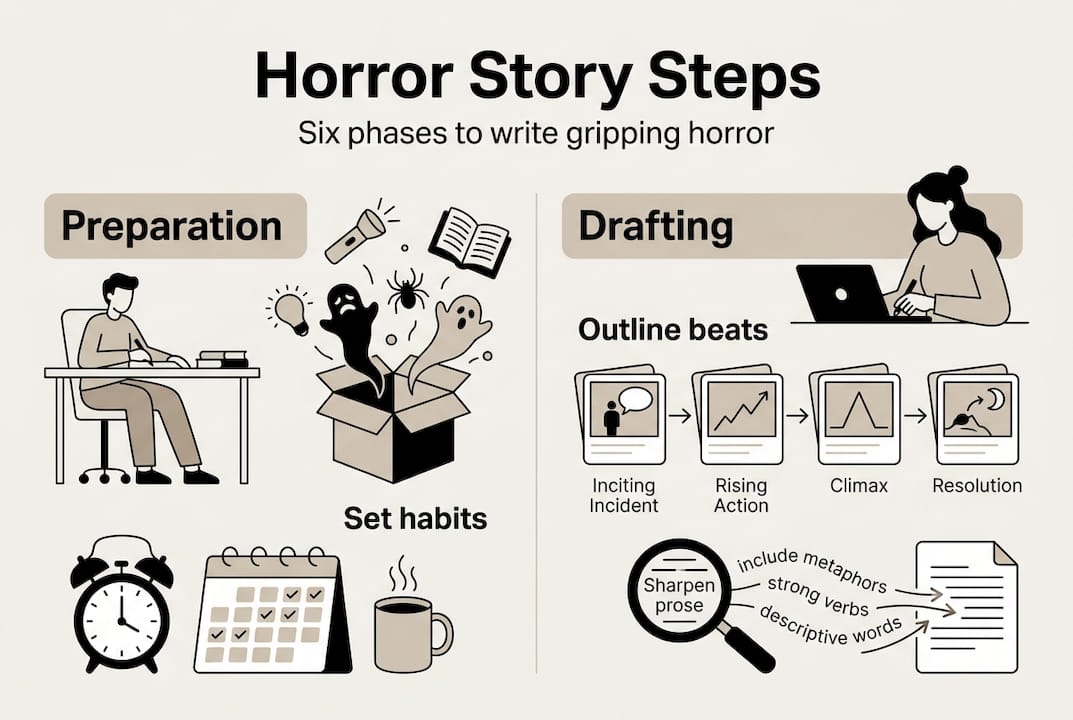
Most horror writers benefit from a hybrid approach. Outline your major beats (the hook, escalation, climax, and ending), then let the scenes breathe organically. Cutting passive voice and tightening prose during editing is far easier when your structure is solid from the start.
Step-by-step: Writing your horror story
Now you're ready to move from planning to action. Here's how to construct your story step by step.
- Find your core fear. Every great horror story is built around one central, primal fear. Isolation. Loss of identity. Death of a loved one. Pick one and go deep.
- Outline your major beats. Map the hook, the escalation, the midpoint revelation, the climax, and the ending. You don't need every scene, just the skeleton.
- Write a killer opening. Your first paragraph must create unease immediately. Drop readers into a world that feels slightly wrong before they even know why.
- Escalate tension deliberately. Each scene should raise the stakes or deepen the mystery. Never let the pressure drop completely. Use short paragraphs and sentence fragments to speed up pacing during tense moments.
- Build to a devastating climax. The climax should feel both inevitable and surprising. Everything you've planted must pay off here.
- Stick the ending. Horror endings don't need to be happy. They need to feel earned. A twist works only if the groundwork was laid earlier.
Pro Tip: Subvert one major expectation in your story. If readers think the monster is the threat, make the protagonist the real danger. Unexpected reversals create the most memorable horror moments. Study classic horror story structure to see how the best writers set up and pay off these reversals.
Also, tightening your prose during drafting, not just editing, keeps the tension alive from the very first sentence.
Sharpen your prose: Editing for maximum fear
Draft complete, the editing phase makes the difference between forgettable and chilling stories. Horror prose must be lean, precise, and visceral. Every unnecessary word bleeds tension from the page.
Here's what strong editing achieves in horror:
| Technique | What it does |
|---|---|
| Cut adverbs | Forces stronger verb choices, sharpens impact |
| Remove passive voice | Creates immediacy and urgency |
| Trim exposition | Keeps readers in the moment, not in backstory |
| Add sensory detail | Makes scenes feel real and inescapable |
| Vary sentence length | Controls pacing and reader heartbeat |
Common editing mistakes in horror writing:
- Over-explaining the monster or threat (mystery is scarier than clarity)
- Using adverbs instead of powerful verbs ("he ran quickly" vs. "he sprinted")
- Letting scenes drag without tension payoff
- Relying on telling emotions instead of showing physical reactions
The goal is crisp horror prose that hits readers in the gut. Cutting passive voice and adverbs consistently ranks as one of the most impactful editing moves you can make in horror fiction.
Testing and feedback: Making your horror truly scary
Once your story is sharpened, it's time to see if it really works. You cannot judge your own horror writing objectively. You know what you intended. Readers only know what's on the page.
Diverse beta readers are essential. Someone who reads horror regularly will catch genre clichés. Someone who rarely reads horror will tell you if the fear translates to a general audience. Both perspectives matter. Sharing your work with fans of creepypasta books can give you sharp, genre-savvy feedback fast.
Questions to ask your beta readers:
- Was there a moment where you felt genuine unease or fear? Where?
- Did any section feel slow or lose your attention?
- Was the ending satisfying, or did it feel unearned?
- Did any character feel flat or unconvincing?
- Was anything confusing that pulled you out of the story?
"Testing on readers for feedback is a non-negotiable step in refining emotional impact. What scares you may not scare your audience."
Apply feedback strategically. Not every note deserves a rewrite. But if multiple readers flag the same issue, that's a signal you can't ignore.
Avoiding common pitfalls in horror writing
Even the best intentions can go awry. Watch for these common problems in horror writing that drain the fear right out of your story.
Common pitfalls to avoid:
- Over-explaining: The moment you fully explain the monster, it loses its power. Leave room for imagination
- Predictable plots: If readers can see the twist coming from chapter one, the impact is gone
- Cliché monsters: Overused creatures (generic zombies, standard vampires) need a fresh angle or they feel stale
- Pacing errors: Moving too fast through setup or too slow through action kills tension
- Weak character motivation: Readers won't fear for characters they don't care about
Studying successful horror examples shows you how skilled authors sidestep these traps with smart structure and character work. Tightening prose and removing clichéd language is part of the same discipline.
Pro Tip: Focus each story on one powerful, specific fear. Trying to be scary in every possible way dilutes the impact. One deep, well-executed fear beats ten shallow ones every time.
Take your horror writing further with Mark Watson Books
Ready to turn your horror story vision into reality? The journey doesn't have to end here. Mark Watson Books offers a vivid collection of horror fiction designed to inspire, unsettle, and show you what's possible when craft meets genuine dread.

Browse the full horror book collection for stories that demonstrate the techniques covered in this guide. If you love the raw, community-driven energy of internet horror, the creepypasta books collection delivers exactly that kind of unsettling tension. And if you want to explore the complete range of what horror can be, the complete horror library is your next stop. Read widely, write boldly, and let these stories fuel your own.
Frequently asked questions
How do I come up with original ideas for horror stories?
Draw from your own fears, nightmares, and what genuinely unsettles you, then push those feelings into unusual "what if?" scenarios. Wide reading and daily writing train you to recognize which ideas have real emotional power.
What's the best structure for a horror story?
Effective horror starts with a familiar world, escalates tension through deliberate pacing, and twists expectations at the climax for maximum impact. Tightening prose at every stage keeps that structure feeling sharp and urgent.
How do I know if my horror story is actually scary?
You can't fully judge your own work. Share your draft with diverse beta readers and ask specific questions about fear and emotional impact. Reader feedback is the only reliable way to know if the dread you intended actually lands.
How can I avoid horror clichés?
Focus on genuine psychological fear rooted in specific, personal dread rather than genre conventions. Removing overused elements during editing and subverting familiar tropes with fresh settings or unexpected character choices keeps your story feeling original.
How much violence or gore is too much in horror?
Gore is only effective when it serves the story's emotional purpose. Psychological tension almost always hits harder than graphic violence. Sharp, purposeful language creates more lasting fear than shock value alone.