

TL;DR:
- Carefully designed scary themes can enhance attention, memory, and social bonds in educational settings. Implementing clear framing, gradual intensity, and structured debriefs ensures safe and effective learning experiences with horror elements. Research shows that emotional arousal from horror promotes deeper engagement and long-term retention when accompanied by reflection.
Most educators and parents assume that scary themes belong in Halloween parties, not classrooms. That assumption is worth questioning. Research into why use scary themes for learning reveals something surprising: fear, when designed carefully, can sharpen attention, deepen memory, build social bonds, and make difficult topics suddenly discussable. The science isn't fringe. It draws from neuroscience, educational psychology, and classroom experience. If you've been curious about whether horror elements in education could actually work, you're about to get a clear picture of what the evidence says.
Table of Contents
- Key takeaways
- Why use scary themes for learning: the psychology behind it
- How to use scary themes safely and effectively
- Evidence of scary themes boosting engagement
- Scary themes versus other emotional engagement methods
- My take on scary themes and real learning
- Explore scary-themed learning with Markwatsonbooks
- FAQ
Key takeaways
| Point | Details |
|---|---|
| Fear sharpens memory | Emotional arousal from scary themes increases retention and engagement when the content is well-framed. |
| Safety signals matter | Scary themes must include clear resolution moments to prevent unresolved anxiety from undermining learning. |
| Social bonding is a benefit | Shared scary experiences, followed by reflection and discussion, measurably increase closeness between participants. |
| Calibrate for anxiety levels | Students with higher anxiety need opt-in choices and graduated intensity to benefit without distress. |
| Post-activity reflection is critical | Structured debriefs after scary activities convert emotional arousal into real cognitive and social gains. |
Why use scary themes for learning: the psychology behind it
Fear is one of the brain's oldest learning signals. When you encounter something that triggers a threat response, your brain locks in the details. That's not a bug. It's a survival feature, and it has real implications for education.
Here's what makes scary themes in education so interesting from a psychological standpoint. Fear learning is not fixed. Neural imaging research shows distinct brain patterns during fear acquisition and reversal, indicating that the brain retains genuine cognitive flexibility even in threatening contexts. That means a student who feels a controlled jolt of fear during a lesson isn't stuck in that fear. With the right design, the brain can update that response and learn from it.
Emotional arousal also increases attention and memory consolidation. When a lesson sparks genuine suspense or unease, the brain treats that content as worth remembering. That's why horror narratives stick with readers long after the last page. The same mechanism works in a classroom, provided the intensity is purposeful rather than gratuitous.

Then there's the social dimension. Shared recreational fear promotes social bonding when followed by reflection and communication. Experiments measuring closeness after haunted house visits found a small but measurable increase in connection between participants, amplified by post-event conversation and physical reassurance. Bring that into a classroom setting, and you have a tool that builds community, not just content knowledge.
One important caveat: not all students respond the same way. Higher anxiety correlates with slower safety learning, meaning anxious students take longer to update their fear response and feel safe again. Any design that ignores this risks doing the opposite of what you intend.
"The degree of anxiety influences how individuals respond to scary themes, so offering choice and control is key in educational settings."
Pro Tip: Before introducing any scary themed content, ask students to self-rate their comfort level on a simple 1 to 5 scale. This one step gives you data, signals that student voice matters, and preemptively filters out students who need a modified experience.
How to use scary themes safely and effectively
Knowing the psychology is one thing. Translating it into practical classroom or home-learning design is another. Here's how to do it responsibly.
-
Use invented horror metaphors as cognitive scaffolds. Don't throw real world horrors at students. Instead, create fictional monsters, unsettling scenarios, or eerie mystery puzzles that represent the concept you're teaching. Horror metaphors help externalize internal fears and make difficult topics approachable in a classroom setting.
-
Frame the experience clearly from the start. Tell students exactly what kind of activity this is, what the learning goal is, and that the discomfort is temporary and intentional. Instructor framing is the single most important variable in whether students feel psychologically safe or blindsided.
-
Build in reversal moments. Every scary themed lesson needs a deliberate "safety landing." This is the moment where the threat is resolved, the mystery is explained, and the emotional tension releases. Research confirms that ambiguous or unresolved fear cues can undermine cognitive flexibility and cause a return of fear. Don't skip the landing.
-
Offer graduated intensity and opt-out options. Some students want maximum immersion. Others need the dial turned down. Provide both. This is especially critical for students with anxiety, who benefit from having a clear exit and lower-intensity alternatives.
-
Schedule structured reflection and debrief. After the activity, give students time to talk, laugh, and process. This is not optional. Post-event social interaction is the hidden ingredient that converts scary experiences into stronger bonds and deeper learning. Use debrief prompts: What did you predict would happen? What surprised you? What did you learn about how your brain responded?
Pro Tip: When designing a scary story based lesson, write the "resolution moment" first. Once you know exactly how the fear will be released and what insight it delivers, building the tension that leads there becomes much more purposeful.
Evidence of scary themes boosting engagement
The research here is more specific than you might expect. Let's look at what actually happens when scary themes enter educational spaces.
What the studies show
| Context | Outcome | Key Factor |
|---|---|---|
| Haunted house visits | Increased closeness ratings among participants | Post-event communication and physical comfort |
| Horror studies course (UNC) | Preserved psychological safety while improving analytical thinking | Academic framing, not pure fright |
| Horror metaphors in classroom | Made complex internal fears discussable and reduced avoidance | Invented scenarios as safe proxies |
| Scary storytelling activities | Stealthily built language and narrative skills | Engagement-driven repetition and elaboration |
The University of North Carolina approach is particularly worth noting. Their horror studies course frames horror analytically, treating fear as a learning object rather than a goal. Students examine why they're afraid, what cultural anxieties horror reflects, and how storytelling manipulates emotion. The result is sharper critical thinking, not traumatized students.
Scary storytelling in classrooms also shows a quiet benefit that often gets overlooked. When students are genuinely gripped by a story, they ask more questions, elaborate more in writing, and remember vocabulary in context. The engagement isn't manufactured. It's real.
There are some concrete benefits worth highlighting:
- Students retain emotionally charged content longer than neutral material
- Group horror activities increase cooperation and communication during debriefs
- Horror narratives give students a safe container to explore anxieties they struggle to verbalize otherwise
- Children's anthologies with spooky themes can spark reading habits in reluctant readers who resist conventional formats
One note on students with higher anxiety: they are not excluded from these benefits, but they need more scaffolding, more control, and more frequent safety signals throughout. Ignoring this group is the most common mistake educators make.
Scary themes versus other emotional engagement methods
Fear is not the only emotional lever in education. Comedy, adventure, and awe all have their place. So what makes scary themes uniquely worth adding to the mix?
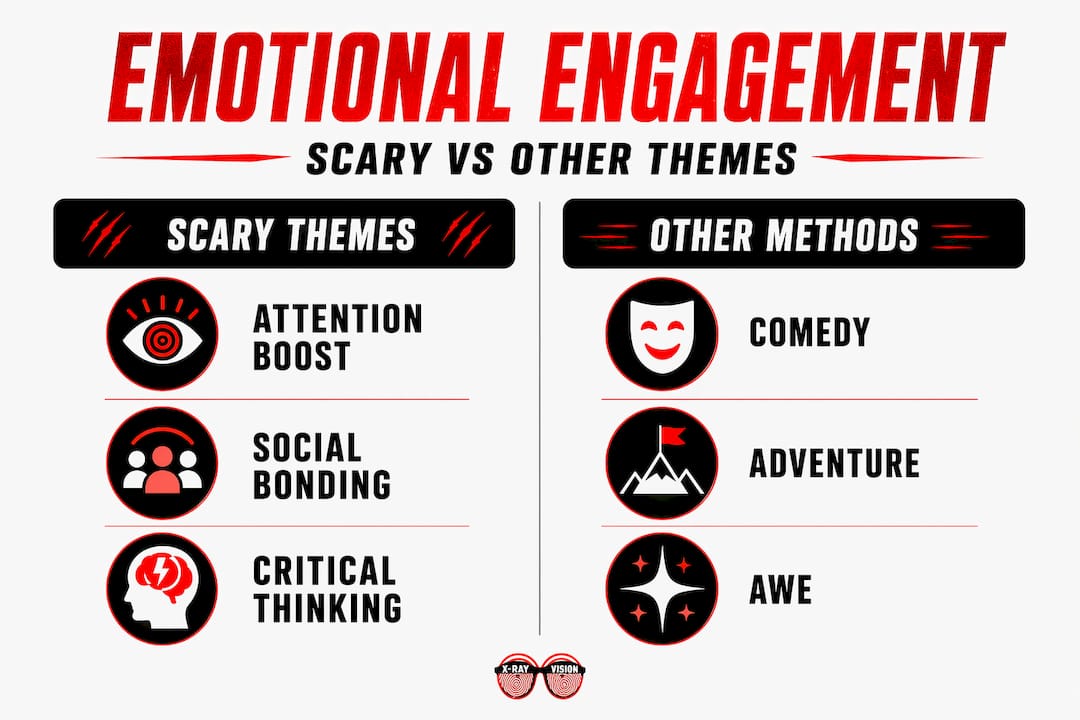
Here's a direct comparison:
| Emotional Trigger | Attention Boost | Social Bonding | Critical Thinking | Risk of Harm |
|---|---|---|---|---|
| Fear (well-designed) | High | High (post-debrief) | High | Medium (manageable) |
| Comedy | Medium | Medium | Low-Medium | Low |
| Adventure | Medium-High | Medium | Medium | Low |
| Awe/Wonder | High | Low | High | Very Low |
Scary themes have a particular edge when the goal is to open up conversations about vulnerability, ethics, or social issues. Comedy deflects. Adventure energizes. Awe inspires. Fear, strangely, connects. When students share something unsettling together and then talk about it openly, the bonding effect from shared fear creates trust that other emotional triggers rarely produce at the same speed.
There's also the curiosity factor. Horror and suspense naturally generate questions. What's behind the door? Why did that happen? What does this mean? That cognitive pull is genuine, and it's hard to replicate with a feel-good story about teamwork. The impact of horror in teaching is most visible in subjects where students usually disengage: ethics discussions, mental health literacy, and complex social history.
The risk, of course, is real. Unmanaged fear doesn't just fail to teach. It can cause harm. The difference between a productive scary experience and a damaging one often comes down to one variable: whether a structured, supportive debrief happened afterward. Shared scary experiences can either strengthen or strain relationships depending on how participants respond to each other in the moment. If mockery replaces support, the bond breaks. If comfort and humor follow, it deepens.
My take on scary themes and real learning
I've spent years thinking about what makes horror work, not just as entertainment, but as a vehicle for genuine insight. Here's what I've learned from that experience.
The scare itself is the least interesting part. I've seen well-intentioned horror activities fall flat, not because students weren't engaged, but because the educator ran out of time and skipped the debrief. That's like cooking a brilliant meal and never letting anyone eat. The conversation that follows a scary story, the questions it raises, the things students admit they were feeling but couldn't say before, that's where the real learning lives.
I've also found that students often surprise themselves during these activities. A kid who thinks he has no imagination suddenly writes three vivid paragraphs about a monster that represents his fear of failure. That's not a coincidence. Horror lowers a particular kind of guard. It gives students permission to say something true using fictional cover.
The mistake I see most often is educators designing for maximum impact and minimum structure. They want the class to feel the tension but haven't planned the landing. They want the bonding but skip the reflection. Fear without resolution is just anxiety. The educational value of scary stories comes from the full arc: tension, release, and meaning-making together.
My advice is this: start smaller than you think you need to. One well-constructed scary story with a ten-minute debrief will do more than a two-hour immersive event with no follow-through.
— Mark
Explore scary-themed learning with Markwatsonbooks
If this has sparked your curiosity, Markwatsonbooks has exactly what you need to take the next step.

Mark Watson's collection spans children's horror books designed with age-appropriate suspense, through to creepypasta anthologies that work brilliantly for older students and reading groups. These aren't just scary books. They're crafted narratives that mirror the design principles discussed here: tension with purpose, resolution with meaning, and stories that leave readers thinking long after the last page. Browse the full collection and find the right starting point for your classroom, your family reading time, or your own learning journey. START EXPLORING NOW.
FAQ
Why use scary themes for learning instead of neutral content?
Scary themes trigger emotional arousal, which increases attention and memory retention. Research shows that emotionally charged content is remembered longer and discussed more deeply than neutral material.
Are scary themes safe for all students?
Not without modification. Students with higher anxiety learn safety more slowly, so scary activities should always offer graduated intensity, opt-out options, and clear safety framing to work for everyone.
What makes a scary learning activity actually effective?
The debrief. Post-fear reflection and conversation are what convert emotional arousal into lasting bonds and real cognitive gains. Skip the debrief, and you lose most of the benefit.
Can horror help kids who struggle with reading?
Yes. Scary storytelling in classrooms engages reluctant readers because the suspense is self-motivating. Students who resist conventional formats often respond to spooky narratives with surprising enthusiasm and vocabulary retention.
What age is appropriate for scary themes in education?
Age appropriateness depends on the intensity and framing, not horror as a category. Age-calibrated scary stories, like those designed for children's horror, can be used effectively from early elementary school onward when the design is thoughtful and the content is age-matched.