
TL;DR:
- Folk horror centers on communities practicing ancient rituals within isolated landscapes, not supernatural monsters. It emphasizes collective belief systems, land as an active agent, and ambiguous endings, with roots extending to early literature and film. The genre's core relies on atmospheric buildup, detailed rituals, and cultural authenticity, demanding thorough research from creators.
Folk horror is a subgenre of horror that treats local folklore, communal ritual, and landscape as the primary engine of dread — not a single monster, not a haunted house, but an entire community whose belief system is older, stranger, and more brutal than anything the protagonist brought with them. According to Wikipedia, it uses elements of folklore, ritual, and pagan traditions to invoke fear, focusing on collective beliefs rather than individual supernatural antagonists. That distinction is everything.
Spot it fast by watching for these cues:
- Rural isolation — the setting cuts characters off from modern law and rescue
- Ritual or ceremony — the community enacts practices with internal logic the outsider cannot decode
- Community as threat — the danger is collective, not a lone predator
- Outsider protagonist — someone from outside the belief system stumbles in
- Landscape as active agent — the land itself feels complicit, even hungry
- Cyclical or ambiguous endings — resolution rarely arrives clean
Canonical examples span decades and media: Witchfinder General (1968), The Blood on Satan's Claw (1971), and The Wicker Man (1973) form the so-called "Unholy Trinity" of British folk horror film. The Witch (2015) and Midsommar (2019) represent the modern revival. Shirley Jackson's short story "The Lottery" delivers the genre's essential shock in under ten pages.
Folk horror differs sharply from backwoods slasher films, which center individual violence, and from supernatural horror, which relies on a discrete paranormal entity. Here, the threat is the group. That shift changes everything about how dread is built.
Table of Contents
- Where did folk horror come from?
- What are the core tropes of folk horror?
- How does folk horror work in literature?
- Which films define the folk horror canon?
- How do TV and video games use folk horror mechanics?
- How does folk horror change across regions?
- How do you write folk horror?
- Does this story qualify as folk horror? A diagnostic checklist
- Where should you start? Recommended reading and viewing
- Key Takeaways
- Why folk horror is the most honest subgenre
- Ready to read something that gets under your skin?
- Useful sources for deeper research
Where did folk horror come from?
The roots run deeper than the 1970s. Literary precursors appeared decades earlier. Arthur Machen's novella The Great God Pan (1894) introduced the idea of ancient, pre-Christian forces lurking beneath the English countryside. Algernon Blackwood's "The Willows" (1907) and "The Wendigo" (1910) pushed landscape itself into the role of antagonist, something vast and indifferent pressing against human sanity. These writers never used the term "folk horror," but their DNA is unmistakable in every film that followed.
Silent cinema offered its own early example. The Swedish documentary-style film Häxan (1922) dramatized witch trial history and folk superstition with an ethnographic intensity that still feels unsettling. Videomaker notes that folk-horror-like films predate the 1970s, pointing to these regional traditions as evidence of the subgenre's long global history.
The term itself has a traceable, if contested, origin. The BFI reports that "folk horror" rose in public prominence after filmmaker and critic Mark Gatiss used it in his BBC documentary series A History of Horror in 2010. But the Revenant Journal argues the term appeared self-consciously in film criticism and trade publications as early as the 1970s, suggesting the label was always lurking, waiting for the right cultural moment to stick.
That moment crystallized around three British films. Witchfinder General (1968), directed by Michael Reeves, used the historical witch-finder Matthew Hopkins as a vehicle for exploring state-sanctioned religious terror. The Blood on Satan's Claw (1971) buried its horror literally in the earth, with the camera placed at ground level in a field to suggest something ancient pressing upward. The Wicker Man (1973) completed the trinity with its vision of a self-contained pagan community on a Scottish island, cheerfully indifferent to the mainland's moral codes. These three films are now the canonical "Unholy Trinity" — the reference points every subsequent discussion returns to.
The modern revival arrived with Robert Eggers's The Witch (2015), which transplanted the formula to Puritan New England, and Ari Aster's Midsommar (2019), which stripped away the darkness and staged its folk horror in broad Swedish daylight. Both films proved the subgenre's structural logic could survive radical changes of setting and tone.
What are the core tropes of folk horror?
The genre's power comes from a recognizable cluster of recurring elements. None of them is strictly required in isolation, but the more a work deploys, the more clearly it belongs to this tradition.
- Isolation and rurality — the setting removes characters from institutional protection. In The Wicker Man, Sergeant Howie's police authority means nothing on Summerisle.
- Ritual and ceremony — communities perform acts with internal coherence that outsiders read as madness. The lottery in Jackson's story is mundane to the villagers; catastrophic to the reader.
- Folk religion or occult practice — belief systems rooted in pre-Christian or animist traditions replace modern moral frameworks. The Witch builds its entire dread on a Puritan family's own theology turning against them.
- Outsider versus community — the protagonist's modern assumptions collide with communal logic. The community is not evil by its own standards; that gap is where the horror lives.
- Landscape as sentient force — hills, forests, and fields feel aware. Blackwood's "The Willows" made this explicit; Midsommar's flower-bright meadows achieve the same effect through excess rather than darkness.
- Cyclical or ambiguous endings — the ritual completes, the outsider is consumed, and the community continues. There is no rescue, no reset.
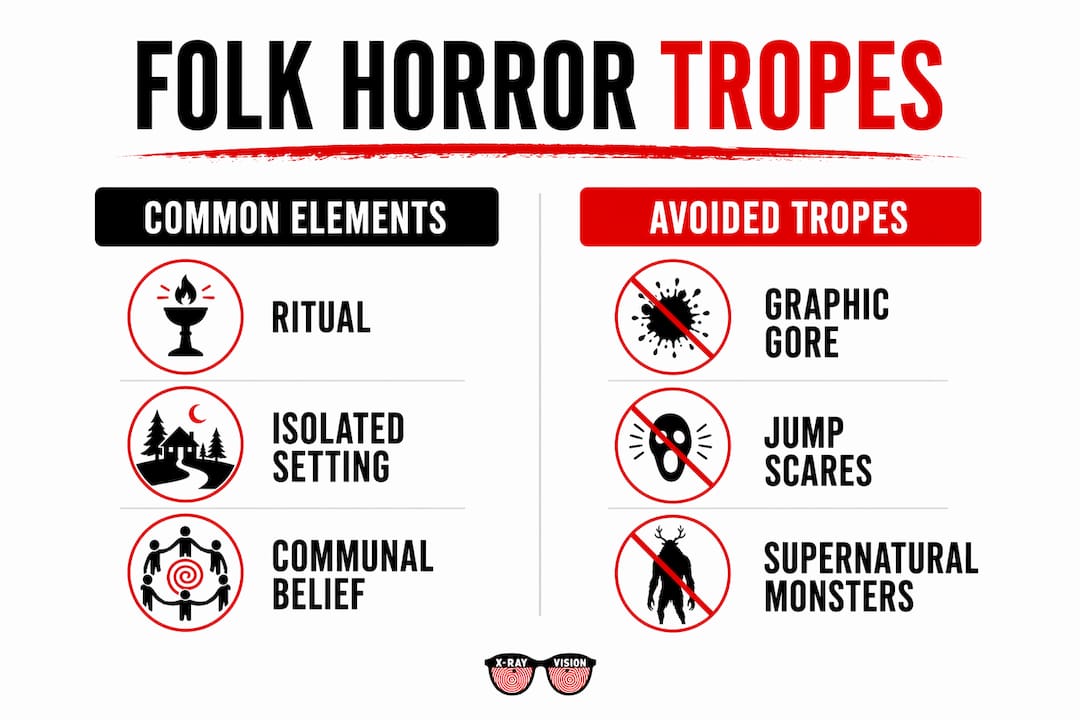
Folk horror does not require explicit supernatural creatures, graphic gore, or jump scares. StudioBinder emphasizes that the genre prioritizes atmosphere and the slow build of unsettling dread. A work can be entirely ambiguous about whether anything supernatural occurred — and still be unmistakably folk horror. The history of horror literature shows this atmospheric emphasis predates cinema entirely.
How does folk horror work in literature?
On the page, folk horror operates through accumulation. The dread builds through setting, dialect, ritual description, and what the narrator refuses to explain. Three writers defined the literary tradition before the films existed.
Arthur Machen treated the Welsh countryside as a membrane between the modern world and something ancient and malevolent. The Great God Pan and The White People use archaic language and nested narratives to make the reader feel the weight of pre-Christian time pressing through the prose.
Algernon Blackwood went further into landscape-as-character. "The Willows" places two canoeists on a Danube island where the willows themselves seem to shift and close in. Nothing is ever confirmed supernatural. The horror is atmospheric, geological almost.
Shirley Jackson's "The Lottery" (1948) is the genre's most efficient short story. A village holds an annual lottery. The ritual is described with the same flat, procedural tone as a town meeting. The ending arrives with no warning and no apology. Jackson never explains the lottery's origin or purpose, which is precisely the point: the community doesn't need to explain it to itself.
Literary techniques that folk horror writers use consistently:
- Setting as character — map the location's history so the landscape feels inevitable, not decorative
- Archival fragments — letters, diary entries, local records that hint at older practices
- Unreliable narration — the outsider narrator misreads what they observe, and the reader catches it too late
- Folkloric lexicon — local names, dialect terms, and ritual vocabulary that the text never translates
- Ritual without motive — describe the ceremony in precise physical detail; withhold the why
One practical caution: when borrowing real-world folklore, research the source culture carefully. Lifting ritual elements from living traditions without context can flatten or misrepresent them. The strongest folk horror either invents its own traditions with internal coherence or engages deeply with a specific historical record. The relationship between folk tales and horror is worth studying before you write a single scene.
Which films define the folk horror canon?
The "Unholy Trinity" remains the genre's foundation, but the canon has expanded considerably across national cinemas.
| Title | Year | Country | Defining folk-horror cue |
|---|---|---|---|
| Witchfinder General | 1968 | UK | State-sanctioned religious terror as communal violence |
| The Blood on Satan's Claw | 1971 | UK | Ancient evil rising through the earth; youth cult ritual |
| The Wicker Man | 1973 | UK | Pagan island community; outsider as ritual sacrifice |
| The Blair Witch Project | 1999 | USA | Local legend weaponized; landscape as active pursuer |
| The Witch | 2015 | USA | Puritan colonial isolation; community belief turned inward |
| Midsommar | 2019 | USA/Sweden | Daylight folk ritual; grief and communal absorption |
Witchfinder General works because Matthew Hopkins is not a supernatural villain. He is a man empowered by a community's fear, which makes him more disturbing than any demon. The Blood on Satan's Claw literalizes the genre's obsession with buried history: the horror literally comes out of the ground. The Wicker Man's final sequence, the burning wicker structure, is folk horror's most iconic image precisely because the community watches it with joy, not guilt.
The Blair Witch Project (1999) translated the formula to American soil, using the mythology of a Maryland witch to make a forest feel like a trap closing slowly. The found-footage format amplified the outsider's disorientation. The Witch stripped the genre to its theological bones: a Puritan family exiled to the edge of a New England forest, where their own faith becomes the instrument of their destruction. Midsommar inverted the visual grammar entirely. Contemporary spikes in interest around these films broadened the subgenre's audience and pushed it into TV and games.
Regional cinema has produced compelling variants. Japanese films like Onibaba (1964) use rice-field landscapes and ancient masks to achieve similar communal dread. South Korean horror has drawn on shamanistic ritual. The structural logic travels; the specific folklore changes.
How do TV and video games use folk horror mechanics?
Television's episodic format gives folk horror room to breathe that a two-hour film rarely can. Slow revelation across multiple episodes lets the community's logic unfurl gradually, so the viewer absorbs the ritual logic almost before they realize it.
- "The League of Gentlemen" (BBC, 1999–2002) — a dark comedy that uses a fictional northern English town, Royston Vasey, to satirize and horrify through insularity, local custom, and the community's hostility to outsiders. The folk-horror mechanics are played for grotesque laughs, but the dread is genuine.
- "Midsomer Murders" — a procedural that repeatedly uses English village ritual and tradition as the backdrop for violence, demonstrating how folk-horror tropes can operate even within genre-adjacent formats.
- "The Watcher in the Woods" (various adaptations) — uses English woodland mythology and community secrecy to generate sustained unease across a longer narrative.
- "True Detective" Season 1 — American folk horror in television form, using Louisiana bayou landscape, rural cult ritual, and the slow revelation of communal violence to devastating effect.
Video games have found folk horror's mechanics particularly well-suited to the medium. Player agency creates a specific kind of dread: you choose to walk into the ritual space, and the game holds you responsible for what happens next.
- "Folklore" (PS3) — uses Celtic and Norse mythology as the structural basis for its world, with communities of the dead organized around belief systems.
- "Mundaun" (2021) — a hand-penciled Swiss Alps horror game built entirely on local Alpine folklore, with environmental storytelling replacing exposition.
- "Dread Templar" and similar atmospheric titles use audio cues, ambient sound design, and environmental detail to replicate the communal dread that film achieves through cinematography.
The key mechanic in games is environmental storytelling: objects, architecture, and sound design carry the ritual logic without a character explaining it. That mirrors exactly what the best folk horror literature does on the page.
How does folk horror change across regions?
The structural bones stay consistent. What changes is the specific folklore, the landscape, and the social anxiety each culture projects onto its rural spaces.
Britain produced the genre's canonical form. The English and Scottish countryside carries centuries of pre-Christian practice layered beneath Christian surface culture. British folk horror draws on that tension: the old ways are not gone, just buried. Films like The Wicker Man and The Blood on Satan's Claw locate horror in the gap between modern institutional authority and ancient communal practice. Academic work on films like David Gladwell's Requiem for a Village (1975) frames this as anxiety about modernity erasing rural tradition — the horror runs in both directions.
The United States inflects the formula through colonial and frontier anxiety. The Blair Witch Project uses Indigenous legend filtered through settler guilt. The Witch uses Puritan theology as the community belief system. American folk horror tends to locate its buried past in colonial violence, slavery, or Indigenous displacement — the land remembers what the nation prefers to forget.
Southeast Asia brings animist traditions, spirit hierarchies, and ancestor veneration into the genre's framework. Thai and Indonesian horror films frequently use ritual spaces, spirit houses, and community taboos as the mechanism of dread. The outsider is often someone who has left their village for the city and returned, violating the old protocols.
Scandinavia contributes Norse mythology, the concept of the utmark (the wild land beyond the farm's boundary), and a tradition of folktales in which the natural world is actively hostile. Midsommar draws on Swedish midsummer traditions and the Hårga community's internal logic to create a horror that feels ethnographically specific even when it is invented.
When cultural traditions shape scary stories, the specificity is the point. Generic "ancient evil" is far less frightening than a ritual with a name, a history, and a community that believes in it completely.
How do you write folk horror?
The genre rewards writers who do their research and resist the urge to explain. Here is a practical sequence.
- Root the setting in real history. Choose a specific place and research what actually happened there: land disputes, religious conflicts, agricultural practices, local legends. The horror should feel like it grew from the soil, not dropped in from outside.
- Build the community's logic before you write a word of plot. What does this community believe? What do they fear? What do they protect? The ritual must make sense from inside the community's worldview, even if it horrifies the reader.
- Design the ritual with physical precision. What objects are used? What words are spoken? What sequence is followed? Believable communal logic requires that rituals have internal coherence; exposition should reveal that logic gradually through artifacts, dialogue, and landscape.
- Limit exposition ruthlessly. The outsider does not get a guided tour. They observe, misread, and piece together fragments. The reader should be slightly ahead of the protagonist — or slightly behind.
- Tie the stakes to communal values, not individual survival. The community is not trying to kill the protagonist out of malice. They are completing something necessary. That distinction is what separates folk horror from a slasher film.
- Choose your ending deliberately. Does the ritual complete? Does the outsider escape but carry the infection? Does the community absorb them? Cyclical endings, where the pattern simply continues, are the genre's most characteristic choice.
Pro Tip: Let folklore emerge through objects and dialect rather than dialogue. A carved figure on a doorpost, a word the locals use for a specific field, a song sung at a particular time of year — these details do more atmospheric work than any expository paragraph. Setting shapes atmosphere most powerfully when it operates below the level of explanation.
Use local topography as an active antagonist. LitReactor advises writers to treat setting as a character: map the location's history and its "monsters" so the landscape feels active and inevitable. A hill that the community avoids, a river with a local name that translates to something ominous, a field where crops grow strangely — these are your antagonists before any human character acts.
On ethics: if you are drawing on a real cultural tradition, read primary sources, not secondary summaries. Consult scholarship by people from that culture. The strongest folk horror either invents a tradition with enough internal detail to feel real, or engages so specifically with a historical record that the research shows. Vague "ancient evil" is both less frightening and more likely to flatten a living tradition into a prop.
Does this story qualify as folk horror? A diagnostic checklist
Run any work through these eight questions. Four or more "yes" answers place it firmly in the genre.
- Is the setting rural or geographically isolated from modern institutional authority?
- Does the community practice a ritual or belief system with internal logic the outsider cannot immediately decode?
- Is the threat collective rather than individual?
- Does the landscape function as more than backdrop — does it feel complicit or active?
- Is the protagonist an outsider to the community's belief system?
- Does the horror arise from the community's values rather than from a discrete supernatural entity?
- Is the ending cyclical, ambiguous, or does the ritual complete without moral resolution?
- Does the work avoid relying primarily on jump scares or gore to generate fear?
Three quick applications:
The Wicker Man (1973): Yes to all eight. The island community, the pagan ritual, the outsider detective, the landscape of Summerisle as a character, the completion of the sacrifice — it is the genre's purest expression.
The Blair Witch Project (1999): Six of eight. The Maryland forest is isolated and active; the Blair Witch legend is a communal belief; the protagonists are outsiders; the ending is ambiguous. It scores slightly lower because the threat is more ambiguous about whether it is collective or individual, and the found-footage format occasionally leans on shock over atmosphere. Still firmly folk horror.
The Shining (1980): Two or three of eight. The Overlook Hotel is isolated, and the landscape of the Colorado Rockies is oppressive. But the threat is primarily supernatural and individual (the hotel's ghosts, Jack's madness), there is no community practicing a ritual, and the outsider/community dynamic is absent. A common misconception is that woods or isolation alone qualify a work; scholars stress the need for community-based belief systems. The Shining is gothic psychological horror, not folk horror.
Borderline cases are common. Hereditary (2018) sits at the edge: it has a secret society, a ritual, and a communal belief system, but its setting is suburban and its mechanics lean toward demonic horror. Cultural specificity can complicate the label further — a Southeast Asian film using spirit-house rituals may check every box structurally while operating in a tradition that has its own genre vocabulary entirely.
Where should you start? Recommended reading and viewing
A manageable starter list across film, fiction, and television, with a note on why each entry earns its place.
| Title | Medium | Best entry point |
|---|---|---|
| The Wicker Man (1973) | Film | The genre's clearest single example; watch the theatrical cut |
| The Witch (2015) | Film | Best modern entry; slow-burn and historically grounded |
| Midsommar (2019) | Film | Ideal for readers who want daylight horror and emotional complexity |
| The Blair Witch Project (1999) | Film | Best for found-footage and American folk-horror tradition |
| "The Lottery" — Shirley Jackson | Short fiction | the genre's essential literary text |
| "The Willows" — Algernon Blackwood | Short fiction | Best introduction to landscape-as-antagonist in prose |
| The Great God Pan — Arthur Machen | Novella | Essential precursor; dense but rewarding |
| True Detective Season 1 | Television | Best TV entry; American bayou folk horror across 8 episodes |
| Mundaun (2021) | Video game | Best game entry; Alpine folklore, atmospheric, short |
For U.S. readers, The Wicker Man is available on multiple streaming platforms and in physical editions. Shirley Jackson's "The Lottery" is widely anthologized and freely available online. Blackwood and Machen are in the public domain and available through Project Gutenberg. Mundaun is available on PC, PlayStation, and Xbox.
For readers who want to keep building their horror library beyond these classics, the best new horror releases in 2026 include titles that carry folk horror's atmospheric DNA into contemporary fiction.
Key Takeaways
Folk horror is defined by communal belief as the source of dread, not a single monster — and that structural distinction separates it from every other horror subgenre.
| Point | Details |
|---|---|
| Core definition | Folk horror uses folklore, ritual, and landscape as the engine of fear, not a discrete supernatural entity. |
| Essential cues | Watch for rural isolation, outsider protagonist, community-as-threat, and a ritual with internal logic the outsider cannot decode. |
| The Unholy Trinity | Witchfinder General, The Blood on Satan's Claw, and The Wicker Man are the canonical foundation; every discussion returns to them. |
| Writer's priority | Build the community's belief system before plotting; let ritual logic emerge through objects and dialect, not exposition. |
| Markwatsonbooks | Mark Watson's horror and Creepypasta collections offer folk-horror-adjacent short fiction for readers ready to go deeper. |
Why folk horror is the most honest subgenre
Folk horror unsettles me in a way that supernatural horror rarely does anymore. A ghost can be disbelieved. A demon can be exorcised. But a community? A community that has practiced the same ritual for three hundred years, that genuinely believes in what it is doing, that looks at you with patience rather than malice? There is no counter-spell for that.
What the genre gets right — and what I think writers underestimate — is that the real horror is not the ritual. It is the discovery that your moral framework is local. That the rules you assumed were universal are, in fact, just the rules of the place you came from. The Wicker Man does not work because the pagans are evil. It works because they are not, by their own lights, evil at all. That is a much more disturbing thought.
For casual viewers, start with Midsommar — it is visually stunning and emotionally accessible. For serious readers, go straight to Blackwood's "The Willows" and sit with the discomfort of a landscape that simply does not care whether you survive. For writers, draft one scene in which a ritual is described in precise physical detail, with no explanation of its purpose, and see how much dread you can generate from procedure alone.
Ready to read something that gets under your skin?
If folk horror's blend of atmosphere, ritual, and communal dread has you hungry for more, Markwatsonbooks has fiction built for exactly that appetite. Mark Watson's horror collection delivers the kind of slow-burn, atmosphere-first storytelling that folk horror fans respond to. The Creepypasta anthologies work in a related tradition — modern folklore, internet legend, and communal myth-making that functions as the digital age's answer to the village story passed around a fire.

Both collections are available in print and ebook formats. Browse the full catalog at Mark Watson Books and find the title that fits your reading mood — whether you want a single unsettling story or a full anthology to work through.
Useful sources for deeper research
-
Folk horror — Wikipedia — The most comprehensive single-page overview of the genre's definition, history, and canonical examples. Best for general readers and students building a foundational understanding.
-
Where to begin with folk horror — BFI — The British Film Institute's curated entry point, with film recommendations and historical context. Best for film historians and serious cinephiles.
-
What Is Folk Horror? Definition, Themes & Famous Examples — StudioBinder — A filmmaker-focused breakdown of genre mechanics, atmosphere, and visual technique. Best for creators and directors.
-
The Rise of Folk Horror: What Is It? And How to Write It — LitReactor — Craft-focused analysis aimed at fiction writers, with practical advice on atmosphere, ritual, and communal logic. Best for writers.
-
Everything there is to know about the folk horror genre — Videomaker — Covers the genre's global history and its appeal for indie filmmakers working with limited budgets. Best for independent filmmakers.
-
Introduction — Defining folk horror — Revenant Journal — Academic essay tracing the term's usage in trade publications from the 1970s onward. Best for scholars and researchers.
-
Folk Horror and the Horror of Modernity — University of Worcester — Peer-reviewed academic chapter analyzing British folk horror films through the lens of modernity and rural anxiety. Best for film historians and academic researchers.
-
History of horror literature: From folklore to fiction — Markwatsonbooks Blog — Traces the evolution from oral folklore to modern horror fiction, with practical context for writers. Best for creators exploring the genre's literary lineage.
-
Why folk tales give horror its power and depth — Markwatsonbooks Blog — Analyzes how folkloric structures create emotional resonance in horror storytelling. Best for writers and readers interested in the craft mechanics behind the genre.
-
Building atmosphere in horror: A creator's guide — Markwatsonbooks Blog — Step-by-step craft guidance on mood, pacing, and sensory detail. Best for writers working on their first folk horror story.