
TL;DR:
- Folk tales underpin horror by embedding cultural fears, rituals, and beliefs that resonate authentically. These stories create layered, believable narratives rooted in community memory and tradition. Recognizing the Folk Horror Chain enhances understanding of horror's psychological and social power across cultures.
Horror isn't born in a vacuum. The monsters that keep you awake, the rituals that send a chill down your spine, the eerie sense that something ancient is watching — these fears didn't appear out of thin air. They crawled out of folk tales, passed down through generations around fires, whispered between neighbors, and encoded into the very landscape of human culture. If you've ever felt that the most unsettling horror stories carry a weight that pure invention simply can't match, you're picking up on something real. Folk tales are the hidden skeleton inside the body of horror literature, and understanding them changes how you read, write, and feel every scary story you encounter.
Table of Contents
- Grounding horror: Why folk tales resonate in horror narratives
- The folk horror chain: Landscape, belief, and ritual
- How folk tales evoke primal fears: Hauntology, liminality, and belief
- Folk horror vs. other horror: Key differences and global forms
- What most horror analyses miss about the power of folk tales
- Next steps: Dive deeper into folk horror storytelling
- Frequently asked questions
Key Takeaways
| Point | Details |
|---|---|
| Cultural grounding | Folk tales make horror deeply believable by rooting fear in shared traditions rather than pure invention. |
| Folk Horror Chain | Classic folk horror relies on isolated setting, folklore-based belief, and ritual to create dread. |
| Primal fear triggers | Liminal spaces and hauntology in folk tales evoke primal anxieties through familiar but unsettling narratives. |
| Subgenre distinctions | Folk horror stands apart from gothic or supernatural horror by focusing on human rituals and cultural practice. |
| Expansive influence | Folk horror today spans global traditions and formats, influencing literature, film, and even music. |
Grounding horror: Why folk tales resonate in horror narratives
Great horror makes you believe, at least for a moment, that what you're reading could actually happen. That believability rarely comes from imagination alone. It comes from cultural memory. Folk tales carry the weight of communities that once genuinely feared the creatures and forces they described. When a horror story taps into that, the fear hits differently.
As folklore in horror literature shows us, the relationship between the two goes back centuries. Cultures across the world embedded their deepest anxieties into stories: the Irish banshee heralding death, the Slavic Baba Yaga lurking in the forest, the Japanese kappa dragging children into rivers. These weren't casual inventions. They were functional explanations for a terrifying world.
"Folk tales matter in horror because they provide authentic, culturally resonant sources for supernatural elements, rituals, and monsters" that ground the horror in believable traditions rather than pure invention. That authenticity is the secret ingredient most readers feel but can't name.
Here's what folk tales specifically bring to horror narratives:
- Cultural specificity. A monster drawn from a real tradition feels rooted and purposeful, not generic.
- Shared emotional memory. When an audience recognizes elements of their own folklore, fear becomes personal.
- Built-in ritual logic. Folk tales often explain why something terrifying happens, which makes the horror feel coherent and inescapable.
- Moral weight. Many folk tales punish transgression, adding a layer of dread beyond simple shock.
Modern horror that adapts these traditions, rather than replacing them, creates layered narratives that linger long after the last page. Think about how traditions shape scary stories across different cultures and you'll see a consistent pattern: the stories that endure are the ones anchored in something the audience already half-believes.
"The most powerful horror draws from the well of what communities have feared across generations. You can feel the difference between a monster invented for shock value and one distilled from centuries of genuine dread."
The folk horror chain: Landscape, belief, and ritual
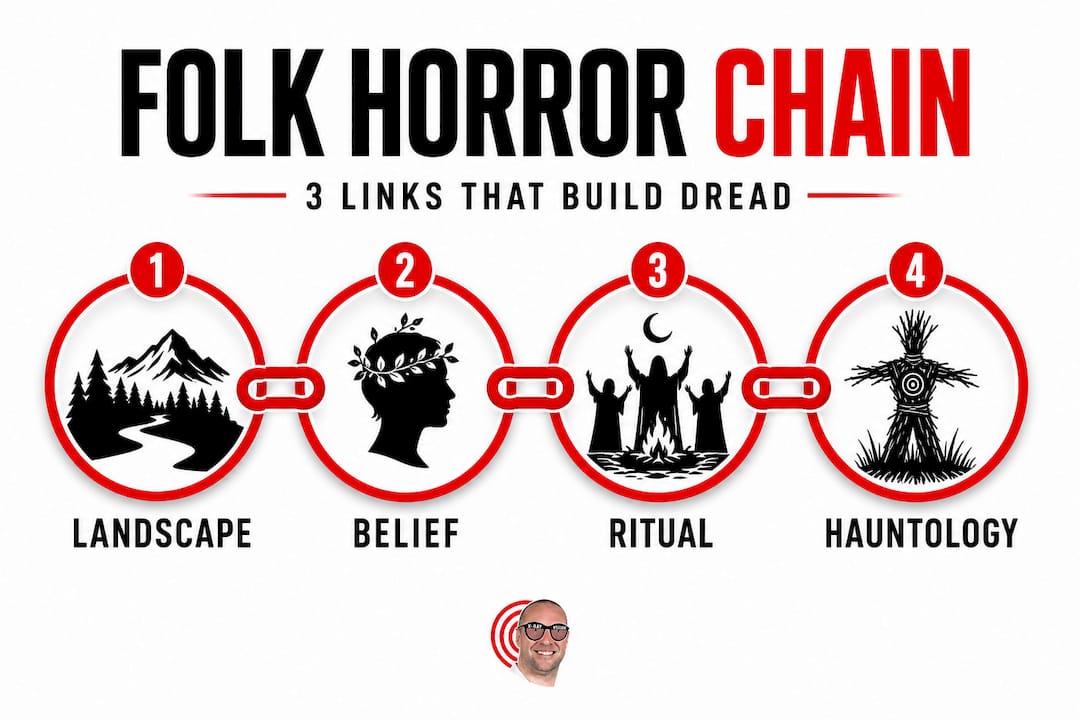
Understanding folk horror's formula unlocks a whole new reading experience. Scholar Adam Scovell gave us a powerful tool for this: the Folk Horror Chain. According to Wikipedia's entry on folk horror, the "Folk Horror Chain" by Adam Scovell consists of three core elements: landscape (rural isolation), skewed belief systems derived from folklore, and a summoning or ritual event.
Each link in this chain builds on the last, creating a spiral of tension that pulls you deeper into unease.
The three links of the Folk Horror Chain
-
Landscape. Isolation is the first weapon. Rural settings cut characters off from modernity, law, and outside help. The physical environment stops being background and becomes an active, oppressive force. Think of fog-covered moors, dense ancient forests, or cliffs with no road back to civilization.
-
Skewed belief systems. Communities in folk horror don't follow mainstream morality. They operate by a different set of rules, usually derived from older traditions, local superstitions, or deviated religious practices. This is where the folk tale directly enters: the belief system is built on stories the community tells itself about who they are, what they owe, and what powers they serve.
-
Summoning or ritual event. Every folk horror story builds toward a convergence point. A sacrifice, a ceremony, a seasonal event that can't be stopped. This is where the accumulated tension releases, often with devastating and visceral results.
Modern scholars have added richer layers to this framework. Concepts like psychogeography and hauntology in folk horror explore how place and past create psychological dread that goes beyond simple supernatural threat.
| Folk Horror Chain element | What it creates emotionally | Example in fiction |
|---|---|---|
| Isolated landscape | Helplessness, claustrophobia | A village cut off by winter storms |
| Skewed belief system | Distrust, paranoia, moral vertigo | A community that sacrifices outsiders for a harvest |
| Ritual or summoning event | Inevitability, dread, catharsis | A midsummer ceremony that cannot be interrupted |
Understanding the horror genre evolution shows how these elements appear again and again, from classic literature to contemporary horror fiction.
Pro Tip: When you pick up a folk horror novel, map it to the Folk Horror Chain. Identify the landscape, the belief system, and the ritual event early. Knowing where the story is heading structurally helps you feel the dread more consciously and appreciate how the author builds tension through each link.
How folk tales evoke primal fears: Hauntology, liminality, and belief
The Folk Horror Chain tells you what folk horror uses. But how does folklore actually light up fear in your brain? Two concepts are essential here: liminality and hauntology. Both explain why folk tales carry such psychological force in horror narratives.
Liminality refers to threshold states, moments or places that exist between defined categories. Dawn and dusk. Crossroads. The edge of a forest. A person caught between living and dead. Folk tales are saturated with liminal spaces because our ancestors understood that these in-between zones were dangerous, unpredictable, and inhabited by things that didn't belong to either world. Horror that uses liminal imagery triggers a deep, instinctive unease.
Hauntology is a related but distinct concept. The word, coined by philosopher Jacques Derrida and adopted enthusiastically by horror and cultural critics, describes how ghosts of the past haunt the present. In folk horror, this means old beliefs, dead traditions, and buried myths that refuse to stay gone. As folk horror scholars note, "folk tales evoke primal fears via liminality and hauntology", where past beliefs haunt the present, creating dread through the persistence of "survivals."
The word "survivals" is key. Victorian anthropologists used it to describe cultural practices that outlasted their original context, customs that stuck around after the world that gave them meaning had changed. Folk horror weaponizes survivals: old rituals performed by people who no longer know why, seasonal celebrations that once involved blood and sacrifice, stories that were meant as warnings but became entertainment, then became something threatening again.
Consider these specific mechanisms folk tales use to trigger fear:
- The weight of obligation. Many folk traditions involve debts, deals, and duties that must be honored or else. This moral machinery creates horror from within the community rather than from outside invasion.
- The uncanny familiar. When something looks like a neighbor, a child, or a priest but follows rules you don't recognize, the horror is immediate and personal.
- Inescapable cycles. Folk tales often operate on seasonal or celestial rhythms. The harvest must come. The solstice must be observed. This cyclical inevitability makes the horror feel cosmically unstoppable.
- Children as conduits. Folk tales frequently use children either as victims or as knowing participants in the horror, because children occupy their own liminal space between innocence and understanding.
The Routledge Companion to Folk Horror explores many of these mechanisms in depth, examining texts and films that use folklore as both subject and structure. Understanding why horror books matter in a broader cultural sense becomes even clearer when you see how folk tales encode genuine social anxieties.
It's also worth noting that these mechanisms aren't limited to rural or historical settings. Urban environments have their own liminal spaces and their own survivals. And themes and elements of scary stories drawn from folk traditions appear across children's fiction, digital horror, and contemporary literary fiction.
Folk horror vs. other horror: Key differences and global forms
Not all horror is folk horror, and the distinction matters. Understanding what makes folk horror unique sharpens your ability to recognize it and appreciate it more fully.
"Folklore's role differentiates folk horror from gothic or supernatural horror, emphasizing human beliefs and actions over overt supernatural forces."
That's the critical line. Gothic horror leans on atmosphere, aristocratic decay, and the weight of crumbling institutions. Supernatural horror often presents threats that are explicitly magical, demonic, or otherworldly. Folk horror's antagonists are frequently human. The horror comes from what communities choose to believe and do as a result.
| Subgenre | Core source of fear | Setting preference | Relationship to tradition |
|---|---|---|---|
| Folk horror | Human belief, ritual, community | Rural, isolated | Deeply embedded in local folk tradition |
| Gothic horror | Decay, repression, aristocratic darkness | Urban mansions, castles | Rebels against or is trapped by tradition |
| Supernatural horror | External evil forces, demons | Variable | Often ignores or opposes tradition |
| Psychological horror | Internal mind, perception | Any | Uses tradition as metaphor, not structure |
Folk horror is also genuinely global. British folk horror gets the most academic attention, drawing on Celtic and Anglo-Saxon tradition. But Japanese horror fiction and film, rooted in yokai mythology and Buddhist traditions about the dead, absolutely qualifies. West African folklore, with its trickster spirits and cosmological systems, has produced horror narratives that operate entirely within the Folk Horror Chain framework. Indigenous American traditions about place-based spirits and obligations to the land generate folk horror that feels utterly distinct from its British counterpart.
Pro Tip: If you want to expand your folk horror reading beyond British examples, look for horror fiction rooted in specific regional mythologies. Japanese, West African, and Latin American horror traditions use folk tale mechanics with a completely different emotional palette, and the results are startling.
Modern folk horror has also migrated into unexpected genres. The modern urban legends in horror tradition produces internet-age folk horror through creepypasta and digital mythology. Black metal music frequently builds its aesthetic entirely on folk horror frameworks. Children's fiction, from Arthur Ransome to Alan Garner, uses folk traditions to create horror that operates under the surface of adventure. The guide to horror genres is expanding because folk horror proves endlessly adaptable.
What most horror analyses miss about the power of folk tales
Here's the uncomfortable truth that most standard horror analysis glosses over. Folk tales in horror aren't just vehicles for delivering ancient atmosphere and rural dread. They're loaded with political and social content that the stories carry whether their authors intend it or not.
The folk traditions that feed horror were recorded, codified, and often distorted by Victorian anthropologists who had their own cultural biases. The concept of "survivals," those old practices persisting into modernity, was originally framed in ways that positioned rural and non-European peoples as primitive. Folk horror that draws from this tradition without self-awareness can inadvertently reproduce those hierarchies. As researchers have noted, some analyses highlight racial biases from Victorian anthropology embedded in folk horror, as well as the reinforcement of hegemonic structures like English centrism and androcentrism.
This doesn't mean folk horror is compromised. It means the best folk horror is self-aware. The stories that use folk traditions to question social hierarchies, to ask whose beliefs count as valid and whose count as threatening, generate the richest reading experiences. Fear is always political. What a culture chooses to be frightened by reveals what that culture values and who it excludes.
The double-edged quality of folk horror is its real power. A folk tale can reinforce community identity or expose its violent foundations, sometimes in the same paragraph. Readers who watch for this tension, rather than simply riding the atmosphere, get something much richer than a scare. They get insight into fear and culture that illuminates how communities construct meaning from darkness.
The most compelling folk horror being written right now understands this. It uses old stories to interrogate the present. It asks what we're still performing without knowing why, what obligations we've inherited that we didn't choose, and who gets sacrificed when the ritual demands it.
Next steps: Dive deeper into folk horror storytelling
You've just pulled back the curtain on one of horror's most potent and underappreciated engines. Now imagine that electricity running through the fiction you're about to read.

At Mark Watson Books, you'll find horror fiction that doesn't just scare you. It grounds you in exactly the traditions, belief systems, and dark rituals we've been unpacking here. From the horror book collection packed with folk-influenced thrillers to the creepypasta books that carry the digital age's own form of folk horror mythology, these stories are built on the same cultural foundations that make folklore so enduringly terrifying. Browse the collections and find your next unsettling obsession waiting for you.
Frequently asked questions
What makes a horror story "folk horror"?
A folk horror story centers on traditional customs, beliefs, and rituals, often set in isolated environments, that use folk tales to heighten fear. The Folk Horror Chain by Adam Scovell defines these as landscape, skewed folklore-derived belief systems, and a summoning or ritual event.
How do folk tales make horror feel more real?
Folk tales give horror authenticity because they're rooted in cultural beliefs and shared mythologies, making supernatural elements feel genuinely plausible rather than invented. As noted in connections between folklore and horror, they provide culturally resonant sources that ground the story.
Are folk tales in horror always from rural cultures?
While rural folklore is the classic setting, folk horror extends far beyond British origins to include global and transnational forms, children's fiction, music traditions like black metal, and thoroughly non-rural adaptations using urban legends.
What is hauntology in folk horror?
Hauntology is when ghostly memories or old beliefs linger into the present, making the past feel active and menacing rather than safely buried. Folk horror uses this to create dread through "survivals", practices and beliefs that outlasted the world that created them.