
TL;DR:
- Traditions in horror evoke fear through internal beliefs, social control, and primal rituals.
- They serve as cultural tools to police behavior, explain the inexplicable, and warn of dangers.
- Modern horror continually reinterprets ancient rituals, blending tradition with contemporary anxieties.
Some of the most unsettling moments in horror don't come from a monster lurking in the shadows. They come from a candle lit at midnight, a door you were told never to open, or a ritual everyone in the village seems to know except you. Traditions and cultural practices carry a unique weight in scary stories. They feel familiar yet foreign, safe yet deeply threatening. This article explores exactly why rituals unsettle us so powerfully in horror, how they serve as tools of social control, where ancient and modern anxieties collide, and how traditions have evolved from campfire folklore into digital horror for the 21st century.
Table of Contents
- Why traditions terrify: The psychological mechanism
- Moral lessons and social control: Traditions as cultural tools
- The interplay of ancient rituals and modern anxieties
- Traditions in the evolution of scary stories: Classic to contemporary
- Why traditions will always haunt horror: A fresh perspective
- Discover more chilling traditions in horror books
- Frequently asked questions
Key Takeaways
| Point | Details |
|---|---|
| Traditions evoke deep fear | Rituals and familiar customs in scary stories connect with primal anxieties and unsettle more than monsters alone. |
| Stories teach and control | Cultural traditions in horror often reinforce social norms and deliver moral lessons using fear. |
| Modern horror thrives on the old | Contrasting rituals from the past with today's world creates unique dread and revitalizes the genre. |
| Debate on traditions continues | Critics argue whether traditions in stories preserve culture or perpetuate outdated harm and prejudice. |
| Digital tales keep traditions alive | Online stories like creepypasta adapt folklore elements for new generations, ensuring traditions persist in modern horror. |
Why traditions terrify: The psychological mechanism
Having set the stage with the power of traditions, let's explore the specific mechanics that make them so effective and frightening in scary stories.
There's a reason folk horror feels different from slasher films. When a masked killer chases victims through a forest, the threat is external and visible. But when a whole community follows an ancient practice with absolute conviction, the fear becomes internal. You can't outrun a belief system. You can't stab a centuries-old ritual.
Traditions in scary stories, particularly in folk horror, serve as a primary mechanism for generating fear by embedding ancient rituals, moral lessons, and cultural fears into narratives that contrast modernity with primal beliefs. This contrast is key. When a character from the modern world stumbles into a community still operating on ancient customs, the horror is both real and philosophical. What does it mean when the old ways still hold power?
Understanding the themes and elements in scary stories helps clarify why tradition-based horror cuts so deep. Several specific mechanisms are at work:
- Mystery. Traditions often involve knowledge that is passed down selectively, leaving outsiders and even initiates uncertain about what is actually happening and why.
- Social control. Rituals regulate behavior. When a community enforces them with chilling unanimity, the individual feels powerless against collective will.
- Communal anxiety. Horror that implicates an entire community, not just a lone villain, suggests there is no one safe to turn to.
- Inversion of the ordinary. Many traditions in horror flip safe, familiar acts (communal meals, seasonal celebrations, harvest festivals) into sites of dread.
- Repetition and taboo. The cyclical nature of ritual creates the sense that something terrible is inevitable. Taboos signal that certain knowledge or actions carry catastrophic consequences.
Pro Tip: The most effective tradition-based horror rarely announces itself with jump scares. Instead, it builds through subtle cues: a costume worn only on one night, a phrase repeated in a specific order, a gathering at a place locals avoid. Let the ritual breathe before the terror strikes.
"Folk horror uses the mechanics of tradition, repetition, communal knowledge, and liminal space to generate a dread that feels both ancient and immediate. The fear is not just of death, but of being absorbed into something that predates you entirely."
This is what separates folk horror from other subgenres. The fear isn't about survival. It's about identity, autonomy, and the terrifying possibility that the old world never actually disappeared.
Moral lessons and social control: Traditions as cultural tools
With the psychological role of traditions explained, let's investigate how they're also practical tools societies use to shape behavior and teach unwritten rules.
Every culture has stories it tells its children to keep them safe, obedient, and aligned with community values. These stories almost always involve traditions. The ghost who punishes liars. The spirit summoned by those who break curfew. The monster that only takes children who disobey their parents. These aren't just spooky tales. They are operating systems for social behavior.
Cultural traditions in scary stories act as vehicles for moral policing, protection, and processing fears. Arab jinn tales, for example, warn children against venturing out alone at night or disrespecting elders. European ghost legends reinforce values around honesty, proper burial rites, and loyalty to family. In both cases, the scary story does cultural work that goes far beyond entertainment.
The social functions of tradition in horror typically fall into three categories:
- Policing behavior. The tradition defines what is acceptable and punishes deviation, sometimes through supernatural consequence, sometimes through community judgment. Think of stories where someone violates a local taboo and suffers for it. The lesson is clear: conform, or face the unknown.
- Protecting against dangers. Many traditions originated as practical warnings that became ritualized over generations. Coastal communities in Ireland developed stories of the sea taking those who swim at certain times. These traditions encoded real dangers in memorable, emotionally resonant form.
- Explaining the inexplicable. Before science could account for disease, famine, or sudden death, traditions filled the gap. The scary story gave communities a framework for tragedy. Bad things happened because someone broke a rule, offended a spirit, or failed to follow the proper ritual at the proper time.
The story of urban legends and modern fears shows that this dynamic has not disappeared. Modern urban legends often perform the same function, warning against hitchhiking, inviting strangers inside, or ignoring community warnings. The history of horror literature reveals a continuous thread from ancient cautionary tale to contemporary thriller.
"The genius of tradition-based horror is that it doesn't need to be believed literally to be effective. Even a secular reader feels the weight of a ritual broken or a warning ignored, because the story taps into something older than individual belief."
This is why tradition-based horror translates across cultures. The specific content changes, but the structure remains: here is the rule, here is the consequence, here is what happens to those who forget.
The interplay of ancient rituals and modern anxieties
Once we see how traditions guide behavior, we can better appreciate the unique fear that arises when old ways collide with the modern world. This collision is the true stage for much of today's most compelling horror.
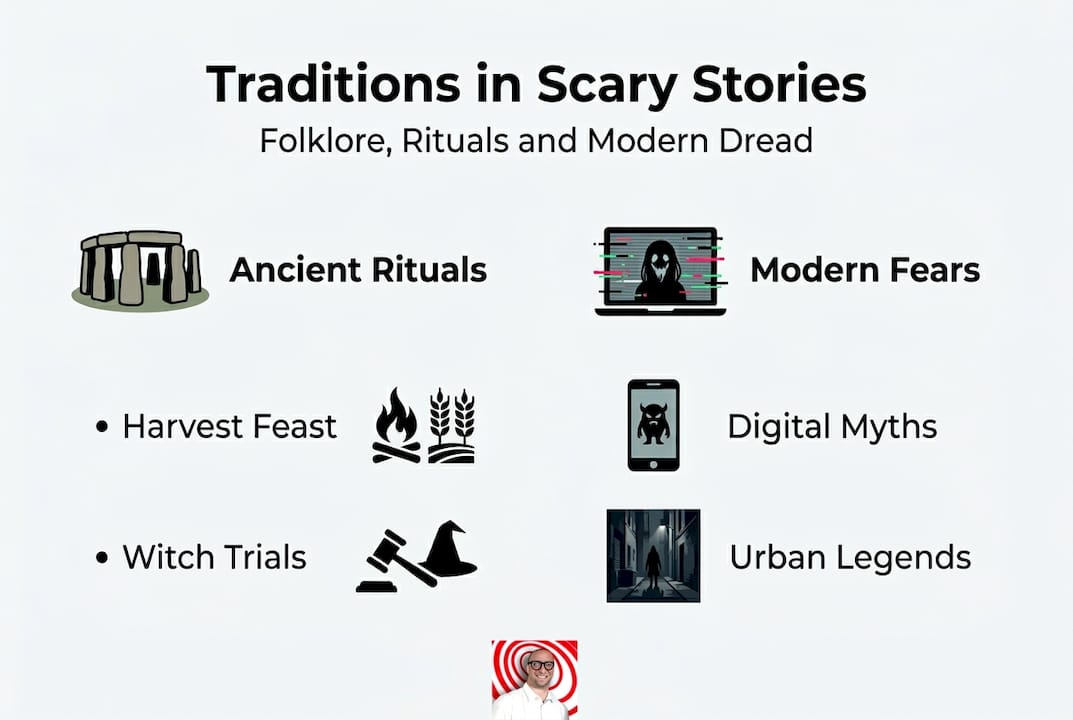
Contemporary horror is saturated with hauntology, a term describing how the past haunts the present through revived traditions and forgotten beliefs. Rituals like the Alpine Perchtenlauf processions, ancient winter ceremonies featuring masked figures, blur the line between life and death, celebration and terror. When horror films or stories import these rituals into modern settings, they create dread through contrast. The ancient feels out of place, and yet it feels more powerful than anything the modern world can muster against it.
The scary storytelling guide framework shows that writers use this tradition-versus-modernity tension to inject fresh dread into otherwise familiar tropes. A character with a smartphone and a rational worldview is still helpless when the village drums start at midnight.
| Story element | Ancient ritual framing | Modern anxiety framing |
|---|---|---|
| Community gathering | Sacred harvest festival | Cult-like group pressure |
| Seasonal change | Pagan solstice rite | Environmental collapse |
| Blood offering | Ancestral sacrifice | Violence normalized by tradition |
| Masked figures | Spirit embodiment | Loss of individual identity |
| Sacred sites | Liminal holy ground | Abandoned, forgotten spaces |
| Oral transmission | Folklore passed mouth to ear | Viral misinformation |
This table shows how the same story element can read as both ancient and urgently modern. A harvest ritual becomes a metaphor for what we sacrifice for community belonging. A masked procession becomes a meditation on anonymity and mob behavior. The tradition provides the structure, but modern anxieties fill it with new meaning.
Pro Tip: If you're writing horror that draws on tradition, resist the urge to explain the ritual completely. Ambiguity is more frightening than clarity. Let readers feel the weight of the tradition without fully understanding it. That gap between knowing and not knowing is where the real dread lives.
Traditions in the evolution of scary stories: Classic to contemporary
To understand how enduring and debated the role of traditions is, let's review their evolution from folklore through today's digital horror.
Traditions have never been static in horror storytelling. They adapt, mutate, get critiqued, get revived, and find new audiences with every generation. The folk horror revival across the 20th and 21st centuries confirms that traditions remain central to the genre's appeal, from what critics call the Unholy Trinity of British folk horror (Witchfinder General, Blood on Satan's Claw, The Wicker Man) to contemporary films and fiction that rework these same themes.
- Revival movements. Films and books from the 2010s onward have consciously returned to tradition-based horror, drawing on regional folklore, pagan practice, and pre-Christian ritual. They treat traditions not as curiosities but as living, dangerous forces.
- Subverted traditions. Some of the most exciting contemporary horror deliberately inverts tradition. It asks: what if the tradition was right? What if the outsider, not the community, is the real threat? This subversion creates moral discomfort alongside the usual chills.
- Criticisms of the form. Not everyone celebrates the tradition-in-horror formula without question. Some scholars and critics note that folk horror revival can inadvertently perpetuate racialized ideas rooted in Victorian anthropology, treating certain communities' traditions as inherently primitive or threatening. Others point out that depicting ritual violence without critique can normalize it.
| Era | Format | Key tradition example | Notes |
|---|---|---|---|
| Pre-1900 | Oral folklore | Harvest spirits, ancestor veneration | Community transmission, morality-focused |
| Early 20th century | Gothic literature | Pagan revival, secret societies | Written form, class and religion themes |
| 1960s-1970s | Film | Wicker Man, witch trials | Cinematic folk horror, social critique |
| 1980s-1990s | Mainstream horror | Slasher rituals, supernatural hauntings | Tradition used as backdrop rather than center |
| 2000s-2010s | Global cinema and lit | Regional folklore reboots | Cross-cultural tradition, world horror |
| 2010s-present | Digital/creepypasta | Online ritual horror, new myth-making | Tradition adapted for internet audiences |
The classic horror books that shaped the genre almost always featured traditions as central plot engines. And today's creepypasta horror stories continue this lineage. Rituals like "Smile Dog" rituals or games you should never play alone are modern traditions, shared online, adapted, and expanded by a global community. The format changes. The fear mechanism stays the same.
Why traditions will always haunt horror: A fresh perspective
Here's an uncomfortable truth: monsters get dated. Vampires become romantic. Werewolves become sympathetic. Zombies become political metaphors. But traditions? Traditions stay scary. That's not an accident.
Traditions are frightening because they represent collective will. A single monster can be defeated. A belief held by an entire community, passed down across generations, enforced by ritual and social pressure, cannot simply be destroyed. It has to be understood. And understanding it takes you somewhere you might not want to go.
The contrarian view worth considering is this: treating traditions in horror as mere superstitions or colorful folklore actually weakens the genre. When a writer reduces an ancient ritual to a backdrop or a plot device, they strip out the most frightening element, which is that the tradition might be right. The community might have a point. The old way might work. That ambiguity is what makes tradition-based horror linger long after the book is closed or the credits roll.
For writers, this is both a challenge and an opportunity. Learning how to write scary stories that use tradition effectively means doing your homework. It means treating the source material with genuine respect and curiosity, not as exotic decoration. The richest, freshest horror draws from overlooked local traditions: regional festivals, obscure agricultural practices, neighborhood superstitions that haven't made it into any mainstream horror film yet.
Pro Tip: Before you reach for a well-known tradition (Salem witch trials, Samhain, Krampus), dig one level deeper. Every region has traditions that haven't been fully explored in horror fiction. Those are the ones that will genuinely surprise your readers.
For readers, understanding the tradition-as-mechanism transforms how you experience horror. You stop asking "what is the monster?" and start asking "what does this community believe, and why?" That shift opens up an entirely richer way of engaging with scary stories, one that connects you to history, anthropology, and the very human need to make meaning out of fear.
Discover more chilling traditions in horror books
After diving into the story behind scary traditions, here's where to immerse yourself in tales built on these enduring themes.
If this exploration of traditions in horror has lit something up for you, the next step is clear: go deeper into the stories themselves. The theories are thrilling, but nothing beats experiencing tradition-soaked horror firsthand through expertly crafted narratives.

Mark Watson's horror books collection brings these themes to vivid, pulse-quickening life, weaving cultural dread and ritual tension into stories that stay with you. For readers hungry for the tradition-rich world of internet horror myth-making, the creepypasta books collection delivers modern tradition and digital folklore at its most unsettling. Don't just study the fear. Feel it.
Frequently asked questions
Why do horror stories often rely on rituals and traditions?
Traditions provide a sense of the unknown within the familiar, and folk horror narratives generate fear by embedding ancient rituals and cultural anxieties into stories that directly contrast modernity with primal belief systems. The result is a dread that feels both deeply personal and universally human.
How do scary stories use traditions to teach lessons?
Many horror stories embed cultural warnings within traditional frameworks to shape behavior and transmit social norms across generations. Arab jinn tales and European ghost legends both demonstrate how the scary story doubles as a moral instruction manual for its community.
Are traditions in horror stories always positive?
While traditions often preserve cultural continuity and provide psychological catharsis, they can also carry darker freight. Some critics argue that folk horror's use of traditions sometimes perpetuates racialized Victorian ideas about "primitive" cultures or normalizes ritual violence without critical examination.
How have digital platforms changed the way traditions appear in scary stories?
Digital storytelling has revitalized traditional horror motifs, adapting them into formats that reach global audiences instantly. The folk horror revival confirms that traditions remain central to horror across formats, from classic film to creepypasta, because the underlying fear mechanism is timeless.