
TL;DR:
- Setting in horror creates sustained unease and mirrors characters' psychological states.
- Authors layer real geography, history, and sensory details to build authentic, atmospheric dread.
- Ambiguous environments evoke supernatural fears or internal psychological collapse, deepening suspense.
The monster doesn't always frighten you most. Sometimes it's the house. The fog-choked forest. The town where everyone smiles just a little too long. Setting in horror literature is one of the most powerful and most underestimated tools in a writer's kit, and once you start noticing it, you can't stop. This guide breaks down exactly how authors transform place into dread, why familiar or historical locations sharpen suspense, and how you can analyze setting's role in every spooky story you pick up. Whether you're a devoted horror reader or a literary analyst, understanding setting changes everything.
Table of Contents
- Why setting matters: From backdrop to source of dread
- How authors use location and history to build atmosphere
- Ambiguity and double meaning: Setting as supernatural or psychological
- From page to practical analysis: Spotting setting's role in your next spooky read
- Our take: Why setting is the secret weapon of horror literature
- Discover more chilling settings and spooky tales
- Frequently asked questions
Key Takeaways
| Point | Details |
|---|---|
| Setting drives mood | Where a spooky story unfolds is often the main driver of fear and suspense. |
| History and familiarity add realism | Writers use real places or local history to make horror more believable. |
| Ambiguity creates tension | Unclear whether settings are truly haunted or psychological reflections, enhancing unease. |
| Analysis deepens appreciation | Understanding a story’s setting reveals hidden depths and enhances your reading experience. |
Why setting matters: From backdrop to source of dread
Most readers instinctively focus on villains, plot twists, and the fate of characters. That's natural. But ask yourself: would The Shining feel as terrifying set in a cheerful beach resort? Would Shirley Jackson's "The Haunting of Hill House" hit as hard if the house were ordinary and well-lit? Absolutely not. The setting isn't just where the story happens. It's often why the story is frightening at all.
Understanding why horror books matter means recognizing how deeply environment shapes our emotional response as readers. When an author places characters in a decaying Victorian mansion, a mist-covered moor, or an isolated small town, they aren't choosing those locations for visual interest alone. They're activating a specific emotional frequency in the reader's mind.
Here's what setting does that pure plot cannot:
- Creates sustained unease. A setting can maintain tension across hundreds of pages, long after a specific plot event has faded. The oppressive atmosphere of a haunted house, for example, presses down on every scene, every conversation, every small decision a character makes.
- Shapes character psychology. Environments in horror bend and warp the people living in them. Characters in isolated settings grow paranoid. Those in decaying houses begin to deteriorate alongside the walls.
- Generates meaning beyond the surface. A rotting mansion isn't just visually grim. It often signals a rotting family legacy, a broken social order, or a mind fracturing under pressure.
- Acts as an antagonist without a face. Gothic horror in particular leans hard into this. As one gothic and psychological reading notes, gothic horror frequently uses architecture and atmosphere to function like an antagonist or a "character," where environments mirror internal deterioration, confinement, and dread. The house doesn't need to speak. It simply presses.
"The environment becomes the story's nervous system. Every drafty hallway, every locked door, every shadow is a nerve firing, transmitting dread directly to the reader."
Looking at the history of horror literature, this pattern shows up repeatedly. From the brooding castles of early gothic fiction to the suburban streets of modern psychological horror, authors have always understood that where the story happens is inseparable from what the story means.
Once you realize setting isn't just a backdrop, it's natural to wonder exactly how authors turn ordinary places into sources of terror.
How authors use location and history to build atmosphere
The craft behind a truly chilling setting is both intentional and deeply layered. It doesn't happen by accident. Authors research, feel, and sometimes obsess over the physical reality of their settings before a single frightening scene is written.
One of the most famous examples in modern horror is Stephen King's use of Maine. King anchors horror in place-specific history and familiarity to intensify plausibility and thematic force. His fictional Derry, Maine draws from real geography, real weather, real small-town social dynamics. Readers who know Maine recognize the cold, the insularity, the long winters. Readers who don't still feel it through King's precise and sensory descriptions. Familiarity breeds authenticity. Authenticity makes the horror land harder.
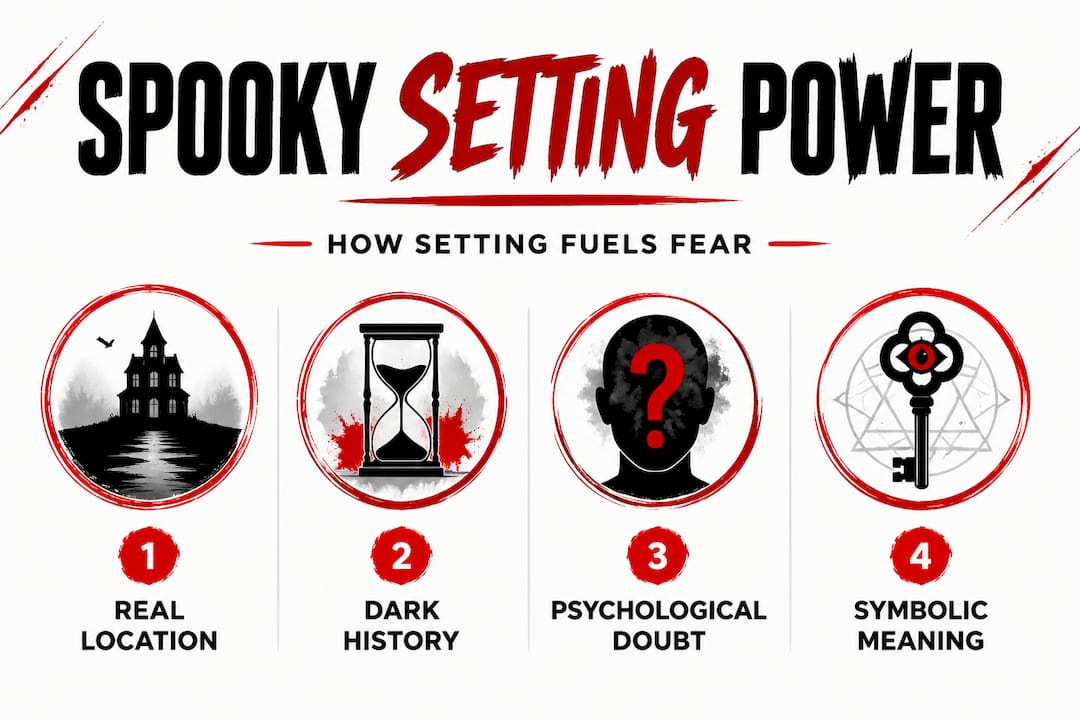
So how do authors actually build this kind of layered, atmospheric setting? Here's a framework that works across classic horror books and newer releases alike:
- Root it in real geography or history. Authentic physical details, actual weather patterns, genuine regional culture, all of these ground the supernatural in something tangible. Readers believe in the place first, which makes them believe in the horror.
- Add a specific, troubling past. A house with a documented history of violence. A town with a founding story that never quite sits right. A forest where people have vanished for generations. History gives setting moral weight.
- Layer in local legend and folk knowledge. Urban myths, local superstitions, and communal fears lend a story collective dread. When an entire community fears a particular place, that fear becomes contagious to the reader.
- Use sensory immersion. Smell, sound, texture, and temperature anchor readers in a setting viscerally. The smell of mildew in a basement. The way cold air feels in an empty corridor at night. These sensory details don't just decorate the scene. They put you inside the fear.
- Let the setting evolve. The best horror settings aren't static. They decay, shift, or become more oppressive as the story progresses, mirroring the characters' mental and emotional states.
| Setting technique | Effect on reader | Example |
|---|---|---|
| Real geographic grounding | Increases plausibility and immersion | Stephen King's Maine |
| Documented or invented local history | Adds moral weight and backstory | Shirley Jackson's Hill House |
| Sensory immersion | Creates visceral, physical dread | Poe's "The Fall of the House of Usher" |
| Setting evolution and decay | Mirrors character deterioration | Gothic mansion narratives |
| Community-held fear | Amplifies dread through social proof | Small-town horror stories |
Pro Tip: If you're analyzing a horror novel, look up the real geography or historical events the author references. Often you'll find that the most frightening fictional details have uncomfortable real-world roots.
The resource for writing horror step by step digs further into how writers build these techniques from the ground up, which is worth reading if you want to see the craft from the inside.
Ambiguity and double meaning: Setting as supernatural or psychological
Here's where horror gets genuinely sophisticated. The most unsettling stories leave you unsure whether the place is literally haunted or whether it's the character's own mind generating the horror. That ambiguity is not a flaw in the storytelling. It's the point.
Think about Sarah Waters' The Little Stranger. The Hundreds Hall estate could be genuinely haunted, or it could be a projection of grief, class anxiety, and psychological instability. Gothic and psychological readings reveal that setting in these stories can be read as either supernatural "evidence," complete with haunting motifs and sinister architecture, or as an externalization of a character's inner collapse. The ambiguity is the engine that keeps readers turning pages.
This double meaning is what separates literary horror from simple shock-horror. Consider the contrast:
| Reading of the setting | What the horror suggests | Examples |
|---|---|---|
| Supernatural interpretation | The place is genuinely malevolent; evil exists externally | Traditional ghost stories, haunted houses |
| Psychological interpretation | Characters project fear, grief, or guilt onto the environment | Gothic literary fiction, unreliable narrators |
| Ambiguous (both at once) | The story refuses to confirm either reading | The Turn of the Screw, The Little Stranger |
The ambiguous reading creates a specific kind of dread. You're not just frightened by the ghost, you're frightened by the possibility that the character is losing their mind. Or worse, that both things are true simultaneously.
- Isolation amplifies psychological pressure. Cut a character off from outside perspectives and the setting becomes their entire reality. This is why remote houses, islands, and locked rooms are such potent horror environments.
- Architectural detail signals psychological state. Crumbling walls, locked rooms, narrow passages, these aren't random. Authors use them to externalize what's happening inside a character's mind.
- Reader uncertainty generates personal fear. When you can't quite tell if the horror is real or imagined, you start filling the gaps with your own anxieties, which makes the fear deeply personal.
Understanding how horror affects readers sheds light on why this psychological ambiguity works so powerfully. Horror triggers real emotional and physiological responses, and ambiguous settings intensify those responses because the mind works overtime trying to resolve what it cannot quite explain.
Pro Tip: When you encounter an eerie or inexplicable moment in a horror setting, pause and ask yourself: does this serve as evidence of something supernatural, or could it be explained by the character's mental state? Tracking your own interpretations reveals the story's technique in action.
From page to practical analysis: Spotting setting's role in your next spooky read
Whether you're reading for pleasure or analysis, knowing how to break down the role of setting makes every spooky story richer and more chilling.
Here's a step-by-step approach you can use with any horror novel, short story collection, or book club pick:
- Map the geography. Where exactly is this story set? Is it isolated or crowded? Urban or rural? Real or invented? Note how the physical geography limits or expands the characters' options.
- Trace the history. What happened in this place before the story began? Authors often seed backstory into the setting itself, through local legends, newspaper clippings within the narrative, overheard conversations, or architectural details.
- Track the sensory cues. Which senses does the author engage most when describing the setting? Darkness and silence suggest a different kind of fear than rot and moisture. Pay attention to what the setting feels like to inhabit.
- Watch for setting changes. Does the environment shift as the story progresses? A house that begins as merely gloomy and becomes actively dangerous tells you something about narrative arc and character psychology.
- Ask what the setting symbolizes. As gothic analysis consistently shows, gothic horror uses architecture and atmosphere to function like an antagonist or a "character." What does this particular environment represent beyond its literal description?
- Measure your own emotional response. Where in the story did the setting make you most uncomfortable? Note the specific details. That discomfort is the author's technique working on you directly.
These steps apply brilliantly in book club settings, too. Asking your group "what does this house represent?" or "why does the author place the climax in this specific location?" opens up genuinely exciting literary conversation.
Exploring themes in scary stories is a natural extension of this kind of setting analysis. Themes and setting reinforce each other constantly in horror, and tracing that relationship reveals the deeper architecture of any spooky story.
Our take: Why setting is the secret weapon of horror literature
Here's an opinion you don't hear enough: the best horror stories are remembered for their places long after the plot fades. Think about the stories you carry with you. Chances are you remember how a setting felt more than you remember the precise sequence of events. That's not an accident.
Many readers and critics still frame horror around its monsters, killers, and plot twists. Those elements matter. But they're temporary. A compelling setting outlives them. The Overlook Hotel. Hill House. The village of Midwich. These places have burrowed into collective memory because they were built with precision and intention to carry dread on every page.
Our perspective, having spent real time with horror fiction across decades and genres: when a story falters, it almost always falters in its setting. A villain with no terrifying environment is just a person doing bad things. A well-constructed, psychologically weighted setting makes even ordinary events feel monstrous.
For writers, this means treating setting as a primary character with its own arc, its own personality, and its own agenda. For readers and analysts, it means asking where before asking what happened and to whom. Place shapes perception. Perception shapes fear. Fear shapes meaning.
Browsing the horror collection at Mark Watson Books reveals this principle in action across multiple styles and subgenres. The stories that stay with you will almost always have a setting you can still picture clearly.
Discover more chilling settings and spooky tales
If this guide has sharpened your eye for how setting operates in horror, the next step is experiencing it first-hand across a range of unforgettable stories. Great analysis only deepens when paired with great reading.

Mark Watson Books offers a carefully curated selection of horror titles where atmosphere, place, and psychological tension are front and center. Whether you're building a reading list for literary analysis or simply chasing that perfect chill, the horror books collection is a strong starting point. From psychological thrillers to Creepypasta-style internet horror with vivid, unsettling settings, there's something to feed every kind of dread. Browse all spooky books and let the settings pull you in. Your next unforgettable fictional landscape is waiting.
Frequently asked questions
How does the setting influence the mood in horror books?
Setting shapes mood by generating sustained atmosphere, tension, and physical context for fear. As gothic horror analysis demonstrates, environments frequently function like antagonists, mirroring internal deterioration and confinement to produce dread across every scene.
Why do authors choose familiar places for scary stories?
Familiar or real locations make supernatural events feel far more believable. Authors like Stephen King anchor horror in place-specific history to create authenticity, making readers trust the world before the terror arrives.
Can the setting in spooky books be symbolic?
Yes, absolutely. Setting in horror regularly symbolizes characters' emotional states, grief, guilt, or class anxieties rather than representing purely physical danger. Gothic and psychological readings show that haunting motifs are often exteriorizations of a character's psychological instability.
How can readers analyze setting's impact in a horror novel?
Track how geography, history, sensory detail, and atmosphere shape both the story's tone and the characters' mental states chapter by chapter. Architecture and atmosphere in gothic horror consistently function as a mirror for character deterioration, giving readers a reliable framework for analysis.