
Horror's most effective narrative styles are first-person, close third-person, epistolary/found-footage, unreliable/fragmented narration, second-person, third-person omniscient, frame story, nonlinear/dual timelines, and multiple POVs. Each one pulls a different lever on dread. First-person locks you inside a panicking mind, creating intimacy and the potential for unreliable perception. Close third-person keeps psychological pressure high while allowing slightly more narrative distance. Epistolary and found-footage forms weaponize plausibility — a discovered journal or a corrupted video file feels terrifyingly real. Unreliable and fragmented narration destabilizes what the reader can trust. Second-person makes the horror personal, almost accusatory. Omniscient third can build cosmic dread across a wide cast. Frame stories signal that something terrible already happened. Nonlinear timelines create creeping inevitability. Multiple POVs spread fear across perspectives, showing the monster from every angle.
Quick selection rule: choose first-person or close third for psychological and intimate horror; reach for epistolary or frame story when plausibility is your weapon; use nonlinear timelines when inevitability is the point; reserve second-person for short, experimental pieces where disorientation is the goal.
Key Takeaways
The most effective narrative style in horror is the one that best controls what the reader can know, trust, and feel — and that decision should come before the first draft, not after.
| Point | Details |
|---|---|
| Match POV to intimacy level | First-person and close third restrict information and maximize psychological dread; use omniscient for systemic or cosmic horror. |
| Withhold over over-explain | Implied threat and reaction-based writing activate reader imagination more reliably than explicit description. |
| Use sentence rhythm deliberately | Short, staccato sentences heighten physiological response; longer sentences build atmosphere — contrast between the two is where terror lives. |
| Apply the rule of threes | First mention creates awareness, second builds anticipation, third delivers the payoff; this structure earns scares rather than relying on shock. |
| Test reveals with beta readers | Ask "where did you feel most uncomfortable?" — the answer tells you whether your climax is landing or over-explained. |
Table of Contents
- What are the main types of narrative styles in horror?
- Narrative devices that sharpen horror inside any style
- How do you choose the right narrative style for your horror story?
- What does research say about effective horror narrative techniques?
- Which authors best demonstrate horror narrative styles?
- Why narrative style is the first decision, not the last
- Explore Mark Watson's horror fiction
- Sources
What are the main types of narrative styles in horror?
Horror's power lives in what the reader doesn't see. The narrative style you choose controls exactly how much they can see, and from whose fractured perspective.
1. First-Person The narrator speaks as "I," placing the reader directly inside one consciousness. In horror, this creates claustrophobic intimacy — the reader can only know what the narrator knows, and that restriction is the engine of dread. The risk: if the narrator sounds too composed, tension bleeds out. The payoff: first-person horror narratives are the natural home of unreliable perception, because readers have no external check on what's real. Best for psychological horror, haunting narratives, and anything where the protagonist's sanity is in question.
2. Close Third-Person The narrator uses "he/she/they" but stays tightly tethered to one character's sensory experience and thoughts. It delivers nearly the same psychological immediacy as first-person while giving the writer a hair more flexibility. Craft commentators consistently identify close third as one of horror's most effective POVs because it restricts information without the confessional weight of "I." Best for character-driven horror novels where you want intimacy without the first-person trap of a single, potentially unreliable voice.
3. Third-Person Omniscient The narrator knows everything — every character's thoughts, every room in the house, every secret the monster holds. Used well, omniscient narration builds cosmic or societal dread. Used carelessly, it deflates tension by revealing too much. Best for epic horror, ensemble casts, and stories where the horror is systemic rather than personal.
4. Second-Person "You walk into the basement." Second-person is an intentional alienation tool. It forces the reader into the protagonist's body, creating cognitive dissonance that amplifies unease. Long-form second-person risks reader fatigue — the sustained dissonance becomes exhausting rather than unsettling. Best for short, experimental pieces or interactive horror where the point is to make the horror feel inescapable and personal.
5. Epistolary and Found-Footage The story is told through documents: letters, diary entries, text messages, corrupted audio transcripts, forum posts. The form implies that someone survived to compile the record — or didn't. Plausibility is the weapon here. Readers accept the horror more readily because it arrives in a format that mimics real life. Pitfall: inconsistent voice across documents shatters the illusion instantly. Best for slow-burn, paranoia-driven horror and Creepypasta-style internet horror.
6. Frame Story A narrator recounts a tale told by someone else, or a story is embedded inside another story. The frame signals from the first page that something terrible happened — the only question is how bad. This creates dramatic irony before a single scare lands. Pitfall: a weak frame feels like padding. Best for gothic horror, anthology structures, and stories where the act of telling is itself part of the horror.
7. Unreliable and Fragmented Narration The narrator's account cannot be trusted — through delusion, trauma, deception, or supernatural interference. Fragmented narration (gaps, repetitions, contradictions) mirrors a fractured mind. This style is particularly potent in psychological and cosmic horror, where the reader's own certainty erodes alongside the narrator's. Pitfall: unreliability must be planted deliberately, not discovered accidentally. Best for psychological horror, gaslighting narratives, and stories where the monster might be internal.
8. Nonlinear and Dual Timelines The story moves between time periods, often cutting between a "before" and an "after" that the reader slowly assembles. The technique creates creeping inevitability — you know something terrible is coming, you just don't know exactly what shape it takes. Pitfall: without clear temporal anchors (a date, a sensory detail, a recurring object), readers lose the thread and disengage. Best for novels with a mystery structure, generational horror, and stories where the past literally haunts the present.
9. Multiple POVs Different chapters or sections follow different characters, each with their own partial view of the horror. This style can show the monster from multiple angles, build dramatic irony (the reader knows more than any single character), and spread dread across a wide cast. Pitfall: POV slippage — accidentally sliding into another character's head mid-scene — wrecks dread by dissolving the sense of a single, trapped perspective. Commit to each POV fully, or the horror leaks out through the cracks.
Blending styles without losing dread
Combining styles is legitimate and often thrilling. A close-third novel can embed epistolary chapters (journal entries, news clippings) to shift register and add plausibility. A frame story can use an unreliable narrator for the inner tale. The rule: every blend must serve the dread, not the writer's desire to show range. When you blend, ask whether the shift increases or decreases the reader's sense of vulnerability. If it decreases it, cut the blend.
POV slippage is the single most common dread-killer in workshop manuscripts. Drifting from one character's head to another's within a scene — even for one sentence — signals to the reader that no perspective is truly trapped, and trapped perspective is what makes horror work.
Narrative devices that sharpen horror inside any style
Choosing a style is the architecture. These devices are the wiring — the scene-level tools that make any style genuinely frightening.
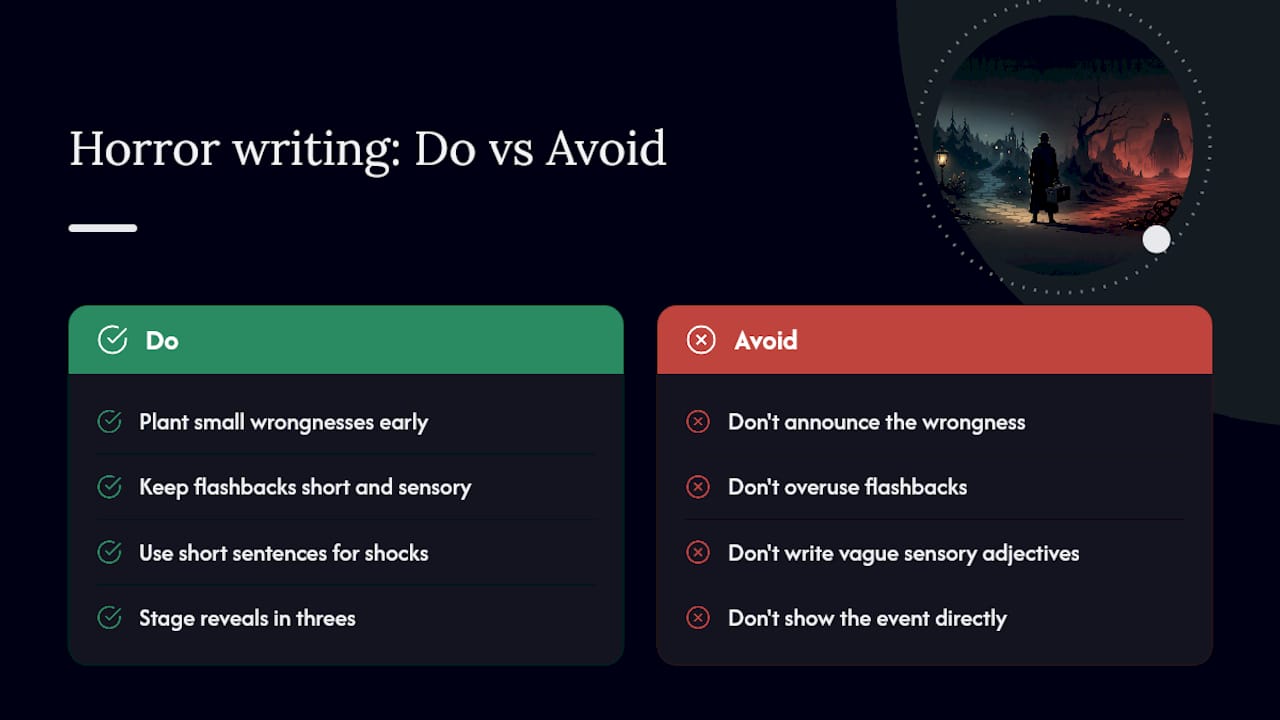
Foreshadowing. Plant small wrongnesses early: a smell that doesn't belong, a door that opens the wrong way, a child who avoids a specific room. The reader's brain registers the anomaly without consciously cataloging it, building a reservoir of unease that pays off later. Don't announce the wrongness. Let it sit.
Flashback. Use sparingly. A flashback that arrives at the wrong moment deflates tension like a pin in a balloon. The best horror flashbacks arrive when the present-tense situation has already created maximum dread, then the flashback recontextualizes everything the reader thought they understood. Keep them short and sensory.
Dramatic irony. The reader knows something the character doesn't. This is one of horror's most reliable engines — watching a character walk toward danger they can't perceive creates a specific, sustained discomfort. Multiple POV structures are particularly good at generating dramatic irony organically.
Misdirection. Lead the reader to expect the horror from one direction, then deliver it from another. Effective misdirection requires genuine setup — a false trail the reader will believe on first read. It's not a cheat; it's a promise kept in an unexpected way.
Sensory detail. Vague adjectives ("it was terrifying") do nothing. Precise sensory specifics force the reader to slow down and process, which is where fear lives. Saskia Nislow describes this as horror writing as an act of "un-thinking" — breaking complex thoughts into raw sensory fragments so readers assemble the nightmare themselves. Don't write "the smell was wrong." Write "the smell was copper and something sweeter, like fruit left too long in the sun."
Sentence rhythm. Short sentences accelerate perceived pace and heighten physiological response. Long, winding sentences build atmosphere and a sense of creeping dread. A 2025 synthesis confirmed that staccato rhythm and delayed disclosure produce measurable increases in fear-related processing. Use short sentences at the moment of shock. Use longer ones in the slow build. The contrast between the two is where real terror lives.
Staged disclosure and the rule of threes. The first mention of a threat creates awareness. The second builds pattern and anticipation. The third is the payoff. This structure earns scares rather than relying on cheap shocks. Applied to a haunted house: the protagonist hears a sound (awareness), finds evidence of something moved (pattern), then sees the thing itself (payoff). Each stage should be more specific and more visceral than the last.
Reaction over depiction. Show the aftermath of the horror event, not the event itself. A character's shaking hands, a room that smells wrong, a scream heard from the next floor — these implied threats and partial reveals activate the reader's imagination far more reliably than explicit description. The monster the reader builds in their own mind is always more frightening than the one you describe.
For a deeper look at how these devices interact with suspense mechanics, the horror suspense techniques guide on the Markwatsonbooks blog breaks down anticipation and dread in practical detail.
Pro Tip: Test your reveal timing with beta readers by asking one specific question: "At what point did you feel the most uncomfortable?" Not "did you like it?" — that's too broad. Discomfort is the signal. If they name a scene earlier than your intended climax, your actual climax is over-explained. If they can't name a scene at all, your withholding has tipped into opacity.
How do you choose the right narrative style for your horror story?
Style should follow story, not habit. Most writers default to first-person because it feels intimate, or third because it feels "safe." Neither instinct is wrong, but neither is a decision. Here's a repeatable framework.
Decision checklist:
- Intimacy vs. scope. Does your horror live inside one mind, or does it require multiple perspectives to feel complete? Intimate horror (one character's unraveling) points to first-person or close third. Systemic or cosmic horror points to omniscient or multiple POVs.
- Ambiguity vs. explicitness. Psychological horror thrives on ambiguity — the reader should never be entirely sure what's real. First-person and unreliable narration serve ambiguity. If your horror is explicit (body horror, creature horror), close third or omniscient gives you the distance to describe it without the narrator's credibility collapsing.
- Length and structural complexity. Second-person works in a 2,500-word short story. It rarely survives a 90,000-word novel. Nonlinear timelines reward patient readers in long-form work but can exhaust readers in short fiction where there isn't enough space to establish the anchors. Match structural complexity to the form.
- Unreliable perception. Can you sustain a narrator whose account is genuinely in question for the full length of the work? Unreliable narration requires careful, deliberate planting of contradictions. If you can't commit to that level of control, a more stable POV will serve the story better.
- Plausibility as a weapon. If your story's power depends on readers believing it could be real, epistolary or found-footage forms do that work structurally. The format itself argues for authenticity.
Questions to ask your story:
- Who is most afraid, and does the reader need to be inside that fear or watching it?
- What does the reader need NOT to know, and which POV best withholds it?
- Is the horror in the event, or in the character's perception of the event?
- Does the timeline's structure add dread, or does it just add complexity?
- Would a reader trust this narrator? Should they?
Applying the checklist: two quick examples.
A 2,500-word haunted-house short story benefits from first-person or close third. The intimacy is the point. The reader needs to feel trapped in one perspective, unable to verify what's real. An epistolary structure (a single diary entry) can work beautifully at this length. Second-person is viable if the disorientation serves the specific effect you want.
A 90,000-word generational horror novel has room for nonlinear timelines, multiple POVs, and embedded epistolary chapters. The complexity rewards the reader's investment. But every structural choice needs a clear anchor — a recurring object, a date, a sensory signature — so readers always know where they are in time and whose fear they're inhabiting.
For a full drafting workflow, the step-by-step horror story guide on Markwatsonbooks walks through building a horror story from concept to final scene.
Red-flag checklist:
- POV drift mid-scene (the single most common dread-killer)
- Over-explaining the monster or the threat
- Using second-person in long-form without a structural justification
- Revealing the horror before the reader is invested in the character
- Nonlinear timelines without clear temporal anchors
What does research say about effective horror narrative techniques?
The craft intuitions horror writers have developed over centuries now have empirical backing, and the findings are specific enough to be directly useful.
A 2025 synthesis of narrative strategies found that sentence rhythm, staged disclosure, and multisensory description produce measurable increases in reader engagement and fear-related processing across psycholinguistic and neurocognitive measures. Short, staccato sentences correlate with faster perceived rhythm and stronger physiological response. Delayed disclosure increases predictive tension — the reader's brain keeps generating predictions, and the gap between prediction and revelation is where sustained dread lives.
Multisensory description amplifies this effect. When a reader processes a specific tactile, olfactory, or auditory detail, they slow down and inhabit the scene more fully. That immersion is what makes fear stick. As Nislow argues in Writer's Digest, breaking thought into sensory fragments lets readers build the nightmare themselves, which is always more frightening than being told what to feel.
Experienced craft commentators recommend prioritizing dread over shock: slow escalation, investment in ordinary life before the horror arrives, and sentence shortening as a reliable stylistic tool during high-tension moments. The literary devices guide on Markwatsonbooks covers how unreliable narration, misdirection, and sensory specificity interact in practice.
| Technique | Claimed effect | Source |
|---|---|---|
| Short, staccato sentences | Heightened physiological fear response; faster perceived rhythm | Multirev synthesis |
| Multisensory description | Increased immersion; reader-assembled fear | Writer's Digest / Nislow |
| Staged disclosure (rule of threes) | Sustained predictive tension; earned payoff | River 2026 guide |
| Implied threat / reaction-based writing | Activates imagination; avoids over-explanation | River 2026 guide |
| Dread over shock (slow escalation) | Deeper emotional investment; lasting fear | ProseEngine craft guide |
Writing exercise: apply the rule of threes. Take any paragraph in your current draft where you introduce a threat. Identify the first mention. Now find or write a second mention that builds pattern — same sensory register, slightly more specific. Then write the third: the payoff, more visceral and more specific than either of the first two. Read all three aloud. If the third doesn't feel earned, the first two aren't specific enough.
Before/after micro-edit: ✗ "The room smelled strange and wrong." ✓ "The room smelled of old copper and something sweeter — overripe fruit, or meat left in warm air."
The second version forces the reader to process two competing sensory signals, which creates unease more reliably than any adjective.
Pro Tip: First-person and close third amplify the rule of threes most powerfully because the reader is locked into one character's accumulating dread. In omniscient narration, the pattern can feel like authorial manipulation rather than lived experience. Match the technique to the POV.
Which authors best demonstrate horror narrative styles?
These are the writers to read with a pencil in hand. Each one has something specific to teach.
-
Edgar Allan Poe (The Tell-Tale Heart, The Fall of the House of Usher) — Study for: first-person unreliable narration at its most compressed. Poe's narrators insist on their own sanity while dismantling it sentence by sentence. Watch how he uses sentence rhythm to mirror psychological deterioration, and how he withholds the "proof" of the horror until the narrator's credibility is already gone.
-
Stephen King (The Shining, It, Pet Sematary) — Study for: close third-person and the psychology of ordinary life under pressure. King builds dread by making you love the characters before he destroys them. His POV discipline in close third is worth close attention — he rarely slips, and when he does, it's deliberate. His everyday psychology and pacing are the model for investment-before-horror.
-
Paul Tremblay (A Head Full of Ghosts, Survivor Song) — Study for: ambiguity and unreliable framing. Tremblay builds entire novels on the question of whether the supernatural is real or a symptom of something worse. His epistolary and meta-narrative structures are worth dissecting for how they sustain ambiguity across long-form work without ever cheating the reader.
-
Carmen Maria Machado (Her Body and Other Parties, In the Dream House) — Study for: formal experimentation and perspective as horror. Machado uses second-person, choose-your-own-adventure structures, and fragmented timelines to make the form itself feel threatening. In the Dream House is a masterclass in how structural choices can mirror psychological entrapment. For more on how metafiction and experimental framing work in horror, the metafiction in horror guide on Markwatsonbooks is a useful companion.
-
Tananarive Due (The Between, My Soul to Keep, The Good House) — Study for: Black horror, perspective, and the specific weight of cultural and historical dread. Due's work demonstrates how POV choices carry cultural and psychological freight that generic horror often ignores. Her protagonists' vulnerability is specific, not generic, and that specificity is what makes the fear land.
-
For gothic-style narrative techniques, the gothic horror resource at E.L. Ravenheart is worth a read for atmosphere and setting as structural elements.
-
For unreliable narrators specifically, the explainer on why readers love unreliable narrators at The Digital Reads breaks down the psychological appeal in accessible terms.
Close-reading prompts for any horror text:
- At what sentence does the dread first register? What sensory detail triggers it?
- How does the author control information — what does the POV character not know, and when?
- Where does sentence length change, and what is happening in the story at that moment?
Modern horror is also pushing into subjective and antagonist POVs — films and novels that force identification with the threat rather than the victim. This is one of the most interesting experiments in contemporary horror storytelling, and it's worth tracking in both film and fiction.
Why narrative style is the first decision, not the last
Most writers treat POV as a default setting rather than a craft decision. That's the mistake. The narrative style you choose is not a container for your story — it is the story's nervous system. Change the POV and you change what the reader can know, what they can trust, and how long the dread can sustain itself.
The writers who scare readers most reliably — Poe, King, Tremblay, Machado, Due — made deliberate, specific choices about perspective before they wrote the first scene. Poe's narrators are unreliable because unreliability is the horror. King's close third is intimate because intimacy is what makes the loss devastating. Machado's formal experiments are the threat, not just the vehicle for it.
One habit worth building immediately: the 10-minute POV swap. Take a scene you've already drafted and rewrite the opening paragraph in two other POVs. First-person to close third. Close third to second-person. Note where the dread increases and where it flattens. The version that makes you most uncomfortable is usually the right one. It's a fast, low-stakes way to pressure-test a style choice before you're 40,000 words in.
The Markwatsonbooks blog exists precisely for this kind of craft-first exploration — practical, research-informed, and grounded in the actual work of writing horror that sticks.
Explore Mark Watson's horror fiction

If you're studying narrative styles in horror, reading widely is the fastest way to internalize what works. Markwatsonbooks publishes horror thrillers and Creepypasta anthologies that demonstrate many of the styles covered here — from short-form internet horror to longer thriller structures. Browse the full horror collection or explore the complete books catalog to find your next read and your next craft model.