
TL;DR:
- Creating genuinely terrifying characters requires establishing threat credibility through consistent motivation, justified actions, and logical ability to act. Focusing on the character's internal logic and strategic withholding of information enhances psychological fear and long-lasting dread. Design their physical appearance and environment to evoke 'wrongness' and layered escalation to deepen emotional impact throughout the story.
Most writers know how to write a menacing character on paper. Few know how to create scary characters that genuinely disturb readers long after they close the book. There's a real difference between a villain who feels threatening and one who makes your skin crawl at 2 a.m. That gap lives in the psychology, the pacing, and the specific craft decisions you make before you write a single scene. This guide breaks down exactly how to get there, with frameworks, techniques, and creative exercises you can apply to your current project today.
Table of Contents
- Key takeaways
- How to create scary characters readers won't forget
- Designing physical presence and atmosphere
- Building escalating dread through threat design
- Practical exercises to develop your scary character
- My take on what actually makes horror characters last
- See these techniques in action
- FAQ
Key takeaways
| Point | Details |
|---|---|
| Credible threat beats shock value | Use the JACA framework to make your villain's motivation feel inevitable and real. |
| Restraint amplifies fear | Suggestion and partial reveals let the reader's imagination do the heaviest lifting. |
| Atmosphere and appearance work together | A character's physical design should mirror their environment to deepen dread. |
| Escalation must feel personal | Tailor the threat to your protagonist's specific vulnerabilities for maximum psychological impact. |
| Withhold information strategically | Fragment your reveals like evidence layers to maintain tension throughout the story. |
How to create scary characters readers won't forget
The first mistake most writers make is treating fear as a visual problem. They focus on appearance: the ragged cloak, the hollow sockets, the dripping wound. Those details can work. But they're decoration without a foundation beneath them.
The foundation is threat credibility. A character becomes terrifying when the reader believes, on a gut level, that this person or entity will actually do something horrifying. That belief doesn't come from description. It comes from motivation and logic.
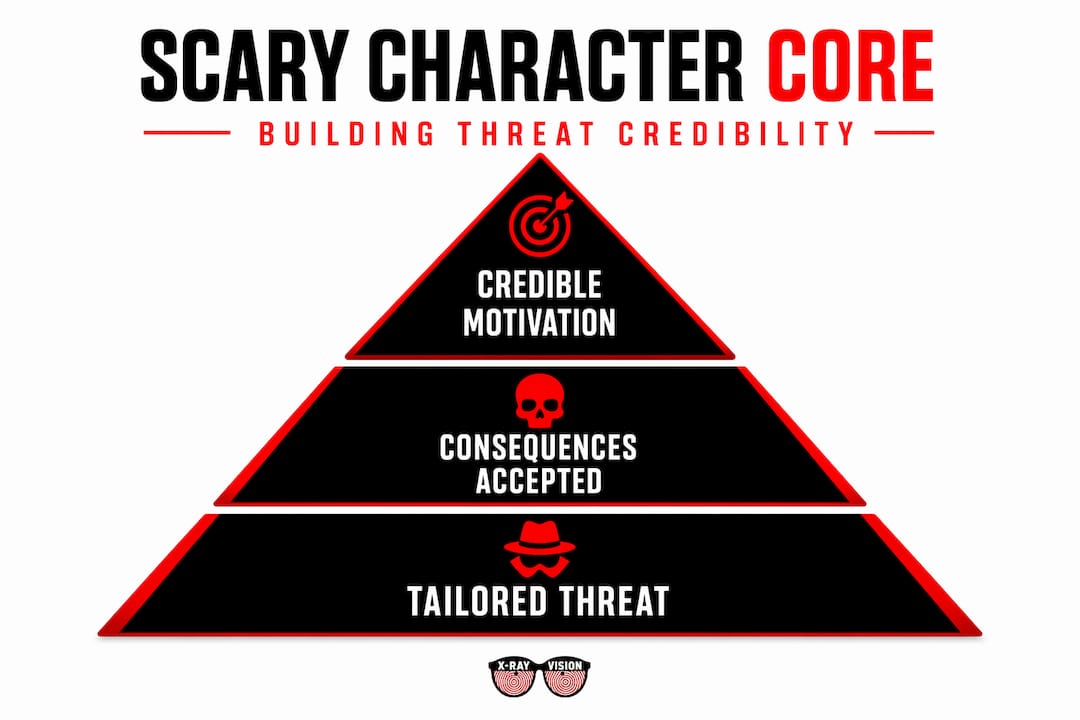
This is where the JACA framework becomes one of the most useful tools a horror writer can own. JACA stands for justification, alternatives, consequences, and ability to act. A character who feels justified in their violence, who perceives no alternative, who accepts the consequences, and who has the physical or psychological ability to follow through? That character is frightening before they do a single thing.
Think about Annie Wilkes from Stephen King's Misery. She doesn't see herself as a monster. She believes she is protecting something sacred. Her logic is warped, but internally consistent. That internal consistency is what makes her genuinely terrifying rather than cartoonishly evil.
- Justification: Your character must believe their actions are right, or at least necessary.
- No alternatives: They've ruled out every other option. Violence, cruelty, or predation is the only path they see.
- Consequences accepted: They are not deterred by punishment, social judgment, or personal cost.
- Ability confirmed: They have demonstrated, or will demonstrate, that they can act on their intent.
Gavin de Becker's research identifies willingness and perceived justification as the core of real-world threat credibility. Horror fiction works the same way.
"The scariest characters don't threaten. They explain."
Pro Tip: Write a one-page internal monologue from your villain's perspective where they justify their next act. If you find yourself convinced by their logic, even briefly, you've built something genuinely scary.
Once you've locked in the threat credibility, lean into restraint. Distant sounds and shadowy reactions consistently outperform full early reveals when it comes to psychological fear. The reader's imagination, when given the right signals, will construct something more personal and more horrifying than anything you could describe directly.
Designing physical presence and atmosphere
Appearance matters, but not in the way most writers think. The goal isn't to describe the scariest-looking creature possible. The goal is to create a visual signature that feels wrong in a specific, memorable way.
Classic horror villains like Freddy Krueger work because their appearance carries symbolic weight. The burned skin, the bladed glove. Each element connects to a deeper psychological fear: violation of safety during sleep, the inescapable reach of punishment. The visual is a metaphor made flesh.
When designing your character's appearance, focus on wrongness rather than grotesqueness. These physical details tend to generate the most sustained unease:
- Eyes that don't move naturally: Hollow sockets, eyes that don't blink on schedule, or pupils that track with mechanical precision.
- Smiles that don't match the situation: A character who smiles when others would flinch signals a broken internal world.
- Movement that violates expectation: Too slow, too fast, too fluid, or with joints that bend the wrong direction.
- Features that are almost human but not quite: This triggers the uncanny valley effect, which is one of the most reliable sources of primal discomfort.
Now pair that appearance with environment. A scarred visage paired with a ruined cathedral environment creates dread that neither the character nor the setting could produce alone. Gothic horror has understood this for centuries. The character's body and their world should mirror each other, both reflecting the same inner corruption.
| Design Element | Weak Approach | Strong Approach |
|---|---|---|
| Eyes | "Cold, dark eyes" | "Eyes that moved a half-second after his head turned" |
| Movement | "He walked toward her slowly" | "She arrived at the door without seeming to cross the room" |
| Environment | Generic abandoned house | A space that reflects the character's specific obsession or trauma |
| Sound | Silence | Wrong sounds: breathing where there shouldn't be, music that doesn't fit |
Pro Tip: Describe your character only through your protagonist's physical reactions first. What does their body do before their brain catches up? That physiological response will tell you which details to keep.
Avoid building your character around a single "scary trait." Memorable horror characters gain their power from symbolic archetypes layered with specific, unexpected quirks. The archetype creates recognizable dread. The quirk makes them feel real and unique.
Building escalating dread through threat design
A scary character who stays at the same intensity throughout a story stops being scary by chapter three. Dread requires movement. It requires the reader to feel the trap closing.
Think of your character's threat as operating on three layers simultaneously:
- Physical threat: Direct danger to the protagonist's body or survival.
- Psychological threat: Erosion of the protagonist's sense of reality, identity, or safety.
- Existential threat: The suggestion that something fundamental about the world, or the protagonist's place in it, is permanently wrong.
The most terrifying antagonists press on all three layers at once, even if only one is visible at any moment. The physical threat gives the reader something immediate to track. The psychological layer creates creeping unease. The existential layer is what keeps readers awake.
Personalizing the threat is what separates forgettable horror from genuinely disturbing stories. Fiction designers ask what the threat wants, why it can't be escaped, and what is lost over time. Your character's threat should target exactly what your protagonist values most and fears losing most deeply.
| Escalation Stage | Technique | Effect on Reader |
|---|---|---|
| Early story | Indirect evidence, wrong details | Unease without confirmed threat |
| Mid story | First direct encounter, constrained escape | Rising fear with hope still intact |
| Late story | False safe space collapses, loss confirmed | Dread becomes inevitable and personal |
| Climax | Full reveal aligned with protagonist's core vulnerability | Maximum psychological impact |
Introducing contradictions in safe spaces and slowly collapsing the protagonist's control is one of the most effective escalation tools available to horror writers. When the place your protagonist thought was safe becomes the most dangerous location in the story, the reader has nowhere to breathe.
Timing your reveals matters as much as the reveals themselves. Frequent antagonist appearances reduce mystery and bleed the menace dry. Every time your scary character appears, something should change. The reader should feel the situation worsen. Appearances should feel like events, not routine.
Practical exercises to develop your scary character
Knowing the theory is half the work. The other half is getting it onto the page in a way that feels lived-in rather than mechanical. Here's how to move from concept to a character that genuinely frightens.
- Map your character's justification. Write down, in the character's own voice, exactly why they do what they do. This doesn't need to make moral sense. It needs to make internal sense to them.
- Define their specific ability. What can they do that makes them impossible to simply outrun or outwit? This ability should connect to your protagonist's specific weaknesses.
- Establish their limitation. Every terrifying character needs one genuine constraint. A character who can do anything stops being scary because the tension collapses. The limitation is where your story lives.
- Write their first appearance as three drafts. In draft one, reveal everything. In draft two, cut it in half. In draft three, cut it in half again. The third draft is almost certainly the strongest.
- Test the false safe space. Write a scene where the protagonist believes they are momentarily safe, then plant one detail that makes the reader realize they're not. This is the engine of sustained dread.
Villain traits revealed like accumulating evidence keep readers re-evaluating what they know and fearing what they don't. Give readers incomplete information, then let them feel the gap.
"The reader who is trying to figure out your character is the reader who is afraid of them."
Avoid these common pitfalls when building terrifying characters: explaining the villain's backstory too early, making them omnipresent to the point of predictability, and giving them motivations that only make sense as plot convenience. If the character's actions only happen because the plot requires them, the reader will feel it.
Pro Tip: After you finish your first draft, go back and remove the first time your scary character appears. In most cases, the second appearance is actually the stronger introduction. The removed scene can become backstory you hint at instead.
You can also use visualization tools to sketch out how your character looks before committing to prose descriptions. AI horror character creators let you describe features like "hollow eyes" or "cracked porcelain skin" and generate visual references that sharpen your written descriptions.
My take on what actually makes horror characters last
I've written and studied horror antagonists long enough to have one strong conviction: the writers who focus on gore are writing for the moment. The writers who focus on wrongness are writing for the nightmare.
The most memorable scary characters I've encountered, and the ones I've worked hardest to create myself, share one quality. You can't quite explain why they scare you. There's something slightly off in how they speak, or what they want, or the gap between their affect and their actions. That gap is where real horror lives.
I've learned to trust restraint over spectacle almost every time. When I show less, readers project their own worst fears onto the character. That projection is always more personal, more precise, than anything I could construct. A reader's imagination knows exactly where they're most vulnerable. Your job as a writer is to give it permission to go there.
Revising for emotional impact means asking one question about every scene where your scary character appears: does the protagonist, and by extension the reader, feel worse leaving this scene than entering it? If the answer is no, the scene isn't doing its job. Cut or deepen until the answer changes.
The characters who haunt readers are the ones who feel like they could exist. Not necessarily in a supernatural sense, but in the sense that their logic is real, their presence is physical, and their interest in your protagonist feels specific and chosen. Build that specificity. Then trust your reader to be scared.
— Mark
See these techniques in action
Reading great horror is one of the fastest ways to internalize what makes a scary character work. Markwatsonbooks offers a hand-picked selection of horror fiction that puts these exact techniques on display, from psychological dread to gothic atmosphere to relentless escalation.

If you want to study iconic horror figures in their natural habitat, the Creepypasta anthology collection is packed with examples of internet horror's most unsettling characters. These stories strip away production budgets and cinematic tricks, leaving only the writing. You'll see firsthand how restraint, fragmented reveals, and psychological threat design carry entire narratives. Browse the full horror collection at Markwatsonbooks and start reading like a writer. Every story is a masterclass waiting to be decoded.
FAQ
What makes a character genuinely scary vs. just dangerous?
A genuinely scary character combines credible motivation, accepted consequences, and a threat tailored to what the protagonist values most. Danger is physical. Fear is psychological.
How do you write a horror villain with believable motivation?
Use the JACA framework: give them justification for their actions, remove their perceived alternatives, show they accept the consequences, and confirm they have the ability to act. Internal consistency makes motivation believable.
How often should a scary character appear in a story?
Less than you think. Frequent antagonist appearances reduce mystery and diminish fear. Treat every appearance as a significant event that changes the story's stakes.
What's the fastest way to improve a scary character I've already written?
Remove the first scene where they appear and read what remains. If the second introduction is stronger, cut the first entirely and let it inform your subtext instead. Then check that threat escalation worsens across every scene they're in.
Should scary characters have a weakness or limitation?
Yes, always. A limitation creates the tension that drives your story forward. A character without constraint removes the reader's hope, and without hope, there's no dread. Only despair.