
TL;DR:
- Horror's most terrifying moments stem from psychological feelings rather than visual scares, created through literary devices. Techniques like imagery, symbolism, and the uncanny build visceral dread and deep emotional resonance that outlast immediate fear. Layering these devices intensifies horror by combining physical, thematic, and psychological elements, provoking sustained uncertainty and terror.
Horror's most terrifying moments rarely come from what you see. They come from what you feel. The literary devices in horror are what separate a story that rattles you for days from one you forget by morning. Whether you're a writer reaching for that unsettling edge or a reader trying to figure out why certain scenes burrow under your skin, understanding these techniques changes everything. This article breaks down the specific devices that craft psychological dread, from foundational tools like symbolism and imagery to the deeper psychological machinery of the uncanny and unreliable narrators.
Table of Contents
- Key takeaways
- Literary devices in horror: the foundational four
- How language itself becomes unsettling
- The psychology of horror: uncanny dread and haunted spaces
- Structure and language that deepen the horror experience
- My take on layering devices for maximum impact
- Explore horror that puts these devices to work
- FAQ
Key takeaways
| Point | Details |
|---|---|
| Imagery builds visceral dread | Sensory details create unsettling worlds that put readers physically inside the fear. |
| Symbolism adds psychological depth | Recurring symbols like darkness and silence encode dread with layers of personal and social meaning. |
| Language patterns embed fear | Repetition and disrupted syntax create neurological unease that goes beyond surface scares. |
| The uncanny is horror's secret weapon | Subtle distortions of the familiar generate sustained psychological terror that outlasts jump scares. |
| Layering devices amplifies impact | Combining multiple literary techniques compounds horror's emotional resonance and symbolic power. |
Literary devices in horror: the foundational four
Most people think horror works because of monsters. It doesn't. Horror works because of atmosphere, and atmosphere is built through specific literary tools that work on your emotions before your conscious mind catches up.
Imagery is the first and most immediate device. It puts you inside a scene through sensory detail so specific it feels real. Stephen King doesn't just describe a dark hallway. He describes the smell of old carpet, the sound of a child's laughter three floors up, the way the light from under a door flickers once and goes still. Combined literary techniques deepen horror's impact by anchoring emotional states in the physical world. When a reader can almost smell the rot or feel the cold, the fear becomes embodied.
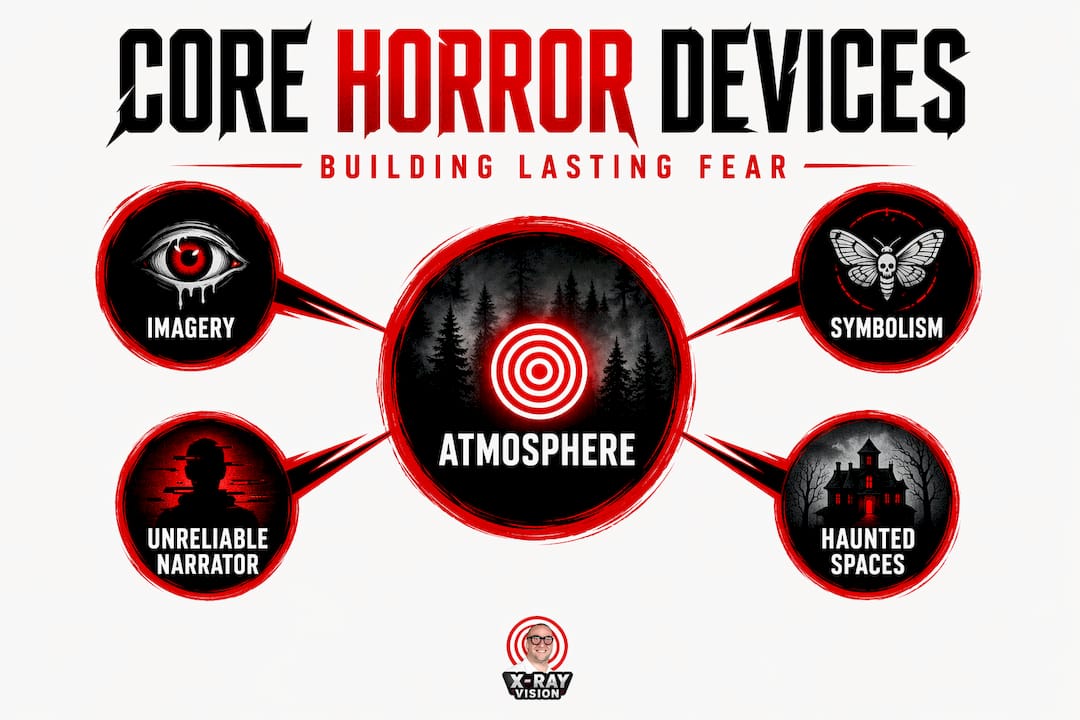
Symbolism layers meaning underneath the surface action. It's what makes horror feel like it's about something. Recurring signifiers like darkness, silence, and liminal spaces construct fear as identity uncertainty and transformation. A locked door isn't just a plot obstacle. It represents entrapment, the self closing in, the world shutting out. When you learn to read these symbols, horror literature opens up completely.
Foreshadowing is the slow burn underneath everything. A character mentions a flood in passing in chapter one. By chapter eight, you can't stop thinking about water. The genius of good foreshadowing is that it creates dread before the reader knows why they're dreading. Readers feel the tension building but can't articulate the source, which is exactly where horror wants you.
Mood is the emotional weather of a story. It's not stated. It's constructed through word choice, sentence rhythm, and what the narrator chooses to notice. A horror writer who slows down their prose during a tense scene, using longer sentences that force the reader to linger, creates a mood of creeping dread. A scene that suddenly cuts to short, staccato sentences signals that something is about to break.
- Imagery: anchors fear in the physical senses
- Symbolism: layers psychological and thematic meaning beneath the action
- Foreshadowing: builds anticipatory dread before the reader knows what they fear
- Mood: shapes the emotional environment readers inhabit throughout the story
Pro Tip: When you analyze horror literature, look at what a narrator notices in a scene. The objects and details a character fixates on often serve as symbols or foreshadowing that pay off much later in the story.
How language itself becomes unsettling
Horror doesn't just use language to describe fear. Horror uses language to create it. This is one of the most underappreciated dimensions of figurative language in horror, and it's also one of the most powerful tools available to writers.
Repetition forms neurological pathways that horror exploits to slip fear into readers' minds. When a phrase repeats across a story, it becomes familiar. Then, when it appears in a new context, that familiarity is weaponized. The phrase you trusted now carries dread. Think of Shirley Jackson's The Haunting of Hill House, where the line "No live organism can continue for long to exist sanely" opens the novel and echoes throughout. By the end, those words feel like a personal warning.
Unusual syntax and agency reversals are another technique writers use to destabilize readers. Instead of writing "the door was open," a horror writer might write "the door stood open, watching." The grammar is subtly wrong. The door has been granted awareness. This kind of grammatical agency shift makes the familiar feel wrong in a way that a standard description never could.
Fear rhetoric frames threats as immediate and personal through the structure of language itself. Ruth Wodak's research on fear shows how language positions threats through framing strategies beyond the literal content. Horror writers use this instinctively. When a narrator says "something is wrong with your house," the second-person framing makes it your problem. The threat is no longer abstract.
Here's a practical breakdown of language devices for writers to deploy deliberately:
- Repetition with variation: Repeat a phrase across the story, but shift its context each time until it means something entirely different.
- Agency reversals: Give inanimate objects verbs that imply awareness or intent. "The mirror reflected" versus "the mirror watched."
- Second-person intrusion: Drop unexpected "you" into third-person narration to make the threat feel personal and immediate.
- Sentence fragmentation: Break syntax at moments of peak dread. Short. Incomplete. Wrong.
- Pattern disruption: Establish a rhythm in your prose, then violate it precisely when the horror peaks.
Pro Tip: Read your horror prose out loud. The places where your voice naturally hesitates or speeds up are exactly where your language patterns are working. Use that instinct deliberately in revision.
The psychology of horror: uncanny dread and haunted spaces
Here's where horror literature gets genuinely interesting to analyze. The deepest horror doesn't scare you with what's there. It scares you with what might be there, and with the creeping sense that the world you understand is no longer reliable.
Sigmund Freud's concept of the uncanny describes horror's most effective psychological effect: making the familiar strange. The uncanny in Poe's works applies this theory directly, showing how ambiguity and cognitive dissonance create sustained psychological terror. When you encounter something that almost looks human but doesn't move right, that wrongness registers as fear before you can explain why. The best horror writers know this and create it deliberately through subtle distortions of the familiar rather than outright monstrous imagery.
The unreliable narrator is one of the most psychologically potent devices in horror literature. When you cannot trust the person telling the story, every detail becomes suspect. Is the ghost real or is the protagonist losing their mind? Is the danger external or internal? This ambiguity forces the reader to become actively engaged, sorting through clues and second-guessing their own interpretations. That active participation in uncertainty is itself terrifying.
Haunted spaces carry extraordinary symbolic weight. Gothic haunted settings function as dual-purpose symbols, reflecting both personal and collective trauma. Toni Morrison's Beloved is the definitive example: the haunted house isn't just a ghost story. It's a physical manifestation of historical trauma, the wounds of slavery made literal and unavoidable. When you learn to read haunted spaces this way, symbolism in horror stories takes on a completely different scale.
Personification and anthropomorphism make settings act as ambiguous psychological agents, where haunted houses described as living bodies create a dual sense of dread and ongoing ambiguity. The house breathes. The walls contract. The building wants something. This technique works because it mirrors how anxiety actually feels: the sense that your environment is hostile, aware, and specifically oriented toward you.
| Device | Effect on reader | Example |
|---|---|---|
| Uncanny familiarity | Cognitive dissonance, sustained dread | Poe's personified palace crumbling with its owner |
| Unreliable narrator | Active uncertainty, reader paranoia | Eleanor's instability in The Haunting of Hill House |
| Haunted space as symbol | Emotional resonance, thematic depth | The house in Beloved as historical trauma made physical |
| Personification of setting | Ambient threat, environmental dread | A house described as exhaling, watching, narrowing |
Structure and language that deepen the horror experience
Beyond individual devices, the architecture of a horror story shapes how fear accumulates. How you analyze horror literature at the structural level reveals a whole second layer of craft that most readers feel without consciously identifying.
Plot twists in horror don't just surprise. They reframe. When the twist lands in a good horror story, everything you experienced before it shifts meaning. The clues were there. You missed them. That retroactive dread, the realization that the threat was present from page one, is uniquely disturbing because it implicates the reader. You were in the story the whole time and didn't see it.
Red herrings in horror work differently than in mysteries. In mysteries, red herrings misdirect logic. In horror, they misdirect safety. You spend energy fearing the wrong thing, which means your guard is completely down when the real threat appears. It's the literary equivalent of looking left before a punch from the right.
Multiple perspectives fragment reality in ways that serve horror brilliantly. When different characters describe the same event in incompatible ways, the reader loses the solid ground of objective reality. That loss of certainty is exactly what horror needs to thrive.
- Plot twists: reframe everything the reader has already experienced, creating retroactive dread
- Red herrings: misdirect safety rather than just logic, leaving readers exposed to the real threat
- Multiple perspectives: fracture objective reality, removing the reader's stable ground
- Emotional word choice: emotion-laden words are processed faster and more deeply than neutral language, meaning strategic vocabulary choices hit harder and linger longer in the reader's mind
Understanding how setting shapes atmosphere is part of the same structural conversation. The physical world a horror story builds is always doing symbolic and emotional work in parallel with the plot.
My take on layering devices for maximum impact
I've spent years reading, analyzing, and writing horror, and the biggest mistake I see in horror writing is going wide instead of deep. Writers pack their stories with every scary element they can think of, monsters and gore and jump scares and dark settings, and end up with something that frightens no one.
What actually works is layering. A symbol that first appears as simple imagery, then recurs with foreshadowing weight, and finally pays off as psychological revelation. When you stack literary techniques intentionally, each device multiplies the others. The dread becomes compounded. It accumulates.
The other thing I've learned is that ambiguity is generosity. When you leave a horror story partially unexplained, you invite the reader to complete it with their own fears. That's the scariest possible outcome, because no writer can know what terrifies a specific reader the way that reader's own subconscious can. The uncanny works precisely because it doesn't resolve. It leaves you uncertain. That uncertainty is where the real horror lives.
If I could push writers toward one habit, it would be this: before you write a scene, ask what it means emotionally and symbolically, not just what happens in it. The best horror works on both tracks simultaneously, and readers feel that depth even when they can't name it. Check out how horror affects readers emotionally to understand just how deep that impact can go.
— Mark
Explore horror that puts these devices to work
If this breakdown has sharpened your appetite for horror that operates on multiple levels, Markwatsonbooks is exactly where to go next.

Mark Watson's horror book collection showcases stories built on the very devices explored here: layered symbolism, psychological tension, and language that gets under your skin. For fans of internet horror and digital dread, the Creepypasta collections offer a different flavor of the uncanny, where the familiar digital world becomes deeply, specifically wrong. Writers looking to build their craft will also find resources and guides across the Markwatsonbooks blog, including a step-by-step writing guide that applies structural horror techniques directly. Don't wait. The stories are already there, and the fear is real.
FAQ
What are the most common literary devices in horror?
The most common literary devices in horror include imagery, symbolism, foreshadowing, mood, and the uncanny. These tools work together to build psychological dread and emotional depth that outlast surface-level scares.
How does symbolism work in horror stories?
Symbolism in horror stories layers psychological or thematic meaning beneath the plot action, with recurring elements like haunted spaces often representing both personal trauma and broader social or historical wounds.
Why do horror writers use unreliable narrators?
Unreliable narrators remove the reader's sense of stable, objective reality, forcing active engagement with uncertainty. That sustained ambiguity is a more psychologically potent form of fear than any direct threat.
How do you analyze horror literature for literary devices?
When analyzing horror literature, focus on what the narrator notices in a scene, how language patterns are established and disrupted, and what recurring symbols might represent beyond their literal meaning. Looking at structure, including plot twists and perspective shifts, reveals a second layer of craft.
What is the uncanny in horror writing?
The uncanny is the psychological effect of making the familiar strange through subtle distortion and ambiguity. It generates sustained dread because the reader's sense-making breaks down without a clear, identifiable threat to point to.