
TL;DR:
- Horror suspense is an emotional state of anxious anticipation before a threat occurs, distinct from terror. It relies on techniques like restricted viewpoints, dramatic irony, and delayed information to build sustained unease. This prolonged dread creates deep character investment and a lasting emotional impact beyond the story's resolution.
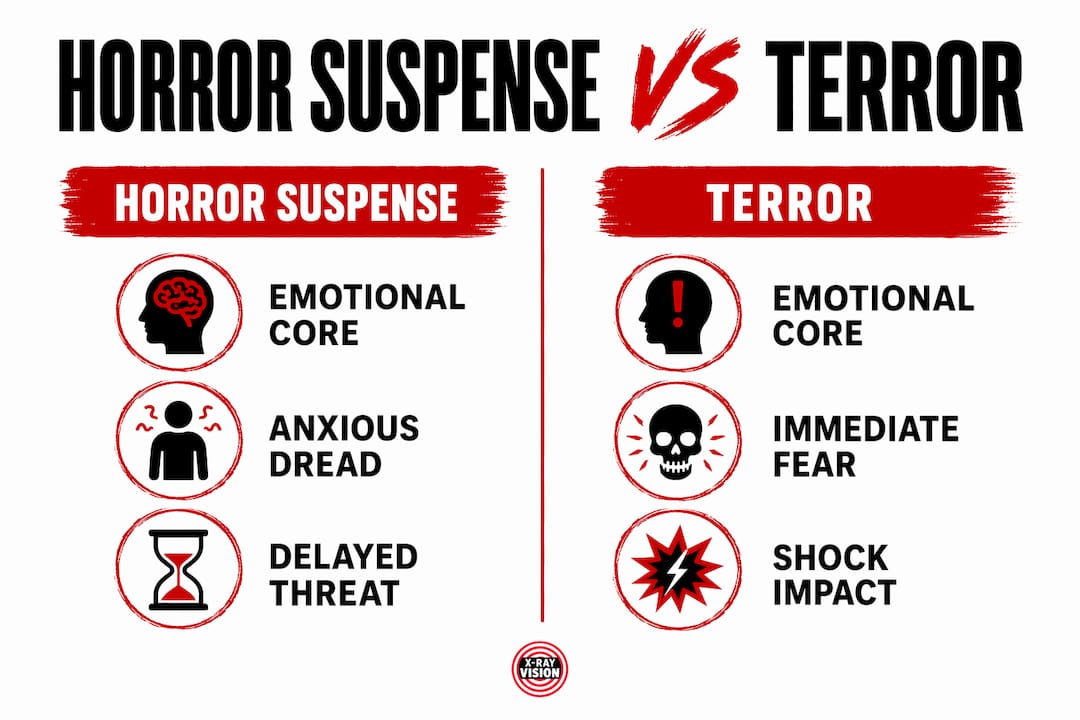
Horror suspense is defined as the emotional state of anxious anticipation where an audience expects a threatening event that has not yet occurred. It is the slow tightening in your chest before the monster appears, the silence before the scream. Alfred Hitchcock, the undisputed master of cinematic suspense, drew a sharp line between suspense and terror: terror is the visceral shock of an encounter, while suspense is the agonizing wait before it. Understanding this distinction is the key to appreciating why horror works so powerfully on us, whether on screen or on the page.
What is horror suspense and how does it differ from terror?
Horror suspense and terror are not the same emotion, even though most people use the words interchangeably. Suspense is anxious anticipation, the state of knowing something terrible is coming but not yet experiencing it. Terror is the immediate, visceral shock that hits when the threat finally arrives.
Hitchcock illustrated this with a famous example. Two people sit at a table with a bomb hidden underneath. If the bomb explodes without warning, you get fifteen seconds of shock. But if the audience knows the bomb is there and watches the characters talk, unaware, you get fifteen minutes of unbearable suspense. The information gap is everything.
Thriller suspense works differently from horror suspense. Thrillers build procedural tension through plot complexity and the question of what will happen next, often centering on a protagonist who is actively solving a problem. Horror suspense creates existential dread. The protagonist is not solving anything. They are fleeing something unstoppable, and safety feels permanently out of reach.
Here is a direct comparison of the three emotional states:
| Feature | Horror suspense | Terror | Thriller suspense |
|---|---|---|---|
| Emotional core | Anxious dread and anticipation | Immediate visceral shock | Procedural tension and urgency |
| Audience knowledge | More than the character | Equal to the character | Slightly ahead of the character |
| Resolution | Often unresolved or ambiguous | Sudden and jarring | Typically resolved through plot |
| Pacing | Slow, atmospheric buildup | Instantaneous | Fast, plot-driven |
| Lasting effect | Existential unease | Adrenaline spike | Intellectual satisfaction |
Pro Tip: If you want to feel the difference in real time, watch the shower scene in Alfred Hitchcock's Psycho twice. The first time, notice the terror of the attack itself. The second time, pay attention to how Hitchcock builds unease in the minutes before Marion Crane ever steps into the shower. That slow build is pure horror suspense.
What cinematic and literary techniques create horror suspense?
The mechanics of horror suspense are not accidental. Filmmakers and authors use specific, repeatable techniques to manufacture that unsettling tension in the audience. A 50-year study of horror trailers confirmed that restricted camera viewpoints, cataphoric pronouns, and environmental noises from unseen creatures consistently drive suspense across decades of horror filmmaking.
Here are the core techniques that make horror suspenseful:
- Restricted viewpoint. The camera or narrator shows only what the protagonist can see. You hear breathing behind a door but cannot see what is there. This limitation forces the audience to fill the gap with their own imagination, which is almost always worse than the reality.
- Dramatic irony. Dramatic irony heightens tension by giving the audience information the character does not have. You see the killer enter through the back door. The character keeps talking on the phone, oblivious. Every second they remain unaware is agony.
- Cataphoric pronouns. This is a literary device where a pronoun like "it" or "something" is used before the noun it refers to is ever revealed. "Something moved in the dark." The vagueness creates dread because the mind races to fill in the blank.
- Environmental sound design. Creaking floorboards, distant footsteps, a child's laughter in an empty house. Sound signals threat before the image confirms it, priming the audience for fear.
- Pacing and silence. Slowing the narrative down forces the audience to sit inside the dread. Jump scares are not suspense. Suspense is built through mood, layered tension, and deliberate pacing that sustains fear over time rather than delivering a quick shock.
- Delayed information. Withholding key facts, like the nature of the threat or the fate of a character, keeps the audience in a state of uncertainty. Uncertainty is the engine of suspense.
Pro Tip: The biggest mistake new horror writers make is resolving tension too quickly. Once you reveal the monster in full, suspense collapses. Keep the threat partially hidden for as long as the story can bear it.
Horror suspense examples in popular films and literature
Theory only goes so far. The best way to understand horror suspense is to see it in action across specific works.
- Psycho (1960, Alfred Hitchcock). The shower scene is famous for its terror, but the film's real genius is the 45 minutes before it. Hitchcock builds unease through Marion Crane's guilt, the oppressive lighting at the Bates Motel, and Norman Bates's unsettling small talk. By the time the attack comes, the audience is already wound tight.
- Hereditary (2018, Ari Aster). This film uses grief and family dysfunction to create a slow, suffocating dread. The threat is never fully explained, which means the existential unease never fully resolves. Audiences reported feeling disturbed for days after watching, which is the hallmark of effective horror suspense.
- The Haunting of Hill House by Shirley Jackson (1959). Jackson builds suspense almost entirely through atmosphere and unreliable perception. The reader is never certain whether the house is genuinely haunted or whether Eleanor's mind is fracturing. That ambiguity is the source of the dread.
- Get Out (2017, Jordan Peele). Peele uses dramatic irony masterfully. The audience senses something is wrong with the Armitage family long before Chris does. Watching him remain unaware while the threat closes in is a textbook example of suspense through information gaps.
- The Silence of the Lambs (1991, Jonathan Demme). The film operates at the intersection of thriller and horror suspense. The procedural tension of Clarice Starling's investigation is layered with existential dread whenever she faces Hannibal Lecter, a threat she cannot fully understand or control.
For readers who want to explore classic horror books that demonstrate these techniques across literary history, the range is extraordinary. From Poe's slow psychological unraveling in "The Tell-Tale Heart" to Stephen King's atmospheric dread in The Shining, literature has always been a laboratory for suspense.
| Work | Primary technique | Emotional effect |
|---|---|---|
| Psycho (1960) | Restricted viewpoint, pacing | Creeping unease before sudden terror |
| Hereditary (2018) | Ambiguity, atmosphere | Sustained existential dread |
| The Haunting of Hill House | Unreliable narrator | Psychological uncertainty |
| Get Out (2017) | Dramatic irony | Anxious anticipation, helplessness |
| "The Tell-Tale Heart" | Internal monologue, sound | Psychological mounting tension |
Why horror suspense is so effective in storytelling
Suspense works because it manipulates knowledge gaps and uncertainty to engage audiences at a deep emotional level. When you know danger is coming but cannot stop it, your brain enters a state of heightened alertness. That state is uncomfortable, but it is also intensely engaging. You cannot look away.
Horror suspense specifically aims for existential dread, a feeling that safety is not just temporarily absent but permanently violated. A thriller resolves its tension through plot. The detective catches the killer. The bomb is defused. Horror often refuses that comfort. The threat may be defeated, but the world feels different afterward. That lingering unease is what separates horror from every other genre.
Suspense also builds emotional investment in characters. When you are anxiously waiting for a character to escape danger, you are, by definition, invested in their survival. This is why horror suspense is such a powerful storytelling tool. It does not just scare you. It makes you care. The emotional impact of horror extends well beyond the final page or the closing credits, touching on themes of fear, resilience, and the human need to confront the unknown.
The best horror stories use suspense to say something true about vulnerability. They remind you that control is an illusion, that the world contains forces you cannot predict or fully understand. That is not a comfortable message. But it is an honest one, and audiences respond to it with remarkable loyalty.
Key takeaways
Horror suspense is the most emotionally durable tool in the horror storyteller's kit because it keeps audiences inside the dread rather than delivering a single shock and releasing them.
| Point | Details |
|---|---|
| Core definition | Horror suspense is anxious anticipation of a threat that has not yet arrived, distinct from terror. |
| Key technique | Dramatic irony and restricted viewpoint are the most reliable methods for building suspense. |
| Genre distinction | Horror suspense creates existential dread; thriller suspense resolves through plot and procedure. |
| Emotional power | Suspense builds character investment and leaves lasting unease beyond the story's end. |
| Common mistake | Revealing the threat too early collapses suspense; partial concealment sustains it far longer. |
Why suspense is the soul of horror, not just a technique
I have spent years writing horror, and the question I get most often is some version of: "How do you make something actually scary?" My honest answer is always the same. You do not make something scary. You make the audience afraid of what might happen next. That is a completely different problem.
Jump scares are easy. Any loud noise in a quiet room will make someone flinch. But that flinch is gone in two seconds. Real suspense lingers. It follows the reader home. The stories that have stayed with me longest, from Shirley Jackson's We Have Always Lived in the Castle to the best Creepypasta I have read online, all share one quality. They never fully explain themselves. They leave a door open that you cannot close.
The balance between anticipation and payoff is genuinely difficult to get right. Too little payoff and the audience feels cheated. Too much explanation and the dread evaporates. I think the sweet spot is giving the audience just enough to confirm their worst suspicions while leaving the full picture just out of reach. Modern horror films like Hereditary and Midsommar understand this instinctively. Classic horror literature understood it first.
If you are creating horror, resist the urge to explain. If you are consuming it, pay attention to what the story is withholding. That gap between what you know and what you fear is where horror suspense lives.
— Mark
Discover suspenseful horror at Markwatsonbooks

If this breakdown of horror suspense has you craving the real thing, Markwatsonbooks has you covered. Mark Watson's horror collection delivers exactly the kind of slow-burn dread and unsettling tension this article describes, with stories built on atmosphere, character investment, and threats that do not fully resolve. For fans of internet horror, the Creepypasta books bring the genre's most chilling tradition to print, with suspense baked into every page. These are not quick-shock reads. They are the kind of stories that stay with you. Browse the full collection and find your next sleepless night.
FAQ
What is the definition of horror suspense?
Horror suspense is the emotional state of anxious anticipation where an audience expects a threatening event before it occurs. It is distinct from terror, which is the immediate shock of the threat itself.
What makes horror suspenseful rather than just scary?
Suspense is created by dramatic irony and information gaps, where the audience knows more than the character and watches helplessly as danger approaches. Mood, pacing, and withheld information sustain that fear over time rather than delivering a single shock.
How does horror suspense differ from thriller suspense?
Thriller suspense builds procedural tension around what will happen next, typically resolving through plot. Horror suspense creates existential dread where safety feels permanently threatened and resolution is often ambiguous or incomplete.
What are the best examples of horror suspense in film?
Psycho (1960), Hereditary (2018), and Get Out (2017) are widely cited as masterclasses in horror suspense, each using restricted viewpoints, dramatic irony, and atmospheric dread to keep audiences in a state of prolonged anxious anticipation.
Are jump scares the same as horror suspense?
Jump scares and suspense are not the same. Jump scares deliver instant shock that fades within seconds, while suspense is a sustained emotional state built through pacing, sound design, and narrative tension that can last an entire film or book.