

TL;DR:
- Resolution shapes whether horror stories provide closure or leave lingering dread in the reader's mind. Open or ambiguous endings prolong fear and encourage audience participation, while clear resolutions offer safety and emotional recovery. Writers should match the resolution type to their audience's age and the story's intent to maximize emotional impact.
Resolution in scary stories is defined as the narrative moment where the central threat is addressed, defeated, or deliberately left unanswered. That choice shapes everything. Whether a story closes with safety restored or leaves the monster still breathing in the dark determines how long fear lives in the reader's mind. The role of resolution in scary stories goes far beyond a tidy ending. It is a psychological lever that writers can pull to produce closure, dread, or something far more unsettling: the feeling that the horror never really stopped. Understanding how resolution functions across children's horror, adult thrillers, and short-form Creepypasta is the difference between a story that fades and one that haunts.
How resolution shapes fear and emotional impact in horror
Resolution is the single most powerful tool for controlling how a reader feels after the last page. A story that wraps up cleanly sends the reader home safe. A story that refuses to close sends them home with something they cannot shake.
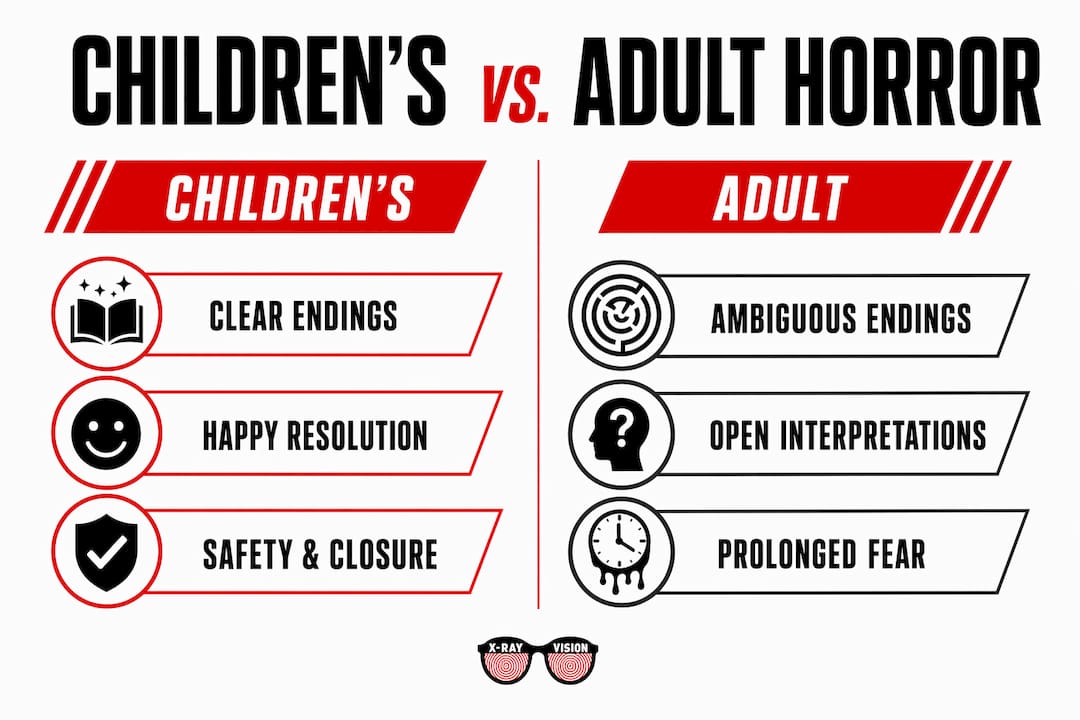
Adult horror stories often reject traditional resolution to prolong fear beyond the story's conclusion. Non-resolution causes fear to lodge in the reader's mind, extending the emotional impact long after the final sentence. This is not a flaw in the writing. It is the intended effect.
Horror critics recognize that leaving threats uncontrollable aligns with horror's core mission. Real fear does not come with a receipt. The genre earns its power by mirroring that truth.
Short-form horror stories with open endings see higher engagement because they invite readers to fill narrative gaps with their own personal fears. Stories that avoid traditional resolutions gain more comments, shares, and repeat views. That engagement spike is not accidental. It happens because the reader becomes a co-author of their own dread.
Here is how the main resolution types function in horror:
- Full closure: The threat is defeated. Safety is restored. Used most effectively in children's horror and action-driven thrillers. Provides catharsis but limits lingering fear.
- Partial resolution: Some questions are answered, but the core threat remains ambiguous. Creates a satisfying story arc while leaving unease intact.
- Open ending: The threat is unresolved or the protagonist's fate is unknown. Fear lodges in the reader's imagination and grows there.
- False resolution: The story appears to close, then delivers a final beat that destabilizes everything. Produces the sharpest jolt of sustained dread.
Pro Tip: If you want your story to stay with readers for days, resist the urge to explain what the monster was. Name it and you shrink it. Leave it unnamed and it grows.
Children's horror vs. adult horror: how resolution expectations differ
The audience determines the resolution. This is not a preference. It is a structural requirement of the genre.
Children's horror almost always requires a clear, happy resolution to provide safety and teach resilience. Closure contains fear effectively and promotes emotional recovery. A child who reads a scary story needs to know the world is still safe when the book closes. That reassurance is the point. Stories like Goosebumps by R.L. Stine follow this pattern precisely. The threat appears, escalates, and then resolves. The child reader learns that fear is survivable.
Adult horror operates on the opposite logic. Ambiguous or open endings reflect societal anxieties that do not resolve neatly. Successful horror endings often reject neat closure to reflect real-world trauma as ongoing rather than defeated. Fear transforms and propagates rather than resolving, providing deeper thematic resonance. Films like Hereditary and novels like House of Leaves by Mark Z. Danielewski use this approach deliberately. The horror does not end. It evolves.
| Demographic | Resolution preference | Primary function | Example approach |
|---|---|---|---|
| Children (ages 6–12) | Clear, happy resolution | Safety, resilience, emotional recovery | Threat defeated, world restored |
| Young adult readers | Partial resolution | Identity, consequence, moral complexity | Some answers, some ambiguity |
| Adult horror readers | Open or ambiguous ending | Societal anxiety, psychological dread | Threat unresolved or transformed |
| Short-form horror fans | Open loop endings | Engagement, personal fear projection | Reader fills the narrative gap |
Writers targeting children should also study plot pacing in children's horror to understand how resolution timing affects the emotional arc for younger readers.
Pro Tip: Before you write your ending, write down your reader's age. That number tells you how much ambiguity they can carry out of the story with them.
What modern horror experts say about ambiguity and the "Curse of Clarity"
The most dangerous thing a horror writer can do is explain too much. Horror critics and practitioners have a name for it: the Curse of Clarity.
Providing too much explanation or tidy resolution in horror kills the fear by removing ambiguity. Over-explaining breaks immersion and diminishes horror impact. The moment a reader fully understands the monster, the monster loses its teeth. Mystery is the engine of dread.
The concept of residual horror takes this further. Residual horror refers to the lingering unease left by unresolved horror stories, which embeds fear in the audience's psyche. Horror that refuses catharsis leaves a stain that sustains anxiety. That stain is not a side effect. It is the goal.
"Ambiguity in horror endings activates the audience's imagination, which universally evokes greater psychological fear."
Experienced horror writers intentionally withhold resolution to create active audience participation and extend fear impact. Ambiguous endings transform readers from passive recipients to producers of fear, increasing engagement. The reader does not just receive the horror. They generate it from their own imagination.
Analog horror, a format that uses degraded media and incomplete footage to simulate found recordings, leans entirely on this principle. Analog horror relies on ambiguity and imperfect media to leave open questions, fueling unsettling experiences. Ambiguity encourages viewers to become active participants, personalizing their fear. Channels like Marble Hornets and Local 58 built massive audiences by never fully explaining what was happening. The gap was the horror.
The literary devices that make fear last in contemporary horror consistently include partial revelation, unreliable narrators, and endings that refuse to confirm safety. These are not stylistic flourishes. They are precision tools.
How aspiring writers can use resolution strategically in scary stories
Resolution is a decision, not a default. Treating it as a craft choice rather than a formality separates effective horror from forgettable genre fiction.
The core question every horror writer must answer before drafting the final act is this: do I want my reader to feel relief or residue? Relief comes from closure. Residue comes from the gap. Both are valid. Neither is accidental.
The "residue" left after an unresolved horror story is vital for fear longevity and memorability of the experience. Writers who understand this use partial resolutions deliberately. They answer the surface question while leaving the deeper one open. The protagonist escapes the house. But the reader never learns what was in the basement.
Here is a practical framework for applying resolution in scary stories:
Do:
- Decide your resolution type before you write the climax, not after.
- Use partial resolution to satisfy plot while preserving dread.
- Let the reader's imagination do the heaviest lifting in the final act.
- Study how survival themes in horror use narrative gaps to amplify fear and engagement.
- Match your resolution style to your audience's emotional needs.
Don't:
- Over-explain the supernatural threat. Clarity kills horror.
- Resolve every subplot. Loose threads create unease.
- Use a false resolution unless you have a genuinely shocking final beat.
- Assume a happy ending is a weak ending. In children's horror, it is the correct ending.
Pro Tip: Write two versions of your ending: one resolved, one open. Read both aloud. The one that makes you feel slightly uncomfortable after you finish is almost always the stronger horror ending.
Resolution can also be treated as a strategic lever for engagement. Horror narrators who avoid closure boost reader interaction and discussion. That is especially true in online horror communities where Creepypasta and short-form horror thrive on reader speculation.
Key takeaways
Resolution is the most underestimated craft decision in horror writing. Choosing closure or ambiguity determines whether fear ends on the page or follows the reader home.
| Point | Details |
|---|---|
| Resolution type determines fear duration | Open or partial endings lodge fear in the reader's mind long after the story ends. |
| Children's horror requires clear closure | Safe, happy resolutions teach resilience and contain fear for younger audiences. |
| The Curse of Clarity weakens horror | Over-explaining the threat removes ambiguity and breaks the reader's immersion. |
| Ambiguity activates reader imagination | Unresolved endings turn readers into active participants who generate their own fear. |
| Match resolution to your audience | Adult horror favors open endings; children's horror demands closure; short-form horror thrives on open loops. |
Why I think most writers get the ending completely wrong
After writing across horror, children's fiction, and Creepypasta, I have watched the same mistake repeat itself. Writers treat the ending as a destination. They sprint toward it, tie everything up, and feel satisfied. Then they wonder why the story does not stick.
The ending is not a destination. It is a temperature setting. You are deciding how cold the reader feels when they put the book down.
My most memorable horror work has always come from resisting the urge to explain. The stories where I left the threat unnamed, the fate ambiguous, the final image unresolved generated the most reader response. Not because the writing was better, but because the reader's imagination finished the job. And their imagination is always scarier than anything I could write explicitly.
The trend I see accelerating in 2026 is short-form horror that ends mid-sentence, mid-thought, or mid-scene. Creepypasta and analog horror formats have trained a generation of readers to expect the gap. They do not want the answer. They want the question to follow them home.
If you are writing horror right now, the most powerful thing you can do is trust your reader. Give them enough to feel the dread. Then stop. The silence after the story is part of the story.
— Mark
Horror stories and writing resources at Markwatsonbooks
If this breakdown of resolution and fear has you thinking about your own writing or your next read, Markwatsonbooks has exactly what you need.

The horror collection at Markwatsonbooks showcases stories that use resolution in every form discussed here: closed, open, partial, and deliberately unresolved. For readers who love the raw, unpolished dread of internet horror, the Creepypasta anthologies are a masterclass in open-loop endings. These are stories that refuse to let go. Aspiring writers will find them as instructive as they are unsettling. Browse the full range of titles at Markwatsonbooks and find the horror that fits your reading level, your writing goals, and your tolerance for things left unexplained.
FAQ
What is the role of resolution in scary stories?
Resolution in scary stories determines whether fear ends with the narrative or lingers in the reader's mind. It is the craft decision that controls emotional impact, closure, and how long dread persists after the final page.
Why do adult horror stories often avoid clear resolutions?
Adult horror rejects neat closure to reflect real-world trauma as ongoing rather than defeated. Non-resolution causes fear to lodge in the reader's psyche, extending the emotional impact beyond the story.
What is the "Curse of Clarity" in horror writing?
The Curse of Clarity describes what happens when a writer over-explains the supernatural threat. Too much explanation removes ambiguity, breaks immersion, and significantly weakens the horror impact.
How does resolution differ between children's and adult horror?
Children's horror requires clear, happy resolutions to provide safety and promote emotional recovery. Adult horror favors ambiguous or open endings that reflect unresolved societal anxieties and sustain psychological dread.
Do open-ended horror stories perform better with readers?
Short-form horror stories with open endings see higher engagement, including more comments, shares, and repeat views, because they invite readers to fill narrative gaps with their own personal fears.