
TL;DR:
- Horror protagonists are defined by their vulnerability, which directly heightens audience fear. Effective characters possess specific, exploitable flaws, relatable struggles, and clear limits that heighten tension. Unlike other genres, horror arcs emphasize endurance, with protagonists starting stable and deteriorating under extreme threats.
The protagonist in horror is defined as the emotionally vulnerable character whose survival anchors the audience's fear response and drives every narrative decision. This is not a supporting function. The role of protagonists in horror is the engine of the entire story. Without a character the audience can feel for, the monster is just noise. Research confirms that protagonist vulnerability directly predicts how frightened audiences become, with a beta coefficient of -0.80 across a 691-film sample. That number tells you everything: the more exposed your protagonist feels, the more your audience leans forward.
What characteristics define effective horror protagonists?
Horror protagonists characteristics are not simply a checklist of fears. They are a precise combination of traits that make the audience feel the threat personally.
The most effective horror protagonists share these defining qualities:
- Specific vulnerability. This is not general weakness. It is a targeted exposure, whether psychological, physical, or social, that the antagonist can exploit. Think of Eleanor Vance in Shirley Jackson's The Haunting of Hill House, whose desperate need for belonging makes her the perfect target.
- Relatable flaws that drive decisions. Readers invest in protagonists not because they are heroic but because their flaws mirror real human struggles. A character who lies to protect someone they love is far more gripping than a flawless victim.
- A backstory with exploitable secrets. Effective horror protagonists carry trauma or secrets that raise the stakes beyond physical survival. The horror becomes about defending identity, not just escaping death.
- Competence paired with clear limits. A protagonist who is completely helpless generates pity, not dread. The strongest horror protagonists balance real competence against overwhelming threats, which makes their limitations feel devastating rather than convenient.
Pro Tip: Never confuse vulnerability with incompetence. A protagonist who makes smart choices but still cannot win is far more terrifying than one who simply freezes. Competence amplifies dread because it proves the threat is genuinely unbeatable.
The difference between vulnerability and weakness is the difference between tension and frustration. Vulnerability says, "This person is doing everything right and still losing." Weakness says, "This person keeps making dumb choices." Audiences forgive the first. They abandon the second.
How does the horror protagonist differ from other genre heroes?
The contrast between horror protagonists and heroes in other genres is sharper than most readers realize. Understanding it changes how you read and write horror entirely.
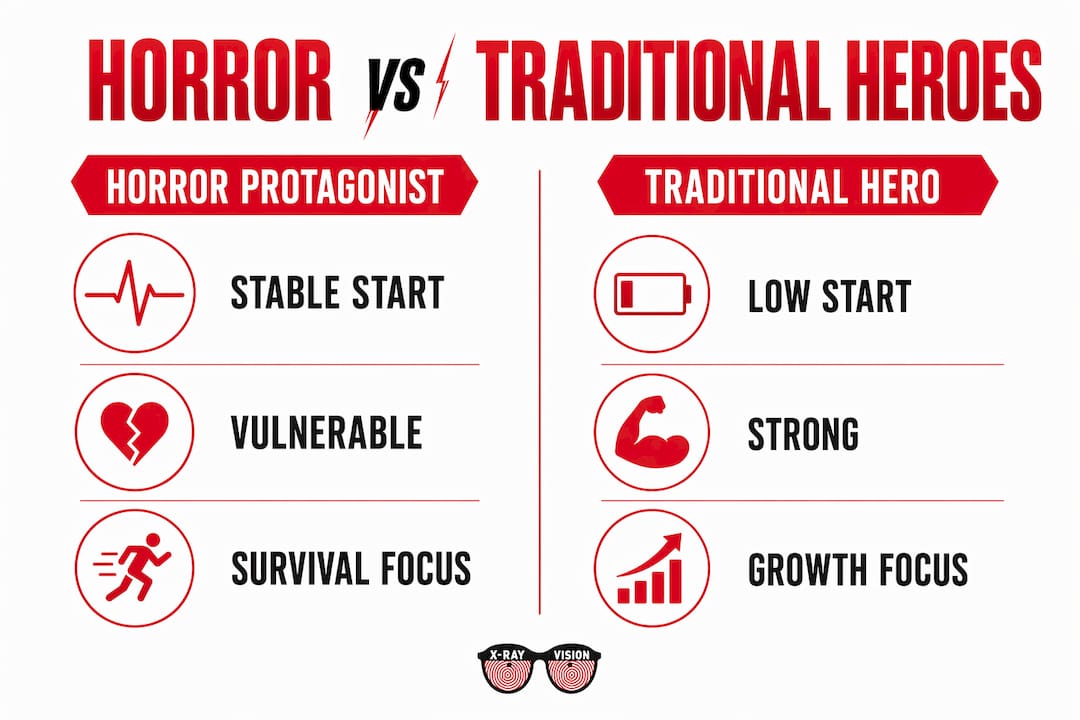
Horror protagonists start at their most stable point, not at their lowest. The story then dismantles that stability. This is the opposite of the traditional hero's journey, where a character begins flawed and grows toward strength. In horror, the arc is about endurance, not transformation.
| Element | Horror Protagonist | Traditional Hero (Adventure/Drama) |
|---|---|---|
| Starting state | Stable, often content | Flawed, restless, or incomplete |
| Primary goal | Survive and preserve identity | Grow, achieve, or transform |
| Power vs. antagonist | Severely outmatched | Capable of eventual victory |
| Arc direction | Deterioration under pressure | Upward growth toward resolution |
| Emotional core | Fear and endurance | Hope and ambition |
The power imbalance in horror is also far more extreme than in other genres. In a thriller, the protagonist and antagonist are often evenly matched. In horror, the gap is the point. That imbalance is what generates dread. When you read about horror vs. thriller narrative structures, this asymmetry is the clearest dividing line.
Motivations also shift. Horror protagonists rarely fight for glory or justice. They fight to protect a child, keep a secret buried, or simply stay alive one more night. That narrowness of purpose is not a limitation. It is what makes the stakes feel real and personal to the audience.
Why does protagonist vulnerability trigger fear in audiences?
Vulnerability is not a stylistic choice in horror. It is the psychological mechanism that makes fear work.
A 691-film study found that protagonist vulnerability relative to the antagonist produced a beta of -0.80 in predicting audience fear levels. That is one of the strongest single predictors in narrative psychology research. The implication is direct: the more exposed your protagonist is, the more your audience activates their own fear response.
The psychological basis is empathy and simulation. When audiences watch or read a vulnerable protagonist, their brains simulate the experience. They feel the threat as if it were happening to them. This is why fear in horror must be embedded in the protagonist's experience rather than delivered through surface-level shocks. Jump scares fade in seconds. A protagonist slowly losing their grip on reality stays with you for days.
"Fear is not decoration. It is the protagonist's lived experience, and the audience borrows it."
Vulnerability also activates the deepest human fears: loss of identity, bodily violation, and the collapse of the people and places that make us feel safe. When a protagonist's sense of self is under attack, not just their body, the horror reaches a level that pure physical threat cannot match. The psychological impact of horror on readers is rooted in this exact mechanism.
Competence sharpens this effect rather than dulling it. When a protagonist is clearly capable and still cannot win, the audience stops looking for a solution and starts feeling the hopelessness. That is the emotional state horror is built to produce.
How can writers craft compelling horror protagonists?
Strong horror protagonists do not happen by accident. They are built through deliberate structural choices that connect character to plot at every level.
-
Give flaws active power over the plot. Labels on flaws are insufficient. A protagonist described as "reckless" must make a reckless decision that directly worsens their situation. The flaw has to cost them something real.
-
Embed personal stakes beyond survival. A character protecting a secret, a relationship, or a belief system has more to lose than their life. That extra layer of stakes creates escalating tension that pure survival plots cannot match.
-
Prioritize understandability over likeability. A deeply unpleasant protagonist can hold an audience's attention if their internal logic is clear and consistent. Readers do not need to like your protagonist. They need to understand why that character makes every choice they make.
-
Build dual conflict layers. Protagonists who carry both an external threat and an internal personal struggle create naturally escalating tension. The external horror forces the internal wound open. The internal wound makes the external threat worse. These two pressures feed each other.
-
Use supporting characters to reveal protagonist limits. A friend who trusts the protagonist completely, or a skeptic who refuses to believe them, both expose different facets of the protagonist's vulnerability. The role of supporting characters in horror is to hold a mirror up to the protagonist's weaknesses and strengths.
Pro Tip: When you finish a draft, trace every major plot turn back to a protagonist decision. If the plot moves forward because of external events alone, your protagonist is passive. Passive protagonists kill horror tension faster than any plot hole.
For a step-by-step approach to building these elements into a full story, the horror story craft guide at Markwatsonbooks breaks down the process with practical structure you can apply immediately.
Key takeaways
The role of protagonists in horror is defined by vulnerability, relatable flaws, and dual conflict layers that transform the audience's empathy into genuine fear.
| Point | Details |
|---|---|
| Vulnerability drives fear | Research shows protagonist vulnerability is the strongest single predictor of audience fear response. |
| Flaws must be active | Protagonist flaws must directly cause plot consequences, not just exist as character labels. |
| Horror arcs emphasize endurance | Unlike traditional heroes, horror protagonists aim to survive and preserve identity, not grow or transform. |
| Understandability beats likeability | Audiences stay invested in protagonists whose motivations are clear, even when those protagonists are unlikable. |
| Dual conflict amplifies tension | External threat combined with internal personal struggle creates escalating dread that neither layer produces alone. |
What i've learned writing horror protagonists
Writing horror protagonists has taught me one uncomfortable truth: the instinct to protect your character is the enemy of good horror. Every time I softened a flaw or gave a protagonist an easy out, the fear drained out of the scene. The moments that hit hardest were always the ones where I let the character's own weakness make things worse.
The shift I have seen in horror over the past decade is meaningful. Audiences are less interested in the invincible final girl and far more drawn to protagonists who are visibly, specifically broken in ways that feel personal. Characters like those in Hereditary or Midsommar work because their psychological wounds are the actual horror. The supernatural element is almost secondary.
Relatable imperfection is not a trend. It is the oldest trick in horror's playbook, and it works because it is honest. When you create scary characters who carry real human damage, readers do not just watch the story unfold. They feel it happening to them. That is the only version of horror worth writing.
— Mark
Explore horror that gets protagonists right
If you want to see these principles in action, Markwatsonbooks has you covered.

The horror collection at Markwatsonbooks features stories built around protagonists who are vulnerable, flawed, and impossible to put down. For readers drawn to internet horror, the Creepypasta anthology series puts you inside the minds of characters facing threats that blur the line between psychological and supernatural. These are not passive victims. They are fully realized people whose specific weaknesses make every page feel urgent. Browse the full book catalog and find the protagonist whose fear feels closest to your own. That is where the best horror always starts.
FAQ
What is the primary role of the protagonist in horror?
The protagonist in horror serves as the emotional anchor for the audience, translating threat into felt fear through vulnerability and relatability. Without a protagonist the audience connects with, the horror has no psychological weight.
Why is vulnerability more important than strength in horror protagonists?
Research across a 691-film sample found protagonist vulnerability to be the strongest predictor of audience fear, with a beta of -0.80. Strength reduces the power imbalance that makes horror frightening.
Do horror protagonists need to be likable?
Likeability is less important than consistency. An unlikable protagonist sustains engagement as long as their motivations are clear and their decisions follow an internal logic the audience can track.
How do horror protagonist arcs differ from other genres?
Horror protagonists begin at their most stable and move toward deterioration, prioritizing survival over growth. Traditional genre heroes begin flawed and arc upward toward transformation or achievement.
What makes a horror protagonist's flaw effective?
A flaw is effective only when it actively drives plot decisions and creates real consequences. Flaws that exist only as character description without narrative impact do not generate tension or reader investment.