

TL;DR:
- Horror creates visceral fear and shock through supernatural or monstrous threats, while thrillers generate suspense via realistic dangers and complex puzzles. Both genres evoke dread but differ in emotional focus, pacing, and narrative structure, with horror confronting audiences physically and thrillers engaging them intellectually. Understanding these distinctions enhances appreciation and aids writers in choosing the right emotional register for their storytelling.
Horror and thriller are defined by the emotional experience they create: horror delivers visceral fear and shock, while thrillers generate intellectual suspense and anticipation. Both genres traffic in dread, but they arrive there by completely different roads. Horror confronts you with something monstrous and forces you to feel it in your gut. A thriller makes you lean forward, pulse quickening, as you try to outthink the danger before the protagonist does. Understanding the horror vs thriller distinction sharpens how you read, watch, and appreciate storytelling at its most intense. Stephen King and film theorist Noël Carroll have both mapped this territory, and their frameworks reveal just how deliberate these genre differences really are.
What are the defining characteristics of horror and thriller genres?
Horror is built on the disruption of normality by a monstrous or supernatural force. Film scholar Robin Wood frames it precisely: horror disrupts normality via the monster, while thrillers revolve around a protagonist's high-stakes problem-solving against realistic threats. That structural gap explains why The Exorcist and Gone Girl feel so different even though both keep you riveted.
Horror movie characteristics cluster around shock, transgression, and the uncanny. The genre traces its roots to Gothic literature, where transgressive and dark themes were the whole point. Think decaying mansions, demonic possession, body horror. The threat is often supernatural or monstrous, and the audience's primary job is to feel fear, disgust, and dread in their body, not just their mind.
Thrillers, by contrast, center on realistic obstacles. The danger is human, institutional, or environmental. A serial killer. A corrupt government. A ticking bomb. The thriller's engine is suspense driven by anticipation of danger in scenarios that feel plausible. Shutter Island and Silence of the Lambs both involve disturbing content, but they pull you forward with puzzle-solving tension rather than visceral shock.
Here's a quick comparison of how the two genres stack up structurally:
| Element | Horror | Thriller |
|---|---|---|
| Primary emotion | Fear, disgust, shock | Suspense, tension, anticipation |
| Threat type | Supernatural or monstrous | Realistic, human, or institutional |
| Narrative focus | Confronting the monster | Protagonist solving a high-stakes problem |
| Pacing style | Dread punctuated by shock | Escalating tension with plot twists |
| Audience role | Witness and victim | Intellectual participant |
The key horror storytelling techniques include visual tension between not seeing the monster and the shock of finally seeing it. Jaws withholds the shark for most of its runtime, which is exactly why the reveal lands so hard. Thrillers use plot-driven pacing, mystery, and time pressure. Psycho is a fascinating case because Alfred Hitchcock built it with thriller mechanics but delivered horror payoffs, which is why it still confuses genre purists today.
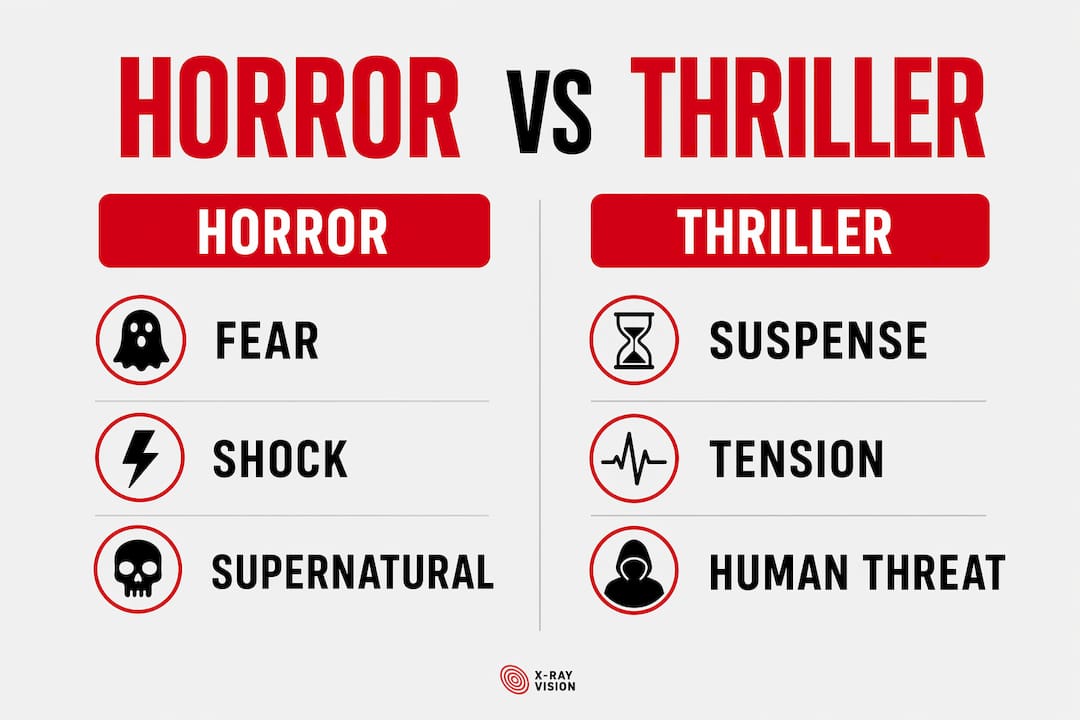
How do horror and thriller differ in pacing, storytelling, and audience experience?
Horror pacing is designed to make you feel trapped. The genre uses dread and jump scares alongside immediate, unavoidable threats. You are not solving a problem. You are surviving one. The narrative often strips the protagonist of agency, which is precisely what makes horror so unsettling. When the characters in Hereditary realize they have no control, the audience feels that helplessness directly.
Thrillers operate on a completely different rhythm. The pacing escalates through information reveals, reversals, and thriller plot twists that reframe everything you thought you knew. Think of the layered reveals in Knives Out or the identity twist in The Usual Suspects. The audience is always one step behind the story, which creates a specific kind of pleasurable tension. You want to figure it out before the answer arrives.
Here is a practical breakdown of how each genre structures the audience experience:
- Setup: Horror establishes a normal world and then introduces an intrusion. Thrillers establish a protagonist with a goal and then introduce an obstacle.
- Escalation: Horror increases the monster's power or presence. Thrillers increase the stakes and narrow the protagonist's options.
- Climax: Horror forces a confrontation with the monstrous. Thrillers deliver a revelation or resolution that recontextualizes the entire story.
- Resolution: Horror often ends with ambiguity or lingering dread. Thrillers typically resolve the central puzzle, even if the ending is dark.
Pro Tip: If you want to sharpen your genre instincts, pay attention to where a story places its tension. If the tension lives in "what is that thing," you're in horror territory. If it lives in "what happens next," you're in thriller territory. That single question tells you almost everything.
Understanding horror suspense techniques can also reveal how skilled authors borrow from both toolkits. The best horror writers know when to slow down and let dread accumulate, and the best thriller writers know when a single shocking image can do more work than three chapters of plot.
What psychological effects and audience responses distinguish horror from thriller?
Horror's appeal is paradoxical. People voluntarily seek out experiences that frighten and disgust them because the genre offers a controlled cathartic release. Horror's paradoxical appeal lies in safely confronting feelings of helplessness, making it a contained emotional workout. You feel the primal fear without the actual danger. That's a powerful psychological bargain.
Stephen King's hierarchy of fear is the most useful framework for understanding how horror actually works on an audience. He identifies three levels: terror (the anticipatory dread before the monster appears), horror (the shock of seeing it), and revulsion (the gag-reflex disgust at something physically wrong). Balancing these elements is what separates effective horror from cheap shock tactics. A story that only delivers revulsion is gross-out fiction. A story that builds genuine terror before the reveal is horror.
Thrillers work on a different psychological register entirely. They engage intellect and suspense through uncertainty and perception, rewarding audiences who pay close attention. The satisfaction is cognitive. When the twist lands in Gone Girl or Parasite, the pleasure comes from realizing how the story had been playing you all along. That's an intellectual payoff, not a visceral one.
"The horror story, in its finest form, is an invitation to look at the worst of ourselves and the world, and to come out the other side still breathing." This captures why the psychological impact of horror on readers goes far beyond simple fright.
Here's what each genre delivers psychologically:
- Horror: Catharsis through confronting primal fears, abjection, and mortality. Leaves audiences shaken but often oddly relieved.
- Thriller: Intellectual stimulation through puzzle-solving, suspense, and the satisfaction of narrative resolution. Leaves audiences energized and mentally engaged.
- Psychological thriller vs horror: The psychological thriller, as seen in films like Black Swan or Rosemary's Baby, blurs these effects by using horror's dread within a thriller's intellectual framework.
How do hybrid and boundary cases blur the lines between horror and thriller?
Genre lines are permeable and subjective, and the most interesting stories often refuse to stay on one side of the divide. The Shining is a horror novel with thriller pacing. Get Out is a social thriller that delivers genuine horror payoffs. Silence of the Lambs won the Academy Award for Best Picture while being shelved in the horror section of every video store. Audience perception plays a massive role in how these works get classified.
Supernatural elements are the strongest indicator of horror, but suspense-heavy films like Jaws show that genre depends on fear intensity and plot structure as much as content. Jaws has a monster, but its DNA is thriller. The shark is a realistic threat. The story is about men solving a problem under pressure. The horror elements are present, but the thriller mechanics dominate.
Here's how some iconic works sit across the genre spectrum:
| Title | Primary Genre | Blended Element |
|---|---|---|
| The Shining | Horror | Thriller pacing and psychological tension |
| Get Out | Thriller | Horror imagery and visceral dread |
| Silence of the Lambs | Thriller | Horror atmosphere and monstrous antagonist |
| Hereditary | Horror | Thriller-style mystery setup |
| Parasite | Thriller | Horror tonal shift in final act |
For enthusiasts, the practical takeaway is this: when a story makes you feel something in your body, it's leaning horror. When it makes you think, it's leaning thriller. Most great genre fiction does both, but one impulse almost always leads.
What are the best horror vs thriller films and books to study each genre?
The best way to internalize the difference between horror and thriller genres is to read and watch works that exemplify each at its purest, then move toward the hybrids. Start with clear examples before you tackle the blends.
For horror:
- Dracula by Bram Stoker: Gothic horror at its most archetypal, built entirely on dread and monstrosity.
- It by Stephen King: A masterclass in building terror before delivering horror and revulsion.
- The Haunting of Hill House by Shirley Jackson: Psychological horror that never fully explains its threat, which makes it more frightening.
- Hereditary (2018): Contemporary horror that uses family trauma as its monster.
For thriller:
- Gone Girl by Gillian Flynn: A thriller built entirely on unreliable narration and escalating reveals.
- No Country for Old Men by Cormac McCarthy: A thriller with a monstrous antagonist who functions more as a force of nature than a supernatural entity.
- Knives Out (2019): A thriller that plays with genre conventions while delivering genuine suspense.
- The Girl with the Dragon Tattoo by Stieg Larsson: A procedural thriller that rewards patient, attentive reading.
Markwatsonbooks also offers new horror films worth watching for readers who want to stay current with where the genre is heading in 2026. The horror genre in particular is experiencing a surge in audience interest, with low-budget films consistently outperforming expectations at the box office. That trend reflects exactly what the genre does best: it delivers maximum emotional impact with minimal reliance on spectacle.
Key takeaways
Horror elicits visceral fear through monstrous threats and shock, while thrillers generate intellectual suspense through realistic danger, escalating plot twists, and puzzle-driven pacing.
| Point | Details |
|---|---|
| Core emotional difference | Horror shocks and disturbs; thrillers build suspense and reward intellectual engagement. |
| Structural distinction | Horror disrupts normality with a monster; thrillers follow a protagonist solving a high-stakes problem. |
| Stephen King's fear hierarchy | Terror, horror, and revulsion are three distinct levels that effective horror balances deliberately. |
| Genre hybrids are common | Works like Get Out and The Shining blend both genres; audience perception often determines classification. |
| Publishing matters too | Authors and agents treat horror and thriller as distinct publishing categories; mislabeling can affect a book's success. |
Why the genre distinction matters more than most readers realize
I've spent years writing across the horror and thriller spectrum, and the single biggest mistake I see readers and aspiring writers make is treating these genres as interchangeable. They're not. They ask fundamentally different things of you.
Horror asks you to surrender. You have to let the fear in, sit with the discomfort, and trust that the story knows what it's doing with your dread. Readers who approach horror with a thriller mindset, always trying to solve it, often find themselves frustrated. They're fighting the experience instead of having it.
Thriller asks you to engage. You're a participant, not just a witness. The best thrillers reward re-reads because you can see exactly where the author was misleading you. That's a craft achievement, not a trick.
What I find most interesting is how the psychological thriller vs horror debate reveals something true about storytelling itself: the most powerful stories know which emotional register they're working in and commit to it completely. Hereditary is terrifying because it never lets you solve it. Gone Girl is gripping because it never lets you stop trying. The genre isn't just a marketing label. It's a contract with the reader about what kind of experience they're signing up for.
If you want to write in either genre, or simply appreciate them more deeply, start by asking what you want your audience to feel. Then build every scene, every pacing choice, and every reveal around that answer.
— Mark
Explore horror and thriller stories at Markwatsonbooks
If this breakdown has sharpened your appetite for the genres, Markwatsonbooks has exactly what you need next.

Mark Watson's catalog spans horror, psychological thrillers, and internet horror anthologies that sit right at the boundary between the two genres. The Creepypasta Omnibus collects 150 stories that demonstrate horror storytelling techniques at their most raw and immediate. For readers who want to explore the full range, the complete books collection organizes everything by genre so you can move from pure horror to genre-blending thrillers at your own pace. Browse the horror collection and find your next unsettling read today.
FAQ
What is the core difference between horror and thriller?
Horror creates visceral fear and shock through monstrous or supernatural threats, while thrillers generate intellectual suspense through realistic danger and escalating plot tension. The primary distinction is emotional: horror targets your gut, thrillers target your mind.
Can a story be both horror and thriller?
Yes. Works like The Shining, Get Out, and Silence of the Lambs blend both genres by combining horror's dread with thriller's plot-driven pacing. Genre classification often depends on which emotional experience dominates.
What makes psychological thriller vs horror different?
Psychological thrillers use uncertainty and perception to create suspense, engaging the intellect rather than delivering immediate shock. Horror, even in psychological form, ultimately confronts the audience with something that triggers visceral fear or revulsion.
Why do people enjoy horror if it's frightening?
Horror offers a controlled cathartic experience that lets audiences safely confront feelings of helplessness and primal fear. The controlled setting makes the fear pleasurable rather than traumatic.
Does genre labeling matter in publishing?
Authors and agents treat horror and thriller as distinct publishing categories, and mislabeling a manuscript can lead to rejection before the story is even read. Getting the genre right is a practical craft decision, not just a marketing one.