
Gothic literature is a genre built on dread, beauty, and the unsettling sense that something ancient and wrong lurks just beneath the surface. The canonical examples of gothic literature include The Castle of Otranto, Frankenstein, Dracula, Wuthering Heights, Jane Eyre, The Monk, The Mysteries of Udolpho, Rebecca, The Woman in Black, and The Fall of the House of Usher. In one line: Gothic fiction uses atmosphere, supernatural dread, isolated settings, and psychological terror to explore the dark edges of human experience.
Here are the ten canonical works to start with:
- The Castle of Otranto (Horace Walpole) [1764]
- The Mysteries of Udolpho (Ann Radcliffe) [1794]
- The Monk (Matthew Gregory Lewis) [1796]
- Frankenstein (Mary Shelley) [1818]
- The Fall of the House of Usher (Edgar Allan Poe) [1839]
- Wuthering Heights (Emily Brontë) [1847]
- Jane Eyre (Charlotte Brontë) [1847]
- Dracula (Bram Stoker) [1897]
- Rebecca (Daphne du Maurier) [1938]
- The Woman in Black (Susan Hill) [1983]
Want the full breakdown? The definition and key characteristics are below, followed by a chronological timeline, close-reading tips, author bios, and modern picks that carry the Gothic flame into the 21st century.
Key Takeaways
Gothic literature's defining power is its insistence that the past never truly dies — every canonical work from The Castle of Otranto in 1764 to Mexican Gothic in 2020 uses atmosphere, isolation, and psychological dread to make that argument with fresh urgency.
| Point | Details |
|---|---|
| Gothic's core definition | Atmosphere, isolated settings, the uncanny, and psychological terror distinguish Gothic from plain horror. |
| The founding text | The Castle of Otranto (1764) introduced every major Gothic motif and framed itself as a found medieval manuscript. |
| The essential canon | Frankenstein, Dracula, Wuthering Heights, Jane Eyre, and Poe's short fiction form the backbone of any Gothic reading list. |
| Gothic is historically adaptive | The genre has evolved from 18th-century castle fiction through Victorian domestic Gothic to feminist and postcolonial retellings. |
| Markwatsonbooks for dark fiction | Mark Watson's horror and Creepypasta collections carry Gothic fiction's atmospheric tradition into contemporary short-form horror. |
Table of Contents
- What is Gothic literature, and why does the label keep shifting?
- A chronological timeline of Gothic literature
- The top canonical examples of Gothic literature, explained
- 1. The Castle of Otranto by Horace Walpole (1764)
- 2. The Mysteries of Udolpho by Ann Radcliffe (1794)
- 3. The Monk by Matthew Gregory Lewis (1796)
- 4. Frankenstein by Mary Shelley (1818)
- 5. The Fall of the House of Usher by Edgar Allan Poe (1839)
- 6. Wuthering Heights by Emily Brontë (1847)
- 7. Jane Eyre by Charlotte Brontë (1847)
- 8. Dracula by Bram Stoker (1897)
- 9. Rebecca by Daphne du Maurier (1938)
- 10. The Woman in Black by Susan Hill (1983)
- How to recognize Gothic features and techniques when you're reading
- The top Gothic authors and what each one contributed
- Modern and contemporary works that carry the Gothic tradition forward
- How to study Gothic literature effectively
- Mark's personal picks and reading notes
- Why Gothic literature still matters for modern readers
- Mark Watson's horror fiction for readers who want more darkness
- Sources
What is Gothic literature, and why does the label keep shifting?
Gothic fiction is the literature of beautiful terror. At its core, it combines atmosphere-heavy settings (crumbling castles, fog-drenched moors, decaying mansions) with psychological dread, the supernatural or its suggestion, and characters trapped by forces they cannot fully understand or escape. The genre's defining mood is what Edmund Burke called "the sublime": a mixture of awe and fear that feels both pleasurable and overwhelming.
The term itself has always been slippery. As scholars like Nick Groom emphasize, "Gothic" migrated from medieval architecture into literary practice in the 18th century, then kept evolving through Romantic poetry, Victorian sensation fiction, American psychological horror, and 20th-century feminist retellings. It is best understood as historically adaptive rather than fixed. A work does not need a castle to be Gothic; it needs a particular quality of dread and a sense that the past refuses to stay buried.
The core characteristics that most teaching guides agree on:
- Atmosphere and setting: Isolated, decaying, or labyrinthine spaces that mirror psychological states
- The supernatural (or its suggestion): Ghosts, monsters, or uncanny events that may or may not be "real"
- Innocence in peril: A vulnerable protagonist (often female) threatened by a powerful, dark figure
- Psychological terror: Fear generated by the mind as much as by external events
- The uncanny: Familiar things made strange, or strange things made uncomfortably familiar
- Family secrets and curses: The sins of the past bleeding into the present
Works like The Castle of Otranto, Frankenstein, and Dracula anchor this definition across three centuries of literary history.
Pro Tip: When deciding whether a text is Gothic, look past the surface scares. Ask whether the setting functions as a psychological mirror, whether the past actively haunts the present, and whether the narrative generates dread through atmosphere rather than shock. If all three apply, you're reading Gothic fiction.
A chronological timeline of Gothic literature
Gothic fiction did not appear fully formed. It grew in stages, each era adding new anxieties and techniques to the tradition.
| Year | Work / Milestone | Why It Matters |
|---|---|---|
| 1764 | The Castle of Otranto (Walpole) | First Gothic novel; introduced isolated castle settings, supernatural intrusions, and the endangered heroine |
| 1794 | The Mysteries of Udolpho (Radcliffe) | Popularized the "explained supernatural" and the female protagonist trapped in a sinister estate |
| 1796 | The Monk (Lewis) | Pushed Gothic into explicit transgression: lust, murder, and diabolism with no rational explanation |
| 1818 | Frankenstein (Shelley) | Fused Gothic atmosphere with Romantic science, creating the template for the monster-as-mirror narrative |
| 1839 | The Fall of the House of Usher (Poe) | Defined American psychological Gothic; the house as a living embodiment of mental collapse |
| 1847 | Wuthering Heights / Jane Eyre (Brontës) | Victorian Gothic at its peak: passion, class, and the tyrannical male figure threatening female autonomy |
| 1897 | Dracula (Stoker) | Fin-de-siècle Gothic; the vampire as colonial and sexual anxiety made flesh |
| 1938 | Rebecca (du Maurier) | 20th-century psychological Gothic; the dead woman as a haunting presence more powerful than the living |
| 1959 | The Haunting of Hill House (Jackson) | Postwar American Gothic; the house as an extension of the protagonist's fractured psyche |
| 1983 | The Woman in Black (Hill) | British Gothic revival; grief and guilt rendered as literal haunting |
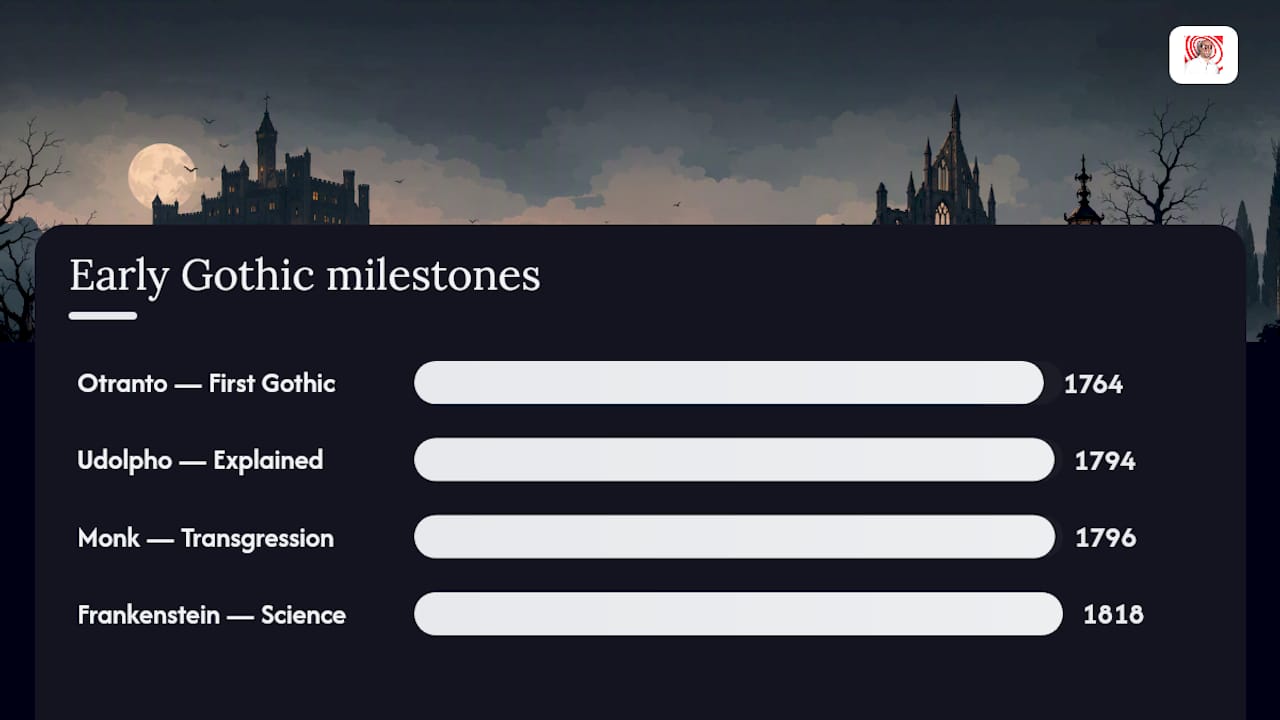
Reedsy Discovery's guide to Gothic literature traces this arc from Walpole through the Romantics and Victorians to 20th and 21st-century revivals, showing how each period reloaded the genre's core anxieties with new cultural content. For a broader view of how horror evolved alongside Gothic fiction, the history of horror literature is worth reading alongside this timeline.
The top canonical examples of Gothic literature, explained
These ten works form the backbone of any Gothic reading list. Teaching guides consistently name Frankenstein, Dracula, Wuthering Heights, Jane Eyre, and Poe's fiction as core Gothic texts, and the full list below covers the complete canon from its 18th-century origins to the 20th-century revival.
Early Gothic (18th century)
1. The Castle of Otranto by Horace Walpole (1764)
The novel that started it all. Walpole set his story in a crumbling Italian castle ruled by the tyrannical Manfred, who is terrorized by a series of supernatural events including a giant helmet that crushes his son. Every Gothic motif you will encounter in later fiction — the isolated estate, the endangered heroine, the monstrous patriarch, the supernatural intrusion — appears here in its first literary form.
What makes it especially fascinating is Walpole's framing device. He originally presented the novel as a rediscovered medieval manuscript, claiming to have translated it from an ancient Italian text. This paratextual trick was designed to heighten verisimilitude and create a sense of uncanny authenticity. It worked. Readers were disoriented in exactly the way Walpole intended.
Reading note: Focus on the architecture. Every room, corridor, and passageway in Otranto functions as a psychological space. Mapping the castle's layout as you read reveals how Walpole used physical confinement to generate dread.
2. The Mysteries of Udolpho by Ann Radcliffe (1794)
Radcliffe's four-volume novel follows Emily St. Aubert, imprisoned in the gloomy Castle Udolpho by her aunt's sinister husband Montoni. The genius of Radcliffe's approach is her "explained supernatural": every apparently ghostly event turns out to have a rational cause. The terror is real, but the monsters are human. This technique made Gothic fiction respectable for middle-class readers and influenced the domestic Gothic tradition that runs through Jane Eyre and Rebecca.
3. The Monk by Matthew Gregory Lewis (1796)
Lewis threw Radcliffe's restraint out the window. The Monk follows Ambrosio, a celebrated Madrid monk who descends into murder, rape, and a literal pact with the Devil. There is no explained supernatural here: the horror is explicit and unresolved. Lewis was 19 when he wrote it, and the novel caused a scandal that never quite faded. For students, it is the clearest illustration of Gothic's transgressive potential.
Romantic and Victorian Gothic (19th century)
4. Frankenstein by Mary Shelley (1818)
Shelley's novel is Gothic in its atmosphere (the Arctic wastes, the charnel-house laboratory, the creature's wanderings through desolate landscapes) and Romantic in its philosophical ambition. Victor Frankenstein's creation is not simply a monster; he is a mirror reflecting his creator's abandonment, arrogance, and moral failure. The frame narrative structure, with Walton's letters enclosing Victor's confession enclosing the creature's own account, is one of the most sophisticated uses of Gothic narrative layering in the canon.
Reading note: Pay close attention to the creature's chapters. His eloquence and suffering are the novel's moral center, and students who read only Victor's perspective miss Shelley's deepest argument.
5. The Fall of the House of Usher by Edgar Allan Poe (1839)
In fewer than 30 pages, Poe achieves what most Gothic novelists need 400 pages to build. The Usher mansion is physically decaying in exact parallel with Roderick Usher's mental collapse, and the story's final image — the house splitting and sinking into the tarn — is one of the most viscerally satisfying Gothic endings in the language. Poe's psychological Gothic strips away the supernatural machinery and locates the horror entirely inside the human mind.
6. Wuthering Heights by Emily Brontë (1847)
Published the same year as Jane Eyre, Wuthering Heights is the wilder, more unsettling of the two Brontë Gothic novels. Heathcliff is the Byronic anti-hero at his most extreme: passionate, vengeful, and morally ambiguous in ways that still unsettle readers. The Yorkshire moors function as a Gothic landscape that externalizes the characters' emotional violence. The novel's nested narrators (Lockwood, Nelly Dean) create a Gothic distance that keeps the reader permanently off-balance.
7. Jane Eyre by Charlotte Brontë (1847)
Charlotte Brontë embedded Gothic machinery inside a realist novel of female development. Thornfield Hall, with its locked third floor and its terrible secret, is one of the most effective Gothic settings in Victorian fiction. Bertha Mason, the "madwoman in the attic," has generated more critical discussion than almost any other Gothic figure, particularly through the lens of the "Female Gothic" tradition that reads her as a double for Jane's own suppressed rage. The concept of Female Gothic reframes works like Jane Eyre as critiques of domestic power structures rather than simply supernatural tales.
8. Dracula by Bram Stoker (1897)
Stoker's epistolary novel — assembled from journals, letters, and newspaper clippings — is Gothic in both form and content. Count Dracula embodies fin-de-siècle anxieties about reverse colonization, female sexuality, and the fragility of rational modernity. The novel's multiple narrators create a Gothic effect of partial knowledge: no single character sees the full picture, and the reader assembles the horror from fragments.
Reading note: The epistolary format is worth analyzing closely. Ask why Stoker chose documents rather than a single narrator, and what that choice does to the reader's sense of certainty.
Late and classic Gothic (20th century)
9. Rebecca by Daphne du Maurier (1938)
Du Maurier's masterpiece is Gothic in the most psychologically precise sense. The unnamed narrator is haunted not by a ghost but by the memory of her husband's first wife, Rebecca, whose presence saturates Manderley so completely that she seems more alive than the living. The housekeeper Mrs. Danvers is one of Gothic fiction's great menacing figures. Reedsy Discovery's guide places Rebecca among the essential 20th-century Gothic works, and it is hard to argue with that placement.
10. The Woman in Black by Susan Hill (1983)
Susan Hill's novella is a masterclass in atmospheric restraint. Solicitor Arthur Kipps travels to the remote Eel Marsh House to settle a client's estate and encounters a malevolent presence that destroys children. Hill uses fog, isolation, and the slow accumulation of dread rather than shock to generate terror. The novel is a deliberate homage to the Victorian and Edwardian ghost story tradition, and it works precisely because Hill understood those conventions deeply enough to deploy them with surgical precision.
Statistic callout: The Woman in Black was published in 1983, nearly two centuries after The Castle of Otranto in 1764 — yet both novels rely on the same core Gothic toolkit: the isolated building, the malevolent past, and the protagonist who cannot escape what the house knows.
The Goodreads Best Gothic Books list shows broad consensus around these ten titles while surfacing dozens of lesser-known works worth exploring once you have the canon under your belt.
How to recognize Gothic features and techniques when you're reading
Gothic fiction has a recognizable toolkit. Once you know what to look for, you will spot these elements across centuries of literature and in contemporary fiction too.
Principal motifs:
- Isolated or ruined settings: Castles, moors, decaying mansions, and remote houses that cut characters off from the rational, social world
- The supernatural or its suggestion: Ghosts, monsters, or uncanny events that may be real or may be projections of psychological states
- Innocence in peril: A vulnerable protagonist (frequently female) threatened by a powerful, dark figure
- The tyrannical aristocrat: A figure of authority who abuses power, often linked to a decaying family line
- Family curses and inherited guilt: The sins of previous generations returning to destroy the present
- Doubling and fragmented identity: Characters who mirror each other, split selves, or lose their grip on who they are
Narrative techniques worth studying:
Gothic writers are as interested in how they tell a story as in what happens. Frame narratives appear in Frankenstein, Dracula, and Wuthering Heights because they create layers of mediation between the reader and the horror. Unreliable narrators — Nelly Dean in Wuthering Heights, the unnamed narrator in Rebecca — keep readers uncertain about what is real. The Byronic anti-hero functions as a mirror for the reader's moral ambivalence: Heathcliff, Rochester, and Dracula are all figures who attract sympathy even as they commit acts the reader should condemn.
The distinction between terror and horror matters here. Gothic fiction primarily generates terror: the dread of what might happen, the atmosphere of wrongness before anything explicit occurs. For a deeper look at how that distinction works in practice, the terror vs. horror explainer is a useful companion read.
Pro Tip: When annotating a Gothic text, mark every description of a building or landscape and ask: what emotion does this space mirror? Then mark every moment where a character's perception seems unreliable. Those two annotation tracks will generate more essay material than any other approach.
For a comprehensive breakdown of Gothic motifs and how they function across different texts, the horror motifs student guide offers practical close-reading frameworks.
The top Gothic authors and what each one contributed
Horace Walpole (1717–1797): A politician and antiquarian who wrote The Castle of Otranto almost as a literary experiment, Walpole invented the Gothic novel's foundational architecture: the medieval setting, the supernatural machinery, the tyrannical patriarch. His contribution was structural. Every Gothic writer since has worked within or against the framework he built. Study focus: Walpole's framing device and how it established Gothic's relationship with authenticity and deception.
Ann Radcliffe (1764–1823): Radcliffe refined Gothic into a form that middle-class readers could enjoy without guilt. Her "explained supernatural" technique — apparently ghostly events revealed to have rational causes — made Gothic respectable and influenced the domestic Gothic tradition. She also developed the female protagonist as a figure of moral resilience rather than passive victim. Study focus: Compare Radcliffe's rational explanations with Lewis's refusal to explain. The contrast defines two competing Gothic traditions.
Matthew Gregory Lewis (1775–1818): Where Radcliffe explained, Lewis transgressed. The Monk is Gothic at its most extreme: explicit, diabolical, and deliberately shocking. Lewis showed that Gothic could be a vehicle for social and religious critique as much as entertainment. Study focus: The novel's anticlerical satire and what it reveals about Gothic's relationship with institutional power.
Mary Shelley (1797–1851): Shelley fused Gothic atmosphere with Enlightenment philosophy and Romantic science to create Frankenstein, a novel that is simultaneously a Gothic horror story, a Promethean myth, and a meditation on creation and responsibility. Her contribution was to give Gothic fiction genuine intellectual ambition. Study focus: The creature's narrative voice and how it complicates the reader's moral sympathies.
Edgar Allan Poe (1809–1849): Poe stripped Gothic down to its psychological core. His short fiction — The Fall of the House of Usher, The Tell-Tale Heart, The Masque of the Red Death — locates horror entirely within the narrator's disintegrating mind. He defined American Gothic and influenced virtually every psychological horror writer who followed. Study focus: Poe's use of the first-person unreliable narrator and how it creates reader complicity.
Charlotte Brontë (1816–1855) and Emily Brontë (1818–1848): The Brontës brought Gothic into the Victorian domestic novel. Charlotte embedded Gothic machinery (the locked room, the dark secret, the Byronic hero) inside a realist narrative of female development. Emily created something wilder: a Gothic landscape of pure emotional violence. Both novels have generated rich feminist criticism through the "Female Gothic" framework. Study focus: How each Brontë uses the Gothic setting (Thornfield, Wuthering Heights) as a psychological space.
Bram Stoker (1847–1912): Stoker's Dracula is Gothic in both form and content. The epistolary structure mirrors the novel's thematic concern with fragmented knowledge and the limits of rational understanding. Dracula himself embodies multiple Victorian anxieties simultaneously: reverse colonization, sexual transgression, the return of the primitive. Study focus: The novel's multiple narrators and what each one's limitations reveal about the Gothic's relationship with certainty.
Daphne du Maurier (1907–1989): Du Maurier modernized Gothic by relocating its anxieties from the supernatural to the psychological. Rebecca achieves its haunting effect without a single ghost. Her contribution was to show that Gothic dread could be generated entirely through obsession, memory, and the power of the absent. Study focus: The unnamed narrator's unreliability and how it shapes the reader's understanding of Rebecca herself.
Susan Hill (born 1942): Hill's The Woman in Black is a conscious revival of the Victorian and Edwardian ghost story tradition, demonstrating that Gothic conventions retain their power when deployed with discipline and craft. Her contribution is to prove that the genre does not need updating to remain terrifying. Study focus: Hill's use of setting and atmosphere, and how she generates dread through restraint rather than revelation.
Modern and contemporary works that carry the Gothic tradition forward
Gothic did not stop in 1900. The 20th and 21st centuries have produced some of the genre's most psychologically sophisticated examples, and many of them update Gothic's core concerns to address contemporary anxieties.
-
Shirley Jackson, The Haunting of Hill House (1959): The definitive postwar American Gothic novel. Hill House is architecturally wrong in ways that defy rational description, and protagonist Eleanor Vance's psychological fragility makes it impossible to separate the supernatural from the psychological. Jackson's Gothic is interior, claustrophobic, and deeply unsettling.
-
Angela Carter, The Bloody Chamber (1979): Carter's short story collection takes classic fairy tales and Gothic archetypes (the Beast, Bluebeard, the vampire) and rewrites them as feminist critiques of male power and female desire. This is Gothic as political argument, and it remains one of the most influential examples of the genre's capacity for reinvention.
-
Daphne du Maurier, Jamaica Inn (1936): A darker, more violent companion to Rebecca, set on the Cornish moors. Du Maurier uses the isolated inn and the brutal Joss Merlyn as Gothic machinery to explore female entrapment and the seductive danger of transgressive masculinity.
-
Toni Morrison, Beloved (1987): Morrison's novel uses Gothic conventions — the haunted house, the returning dead, the sins of the past made flesh — to explore the trauma of American slavery. The ghost of Beloved is both supernatural and psychological, and Morrison's use of Gothic form to address historical atrocity is one of the genre's most powerful modern applications.
-
Silvia Moreno-Garcia, Mexican Gothic (2020): Set in 1950s Mexico, Moreno-Garcia's novel places a young socialite inside a decaying English-style mansion owned by a sinister family. The Gothic conventions are all present, but the colonial dynamic is inverted: the English Gothic house becomes a symbol of colonial violence, and the protagonist's resistance is explicitly cultural as well as personal. Reedsy Discovery identifies Mexican Gothic as a key example of how contemporary writers update Gothic concerns around gender and colonialism.
-
Paul Tremblay, A Head Full of Ghosts (2015): A contemporary American Gothic that plays with the possession narrative and reality television simultaneously. Tremblay's novel is psychologically Gothic in Poe's tradition: the horror may be supernatural, or it may be a family's collective breakdown.
Gothic subgenres worth knowing:
- Southern Gothic (Faulkner, Flannery O'Connor): American Gothic relocated to the post-Civil War South, using Gothic decay to explore racial trauma and social corruption
- Gothic romance: Gothic atmosphere combined with romantic plot structures; Radcliffe and du Maurier are the key practitioners
- Psychological Gothic: Horror generated entirely through unreliable perception and mental fragility; Poe and Jackson are the defining voices
- Feminist/Gothic retellings: Carter, Morrison, and Moreno-Garcia using Gothic conventions to critique patriarchal and colonial power
For a look at how these modern Gothic currents connect to broader trends in contemporary horror, modern horror trends in 2026 is worth reading alongside this list.
How to study Gothic literature effectively
Whether you are approaching Gothic fiction for the first time or writing an advanced essay, the order and method of your reading matters.
Suggested reading order:
- Start with Poe's short fiction (The Fall of the House of Usher, The Tell-Tale Heart) — short, psychologically intense, and immediately accessible
- Move to Frankenstein for the Romantic Gothic at its most philosophically ambitious
- Read Jane Eyre or Wuthering Heights for Victorian Gothic (choose based on whether you prefer psychological realism or raw emotional intensity)
- Then Dracula for the epistolary form and fin-de-siècle anxieties
- Rebecca as the 20th-century bridge between Victorian Gothic and modern psychological fiction
- The Haunting of Hill House for American postwar Gothic
- Return to The Castle of Otranto once you have the full context — it reads very differently when you can see everything it spawned
Close-reading prompts for any Gothic text:
- Describe the primary setting in detail. What emotions does it mirror?
- Identify the narrative voice. Is the narrator reliable? What do they fail to see or understand?
- List the Gothic motifs present (supernatural, isolation, tyranny, doubling, family curse). Which dominates?
- What social or political anxiety does the text encode? (Gender, class, colonialism, science, religion?)
- Where does the text generate terror through atmosphere rather than explicit event?
- How does the past intrude on the present? What form does that intrusion take?
Classroom and solo activities:
- Compare the opening descriptions of two Gothic settings (Thornfield Hall vs. Manderley, for example) and analyze how each author uses architecture to generate dread
- Map the recurrence of a single motif (the locked room, the portrait, the storm) across three texts and trace how its meaning shifts
- Grade a passage for atmosphere: identify every sensory detail and ask whether it creates terror, the uncanny, or the sublime
- For essay writing, cite primary texts from Project Gutenberg (free, citable editions) and use library guides like the Marist University Gothic Classics LibGuide for secondary sources
For theme-based essay angles, the examples of horror themes guide offers additional frameworks that translate directly into Gothic essay prompts.
Mark's personal picks and reading notes
These are personal recommendations, not a formal ranking. They reflect what I find most rewarding to read and teach, and what I think gives readers the sharpest entry into Gothic fiction's real power.
- Frankenstein — Read it for the creature's voice, not Victor's. Shelley's real argument is in those chapters, and they are devastating.
- The Haunting of Hill House — Jackson's prose is the most atmospheric in American Gothic. Read the opening paragraph three times before you continue. It tells you everything about how the novel works.
- Rebecca — The unnamed narrator is one of fiction's great unreliable voices. Pay attention to what she chooses not to say.
- The Fall of the House of Usher — Poe in 30 pages. If you want to understand Gothic atmosphere as a technical achievement, this is the text to study.
- The Bloody Chamber — Carter's retellings are the best argument for Gothic as a living, politically engaged form. Start with the title story and The Company of Wolves.
Mark Watson is the author of horror thrillers, Creepypasta anthologies, and children's books. His author profile and full catalog are available at Markwatsonbooks.
Why Gothic literature still matters for modern readers
Gothic fiction is not a historical curiosity. It is the literature of the present moment wearing period costume.
The anxieties Gothic encodes — the past refusing to stay buried, the body as a site of horror, the powerful figure who cannot be trusted, the house that knows your secrets — are not 18th-century concerns. They are permanent human fears that each generation re-encounters in new forms. Walpole's tyrannical patriarch becomes Stoker's colonial vampire becomes Morrison's haunting ghost becomes Moreno-Garcia's toxic English mansion in Mexico. The vehicle changes; the dread does not.
What makes Gothic particularly useful for contemporary readers is its insistence that the personal and the political are the same thing. The locked room in Jane Eyre is not just a Gothic device; it is an argument about what Victorian society did to women who did not fit. Dracula is not just a monster; he is every anxiety about immigration, sexuality, and the fragility of rational modernity given a face and a castle. Gothic fiction does not let you separate the ghost from the history that created it.
For students, that is the real value. Gothic teaches close reading because every detail carries weight. The color of the wallpaper in The Haunting of Hill House, the shape of the tarn in The Fall of the House of Usher, the sound of laughter behind the locked door in Jane Eyre — none of these are decorative. They are arguments. Learning to read Gothic is learning to read literature at its most concentrated and intentional.
Mark Watson's horror fiction for readers who want more darkness
If the Gothic tradition has you hungry for more dark fiction, Mark Watson's catalog at Markwatsonbooks is worth exploring. The site's horror collection features contemporary horror thrillers that carry Gothic fiction's DNA: atmosphere, dread, and the sense that something is deeply, irreversibly wrong. For readers drawn to the short-form Gothic tradition — Poe's compressed psychological horror, the Victorian ghost story — the Creepypasta anthologies collect internet horror stories that work in exactly that tradition: short, unsettling, and built on atmosphere rather than gore.

Sign up for the Markwatsonbooks mailing list to receive free book offers and updates on new releases directly to your inbox. The catalog spans horror, children's fiction, and anthology collections — there is something for every reader who takes their dark fiction seriously.
Sources
These are the key resources used in researching this article. Each one serves a different purpose for students and readers.
- Gothic literature guide for KS3 English students - BBC Bitesize
- What is the Gothic? - Gothic Classics - LibGuides at Marist University
- The Castle of Otranto (Project Gutenberg text)
- Five Books: Gothic Fiction
- Best Gothic Books of All Time (Goodreads list)