

TL;DR:
- Horror motifs are repeated narrative and visual devices that evoke fear and reveal deeper psychological or social conflicts. Recognizing these motifs enhances understanding of horror's themes, such as death, isolation, the unknown, and trauma. Analyzing motifs systematically transforms horror reading into an active interpretation of its messages.
Horror motifs are recurring narrative and visual devices designed to elicit dread across stories, films, and literature. They are not random scary images. Each motif is a deliberate tool that writers and filmmakers repeat to build fear, signal danger, and tap into deep psychological anxieties. Understanding these devices transforms you from a passive reader into an active interpreter of the genre. Whether you are studying gothic literature or watching a modern psychological thriller, recognizing horror motifs gives you a richer, more satisfying experience of the story.
What are horror motifs and why do they matter?
A horror motif is a repeated narrative or visual element that triggers fear within a story. Think of the flickering light in a haunted house, the fog rolling across a graveyard, or the mirror that shows something the character cannot see. These are not decorative choices. Each repetition trains the reader's nervous system to associate that image with dread.
The standard literary term for this concept is "motif," drawn from the broader field of narratology. Explaining horror motifs specifically means identifying which recurring devices a text uses and then asking what fear response each one is designed to produce. Britannica frames horror as a genre calculated to produce fear, and motifs are the primary mechanism for doing that work.
Motifs also carry meaning beyond the immediate scare. A decayed mansion is not just creepy. It externalizes a character's psychological collapse or a family's buried secrets. That double function, surface fear plus deeper meaning, is what makes horror motifs worth studying seriously.
How do horror motifs relate to themes in horror literature?
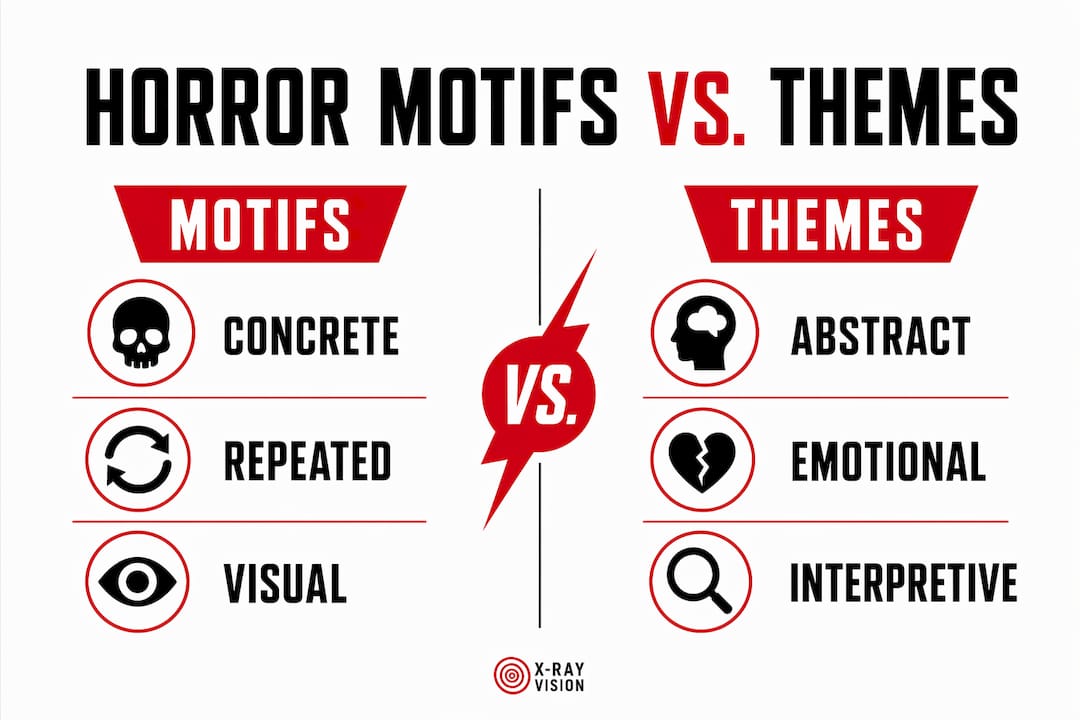
The most common confusion in horror analysis is treating motifs and themes as the same thing. They are not. A motif is a concrete, repeated device. A theme is the abstract idea that device points toward. The dripping faucet in a silent house is a motif. Isolation is the theme it reinforces.
UNC-Chapel Hill's analysis of horror literature identifies four major fear clusters that motifs consistently feed into:
- Fear of death and disease. Motifs like rotting flesh, plague imagery, and the undead all funnel into this cluster. They make mortality visible and immediate.
- Fear of isolation. Empty corridors, abandoned towns, and characters cut off from help repeat throughout horror to trigger the primal terror of being alone and unprotected.
- Fear of the unknown. Unexplained sounds, figures glimpsed at the edge of vision, and forbidden doors all activate this cluster. The unknown is scarier than any revealed monster.
- Fear of psychological trauma. Unreliable narrators, fractured memories, and identity loss are motifs that point toward the terror of losing control of your own mind.
Each motif you spot in a horror text belongs to at least one of these clusters. Mapping that connection is the core skill of horror analysis.
Pro Tip: When you read a horror story, keep a running list of repeated images or situations. After finishing, sort each one into the four fear clusters above. Patterns will emerge that reveal the text's deeper thematic concerns.
Understanding horror themes becomes much clearer once you treat motifs as the entry points. The motif is the door. The theme is the room behind it. For a deeper look at how these themes operate across the genre, the examples of horror themes guide at Markwatsonbooks breaks this down with specific textual examples.
What are classic gothic and atmospheric horror motifs?
Gothic fiction established the foundational vocabulary of horror motifs that writers still use today. Gothic settings function as motif systems that externalize inner turmoil rather than simply providing a creepy backdrop. The ruined castle is not just a location. It represents the crumbling of order, the weight of the past, and the impossibility of escape.
The most recognizable classic gothic motifs include:
- Ruined or decayed architecture. Crumbling castles, rotting mansions, and flooded crypts signal that something has gone deeply wrong. The decay is always moral and psychological, not just physical.
- Claustrophobic spaces. Narrow corridors, locked rooms, and underground passages create physical confinement that mirrors psychological entrapment.
- Supernatural intrusion. Ghosts, demons, and cursed objects represent the past forcing itself into the present. The living cannot escape what the dead left unresolved.
- Persecution and pursuit. A protagonist hunted through dark spaces is one of the oldest horror structures. It activates pure survival instinct in the reader.
- The double or doppelgänger. A character who mirrors the protagonist but embodies their darkest impulses appears in works from Edgar Allan Poe's William Wilson to Robert Louis Stevenson's Strange Case of Dr Jekyll and Mr Hyde.
| Motif | Fear cluster | Example text |
|---|---|---|
| Ruined mansion | Isolation, psychological trauma | Shirley Jackson's The Haunting of Hill House |
| Supernatural intrusion | Fear of the unknown | Henry James's The Turn of the Screw |
| The doppelgänger | Psychological trauma | Poe's William Wilson |
| Claustrophobic space | Isolation, death | Poe's The Cask of Amontillado |
Gothic horror motifs also carry social weight. Decayed ruins and haunted spaces articulate unresolved social tensions, such as class conflict, repressed sexuality, and colonial guilt. The horror is never purely personal.
Pro Tip: When analyzing a gothic setting, ask: whose psychological state does this space reflect? The answer almost always points directly to the text's central theme.
How do modern horror motifs differ across subgenres?
Contemporary horror has expanded the motif vocabulary far beyond gothic ruins. Three subgenres stand out for their distinct and politically charged motif systems.
Body horror centers on the body under threat. Transformation, mutation, infection, and loss of physical autonomy are its defining motifs. These are not arbitrary gross-out images. Body horror explores contested bodily autonomy and biological anxiety, making it one of the most politically resonant subgenres. David Cronenberg's films and Clive Barker's fiction use flesh as a site of social commentary. When a character's body transforms against their will, the motif speaks to fears about medical control, identity, and what it means to be human.
Occult horror builds its motifs around forbidden knowledge and ritual transgression. Christine Maree Reid's analysis defines occult horror by procedural ritual, secret knowledge, and the infection of domestic life by supernatural forces. The motifs here include grimoires, summoning circles, corrupted religious symbols, and ordinary spaces made sinister by hidden ceremony. The dread comes from the sense that the rules of reality have been broken and cannot be repaired.
Psychological horror relies on motifs of unreliable perception, fractured identity, and isolation. The horror is internal. Motifs include mirrors that lie, voices only the protagonist hears, and memories that contradict each other. Films like Hereditary and novels like House of Leaves by Mark Z. Danielewski use these devices to make the reader question what is real alongside the character. This subgenre connects directly to the psychology of fear that Markwatsonbooks explores in depth.
The key distinction across all three subgenres is this: the motif is always a surface manifestation of a deeper anxiety. Body horror externalizes biological and political fear. Occult horror externalizes the terror of knowledge without wisdom. Psychological horror externalizes the terror of losing yourself.
How do you analyze and explain horror motifs in a story?
Analyzing horror motifs is a learnable skill. The process follows a clear sequence that works for both literature and film.
- Identify repetition first. A motif only becomes a motif through repetition. Note every time a specific image, situation, or phrase recurs. One appearance is detail. Three appearances is a pattern.
- Name the motif precisely. Do not write "scary stuff happens." Write "the protagonist repeatedly encounters locked doors she cannot open." Precision is the foundation of good analysis.
- Map it to a fear cluster. Using the four clusters from UNC-Chapel Hill, assign the motif to death/disease, isolation, the unknown, or psychological trauma. Some motifs belong to more than one cluster.
- Ask what the motif externalizes. Gothic fiction scholarship teaches that motifs externalize psychological conflict. What internal or social tension is this recurring image making visible?
- Connect to theme. The motif is your evidence. The theme is your argument. State the connection explicitly: "The repeated motif of locked rooms reinforces the theme of psychological entrapment."
The most common mistake students make is confusing motifs with themes. A motif is always concrete and repeatable. A theme is always abstract. If you can photograph it, it is a motif. If you need a sentence to explain it, it is a theme.
Pro Tip: For film analysis, pause and screenshot every recurring visual. Lay them side by side. The pattern becomes undeniable when you can see all instances at once.
Horror motifs in films operate the same way as in literature, but the visual channel adds color, sound, and composition as additional layers of meaning. The literary devices in horror guide at Markwatsonbooks covers how these devices sustain dread across both mediums.
Key takeaways
Horror motifs are the concrete, repeated devices that carry a story's fear themes. Mastering their identification and interpretation is the foundation of serious horror analysis.
| Point | Details |
|---|---|
| Motifs vs. themes | Motifs are concrete and repeated; themes are abstract ideas motifs point toward. |
| Four fear clusters | Death/disease, isolation, the unknown, and psychological trauma organize most horror motifs. |
| Gothic motifs externalize conflict | Ruined settings and supernatural intrusions represent psychological and social tensions, not just atmosphere. |
| Subgenre motifs carry politics | Body horror, occult horror, and psychological horror each use distinct motifs tied to real-world anxieties. |
| Analysis follows a sequence | Identify repetition, name it precisely, map it to a fear cluster, then connect it to theme. |
Why motif literacy changed how I read horror
Horror is not just about fear. Joe Fletcher at UNC-Chapel Hill frames horror as a lens into individual and societal vulnerabilities. That framing changed everything for me.
Before I understood motifs, I read horror for the adrenaline. After I understood them, I started reading horror for the argument. Every haunted house is a thesis about the past. Every body horror transformation is a position on autonomy. Every occult ritual is a question about what knowledge costs. The surface scares are the delivery mechanism. The motif is the message.
The most rewarding shift is recognizing that horror writers are not trying to traumatize you. They are using fear as a precision instrument to make you feel the weight of ideas that abstract language cannot carry. Shirley Jackson does not tell you that psychological isolation destroys the self. She builds Hill House and lets the walls do it for you.
My honest advice to students: resist the urge to decode every motif into a single symbolic meaning. Motifs are not codes with one correct answer. They are pressure points that activate different fears in different readers. The locked door in one story means entrapment. In another, it means the boundary between the known and the unknown. Context always governs interpretation.
The genre rewards patience. The more horror you read with motif awareness, the more you realize that the best horror writers are also the most precise thinkers about human vulnerability.
— Mark
Horror books rich with motifs, curated by Markwatsonbooks
If you want to put motif analysis into practice, reading widely across horror subgenres is the fastest way to sharpen that skill.

Markwatsonbooks has assembled a curated horror collection that spans gothic atmosphere, psychological dread, and modern internet horror. The titles range from classic fear structures to contemporary Creepypasta anthologies, giving you a full spectrum of motifs to study and enjoy. The complete books catalog includes works across every horror subgenre discussed here, from occult ritual to body horror to psychological unraveling. Each title is a working example of the motif systems covered in this guide.
FAQ
What are horror motifs?
Horror motifs are concrete, repeated narrative or visual devices used to generate fear and dread in a story. They differ from themes, which are the abstract ideas those devices point toward.
How are motifs different from themes in horror literature?
A motif is always a specific, repeatable image or situation, such as a locked door or a flickering light. A theme is the abstract concept it supports, such as isolation or loss of control.
What are the most common horror motifs in films?
The most common horror motifs in films include haunted spaces, the doppelgänger, supernatural intrusion, and the body under threat. Each connects to a core fear cluster such as isolation, the unknown, or psychological trauma.
Why do gothic horror settings function as motifs?
Gothic settings like ruined castles and decayed mansions externalize psychological and social conflict rather than simply providing atmosphere. The decay of the space mirrors the inner state of the characters or the moral corruption of a family or society.
How does studying horror motifs improve literary analysis?
Mapping motifs to fear clusters and then connecting them to themes gives you a structured argument about what a horror text is actually doing. Horror functions as a lens into individual and societal vulnerabilities, and motif analysis is the tool that makes those vulnerabilities visible.