

TL;DR:
- Modern horror now emphasizes psychological and social fears driven by Gen Z's anxieties rather than physical monsters. Digital-native creators and low-budget production models fuel the genre's rapid growth and high box office returns. Liminal horror uses mundane transitional spaces and analog aesthetics to evoke unease rooted in internet culture.
Modern horror is defined by psychological dread over physical monsters, and that shift is rewriting the genre's rules entirely. By mid-2026, original low-budget horror titles are reaching up to $280 million in domestic revenue, proving that fear sells better than spectacle. Young, digitally native creators are driving this surge, pulling themes straight from Gen Z's lived anxieties: loneliness, surveillance, fractured identity, and the creeping unease of online life. Modern horror trends are no longer about what lurks in the dark. They are about what already lives inside your head.
What are the defining modern horror trends right now?
The most significant shift in contemporary horror themes is the move from external threats to internal ones. Traditional monsters represented dangers outside the self. Today's horror uses those same narrative slots to represent anxiety, alienation, and emotional vulnerability. The genre has become a mirror, and what it reflects is unsettling precisely because it is so familiar.
Gen Z loneliness is the defining emotional fuel of this era. Research shows 80% of Gen Z reported feeling lonely in the past year, compared to only 45% of Baby Boomers. That gap is enormous. Horror filmmakers have noticed, and they are building entire narratives around it.
Dr. Katie Barge, a cultural psychologist, captures the shift precisely:
"Modern horror translates raw emotional textures such as anxiety and alienation into visceral experiences, reflecting Gen Z's complex relationship with intimacy."
This is why so many current horror films feel less like thrill rides and more like emotional exposure. The fear is not that something will chase you. The fear is that no one will notice if it does.
Popular horror genres today cluster around several recurring anxieties:
- Parasocial obsession: Stories where fans, followers, or online relationships turn predatory
- Surveillance and visibility: Characters who cannot escape being watched, or who desperately want to be seen
- Intimacy horror: The terror of being truly known by another person, or of being completely unknown
- Digital alienation: Protagonists trapped in systems, platforms, or feedback loops they cannot exit
These themes resonate because they are not metaphors for Gen Z's experience. They are direct descriptions of it. Internet culture and loneliness are not background noise in these films. They are the monster.
Pro Tip: If you want to understand why a horror film hits differently than expected, ask what social anxiety it is actually about. The surface threat is rarely the real one.
What is liminal horror and why is it exploding?
Liminal horror is defined as a subgenre that uses transitional, mundane spaces to generate dread without relying on jump scares or explicit monsters. The word "liminal" refers to threshold spaces: places you pass through but never stay in. Empty shopping malls at 3 AM. Fluorescent-lit stairwells. Childhood playgrounds after dark. These spaces feel wrong because they are familiar but emptied of their usual context.
Films like Backrooms and Skinamarink use grainy analog footage and undefined presences to evoke a somber, surreal atmosphere rooted in internet culture. The Backrooms concept originated as an online creepypasta, a user-generated horror story shared across forums and social platforms. Its transition to film is a perfect example of how digital horror culture is feeding directly into mainstream cinema.
The visual grammar of liminal horror is specific and deliberate:
- Analog aesthetics: VHS grain, washed-out colors, and degraded image quality that evoke nostalgia while signaling wrongness
- Absence over presence: The horror comes from what is missing, not what appears
- Mundane settings: Spaces that should be safe but feel profoundly abandoned
- Slow pacing: Long, unbroken shots that force the viewer to sit with discomfort
| Feature | Traditional horror | Liminal horror |
|---|---|---|
| Primary threat | Visible monster or killer | Undefined presence or wrongness |
| Setting | Isolated, exotic, or dangerous | Familiar, transitional, mundane |
| Visual style | High production, sharp imagery | Grainy, analog, degraded footage |
| Scare method | Jump scares, gore | Sustained unease, atmosphere |
| Cultural origin | Studio development | Internet communities, creepypasta |
The connection to online culture is not incidental. Liminal horror grew out of forums, image boards, and collaborative storytelling platforms where users built shared mythologies around unsettling images and "what if" scenarios. That communal origin gives it an authenticity that studio-manufactured horror often lacks.
How are young digital-native creators changing horror filmmaking?
The future of horror is being written by directors who learned their craft on YouTube before they ever touched a film camera. Kane Parsons (Backrooms) and Kyle Edward Ball (Skinamarink) both built audiences online before transitioning to feature films. Their success is not accidental. It reflects a structural advantage that digital-native creators hold over traditional filmmakers.
These creators already understand their audience at a granular level. They know which images go viral, which narrative beats generate comments, and how to sustain tension across short-form content before scaling those skills to feature length. YouTube serves as a key incubator for horror directors, converting online followings into successful feature projects while minimizing financial risk for studios.
The advantages of this model are concrete:
- Built-in audiences: Creators arrive with followers who are already invested in their aesthetic
- Low production costs: Familiarity with minimal-equipment filmmaking keeps budgets tight and creative control high
- Faster iteration: Online feedback loops let creators test ideas before committing to full productions
- Authentic voice: Stories drawn from real digital experiences feel genuine to audiences who share those experiences
Analysts note that horror now functions as a meritocracy for young creators, bridging internet culture and traditional filmmaking in ways that resonate with audiences' real-time fears. Parasociality, digital alienation, and the anxiety of constant visibility are not abstract concepts for these filmmakers. They lived them.
Pro Tip: When a horror film feels unusually authentic, check the director's background. Odds are strong they built their audience online before they built their career in film.
How do production and distribution strategies fuel horror's dominance?
Horror's box office dominance in 2026 is not purely about cultural resonance. It is also the result of deliberate production and distribution strategies that make the genre uniquely profitable. Successful horror properties now release sequels within 18 months, compared to the 5-year development cycles that were standard in previous decades. That speed keeps audiences engaged and studios profitable.
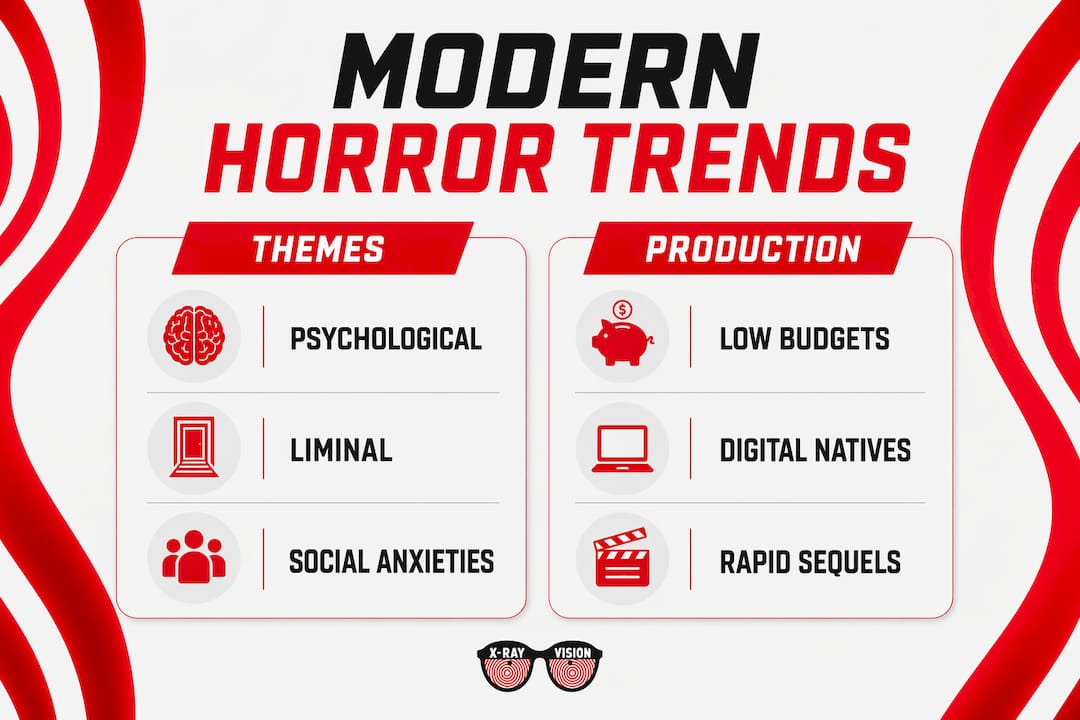
The financial model is straightforward. Low budgets mean lower risk. A film that costs $5 million and earns $100 million domestically is a far better investment than a $200 million blockbuster that needs $400 million to break even. Horror's low-budget, high-return structure gives studios room to take creative risks that they would never accept in other genres.
The modern horror audience skews heavily under 25, and this group returns for repeat viewings while sharing clips and reactions on social media. That behavior extends theatrical runs organically. Films like Backrooms gained viral traction through social clips before their theatrical releases, effectively crowdsourcing their own marketing campaigns.
Horror has also shed its seasonal identity. The genre no longer clusters around Halloween. Studios now release horror titles year-round, treating it as a consistent revenue stream rather than a holiday spike. Social media communities sustain interest between releases, keeping franchises alive and audiences primed for the next entry.
Watching horror films can lower baseline stress by providing a contained emotional release. That psychological function makes horror uniquely recession-proof. When real-world anxiety spikes, horror viewership rises to match it.
Key Takeaways
Modern horror's dominance in 2026 is driven by psychological themes, digital-native creators, and a low-budget production model that turns Gen Z anxiety into box office gold.
| Point | Details |
|---|---|
| Psychological themes dominate | Contemporary horror centers on loneliness, intimacy fears, and digital alienation rather than physical monsters. |
| Gen Z drives the genre | 80% of Gen Z reported feeling lonely in the past year, and horror filmmakers are building narratives around that reality. |
| Liminal horror is rising fast | Transitional spaces and analog aesthetics define this emerging subgenre, rooted in internet creepypasta culture. |
| Digital-native creators lead | Directors like Kane Parsons and Kyle Edward Ball prove that YouTube audiences translate directly into feature film success. |
| Low budgets, high returns | Original horror titles are reaching up to $280 million domestically, with sequels now arriving within 18 months. |
Why modern horror feels more personal than ever
Horror has always been a genre that tells the truth about what a culture fears most. What strikes me about the current moment is how specific that truth has become. We are not talking about vague existential dread. We are talking about the exact texture of scrolling alone at 2 AM, of watching someone's curated life and feeling invisible by comparison, of being surrounded by connection and still feeling completely isolated.
The filmmakers driving this shift are not interpreting Gen Z anxiety from the outside. They grew up inside it. That is why films like Skinamarink feel less like horror movies and more like recovered memories. The horror storytelling techniques that work best right now, withholdment, sensory fragments, ambiguity, are the same techniques that make a half-remembered nightmare more frightening than any explicit image.
I also think the democratization of horror filmmaking is genuinely exciting. When a creator with a camera and an internet audience can produce a film that earns $100 million, the genre stops being a closed club. That openness produces stranger, braver, more personal work. Ramsey Campbell, one of horror's most respected voices, has long argued that authentic horror writing demands genuine emotion over formula. The best current filmmakers and writers are proving him right.
The social meaning embedded in today's horror films is what will make them last. Trends fade. Genuine fear does not.
— Mark
Horror collections that capture these themes
Markwatsonbooks sits at the intersection of these trends, with a catalog that spans horror thrillers and internet horror anthologies built around the creepypasta tradition that gave liminal horror its cultural roots.

If the themes in this article resonate, the Markwatsonbooks horror collection is a strong starting point. For readers drawn specifically to the internet horror tradition, the Creepypasta anthology series collects the stories that shaped online horror culture, featuring characters like Slenderman, Jeff the Killer, and BEN Drowned. These are the narratives that fed directly into liminal horror's rise. Reading them is not just entertainment. It is context for understanding where the genre is going next.
FAQ
What defines modern horror trends in 2026?
Modern horror trends center on psychological and social anxieties rather than physical monsters, with themes like loneliness, digital alienation, and intimacy fear driving the genre. Low-budget productions by digitally native creators dominate the box office, with some titles reaching up to $280 million domestically.
What is liminal horror?
Liminal horror is a subgenre that uses transitional, mundane spaces like empty hallways and fluorescent-lit stairwells to create dread through atmosphere rather than jump scares. Films like Backrooms and Skinamarink use grainy analog visuals and undefined presences rooted in internet creepypasta culture.
Why is Gen Z so central to current horror themes?
Research shows 80% of Gen Z reported feeling lonely in the past year, compared to 45% of Baby Boomers. Horror filmmakers are building narratives directly around that generational anxiety, making the genre feel unusually personal and resonant for younger audiences.
How are horror sequels released so quickly now?
Successful horror properties now release sequels within 18 months, compared to the 5-year development cycles standard in previous decades. Low production budgets reduce financial risk, allowing studios to greenlight follow-ups faster while maintaining strong returns.
What horror storytelling techniques work best today?
The most effective contemporary horror writing uses withholdment, sensory fragments, and ambiguity to activate the reader's imagination rather than describing threats explicitly. This approach produces deeper suspense because the audience projects their own specific fears into the gaps.