
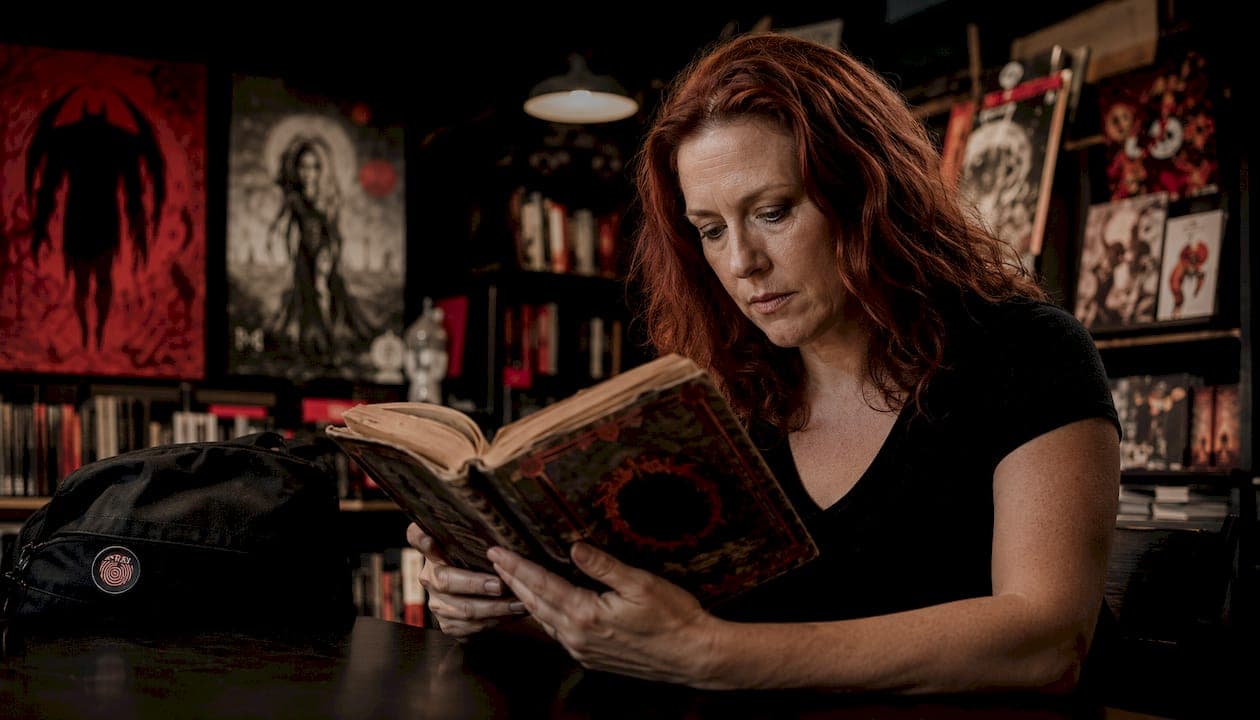
What is the difference between terror and horror?
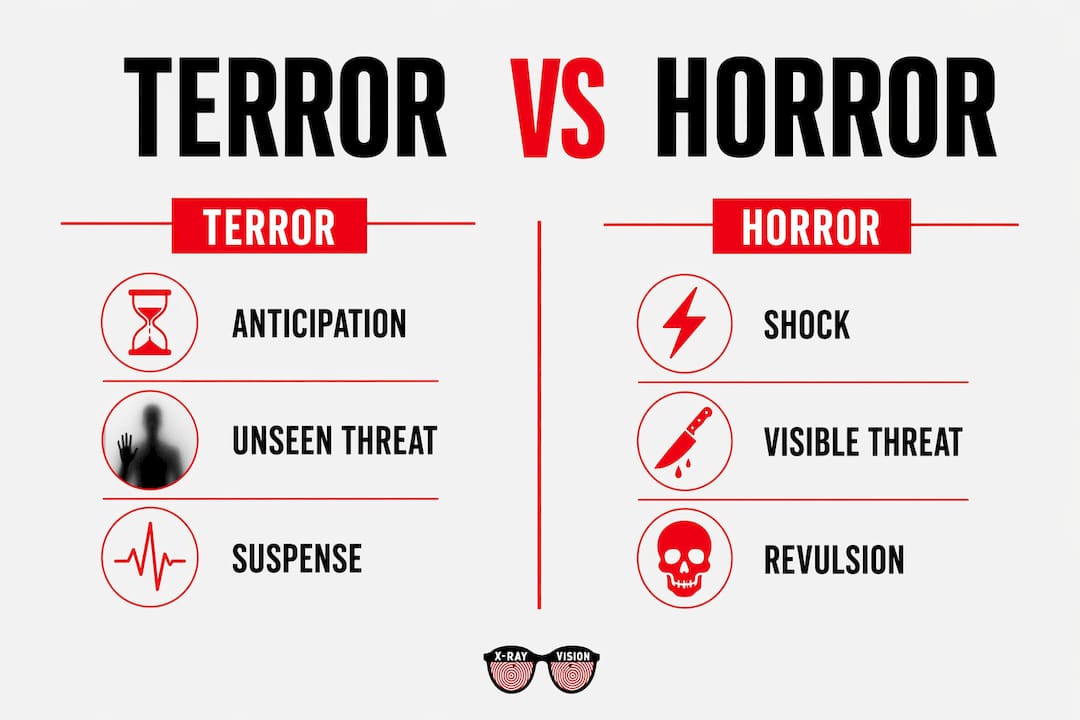
Terror and horror are not the same emotion. Terror is the dread and suspense you feel before a frightening event unfolds. Horror is the shock and revulsion that hits after you've confronted the dreadful reality. That single distinction, anticipation versus realization, shapes everything from Gothic novels to modern slasher films.
Ann Radcliffe, the 18th-century Gothic writer who first drew this distinction, described terror as something that "expands the soul and awakens the faculties to a high degree of life." Horror, by contrast, "freezes and nearly annihilates them." Stephen King built on that framework centuries later, calling terror "the finest element" of fear in his nonfiction book Danse Macabre, placing it above both horror and revulsion in his three-tier hierarchy.
Here's how the two emotions break down at their core:
Terror:
- Rooted in uncertainty and the unknown
- Builds through suspense, dread, and anticipation
- Engages the imagination to fill in frightening gaps
- Prolongs the emotional experience over time
- Produces a freeze response, holding the audience in anxious suspension
Horror:
- Triggered by explicit, unambiguous stimuli
- Arrives as immediate shock, disgust, or revulsion
- Confronts the audience with a visible, concrete threat
- Tends to be visceral and short-lived in its initial impact
- Can overwhelm emotional faculties when overused
Understanding these two states is the foundation for reading, watching, and writing dark fiction with real depth.
How Ann Radcliffe and Gothic literature defined these emotions
The terror vs horror distinction didn't emerge from modern film criticism. It was born inside Gothic literature, and Ann Radcliffe planted the seed.
Writing in the late 1700s, Radcliffe used her novels to deliberately cultivate terror rather than horror. Her approach was philosophical: she believed that obscurity and uncertainty were the engines of the most powerful fear. When a reader's mind is left to imagine what lurks in the shadows, it conjures something far worse than any author could describe outright. That imaginative engagement was, for Radcliffe, the source of the sublime in Gothic fiction.
Gothic literature as a genre emerged in the mid-18th century with Horace Walpole's The Castle of Otranto (1764), but it was Radcliffe who gave the genre its emotional vocabulary. Her novels, including The Mysteries of Udolpho (1794), leaned into shadowy corridors, unexplained sounds, and threats that stayed just out of sight. The reader's imagination did the heavy lifting.
Devendra Varma captured the distinction memorably in The Gothic Flame (1966): the difference between terror and horror is "the difference between awful apprehension and sickening realization: between the smell of death and stumbling against a corpse." That image says everything. One state lives in the nose; the other lands under your foot.
How terror and horror affect the mind differently
Terror operates as acute anxiety. Your brain registers a potential threat, and the uncertainty of what's coming keeps you locked in a state of heightened alertness. That prolonged suspense is psychologically exhausting in the best possible way. It stretches the emotional experience, pulling the audience deeper into the story's grip.
Horror works differently. It's an immediate, visceral reaction to something seen or realized. Where terror keeps the mind racing forward in dread, horror stops it cold. The shock of confronting explicit depravity, whether a monster's face or an act of brutal violence, triggers revulsion rather than imagination. Philosopher Noël Carroll argued that true horror requires intellectual engagement with the monstrous, not just a fright response. The audience must recognize the creature or act as a transgression of the natural order.

Dread sits between these two states. It's the atmospheric mood that saturates a story before terror peaks. Think of it as the emotional weather: a low, persistent pressure that tells you something terrible is coming without specifying what. Writers who master dread can sustain tension across an entire novel without a single explicit scare.
Pro Tip: If your story feels flat between action scenes, you're probably skipping dread. Build it through sensory details: sounds that don't quite fit, light that behaves wrong, characters who can't explain why they feel watched.
Terror and horror in fiction and film: clear examples
The difference between these two emotions becomes vivid when you look at specific works side by side.
Terror in action:
- The slow build in Alien (1979), where the crew hears movement in the vents before anything appears. The atmospheric dread is the entire first act.
- Shirley Jackson's The Haunting of Hill House, where the house feels wrong before anything overtly supernatural occurs.
- The locked-room sequences in Saw (2004), where victims experience prolonged dread about what the trap will do before it activates.
Horror in action:
- The chest-burster scene in Alien, the moment terror converts to horror in a single, graphic revelation.
- The graphic consequences of Jigsaw's traps in Saw, which shift from suspenseful dread to visceral shock.
- The dinner table scene in The Texas Chain Saw Massacre (1974), which confronts the audience with depravity so explicit it leaves no room for imagination.
| Emotion | Trigger | Narrative technique | Audience response |
|---|---|---|---|
| Terror | Unseen or implied threat | Suspense, atmosphere, suggestion | Prolonged dread, heightened alertness |
| Horror | Explicit, visible threat | Graphic revelation, shock | Immediate revulsion, emotional shutdown |
| Dread | Pervasive sense of doom | Mood, setting, foreshadowing | Sustained unease, anticipation |
| Revulsion | Physical or moral transgression | Gore, depravity | Gag reflex, disgust |
Many films labeled as horror rely mostly on violence without the psychological depth that true horror requires. The genre label and the emotional experience don't always match.
Dread and revulsion: the emotions that complete the picture
Terror and horror don't exist in isolation. They anchor a broader emotional spectrum that includes dread and revulsion, and understanding all four states gives you a complete map of how dark fiction works on an audience.
-
Dread is the sustained, atmospheric feeling of impending doom. It precedes terror and sets the emotional stage. Dread doesn't need a specific threat; it's the sense that something is fundamentally wrong. Gothic settings, minor-key music, and unreliable narrators all generate dread before a single frightening event occurs.
-
Terror is dread made acute. When the threat becomes real and imminent but remains unseen or undefined, dread sharpens into terror. The audience knows something is coming. They just don't know what, or when.
-
Horror follows the revelation. Once the threat becomes explicit and undeniable, terror converts to horror. The imagination stops working because reality has arrived. Horror is the sickening realization Varma described.
-
Revulsion is Stephen King's third tier: the gag reflex. It's the physical disgust triggered by graphic content that crosses into the grotesque. King acknowledged using it as a fallback when he couldn't achieve terror or horror, calling it a "cheap gimmick" he wasn't proud of. Revulsion is the easiest of the four to produce and the least artistically rewarding.
These four states build on each other in sequence. The most effective dark fiction moves through all of them deliberately, using dread and terror to earn the horror and revulsion that follow.
Mark Watson's approach to crafting terror and horror
Mark Watson, whose horror fiction spans psychological thrillers, Creepypasta anthologies, and genre-blending narratives, treats the terror-horror balance as a craft problem with a specific solution: earn the horror by building the terror first.
The instinct for many writers is to reach for shock immediately. A graphic scene lands harder, or so the thinking goes, when the audience isn't prepared. Watson's work pushes back on that. Ambiguity is the more powerful tool. When readers don't know the shape of the threat, their imagination constructs something personal and specific to their own fears. That's a scarier monster than any author can invent outright.
Radcliffe's warning about horror is worth repeating here: constant, explicit horror exhausts the audience's emotional faculties. A story that delivers shock after shock without relief trains readers to go numb. The sublime effect that Gothic literature aimed for, and that the best horror fiction still chases, comes from terror, not from gore.
Pro Tip: Reserve your most explicit horror moment for a single, well-earned beat. Everything before it should be terror. Everything after it should be the emotional fallout. That structure gives horror its maximum impact.
Watson's Creepypasta collections demonstrate this rhythm across short-form storytelling, where the constraint of brevity forces writers to choose between suggestion and revelation. The best entries in those anthologies use suggestion almost exclusively, letting the reader's mind do the work.
What you see, what you imagine, and what you never see at all
The sensory dimension of terror versus horror is where the two emotions diverge most sharply in practice. Terror lives in what is implied. Horror lives in what is shown.
A closed door with scratching behind it is terror. The same door opened to reveal what was scratching is horror. The camera that pans away just before impact keeps the audience in terror. The camera that holds on the aftermath delivers horror. Writers and directors make this choice constantly, and it determines the emotional register of every scene.
Radcliffe understood that the mind fills gaps with its worst possibilities. A reader who never sees the monster imagines the version of the monster that frightens them most. That's why suggestion is so powerful: it's personalized fear. The moment you show the creature, you've replaced the reader's imagination with your own, and your version will never be as frightening to them as theirs was.
How setting and atmosphere create terror or horror
Setting does different work for terror than it does for horror. Terror requires environments that feel uncertain, where the rules aren't clear and the geography is disorienting. Gothic mansions, fog-covered moors, and labyrinthine corridors all generate terror because they deny the audience a clear view. You can't see far enough ahead to know what's coming.
Horror, by contrast, often uses stark, clinical, or brutally ordinary settings to amplify its impact. The bright fluorescent lights of a hospital corridor or the mundane suburban home in Halloween (1978) make the horror more disturbing because the setting offers no excuse for what happens there. The contrast between familiar environment and monstrous event is itself a source of shock.
Atmosphere is the sustained emotional tone that setting produces over time. A story can establish an atmosphere of dread through weather, sound design, character behavior, and pacing long before any frightening event occurs. That atmospheric groundwork is what separates a film that genuinely unsettles from one that merely startles.
How different cultures interpret terror and horror
The terror vs horror distinction plays out differently across cultural contexts, and those differences reveal a lot about what each culture fears most.
Japanese horror cinema, particularly the J-horror wave of the late 1990s and early 2000s, leans heavily into terror. Films like Ringu (1998) and Ju-On: The Grudge (2002) build prolonged dread through ambiguity, slow movement, and threats that don't follow logical rules. The horror, when it arrives, often comes from the uncanny rather than the graphic. American audiences encountering these films for the first time frequently described them as more frightening than anything in the domestic horror tradition, precisely because the threat remained so undefined.
American horror has historically favored a more direct approach, with explicit violence and graphic revelation playing a larger role. The slasher genre, which peaked in the late 1970s and 1980s, prioritized horror and revulsion over sustained terror. European art-house horror, from Italian giallo to French extreme cinema, occupies a different position again, often treating horror as a philosophical or aesthetic experience rather than a purely visceral one.
These cultural patterns aren't fixed. The global exchange of horror media has blurred the lines, and contemporary filmmakers draw from multiple traditions simultaneously.
How authors and filmmakers use these emotions to get different responses
The choice between terror and horror is ultimately a choice about what kind of relationship you want with your audience. Terror asks readers to participate. It requires their imagination, their anxiety, their willingness to stay in a state of uncertainty. That participation creates investment. An audience that has spent an hour dreading something cares deeply about the resolution.
Horror asks for a reaction. It delivers a stimulus and waits for the response. That response can be powerful, but it's passive compared to the active engagement terror demands. A horror suspense technique that combines both states gets the best of each: the investment of terror and the cathartic release of horror.
Filmmakers who understand this use the camera as a tool for controlling information. What the lens reveals and what it withholds determines whether a scene produces terror or horror. Authors do the same with point of view and narrative distance. A close first-person narrator who can't see clearly generates terror. A wide, omniscient view that shows everything generates horror.
The mechanisms that make terror and horror work on an audience
Terror operates through suspense, which is the gap between what the audience knows and what they fear might happen. Hitchcock called it the difference between surprise and suspense: a bomb going off under a table is surprise; knowing the bomb is there for ten minutes before it goes off is suspense. Suspense is terror's primary mechanism, and it works because the audience's imagination is always running ahead of the narrative.
Horror operates through shock, which is the sudden confrontation with something the audience wasn't fully prepared for, even if they anticipated it. The moment of monstrous revelation in a horror film lands hardest when it arrives slightly differently than expected. Pure shock without any preceding suspense produces only a startle reflex, which fades immediately. Horror that follows sustained terror produces something that lingers.
The most effective dark fiction uses both mechanisms in sequence. Build suspense long enough to generate genuine dread and terror, then deliver the revelation with enough specificity and force to produce real horror. That sequence, suspense to shock, terror to horror, is the architecture of the genre at its best. Readers who want to experience that architecture across short-form storytelling will find it throughout the Creepypasta collections at Markwatsonbooks, where the format demands that every word earns its place in building toward that final, inevitable reveal.
Key Takeaways
Terror is the anticipatory dread before a frightening event; horror is the visceral shock and revulsion that follows the explicit revelation, and the most effective dark fiction uses both in deliberate sequence.
| Point | Details |
|---|---|
| Terror precedes horror | Terror is anticipatory dread; horror is the shock of explicit confrontation with the frightening reality. |
| Radcliffe's framework | Ann Radcliffe defined terror through obscurity and horror through unambiguous atrocity, shaping Gothic literature's emotional vocabulary. |
| King's three tiers | Stephen King ranked terror as "the finest element," above horror and revulsion, in his hierarchy of fear. |
| Imagination vs. revelation | Terror engages the audience's imagination; horror replaces it with explicit stimulus, making suggestion the more powerful tool. |
| Dread and revulsion complete the spectrum | Dread sustains terror atmospherically; revulsion is the physical gag-reflex aftermath of horror, King's acknowledged "cheap gimmick." |