

TL;DR:
- Suspense in children's books creates eager anticipation without involving monsters or fear, engaging young readers emotionally.
- Techniques like foreshadowing, cliffhangers, and pacing build tension across different formats, fostering empathy, critical thinking, and stamina.
Most parents and educators hear "suspense" and picture something dark, frightening, or inappropriate for young readers. That assumption is wrong, and it quietly blocks children from some of the most engaging stories ever written. What is suspense in children's books, really? It's the art of making a reader lean forward, hold their breath, and need to turn the page. No monsters required. Suspense is the quiet engine behind every beloved children's story, from a piglet worrying about a spider's fate to a young wizard about to face his first real challenge.
Table of Contents
- Key Takeaways
- What suspense in children's books actually means
- Core suspense techniques in children's storytelling
- How suspense scales across different kids' book formats
- The real benefits of suspense for young readers
- Practical tips for parents and educators
- My honest take on suspense in children's stories
- Explore suspenseful children's books at Markwatsonbooks
- FAQ
Key Takeaways
| Point | Details |
|---|---|
| Suspense is not just fear | Suspense is anxious anticipation, and it works beautifully in friendship, school, and adventure stories too. |
| Techniques drive the tension | Foreshadowing, cliffhangers, and pacing are the core tools that create suspense in kids' stories. |
| Format shapes intensity | Picture books use page turns for quick suspense, while chapter books sustain tension across multiple scenes. |
| Suspense builds real skills | Young readers develop empathy, critical thinking, and a love of reading through well-crafted suspenseful stories. |
| Adults play an active role | Parents and educators can guide children to recognize and even create suspense in their own storytelling. |
What suspense in children's books actually means
Suspense is not a synonym for scary. At its core, suspense creates anxious anticipation about uncertain outcomes, keeping readers emotionally invested in what happens next. Think of it as the gap between a question and its answer. The longer and more skillfully that gap is held open, the more engaged the reader becomes.
In adult fiction, suspense often involves high stakes like physical danger, moral collapse, or life-altering decisions. In children's books, those stakes are scaled to what children genuinely care about. Will the new kid at school find a friend? Will the lost puppy make it home? Will the hero beat the clock before the school play starts? These questions carry real emotional weight for young readers, and that weight is the fuel for suspense.
Several key elements make a children's story feel suspenseful:
- Uncertainty: The reader genuinely does not know how things will turn out
- Emotional connection: The reader cares about the character facing the uncertain situation
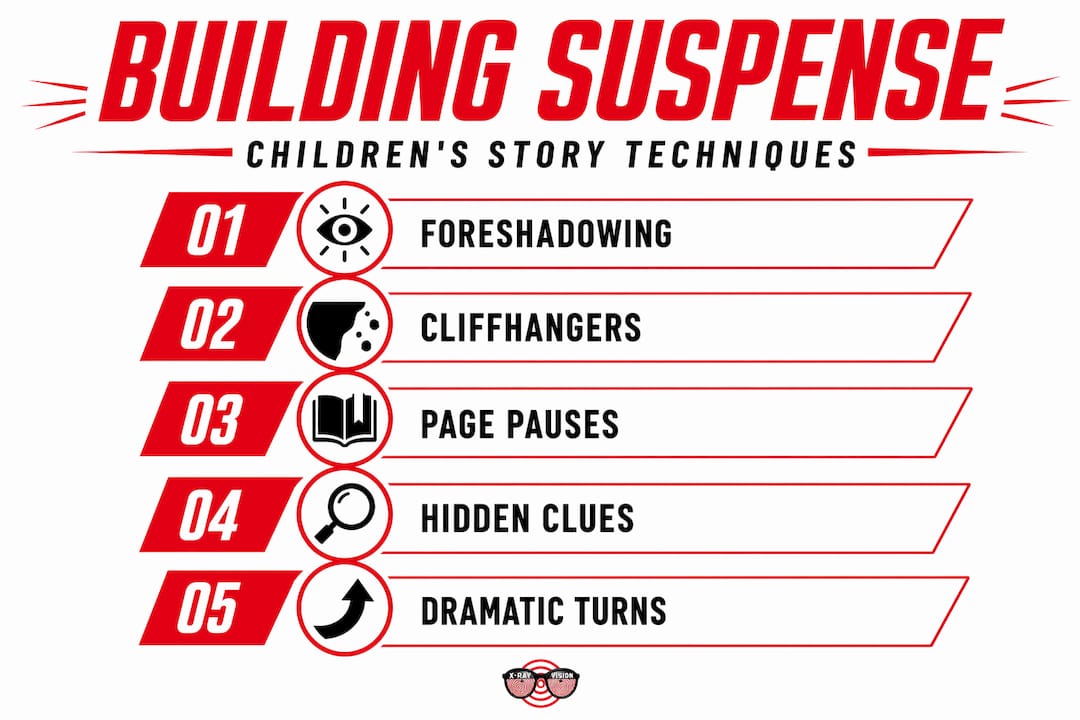
- Foreshadowing: Small clues that hint something important is coming without giving it away
- Cliffhangers: A scene, chapter, or page that ends before the question is resolved
- Pacing: Slowing the story down right before a big reveal to make the moment feel earned
Foreshadowing and cliffhangers are especially powerful in children's books because young readers are sharp. They notice hints. They feel the pull of an unresolved moment. When used well, these tools teach children how stories work while simultaneously hooking them into the narrative.
Core suspense techniques in children's storytelling
Knowing the techniques behind suspense helps both writers and adult readers understand why certain books feel impossible to put down. Here are the methods that work best in children's fiction, in order of how they typically appear in a story:
-
Drop subtle hints early. Foreshadowing plants seeds of curiosity without revealing the harvest. A creak on the stairs. A strange note tucked under the door. A character who acts just a little too nervous. These details signal to young readers that something is coming, and their brains immediately start predicting.
-
Control what the reader knows. Managing the information gap between what the reader understands and what the character understands is one of the most powerful tools in storytelling. When readers know something a character does not, they feel tension on the character's behalf. When the character knows something the reader does not, curiosity spikes.
-
Make the character feel it. A child who reads about a character's sweaty palms or racing heart immediately mirrors that emotional state. Character nervousness builds empathy and draws young readers deeper into the moment.
-
Slow down right before the reveal. Short, punchy sentences. Pauses built into the prose. Delaying the reveal without denying it entirely keeps readers on edge in the best possible way. Rushing to resolution kills the tension. Dragging it out indefinitely frustrates young readers. The sweet spot is deliberate, confident pacing.
-
End sections with open questions. Chapter endings that leave a problem unsolved are a classic move, and children's authors use them brilliantly. "She opened the door. And there it was." That is a cliffhanger at its simplest and most effective.
-
Use surprises thoughtfully. Not every surprise needs to be a shock. A twist that reframes what the reader thought they knew creates a satisfying kind of surprise that makes children want to go back and re-read earlier moments.
Pro Tip: When reading aloud with children, pause before turning a page or starting a new chapter. That physical pause mimics the effect of a literary cliffhanger and trains young readers to notice tension in the text.
How suspense scales across different kids' book formats
Not all children's books have room for the same type of suspense. Format matters, and suspense duration and intensity should be matched to the child's reading stamina and the book's structure.
| Format | Suspense style | How it works | Example approach |
|---|---|---|---|
| Picture books | Page-turn suspense | Spreads end with an unresolved question; the next page delivers the answer | "What's behind the door?" revealed on the next spread |
| Early chapter books | Scene-level suspense | Tension builds and resolves within a chapter or two | A character's plan goes wrong, then recovers by chapter's end |
| Middle grade novels | Narrative suspense | A central question or threat runs through the entire book | Will the protagonist solve the mystery before the villain wins? |
The page-turn structure in picture books deserves special attention. It is a uniquely tactile form of suspense. The physical act of turning the page becomes a storytelling mechanism. Authors like Mo Willems and Jon Klassen have mastered this. A character's expression on the final panel of a spread creates an entire world of anticipation before the child's hand even reaches the corner of the page.
Middle grade novels operate differently. Books in the Goosebumps series and titles like Hilo or Holes carry suspense across hundreds of pages by asking one central question and delaying its answer with smaller wins, losses, and surprises along the way. This trains children to track tension over time, a skill that serves them deeply as readers and thinkers.
The real benefits of suspense for young readers
Here is what surprises most parents: suspense works across every story genre, not just scary or mystery books. A story about a child trying to keep a secret from her best friend can be deeply suspenseful. So can a tale about a dog trying to find its way home before dinnertime. The emotional mechanism is identical.
The benefits of suspense in children's literature go well beyond "keeping them reading," though that alone is significant:
- Builds genuine curiosity. Children who experience suspense in books learn to ask "what happens next?" as a reading habit, which transforms passive readers into active ones.
- Develops emotional depth. Feeling tension for a character teaches children to identify and process emotions. They practice empathy in a safe, low-stakes environment.
- Strengthens critical thinking. Tracking clues, making predictions, and testing those predictions against story outcomes is essentially analytical thinking in disguise.
- Improves reading stamina. A child who is genuinely hooked does not want to stop. That motivation builds the habit of sustained reading better than any reward chart.
"Suspense is not about scaring children. It's about teaching them that uncertainty is a natural part of life, and that answers, when they come, are worth waiting for."
Understanding tension in kids' books also helps adults engage with children around stories in richer ways. When a parent can point to the moment a story begins to feel tense and ask "what do you think will happen next?", that conversation deepens comprehension and makes reading a shared, exciting experience. For more on how mystery and suspense elements can deepen a child's learning, mystery in kids' stories is worth exploring.
Practical tips for parents and educators
Adults shape how children experience suspense in stories. A few deliberate moves make a real difference:
Talk about the tension out loud. Before turning a page, ask: "What do you think is going to happen?" This simple question activates prediction skills and makes children feel like active participants in the story rather than passive receivers.
When children write their own stories, encourage them to use the "hide and reveal" method. Tell them to think of one thing their main character does not yet know, then decide when and how the reader finds out. Creating suspenseful stories becomes intuitive once children start thinking about information as something to share strategically.
Watch the fear calibration. Suspense techniques in kids' literature work best when they create curiosity rather than genuine distress. If a child seems anxious rather than excited, the pacing or stakes may be too intense for their comfort level at that moment. Back off and revisit later.
Age-appropriate books that use suspense brilliantly include The Bad Guys series (funny suspense through character chaos), A Series of Unfortunate Events (layered narrative mystery), and Charlotte's Web (emotional stakes around a beloved character's fate).
Pro Tip: After finishing a suspenseful children's book together, ask the child to identify the moment the story felt most tense. This exercise builds literary awareness and makes the next read even richer.
My honest take on suspense in children's stories
I've written across multiple genres, from horror thrillers to children's books, and I'll tell you this plainly: suspense is harder to write for children than for adults. With adult readers, you have a wide emotional vocabulary to work with. With children, you have to be surgical.
What I've found is that the most common mistake writers and storytellers make with young audiences is confusing suspense with shock. Shock is easy. Drop something terrifying on the page and the child reacts. But that reaction fades fast, and it can leave kids feeling unsettled in ways that don't serve the story. Real suspense, the kind that makes a child beg for one more chapter at bedtime, comes from caring. They have to care deeply about what happens to someone before uncertainty can work its magic.
In my own children's writing, the moments I'm most proud of are not the dramatic reveals. They're the quiet beats right before the reveal, when the reader knows something is coming but doesn't know what. That tension is where the real emotional work happens.
My advice to parents and educators: do not shy away from books that build genuine tension. Suspenseful storytelling for kids does not harm children. Done well, it builds them up.
— Mark
Explore suspenseful children's books at Markwatsonbooks
If reading this has made you want to put a genuinely gripping children's book into young hands, Markwatsonbooks has you covered.

Mark Watson's children's book collection features stories built around the kind of tension that keeps kids reading long past bedtime, without sacrificing warmth or age-appropriate storytelling. These are books where every chapter ending asks a question, every character feels real, and every reveal lands with satisfying weight. Whether you're a parent looking for your child's next obsession, an educator seeking classroom reads that truly engage, or a book lover who knows quality suspense when you see it, browse the full catalog and find the story that will make your young reader hold their breath.
FAQ
What is suspense in children's books?
Suspense in children's books is the feeling of anxious anticipation created when a reader does not know how a situation will resolve. It keeps young readers emotionally engaged and motivated to continue reading.
What are the main suspense techniques in kids' literature?
The core techniques include foreshadowing, cliffhangers, controlled information gaps, character nervousness, and deliberate pacing before key reveals. These methods work across all children's story genres.
Does suspense have to involve scary content for children?
No. Suspense works just as effectively in friendship, school, and adventure stories. Any uncertain outcome that a child cares about is enough to create genuine tension without fear or dark content.
How does suspense vary between picture books and chapter books?
Picture books use physical page turns to create quick bursts of tension and resolution. Chapter books and middle grade novels sustain suspense across scenes and even the entire narrative arc, building toward a central payoff.
Why is suspense good for young readers?
Suspense builds curiosity, emotional intelligence, critical thinking, and reading stamina. When children track tension and make predictions, they are practicing skills that serve them far beyond the page.