

Morality shapes horror by supplying the ethical questions the genre dramatizes. It functions as a testing ground for values, not a training manual for cruelty. Three things follow from that:
- Horror dramatizes moral choices and boundary-testing, forcing characters (and viewers) to confront what they'd do under pressure.
- It works mostly as catharsis and an ethical thought experiment rather than a straightforward corrupting force. The Argument from Reactive Attitudes questions this, but the strongest defenders of horror, including Jordan Peele's Get Out and classics like The Exorcist and Night of the Living Dead, treat fear as a lens on real dilemmas.
- Some horror does invite genuinely troubling responses. Philosophers such as Scott Woodcock argue those cases deserve pointed critique rather than a blanket defense of the genre.
Key Takeaways
Morality in horror functions primarily as a tool for ethical confrontation and catharsis, with genuine risk concentrated in a small subset of victim-blind, sadism-focused works.
| Point | Details |
|---|---|
| Horror moralizes through structure | Devices like poetic justice, cautionary framing, and the final girl trope encode ethical judgments without lecturing. |
| The ARA is narrow, not sweeping | The Argument from Reactive Attitudes targets specific sadistic works, not the horror genre as a whole. |
| Evidence doesn't support broad corruption claims | Empirical reviews find no consistent link between typical horror consumption and lasting moral harm. |
| Context and victim perspective are the key tests | Ask whether a film centers suffering as spectacle or as consequence before judging its ethics. |
Table of Contents
- The Role of Morality in Horror Through History
- How Horror Narratives Frame Moral Choices
- Why Religious Imagery Keeps Showing Up in Horror
- Moral Psychology, Catharsis, and the Argument from Reactive Attitudes
- Who Horror Moralizes About: Gender, Race, and Disability
- Contemporary Horror and Shifting Moral Ground
- How to Watch and Read Horror With Ethical Awareness
- The Verdict on Morality's Role in Horror
- Why This Analysis Matters
- Find Your Next Ethically Complex Read
- Sources
The Role of Morality in Horror Through History
Horror has been on trial almost as long as it's existed. Every generation finds a new reason to worry that scary stories corrupt the people who love them, and every panic follows a familiar script: identify a format, blame it for social decay, then legislate or boycott.
- 1950s horror comics. Titles like Tales from the Crypt drew congressional scrutiny in the United States after critics argued lurid panels encouraged juvenile delinquency, a claim that shaped the Comics Code Authority for decades.
- 1980s and 1990s "video nasties." British censors banned or heavily cut dozens of films on VHS, arguing that home viewing let violent content bypass theatrical gatekeeping entirely.
- Early 2000s "torture porn." Franchises like Saw and Hostel triggered debate over whether prolonged depictions of suffering desensitized audiences or simply pushed practical effects further than critics were comfortable watching.
Each panic tracked a format shift. Comics allow readers to spend more time on a single violent panel. VHS moved horror out of supervised theaters and into bedrooms. Streaming now lets anyone pause, rewind, or binge past the point a theatrical release would ever allow, and format changes shift how moral risk operates more than the content itself does. The historical record shows plenty of censorship and public alarm but very little evidence that any of these formats caused lasting moral harm.
How Horror Narratives Frame Moral Choices
Horror rarely moralizes by lecture. It moralizes through structure, using devices that turn a scare into a verdict.
Poetic justice is the oldest device: the greedy landlord gets devoured, the cheating teenager doesn't survive the night. Cautionary framing works differently, warning against a specific transgression, opening a forbidden door, trusting the wrong stranger, ignoring a clear signal. Transgression-and-consequence arcs stretch that logic across an entire film, letting a character's moral failure compound scene by scene until the horror becomes inseparable from the choice that caused it.
The final girl trope, a staple of slasher cinema, encodes its own moral argument: survival correlates with vigilance, resourcefulness, and refusal to underestimate the threat, while the trope's critics rightly note it has often punished sexuality more than it's rewarded virtue. Readers interested in how these mechanisms recur across horror motifs will spot the same patterns in slashers, folk horror, and haunted house stories alike.
Watch for these mechanisms the next time a horror film reaches its final act:
- Exposure: a hidden sin or secret surfaces and drives the plot's climax.
- Reversal: the hunter becomes the hunted, often as direct payback for earlier cruelty.
- Sacrificial logic: one character's death or sacrifice restores order for everyone else.
- Scapegoating: blame lands on an outsider or marginalized figure, sometimes fairly, often not.
Why Religious Imagery Keeps Showing Up in Horror
Sin, redemption, and the afterlife are horror's oldest raw material, because religion already supplies a vocabulary for confronting death and evil that the genre can borrow wholesale. Horror frequently stages its confrontations with mortality and moral failure using religious symbols and questions that predate the genre by centuries.
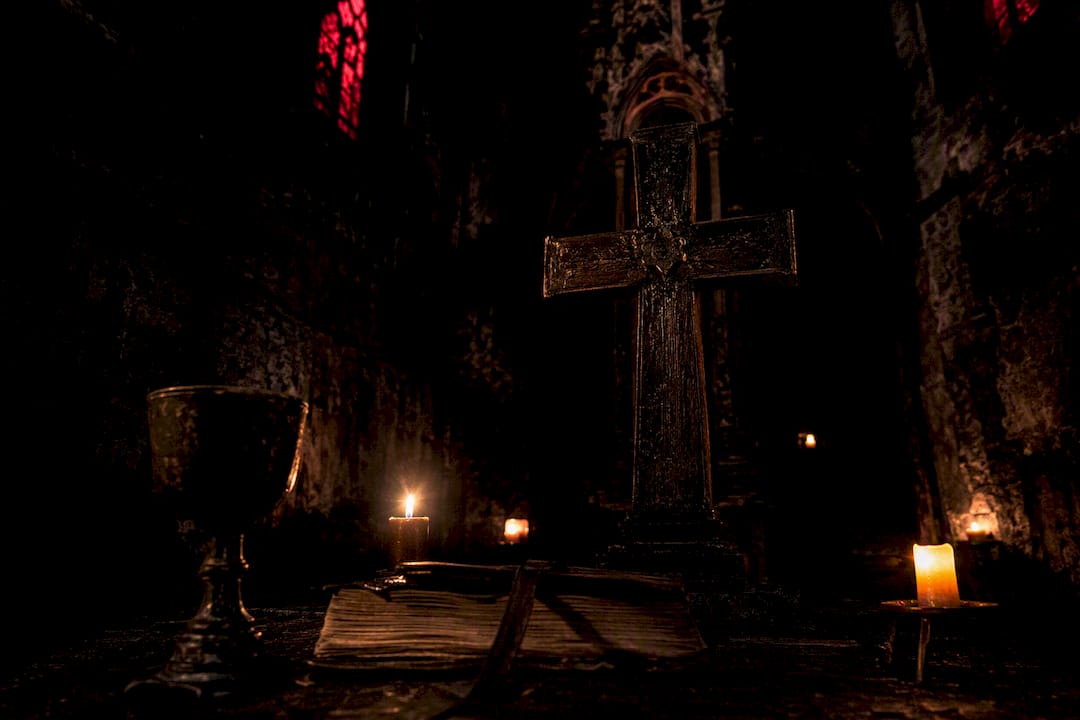
The Exorcist leans hardest into this tradition, framing demonic possession as a literal battle for a soul and casting the priest's doubt as the real moral crisis. Night of the Living Dead takes the opposite route: it strips away overt theology and replaces it with a bleaker, more secular question about who deserves survival when institutions collapse. Both films use imagery that traces back to religious storytelling, but only one treats that imagery as the story's moral engine.
That distinction matters when you're evaluating any film that leans on crosses, holy water, or biblical language. Ask whether the symbolism is doing moral work, staging an actual question about guilt or grace, or whether it's decoration recycled because audiences recognize it instantly. A deeper breakdown of horror symbolism can help you tell the difference on a rewatch.
Moral Psychology, Catharsis, and the Argument from Reactive Attitudes
The Argument from Reactive Attitudes, or ARA, holds that consuming certain horror content can erode a viewer's sympathy and moral responsiveness over time, not by making anyone violent, but by dulling the emotional reflexes that normally accompany witnessing suffering. It's a narrower claim than "horror corrupts," and that narrowness is exactly what makes it worth taking seriously.
Defenders of the genre push back with a simpler observation: audiences mostly watch horror out of curiosity or for catharsis, not to rehearse cruelty, and intent shapes how a scene lands psychologically. Scott Woodcock's work on the ARA doesn't dismiss the concern outright. He argues for case-by-case evaluation rather than a genre-wide verdict, distinguishing works that court sadistic pleasure from ones that keep the victim's perspective front and center. Gianluca Di Muzio and other philosophers writing in this space generally agree the risk is real but narrow, tied to specific narrative choices rather than the genre as a whole.
The strongest ARA cases share a pattern: the camera lingers on suffering without a victim-centered perspective, and there's no aesthetic or political justification offsetting that lingering gaze. Absent those red flags, the same graphic content in a victim-oriented film reads very differently.
The Devil's Rejects is the case defenders concede: its camera spends real time reveling in its killers' cruelty with little counterweight, which is precisely the pattern ARA proponents warn about. Compare that to most victim-oriented slashers, where the audience's sympathy sits with whoever's running, and the ARA concern mostly evaporates. A broad review of the empirical literature found no consistent evidence that ordinary horror consumption makes viewers less empathetic or more sadistic, so the burden of proof sits with the specific film, not the genre.
Before deciding a work has crossed a line, ask:
- Does the narrative center the victim's suffering or the perpetrator's pleasure?
- Is there a countervailing aesthetic or political point being made?
- Would you describe the tone as mournful, angry, or gleeful?
Who Horror Moralizes About: Gender, Race, and Disability
Horror's moral lessons have never been evenly distributed. The slasher genre built decades of plots around punishing female sexuality while rewarding the "pure" survivor, a pattern feminist critics have picked apart for years even as the final girl herself became a figure of resistance in later films that let her fight back rather than merely endure.
Race and disability carry their own uneven history. Horror has repeatedly coded villainy through disfigurement or coded threat through racialized bodies, choices that reinforce real-world stigma rather than challenge it. But the same genre has produced its sharpest rebuttals from inside those tropes. Get Out inverted the "dangerous outsider" formula by making white suburban civility the actual horror, and it isn't alone; a growing body of horror now uses genre conventions specifically to expose the power structures older films took for granted.
The pattern to watch for:
- Does the film punish a marginalized identity, or does it interrogate the systems that marginalize?
- Is disability used as shorthand for menace, or is it given interior life?
- Does the ending reward vigilance and resourcefulness, or does it reward conformity to a narrow social norm?
Contemporary Horror and Shifting Moral Ground
Social horror has pulled the genre's moral center of gravity toward structural critique rather than personal sin. Get Out uses horror explicitly to expose racial injustice rather than to shock for its own sake, turning genre mechanics into a sustained argument about complicity and denial. Psychological horror has moved in a parallel direction: recent films exploring mass violence and social breakdown lean on findings about moral disengagement to explain why ordinary people participate in collective cruelty, drawing on the same psychological groundwork that explains real-world atrocities.
Format keeps reshaping how these moral questions land. Streaming lets viewers pause on a single frame, rewatch a death in slow motion, or binge an entire season's worth of dread in one sitting, changing the texture of moral engagement compared to a single theatrical viewing. That same lingering effect helped drive the "torture porn" debate two decades ago, and it hasn't gone away with better cameras and cleaner platforms.
New voices are also widening what horror considers worth moralizing about. Directors working outside the traditional Hollywood pipeline are bringing folklore, immigrant anxiety, and non-Western religious frameworks into a genre that spent decades recycling the same handful of Western fears. If you're drawn to horror as a shared, discussed experience rather than a solitary one, communal horror gaming offers a useful parallel: group viewing and group play both change how moral reactions get processed, often softening the isolation that makes lingering on disturbing images feel riskier.
How to Watch and Read Horror With Ethical Awareness
Before you press play, ask three questions: whose perspective does the story center, does it linger on suffering as spectacle or as consequence, and does the ending reward cruelty or interrogate it? Those three questions catch most of the ethically shaky material before it has a chance to sit wrong with you.
- Before viewing, check whether you know the creator's intent, satire, social critique, straightforward scares, and set expectations accordingly.
- During viewing, notice whose suffering the camera lingers on and whether the story ever grants that character interior life.
- After viewing, ask whether the ending punished the "right" characters for reasons the story actually earned, or whether it just followed convention.
If a scene leaves you unsettled in a way that feels productive, that's usually the genre working as intended. If it leaves you queasy in a way that feels exploitative, trust that reaction:
- Stop and name specifically what bothered you, the imagery, the framing, the lack of victim perspective.
- Reflect on whether the discomfort is the film doing ethical work or the film failing to do any.
- Seek context: reviews, interviews, or scholarly readings can clarify intent you might have missed.
- Discuss it. Horror hits people differently, and a conversation often surfaces whether your reaction was personal or the film's actual failure.
Pro Tip: Creators and critics reduce harm without softening impact by pairing intense content with brief context, a line about the film's target, its intended audience, or its real-world inspiration, rather than trigger warnings that spoil the scare itself.
The Verdict on Morality's Role in Horror
Horror dramatizes moral choices more often than it corrupts moral character, using fear as the delivery mechanism for questions most genres approach too gently. The evidence, from Woodcock's case-by-case framework to the broader empirical literature, points toward a genre that's ethically complex rather than uniformly dangerous or uniformly redemptive.
That said, complexity isn't the same as innocence. Some films genuinely earn scrutiny, particularly ones that revel in a victim's suffering without any counterweight, and pretending otherwise does the genre no favors.
- Horror works best as a moral instrument when it centers consequence over spectacle.
- The exceptions (gratuitous, victim-blind sadism) are identifiable and worth naming.
- Watch critically, not suspiciously: intent and framing tell you almost everything you need to know.
If you take one habit from this, make it the case-by-case question: what is this specific film asking me to feel, and toward whom?
Why This Analysis Matters
I keep coming back to horror because it's one of the only genres willing to ask its audience uncomfortable questions and then sit in the discomfort rather than resolve it neatly. That's not corruption. That's the genre doing its actual job.
Read critically, and horror rewards you with more than a scare. It hands you a moral puzzle worth carrying out of the theater. Bring that same scrutiny to whatever you read or write next, whether that's a classic like Night of the Living Dead or a new collection of internet horror.
Find Your Next Ethically Complex Read
If the ARA discussion above made you want to test these ideas against actual stories, Markwatsonbooks builds its horror catalog around exactly that kind of moral texture, stories that dramatize consequence rather than simply chase shock value. The Creepypasta Omnibus One collects one hundred and fifty stories built on internet horror's format-specific intensity, the same lingering, screen-based engagement this article traced through comics and streaming alike. For readers who want more after that, Creepypasta Volume 3 adds fifty more tales drawn from the same tradition of internet-native dread. Browse the full book catalog to find the title that matches the kind of moral unease you're actually looking for.
Sources
- The Horror Anomaly | Philosophy Now
- Fear within the frames: horror comics and moral danger — Cambridge Core / Canadian Journal of Philosophy
- Journal of Religion & Film, Vol. 5 2001, Iss. 2, Art. 7
- OUP academic chapter summarizing empirical literature on horror and moral psychology