

TL;DR:
- Horror symbolism uses objects and settings to express deeper psychological and social meanings beyond surface fears.
- Recalling repeated images and their emotional contexts reveals whether symbols serve the story or are merely decorative.
Horror symbolism is defined as the use of objects, characters, and settings to convey psychological, social, and cultural meanings that go far beyond surface-level scares. A doll is never just a doll. A basement is never just a basement. These symbols externalize the fears, traumas, and anxieties that characters cannot speak aloud. Understanding horror symbolism explained through both literary and cinematic lenses reveals why the genre resonates so deeply across generations. Markwatsonbooks explores these themes across its horror fiction catalog, treating symbolism as the engine of meaningful storytelling rather than mere decoration.
What are the most common symbols in horror and what do they mean?
Horror symbols are recurring images that carry layered meaning across stories, films, and cultures. Modern horror cinema increasingly uses visual metaphors like insects, dolls, and blood to explore trauma and social repression. Each symbol earns its power through context, repetition, and the emotional weight a story places on it.
The most recognizable horror symbols include:
- Blood: Represents mortality, guilt, and the body's vulnerability. It marks the moment the safe world breaks open.
- Basements and attics: Basements signal the unconscious mind, buried secrets, and repressed memories. Attics often represent the past pressing down on the present.
- Dolls: Stripped of childhood innocence, dolls signal lost purity, uncanny imitation of life, and the horror of things that should be harmless but are not.
- Fog and darkness: These obscure reality and signal the unknown. They force characters and readers into uncertainty.
- Masks: Masks hide identity and suggest that the real threat is concealed beneath a social surface.
- Animals: Crows signal death. Spiders signal entrapment. Rats signal decay and the collapse of civilization.
The meaning of horror symbols shifts depending on context. A doll in a child's bedroom reads differently than a doll in an abandoned asylum. The setting and narrative framing determine whether a symbol lands as unsettling or merely decorative.
Pro Tip: When analyzing a horror symbol, ask what the character fears most at that moment in the story. The symbol almost always mirrors that specific fear rather than a universal one.
How do filmmakers use horror symbolism to explore psychological fears?
Filmmakers use symbolism to put invisible fears on screen. Psychoanalytic theory explains how horror uses visual symbols to depict internal psychic fragmentation, grounding fear in internal instability rather than external monsters alone. This is why the most disturbing horror films often feature threats that feel personal rather than random.
Guillermo del Toro's Pan's Labyrinth offers one of the clearest examples of political symbolism in horror cinema. The Pale Man symbolizes the collusion between religious institutions and fascist power. His grotesque banquet and child-eating imagery critique religious hypocrisy and authoritarianism directly. Del Toro uses a monster to say what a political speech cannot.
Alejandro Jodorowsky's Santa Sangre takes psychoanalytic symbolism even further. Missing limbs in the film reflect castration anxiety and loss of autonomy, blending Freudian concepts with Mexican spiritual motifs. The anatomical imagery becomes a proxy for mental instability and family trauma. Every severed arm carries the weight of a broken relationship.
"Visual sublimity in horror allows audiences to confront repressed emotions through grotesque imagery. The symbol does not explain the fear. It is the fear, made visible and inescapable."
Horror also uses social meaning in film to address collective anxieties. Insects crawling across a character's skin do not just signal disgust. They signal a loss of control over one's own body and environment. The symbol works on the audience's nervous system before the conscious mind catches up.
What is the difference between meaningful archetypes and conventional horror symbols?
Not every cross, skull, or haunted mirror carries genuine symbolic weight. Religious symbols in horror have become aesthetic conventions that often fail to connect with deeper moral or emotional questions. When a crucifix appears in a horror film purely because it looks ominous, it functions as shorthand rather than symbol. The distinction matters because one creates meaning and the other creates noise.
A meaningful archetype earns its place through narrative function. Consider these contrasting examples:
- Hollow convention: A pentagram drawn on a floor to signal "evil is here." The story does not develop what that evil represents or why it threatens these specific characters.
- Meaningful archetype: The recurring horror motifs in a story where a character's childhood home appears in nightmares, each time slightly more distorted. The home represents a trauma the character cannot process. Its distortion tracks the character's psychological deterioration.
Many modern horror films rely on symbols as meaningful archetypes rather than empty aesthetics, which deepens viewer engagement and creates stories that linger long after the credits roll. The test is simple: remove the symbol and ask whether the story loses meaning. If the answer is no, the symbol is decoration. If the story collapses without it, the symbol is doing real work.
Point-of-view framing separates authentic symbolism from aesthetic shorthand. What characters omit carries symbolic weight just as much as what they notice. A character who refuses to look at a particular object tells the audience that object holds unbearable significance.
Pro Tip: Track which symbols a story returns to repeatedly. Genuine symbolic storytelling revisits the same image in different emotional contexts. Pure aesthetic use plants a symbol once and moves on.
How does spatial positioning and repetition build symbolic meaning?
Cinematic technique turns ordinary images into charged symbols through placement and recurrence. Spatial positioning in films communicates psychological conflicts without explicit dialogue. A character framed in a doorway signals liminality, the state of being caught between two worlds. A character filmed from below signals powerlessness. The frame itself becomes a symbolic language.
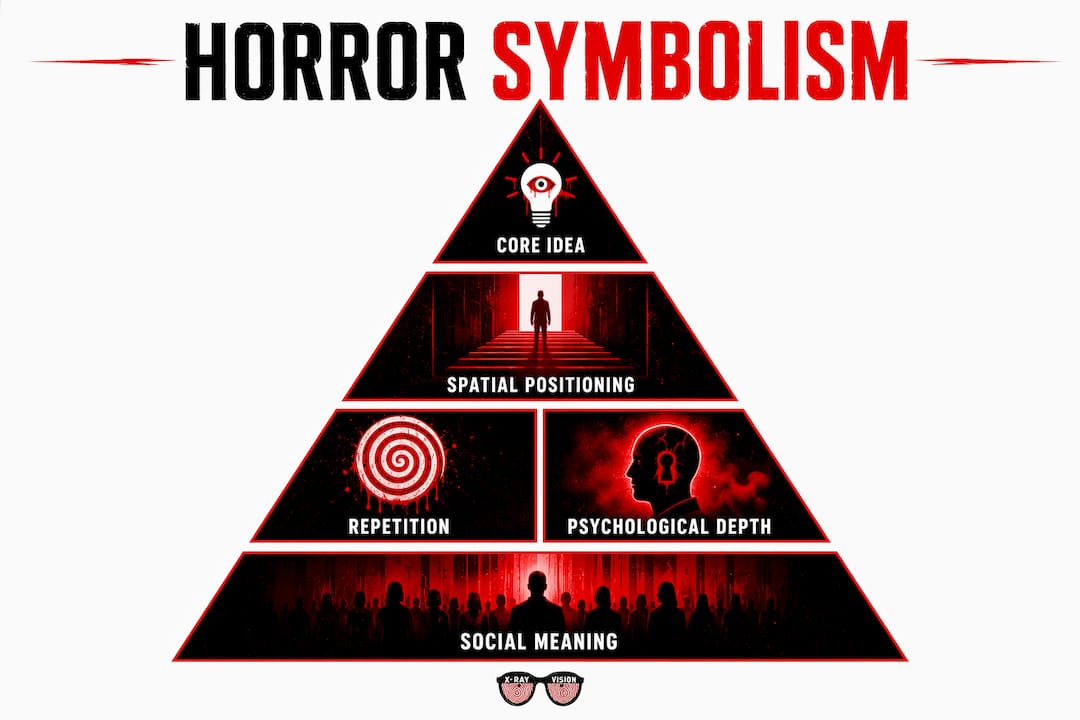
"Repetition with variation" is the technique that gives horror symbols their cumulative power. Recurrent images gain internal trauma significance as they appear in different fraught contexts throughout a narrative. The first time a red balloon appears, it is just a balloon. The fifth time, in a different location and a different emotional context, it carries the weight of everything that came before.
Horror symbols also work simultaneously as literal threats and metaphorical constructs. Complex horror symbols compel audiences to interpret multiple layers, creating emotional and intellectual engagement at the same time. David Lynch's work demonstrates this constantly. The Black Lodge in Twin Peaks: Fire Walk with Me is a real place characters enter and a psychological state they cannot escape. Both readings are true at once.
The table below shows how specific cinematic techniques amplify symbolic meaning in horror storytelling.
| Technique | How it builds symbolism | Example effect |
|---|---|---|
| Spatial positioning | Frame placement signals power, entrapment, or liminality | Character in doorway suggests psychological threshold |
| Repetition with variation | Same image in new contexts accumulates emotional weight | Recurring childhood photo grows more distorted each appearance |
| Point-of-view framing | What a character avoids looking at signals repressed meaning | Protagonist never looks at a mirror after a traumatic event |
| Color and lighting shifts | Tonal changes signal psychological state changes | Warm light in memory scenes, cold blue in present-day dread |
| Sound design paired with image | Audio cues prime the audience to read an image symbolically | A lullaby playing over a violent scene creates cognitive dissonance |
Understanding allegory in horror alongside these techniques reveals how the best horror stories operate on two tracks simultaneously. The surface story delivers tension and dread. The symbolic layer delivers meaning and resonance.
Key Takeaways
Horror symbolism transforms surface-level fear into layered meaning by using recurring images, spatial framing, and psychoanalytic archetypes to externalize psychological and social anxieties.
| Point | Details |
|---|---|
| Symbols carry layered meaning | Objects like dolls, blood, and basements represent psychological states, not just visual horror. |
| Context determines meaning | The same symbol reads differently depending on narrative framing and character perspective. |
| Repetition builds power | Symbols gain weight through recurrence in varied emotional contexts, not through a single appearance. |
| Archetypes outperform conventions | Symbols that serve the story's core fear create lasting impact; decorative symbols create noise. |
| Spatial framing is symbolic language | Where characters stand in the frame communicates psychological conflict without a single word of dialogue. |
Why horror symbolism is the genre's most underrated craft tool
Most readers and viewers focus on plot when they talk about horror. They discuss what happened, who survived, and how frightening a particular scene felt. What they often miss is the symbolic architecture underneath those events. That architecture is what separates a horror story you forget by morning from one that stays with you for years.
I have spent a long time reading and writing in this genre, and the pattern is consistent. The horror that lingers is always the horror that means something. Pan's Labyrinth terrifies you with the Pale Man and then makes you think about institutional power for weeks afterward. Santa Sangre disturbs you with its imagery and then forces you to reckon with what family trauma does to identity. The fear is the entry point. The symbolism is the destination.
What I find most exciting right now is how contemporary horror is evolving its symbolic vocabulary to reflect current anxieties. Surveillance, algorithmic control, and environmental collapse are showing up as new symbolic registers in horror fiction and film. The genre is doing what it has always done: taking what society cannot say directly and putting it in the mouth of a monster.
If you want to read horror more deeply, start by asking one question after every story or film: what was the monster actually afraid of? The answer is almost never the protagonist. It is almost always something the story has been building symbolically from the first page or frame. Once you see that, you cannot unsee it.
— Mark
Horror fiction that puts symbolism to work
If decoding symbolic storytelling has sharpened your appetite for horror that operates on multiple levels, Markwatsonbooks has a curated collection worth exploring.

The horror books collection at Markwatsonbooks features titles built around the kind of symbolic depth this article unpacks. These are not jump-scare collections. They are stories where the dread accumulates through image, repetition, and meaning. The full books catalog spans horror thrillers, Creepypasta anthologies, and more, each selected for narrative craft and thematic richness. Readers who want horror that rewards close attention will find exactly that here.
FAQ
What is symbolism in horror?
Symbolism in horror is the use of objects, settings, and characters to represent psychological, social, or cultural meanings beyond their literal presence in the story. A haunted house, for example, typically symbolizes a character's repressed memories or unresolved trauma.
What are the most common horror symbols?
The most common horror symbols include blood, dolls, basements, fog, masks, and animals like crows and spiders. Each carries established cultural associations with mortality, lost innocence, the unconscious mind, or entrapment.
How does horror symbolism differ from allegory?
Horror symbolism operates through specific images and motifs that accumulate meaning across a narrative, while horror allegory constructs an extended parallel story where characters and events represent real-world systems or ideas. Symbolism is a tool; allegory is a structural approach.
Why do some horror symbols feel clichéd?
Religious symbols and other conventional horror imagery often feel clichéd because they appear as aesthetic decoration rather than serving the story's core psychological or social theme. A symbol loses power when it is used without narrative function.
How can I identify authentic symbolism in a horror film?
Track which images a film returns to repeatedly and in what emotional contexts those images appear. Authentic symbolism gains weight through recurrence and variation, while decorative imagery appears once and carries no narrative consequence.