
TL;DR:
- Magic in horror reveals human desire and destabilizes reality by exposing characters' fears and ambitions.
- The most effective horror stories use supernatural elements to confirm existing tensions rather than introduce new conflicts.
Magic in horror most often functions as a way to reveal human desire and to destabilize assumed reality. It is not decoration. When a character reaches past the natural world, that reach tells you everything about what they want, what they fear, and what the story is really about.
- The reach: Magic appears when desire outpaces what the natural world allows.
- The price: Every magical act carries a cost, moral, physical, or relational.
- The revelation: The supernatural confirms that reality was never as stable as anyone believed.
Pro Tip: When you spot a grimoire or a bargain in a horror story, read it as a character test. The magic is not the point. The desire behind it is.
Table of Contents
- How is horror magic classified — uncanny, marvelous, or fantastic?
- Why does magic work so well as a horror device?
- What magical devices appear most often in horror stories?
- How should you read magical elements in horror?
- Recommended reads that show magic at work in horror
- Tactical advice for writers using magic in horror
- Key Takeaways
- Why magic is the sharpest tool in horror fiction
- Where to find Mark Watson's horror and creepypasta collections
- Annotated sources and further reading
How is horror magic classified — uncanny, marvelous, or fantastic?
Tzvetan Todorov's three-way classification gives readers a precise tool for understanding what kind of dread a story is building toward.
| Mode | What it means | What it asks of you | Dread source |
|---|---|---|---|
| Uncanny | The supernatural has a rational explanation | Accept that the strange was never real | Psychological unease |
| Marvelous | Magic is real and the world accepts it | Suspend disbelief fully | Wonder turned sinister |
| Fantastic | Ambiguity never resolves | Sit with uncertainty | Personal fear fills the gap |
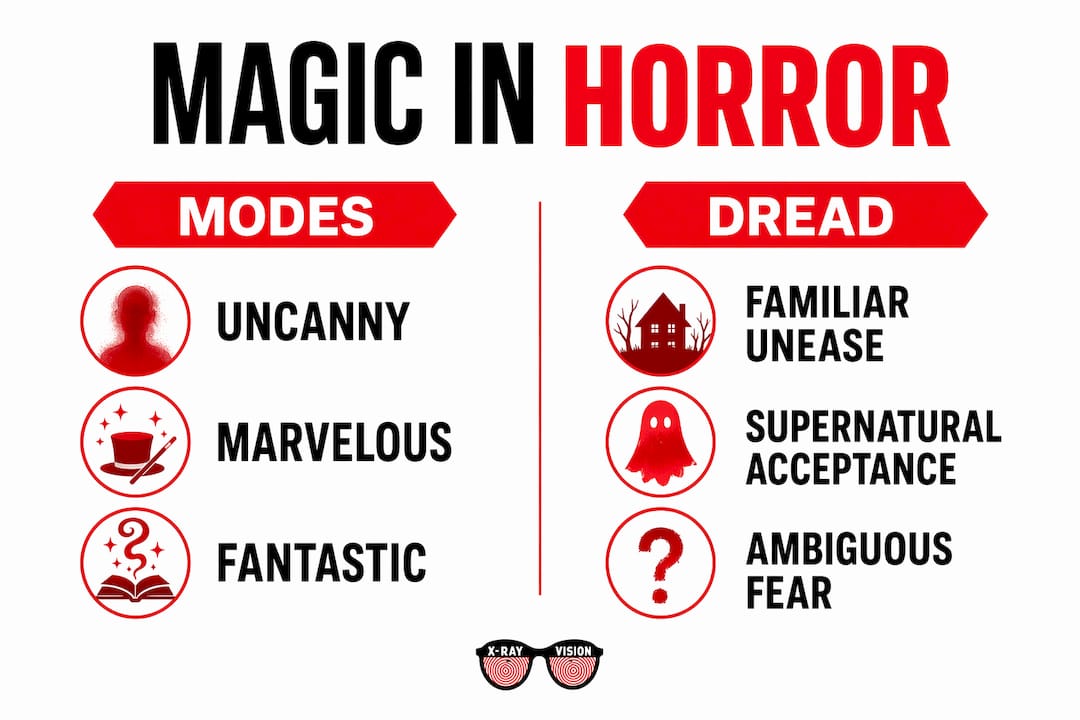
The fantastic mode is where horror lives most comfortably. When a story refuses to confirm whether the ghost was real or the ritual actually worked, readers supply their own worst possibilities. That ambiguity is a deliberate authorial choice, not a flaw. Knowing which mode you are reading shifts your entire interpretive frame.
Why does magic work so well as a horror device?
Magic externalizes what characters cannot say out loud. Grief becomes a curse. Ambition becomes a summoning. Unresolved guilt becomes a haunting. The supernatural event answers the reach of desire, and the horror comes from watching the price arrive.
Magic in horror discloses instability rather than merely intruding upon a stable order. The most effective stories use the supernatural to confirm tensions already present in the characters and the world around them.
Occult themes also carry what scholars call religious affordance: they invite readers to test their own belief structures against the story's logic. That is why supernatural horror feels personal in a way that slasher films rarely do. You are not just watching someone get hurt. You are asking yourself whether you believe in the rules the story is playing by.
Magic also shapes sub-genre boundaries across horror. Ghost stories, witchcraft narratives, and demonic possession tales each alter cause-and-effect logic differently, which is why the same basic fear of the unknown can feel so distinct from one sub-genre to the next.
Pro Tip: In any magical horror scene, locate the ethical axis: who benefits, who suffers, and whether those two are the same person. That axis is where the real horror lives.
What magical devices appear most often in horror stories?
Folklore and regional tradition supply the raw material. Authors adapt archetypes that already carry cultural weight, which is why these tropes land so hard even on first encounter.
- Grimoires and forbidden texts: Knowledge that was never meant to be read. The horror is not the book itself but the reader's choice to open it.
- Bargains and pacts: Moral accounting made literal. The price is always worse than the buyer expected, and the story watches them pay.
- Rituals: Rule-bound tension at its purest. Audiences know the rules, so every deviation becomes unbearable.
- Necromancy: Grief weaponized. Bringing back the dead dramatizes the refusal to accept loss, and the returned thing is never what was wanted.
- Shape-shifting and possession: Identity destabilized. If the body can be replaced or overwritten, nothing about the self is safe.
Breaking a magic system's internal rules is where dramatic stakes spike. When a character misreads a ritual or skips a step, the story's tension becomes almost physical. You can feel the wrongness before the consequence arrives. For deeper context on how these occult motifs function symbolically, the Markwatsonbooks blog breaks them down with sharp, specific examples.
How should you read magical elements in horror?
Read magic as a lens on character desire and social context, not as a plot mechanism. The spell is never the story. The want behind the spell is.
Use these questions while reading:
- Who wants this? Locate the desire driving the magical act.
- What is the cost? Identify what the story demands in exchange.
- Who pays the price? Often it is not the one who cast the spell.
- Is the magic explained? If not, that opacity is intentional.
- What does the magic confirm? Look for pre-existing cracks it reveals rather than new damage it creates.
Pro Tip: Resist the urge to explain ambiguous magic away. When a story leaves the supernatural unresolved, embracing that uncertainty is how you get the full emotional impact the author intended.
Recommended reads that show magic at work in horror
These titles demonstrate the mechanics above in action. Mark Watson's anthologies are particularly strong examples of how short-form horror uses magical logic with precision.
- Creepypasta: Omnibus One — 150 collected stories where supernatural rules shift from entry to entry, keeping readers permanently off-balance. The anthology format means the magic never settles into comfort.
- Creepypasta: Volume 3 — Fifty stories that lean into bargains, cursed objects, and entities with their own internal logic. Rule-breaking is a recurring engine of dread.
- Home-made Creepypasta: The First One Hundred Stories — Grassroots internet horror at its most raw. The magic here is often unexplained and culturally specific, which makes it hit harder.
- Shirley Jackson's We Have Always Lived in the Castle — Witchcraft as grief and social isolation made visible. The fantastic mode holds throughout.
- H. P. Lovecraft's "The Dunwich Horror" — Ritual and forbidden knowledge collide. The oldest and strongest fear is fear of the unknown, and Lovecraft builds every scene around that principle.
- Hereditary (2018, dir. Ari Aster) — A film where the occult confirms family trauma that predates the story's opening frame. The supernatural horror explores unfinished family business rather than introducing new conflict.
| Title | Format | Availability |
|---|---|---|
| Creepypasta: Omnibus One | Paperback / digital | US — Markwatsonbooks |
| Creepypasta: Volume 3 | Paperback / digital | US — Markwatsonbooks |
| Home-made Creepypasta | Paperback / digital | US — Markwatsonbooks |
Tactical advice for writers using magic in horror
Never make magic an easy button. If a character can summon power without cost, the story loses all tension. Large supernatural outcomes require significant input: blood, life-force, relational sacrifice, moral compromise. The price is what makes the power feel real.
Avoid binary good-versus-evil alignments. The most unsettling horror forces sympathetic characters to use morally ambiguous magic. When the protagonist does something you cannot fully defend, the story gets under your skin in a way clean heroism never does.
Here is a scene template that generates dread through ritual and desire: A character who has lost someone prepares a ritual they found in a source they should not have accessed. They follow every step correctly. The thing that arrives is exactly what they asked for. That is the horror. The wrongness is not in the execution but in the wish itself. For more on how storytelling craft shapes fear, the Markwatsonbooks blog covers the specific devices that make dread last past the final page.
Pro Tip: Treat magic as a revealer, not a disruptor. Craft scenes so the supernatural confirms tensions already present rather than importing new ones from outside the story.
Key Takeaways
Magic in horror works because it externalizes desire, confirms pre-existing instability, and forces characters and readers alike to confront what they most want and most fear.
| Point | Details |
|---|---|
| Magic reveals desire | Every magical act in horror traces back to a want the character cannot satisfy through ordinary means. |
| Ambiguity amplifies dread | The fantastic mode, where the supernatural is never confirmed, lets readers fill the gap with personal fear. |
| Rules and rule-breaking | Occult horror depends on internal logic; tension spikes when those rules are misread or broken. |
| Cost is non-negotiable | Proportional sacrifice keeps magic from becoming an easy fix and preserves the story's emotional stakes. |
| Markwatsonbooks anthologies | The Creepypasta collections demonstrate all of these mechanics across hundreds of short-form horror entries. |
Why magic is the sharpest tool in horror fiction
Most horror commentary treats magic as atmosphere, a mood-setter you layer over the real story. That reading is too thin. Magic in horror is the story's argument about human nature. It says: given the chance to reach past what is allowed, people reach. And the cost of that reach is what the genre has always been about.
What gets underestimated is how much the classification matters to the reader's experience. A story in the uncanny mode and a story in the fantastic mode can use identical imagery and produce completely different emotional results. Readers who understand Todorov's framework do not just read more carefully. They feel more, because they know what the author is asking them to accept and where the dread is supposed to land.
The creepypasta format, which Mark Watson has curated across multiple anthologies, is a particularly sharp case study. Internet horror strips away literary scaffolding and delivers magical logic raw. The rules are often unstated. The costs arrive without warning. That rawness is not a weakness of the form. It is the fantastic mode operating at speed.
Where to find Mark Watson's horror and creepypasta collections

Fans of magical horror who want to read the mechanics above in action will find exactly what they need in the Mark Watson horror collection. The Creepypasta anthologies, including Omnibus One, Volume 3, and Home-made Creepypasta, are available now for US readers in paperback and digital formats through Markwatsonbooks. Each volume delivers hundreds of short-form supernatural stories where desire, bargains, and broken rules drive every entry. Browse the full catalog and find the collection that fits your reading appetite.
Annotated sources and further reading
| Source | What it covers |
|---|---|
| Todorov classification (AIJCR) | Defines uncanny, marvelous, and fantastic modes for horror readers |
| Uncanny Lounge — Magic in Horror | Core analysis of desire, transgression, and instability as horror mechanics |
| British Fantasy Society — Occult Horror | Practical breakdown of tropes, rules, and rule-breaking in occult fiction |
| Brill — Religious Affordance & Ambiguity | Scholarly treatment of belief-testing and deliberate ambiguity in supernatural fiction |
| H. P. Lovecraft — Supernatural Horror in Literature | Primary essay on fear of the unknown as horror's foundational principle |
| Markwatsonbooks Horror Hub | Author catalog and blog posts on craft, symbolism, and storytelling technique |