

TL;DR:
- Lovecraft's horror emphasizes cosmic insignificance and atmosphere over monsters.
- His methodical writing process focused on mood, implication, and subtle cosmic themes.
- The Cthulhu mythos and themes influence modern horror, film, games, and literature today.
H.P. Lovecraft is one of the most misunderstood writers in literary history. Many people picture him as a pulp author who dreamed up tentacled monsters. That picture misses almost everything that matters. Lovecraft created an entirely new mode of horror, one built on atmosphere, dread, and the terrifying smallness of humanity against the cosmos. His influence reaches into the stories, films, and games you love today, often without you even realizing it. This guide breaks down who Lovecraft really was, how he built his stories, what his central themes mean, and why his method still shapes the scariest fiction being written right now.
Table of Contents
- Who was H.P. Lovecraft? Context and origins
- Lovecraft's unique horror method: 5-step process and story types
- Core themes and the enduring Cthulhu mythos
- Lovecraft's modern legacy: Influence on storytelling, horror, and beyond
- A modern perspective: What most Lovecraft guides miss
- Explore Lovecraftian and modern horror
- Frequently asked questions
Key Takeaways
| Point | Details |
|---|---|
| Lovecraft’s writing process | He used a methodical approach focused on building atmosphere and subtle horror for maximum effect. |
| Themes matter most | His work endures because of deep themes like cosmic insignificance and forbidden knowledge, not just monsters. |
| Lasting modern influence | Lovecraft’s ideas shape today’s horror, sci-fi, and pop culture—from books to games and movies. |
| Atmosphere over action | The best Lovecraftian fiction uses mood and implication to create lasting psychological impact. |
Who was H.P. Lovecraft? Context and origins
Howard Phillips Lovecraft was born in Providence, Rhode Island in 1890. He spent most of his life in New England, rarely traveling far and living in near poverty for long stretches. His mother was institutionalized when he was young, his father died in a psychiatric facility, and Lovecraft himself suffered from chronic illness. Despite these difficulties, he read voraciously and wrote obsessively, producing essays, poetry, and fiction.
What separated Lovecraft from other horror writers of his era was his insistence on realism as a foundation. He grounded his stories in recognizable American places, Providence streets, Massachusetts fishing towns, Vermont farmhouses. This made the intrusion of the uncanny feel genuinely unsettling. He pioneered the category we now call weird fiction, which blended supernatural horror with science fiction and philosophical pessimism, pushing the genre far beyond gothic ghost stories.
His true impact was almost entirely posthumous. During his lifetime, Lovecraft published mostly in pulp magazines like Weird Tales and earned very little. He died in 1937, largely unknown outside a small circle of correspondents. It was only after friends and fans collected and republished his work that his reputation exploded.
Understanding the full history of horror literature helps place Lovecraft correctly: he was not a mainstream success but a slow-burning revolutionary.
Here are three common misconceptions about Lovecraft that are worth clearing up:
- Misconception 1: His horror is about monsters. In reality, the creatures are almost beside the point. The horror lives in what they represent: an indifferent universe.
- Misconception 2: He was hugely famous in his own time. He was not. Most of his fame arrived decades after his death.
- Misconception 3: His work is outdated pulp. In fact, Lovecraft's writing methodology shows a sophisticated, deliberate craft that modern writers still study.
Statistic to know: Lovecraft wrote over 60 short stories, novellas, and novelettes, yet earned so little that he often could not afford basic necessities. His posthumous influence is worth billions in licensed properties today.
With context around Lovecraft as a figure, we can better examine what truly set his work apart.
Lovecraft's unique horror method: 5-step process and story types
Lovecraft's personal history shaped his creative process. Now, let's break down exactly how he constructed stories so effectively.
Lovecraft did not simply sit down and write whatever frightened him. His approach was methodical. His five-step writing process moved from conceptualization through synopses, drafting, revision, and finally mood refinement. Each stage served a purpose, and mood was not an afterthought. It was the destination.
Here is how those five steps worked in practice:
- Conceptualization: Identify the core horrifying idea, not the monster, but the feeling it should produce.
- Synopsis: Sketch the story's structure before writing a single scene.
- Draft: Write quickly without stopping to perfect sentences.
- Revision: Cut anything that breaks the mood or slows the dread.
- Mood refinement: Read the finished piece purely for atmosphere, adjusting language until every sentence feels heavy with unease.
Lovecraft also identified five elements he considered essential to effective horror fiction:
| Element | What it does |
|---|---|
| Underlying horror | The core concept that disturbs at a primal level |
| Effects on characters | How the horror warps behavior and sanity |
| Manifestation | The controlled, partial reveal of the horror itself |
| Character reactions | Believable human responses that anchor the reader |
| Specific details | Precise sensory details that make the unreal feel real |
He also described four distinct story types: pure atmosphere, character study under pressure, plot-driven cosmic revelation, and hybrid tales mixing all three elements. Exploring horror methodology through Lovecraft's lens shows how flexible these categories are.
Pro Tip: When writing horror, resist describing the monster fully. Lovecraft's most terrifying creations are half-glimpsed and poorly described on purpose. The reader's imagination does the heaviest lifting.
Modern writers like Thomas Ligotti and Jeff VanderMeer openly adapt these techniques. You can also find this methodology alive in modern visions of cosmic horror, where atmosphere always outweighs action.
Core themes and the enduring Cthulhu mythos
Now that we understand how Lovecraft wrote, let's uncover what his stories are really about and why the Cthulhu mythos continues to fascinate.

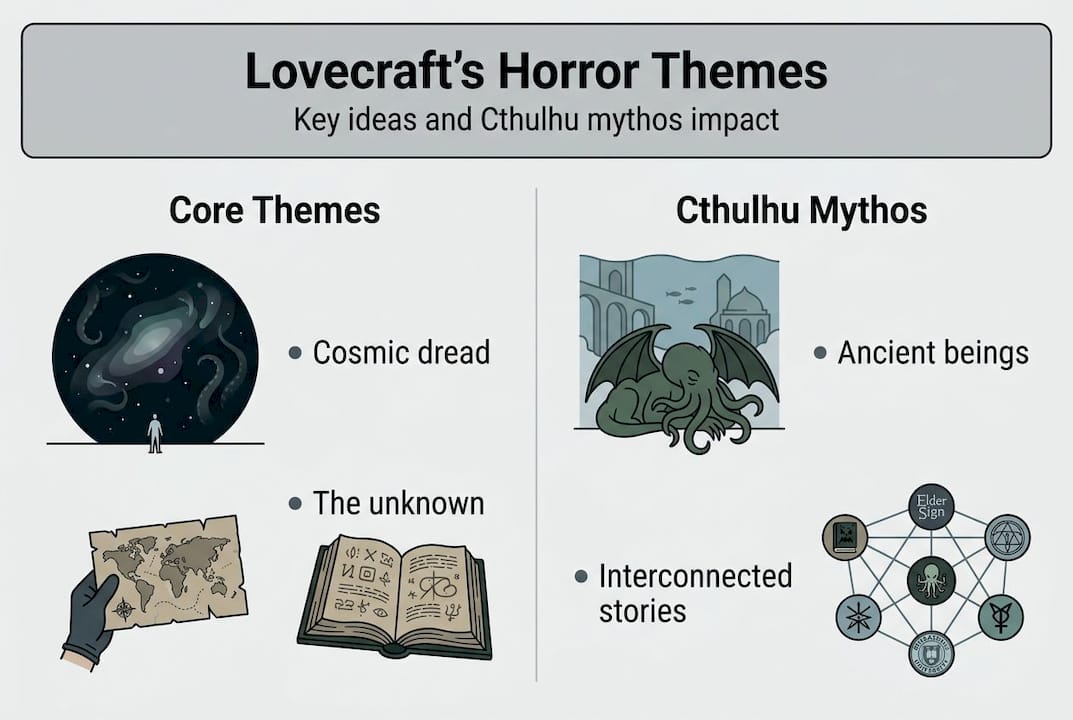
Lovecraft's themes are not simply scary ideas. They are philosophical positions. His fiction insists that humanity is not special, that the universe is not built around us, and that knowledge itself can be dangerous. These ideas hit differently than a vampire or a werewolf ever could.
His most important themes include:
- Cosmic insignificance: Humans are irrelevant on a universal scale. The beings in his stories do not hate us. They simply do not notice us.
- Forbidden knowledge: Learning too much can shatter a person's mind. Characters who seek truth in Lovecraft's world often wish they hadn't found it.
- Unreliable realities: The world we perceive is a thin shell over something older and stranger. Sanity is just a comfortable illusion.
The Cthulhu Mythos is the name given to the loose, interconnected web of stories Lovecraft built around these ideas. Cthulhu himself is just one creature in a vast pantheon of ancient cosmic entities. Other writers, including August Derleth and Clark Ashton Smith, expanded the mythos after Lovecraft's death, turning it into a shared fictional universe long before Marvel made that concept fashionable.
| Lovecraftian horror | Traditional horror |
|---|---|
| Emphasizes cosmic scale | Focuses on personal threat |
| Monster often incomprehensible | Monster usually understandable |
| Dread through atmosphere | Dread through action or violence |
| Knowledge leads to madness | Knowledge helps defeat the threat |
| No resolution is possible | Resolution and survival are expected |
Understanding why horror books matter helps explain why Lovecraft's particular flavor of terror resonates so deeply. His horror does not reassure you that things will be okay.
"The oldest and strongest emotion of mankind is fear, and the oldest and strongest kind of fear is fear of the unknown." — H.P. Lovecraft
The Cthulhu Mythos has influenced hundreds of books, films, games, and television shows. If you enjoy any classic horror books, you have almost certainly felt his shadow.
Lovecraft's modern legacy: Influence on storytelling, horror, and beyond
Having unpacked his ideas and mythos, let's see what Lovecraft's legacy means for storytellers and fans today.
Lovecraft's reach is genuinely staggering. Stephen King has called him the greatest American horror writer of the twentieth century. Neil Gaiman weaves cosmic dread into fantasy with a Lovecraftian sensibility. Ridley Scott's Alien is essentially a Lovecraftian nightmare on screen, a creature so alien it defies comprehension, discovered in the vast indifference of space.
The tabletop game Call of Cthulhu, first published in 1981, introduced Lovecraftian mechanics to gaming, building horror around sanity loss rather than hit points. Video games like Bloodborne and Control build entire worlds on his foundations.
You can spot Lovecraftian influence by looking for these signals:
- The threat is incomprehensible rather than simply dangerous
- Characters react with awe and madness, not just fear
- Setting carries as much weight as plot
- Resolution feels hollow or impossible
- The horror is implied far more often than shown
Lovecraft's impact continues across every storytelling medium, shaping not just literature but film, gaming, and visual art in ways that feel fresh even now.
For fans and writers alike, the horror movies guide at Mark Watson Books connects these cinematic dots clearly. Understanding how horror affects readers also explains why Lovecraft's slow-burn dread works so powerfully on a psychological level.
Pro Tip: If you want to write in a Lovecraftian style, start by identifying what your character fears most about the unknown. Build every scene around that feeling before you write a single line of action.
If you are curious about what horror fiction is as a genre and how it evolved, Lovecraft is an essential stop on that journey.
A modern perspective: What most Lovecraft guides miss
Stepping back from history and legacy, here is a perspective that can reshape how you approach both Lovecraft and modern horror.
Most guides to Lovecraft spend too much time cataloging his creatures. Cthulhu gets described, Nyarlathotep gets a paragraph, and readers walk away thinking they understand the work. They usually don't.
What Lovecraft actually did was find a way to make everyday reality feel unstable. He took familiar New England towns and layered something wrong underneath them. The horror was not the creature at the bottom. It was the moment the protagonist realized the world was not what it seemed. That moment of shattering recognition is what makes his best stories last.
The best modern horror writers know this. They use implication, atmosphere, and creeping wrongness far more than monsters. That is the direct line from Lovecraft to the folklore to fiction tradition that the most effective horror has always drawn on.
When you read or watch something that makes you uneasy without quite knowing why, that is Lovecraftian craft at work. Chase that feeling. It is far richer than any jump scare.
Explore Lovecraftian and modern horror
If this guide has lit a fire under your curiosity, you are in exactly the right place. Mark Watson Books brings together horror fiction that carries on the tradition Lovecraft started, from atmospheric dread to full cosmic terror.

Browse the curated horror collection for titles that use atmosphere and implication the way Lovecraft intended. If you love the creepier, more contemporary side of horror, the creepypasta books collection brings that unsettling energy into the digital age. Discover more horror works by Mark Watson and find your next unforgettable read today.
Frequently asked questions
What is considered 'Lovecraftian' horror?
'Lovecraftian' horror emphasizes cosmic dread, the unknown, and atmosphere over gore or action. As Lovecraft outlined in his own essay, effective weird fiction focuses on mood and the feeling of cosmic insignificance rather than explicit violence.
Which authors and creators were influenced by Lovecraft?
Writers like Stephen King and Neil Gaiman, films like Alien, and many games in horror and sci-fi genres show Lovecraft's influence. The Cthulhu Mythos permeates modern culture far more than most people realize.
How did Lovecraft write his stories?
Lovecraft used a methodical, five-step process emphasizing mood, atmosphere, and subtle horror elements. His five-part writing method moved from conceptualizing core horror all the way through revising specifically for emotional dread.
What is the Cthulhu Mythos?
The Cthulhu Mythos is an interconnected set of stories about ancient cosmic horrors and forbidden knowledge, now a pillar of horror fiction. The mythos has influenced everything from blockbuster films to tabletop games and remains one of fiction's most enduring shared universes.