

TL;DR:
- Thriller structure organizes plot into a three-act framework with specific beats that escalate suspense. Proper placement of inciting incidents, midpoints, and climaxes ensures a gripping story from start to finish. Strategic timing of plot twists and careful scene pacing sustain tension and keep readers engaged throughout.
Thriller structure is defined as organizing plot, pacing, and tension into a three-act framework with precise beats that escalate suspense from the first page to the last. A standard thriller novel runs 70,000–100,000 words across 25–40 chapters, with the inciting incident landing within the first 10–15% of the book. The midpoint arrives at 50%, the "all is lost" moment hits at 75%, and the climax detonates between 90–98%. Knowing how to structure a thriller at this level of precision separates manuscripts that grip readers from ones that lose them by chapter five.
What are the fundamental structural elements of a thriller plot?
The three-act structure is the backbone of every effective thriller. Each act carries specific weight, and placing your key plot beats in the wrong position kills momentum before readers even reach your best material.
Act One: Hook and commit
Act One covers roughly the first 15% of your manuscript. Your job here is to establish the protagonist, define the world, and deliver the inciting incident before readers have a chance to disengage. The inciting incident is not a slow build. It is the event that locks your protagonist into the story's central conflict with no easy exit.
- Introduce your protagonist in action, not in reflection.
- Establish the stakes clearly before the inciting incident lands.
- Deliver the inciting incident by the 10–15% mark without exception.
- End Act One with a point of no return that forces the protagonist forward.
Act Two: Escalate without mercy
Act Two is where most thrillers succeed or collapse. The midpoint at 50% must do more than mark the halfway point. It needs to flip the story's direction. A revelation, a betrayal, or a catastrophic failure forces the protagonist to adapt completely. Then the "all is lost" moment at 75% strips away every advantage the protagonist has built. This is the darkest beat in the story, and it must feel genuinely devastating.
- Midpoint twist: changes the protagonist's understanding of the threat
- Rising complications: each scene creates new obstacles, not just bigger versions of old ones
- Personal stakes: the protagonist's internal arc must deepen alongside the external plot
- "All is lost" moment: the protagonist loses their key ally, resource, or belief
Act Three: Deliver and resolve
Act Three runs from roughly 75% to the end. The climax lands between 90–98%, and the resolution wraps the remaining threads. Each chapter in this act should end on a cliffhanger, a revelation, or a decision point. Chapters that end on mundane beats like a character going to sleep or driving home kill the momentum you spent two acts building.
How can writers plan and time plot twists to maximize impact?
Plot twists are not decoration. They are structural tools that recontextualize everything the reader thought they understood. Experts recommend two to three significant twists per thriller: one at the midpoint, one late in Act Two, and a final twist woven into the resolution.
The most common mistake writers make is treating twists as surprises alone. A twist that comes from nowhere feels cheap. A twist that feels inevitable in retrospect feels brilliant. The difference is preparation.
- Plant clues early: every twist needs at least three planted details readers can find on a reread
- Use red herrings deliberately: misdirect attention without lying to the reader outright
- Space your twists: two twists landing within ten pages of each other cancel each other out
- Recontextualize, don't just shock: the best twists change the meaning of earlier scenes
The late-Act Two twist is the most underused of the three. Writers often save everything for the climax, which leaves the final third feeling crowded and rushed. A well-placed twist at around 75% gives the climax room to breathe and hit harder.
Pro Tip: Write your twists first, then build the scenes around them. If you know where the story is going, you can plant clues naturally rather than retrofitting them during revision.
Strategic clue placement requires earned surprises backed by subtle foreshadowing throughout the narrative. Readers should finish your book, flip back to page one, and see the twist coming from the very first chapter.
What scene-level structure and pacing techniques sustain tension throughout a thriller?
Every scene in your thriller is a tension unit. It either builds pressure or releases it. Every scene must include a protagonist goal, an obstacle blocking that goal, and an outcome that preferably creates new complications rather than resolving the problem cleanly.
The wave pattern: your pacing rhythm
The wave pattern structure alternates between high-action scenes and brief calm moments. This rhythm prevents reader fatigue while continuously escalating stakes. The calm scenes are not filler. They are pressure valves that make the next action scene hit harder by contrast.
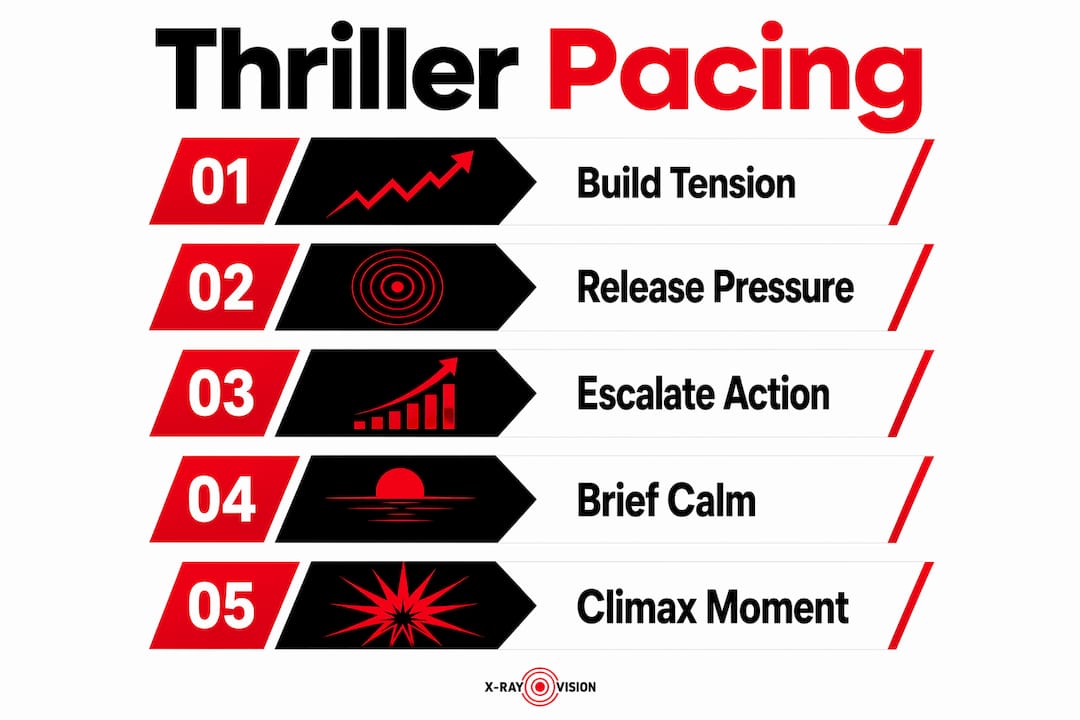
| Scene type | Primary function | Pacing effect |
|---|---|---|
| Action scene | Escalate external threat | Raises heart rate, creates urgency |
| Calm scene | Deepen character or plant clues | Resets reader, builds dread |
| Revelation scene | Shift story direction | Reorients reader, creates new questions |
| Decision scene | Force protagonist choice | Builds investment, raises stakes |
The wave pattern works because thriller pacing is about sustained pressure, not constant speed. Readers need moments to absorb what just happened before the next threat arrives. Without those moments, tension becomes noise.
Dramatic irony as a suspense engine
Dramatic irony is the single most powerful tool for creating suspense at the scene level. The reader knows the bomb is under the table. The characters do not. That gap between reader knowledge and character knowledge generates anxiety that no amount of action can replicate. Alfred Hitchcock called this the difference between surprise and suspense. Surprise lasts seconds. Suspense lasts pages.
Pro Tip: Reveal the threat to your reader before your protagonist encounters it. Let readers watch the protagonist walk into danger they cannot warn them about. That helplessness is what keeps pages turning at midnight.
You can learn more about building suspense effectively across different genres, including how the same core techniques apply whether you write horror, thrillers, or genre-blending fiction.
What common mistakes to avoid when structuring a thriller?
Structural mistakes in thrillers almost always fall into one of four categories: a slow start, a sagging middle, an over-explained villain, or a predictable twist. Each one is fixable once you know what to look for.
- Slow inciting incident: If your protagonist is still in their normal world past the 15% mark, cut everything that precedes the conflict and start closer to the action.
- Middle act sag: The middle of a thriller often fails because writers run out of complications. Fix this by mixing action sequences with investigation scenes and personal stakes so the protagonist faces new, escalating challenges in every chapter.
- Over-explained villain: Antagonist details are most effective when revealed gradually, often withheld until two-thirds into the story. Explaining the villain's full backstory in Act One removes all mystery and deflates tension.
- Predictable twists: If your beta readers guess the twist before it lands, the clues are too obvious or the misdirection is too thin. Add a competing red herring that points toward a plausible but wrong conclusion.
Pro Tip: Print your outline and mark every scene with one of three labels: "escalates tension," "plants a clue," or "cut." Any scene that earns neither of the first two labels should not survive your revision.
Scenes that do not drive the plot or deepen tension are dead weight. Cutting them feels painful in the moment and makes the book significantly stronger in the end. You can also find practical pacing methods that translate directly to thriller structure, particularly for managing momentum through the difficult middle act.
The most underrated fix for structural problems is great storytelling craft at the scene level. When individual scenes are tight and purposeful, structural weaknesses become much easier to spot and correct.
Key Takeaways
A thriller's structure succeeds when the three-act framework, precise plot beats, wave-pattern pacing, and earned twists work together to sustain tension from the first page to the last.
| Point | Details |
|---|---|
| Three-act framework | Place the inciting incident by 15%, midpoint at 50%, and climax between 90–98%. |
| Plot twist timing | Use 2–3 twists at the midpoint, late Act Two, and resolution for maximum impact. |
| Scene-level structure | Every scene needs a goal, obstacle, and outcome that creates new complications. |
| Wave-pattern pacing | Alternate action and calm scenes to sustain pressure without causing reader fatigue. |
| Villain reveal | Withhold antagonist details until two-thirds through the story to preserve mystery. |
What I've learned about structuring thrillers that most guides won't tell you
The advice to "start with action" is correct but incomplete. What most guides miss is that the inciting incident needs to feel personal to the protagonist, not just dangerous. Readers do not turn pages because a threat exists. They turn pages because they care whether a specific person survives it. I learned this the hard way by writing an opening that was technically exciting but emotionally hollow. The action was there. The investment was not.
The wave pattern changed how I think about pacing entirely. I used to believe that a thriller should feel relentless from start to finish. The reality is that relentless action numbs readers. The calm scenes are where you do your most important work. You plant the clue. You show the protagonist's fear. You let the reader feel the weight of what is coming. That contrast is what makes the next action scene land like a punch.
On twists: I write them first and build backward. Knowing the destination lets me seed the path naturally. Retrofitting clues during revision is possible, but it always feels mechanical. When the clues grow organically from the story's DNA, readers feel the twist as inevitable rather than manufactured.
The hardest structural lesson is cutting scenes you love. A scene can be beautifully written and still be wrong for the book. If it does not escalate tension or plant a clue that pays off later, it is slowing your reader down. Cut it. Save it in a separate document if you must. But cut it from the manuscript.
— Mark
Thriller and horror fiction worth reading at Markwatsonbooks
Reading great thrillers is one of the fastest ways to internalize structure. You feel the wave pattern in your gut before you can name it on the page.

Markwatsonbooks offers a horror and thriller collection that puts effective suspense craft on full display. From slow-burn dread to pulse-pounding tension, these titles show structure in action rather than theory. The Creepypasta anthology series is especially useful for writers studying short-form pacing and how to create maximum tension in compressed word counts. Reading fiction that works is the fastest shortcut to writing fiction that works.
FAQ
What is the ideal word count for a thriller novel?
A standard thriller runs 70,000–100,000 words across 25–40 chapters. Each chapter typically lands between 2,000–3,000 words.
Where should the inciting incident occur in a thriller?
The inciting incident should occur within the first 10–15% of the manuscript. Placing it any later risks losing readers before the central conflict is established.
How many plot twists does a thriller need?
Two to three major twists work best: one at the midpoint, one late in Act Two, and a final twist in the resolution. More than three twists dilutes their impact.
How do you avoid a sagging middle act?
Mix action sequences with investigation scenes and personal stakes so the protagonist faces new, escalating challenges in every chapter. Alternating scene types prevents momentum from stalling.
What makes a plot twist feel earned rather than cheap?
Earned twists require planted clues and deliberate misdirection placed throughout the narrative. Readers should be able to find the evidence on a reread and recognize the twist as inevitable.