
TL;DR:
- Effective horror outlining begins with defining a core emotional fear that guides all plot and character decisions. It requires a deliberate three-act structure driven by protagonist choices, with scenes carefully planned to build dread through timing and sensory detail. Balancing scene tension, character vulnerability, and information flow ensures a psychologically compelling and memorable horror story.
You're staring at a blank document, knowing your horror story idea is genuinely frightening — but you can't figure out where the story actually goes. Sound familiar? The horror novel outline process, what experienced authors sometimes call "story mapping for horror," is where most aspiring writers get stuck. Not because they lack imagination, but because horror fiction demands a very specific kind of planning. It requires you to engineer dread deliberately, track your protagonist's psychological unraveling, and choreograph reveals so precisely that the terror never deflates. This guide walks you through exactly how to do that.
Key takeaways
| Point | Details |
|---|---|
| Start with a core fear | Define one fear statement before anything else to keep plot and character decisions focused. |
| Use horror-adapted three-act structure | Adapt classic acts to horror by triggering escalation through protagonist choices, not accidents. |
| Plan information flow, not just plot | Outline when to reveal clues, not only what happens, to build and sustain dread. |
| Alternate tension and relief | Schedule calm moments intentionally so your intense scenes land with full impact. |
| Tie every scare to character | Fear hits hardest when it targets something specific to who your protagonist is. |
The horror novel outline process: what you need first
Before you write a single scene beat, you need to make three foundational decisions. Skip them, and your outline will drift. These are the prerequisites that separate a focused horror novel from a collection of creepy moments that never coalesce into something truly terrifying.
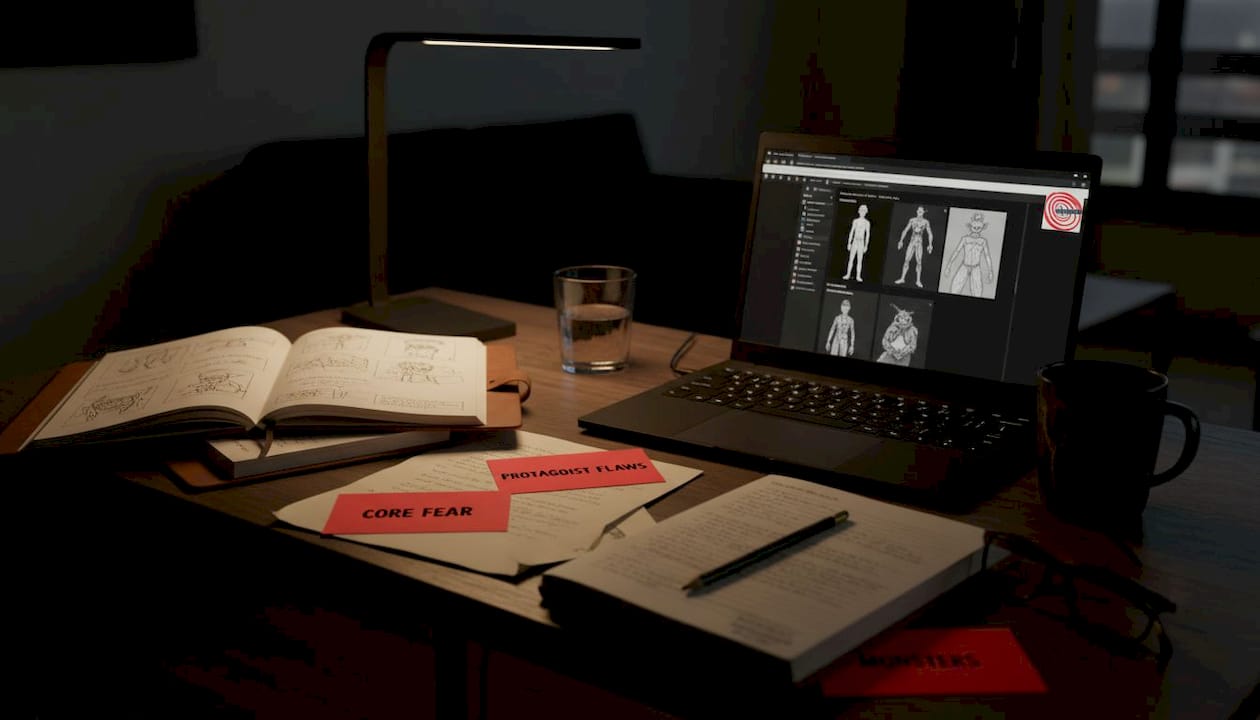
Define your core fear statement. This is a single sentence naming what your story is fundamentally about at an emotional level. Not "a haunted house kills people," but "a woman who abandoned her family is consumed by guilt made physical." One fear statement focuses every plot choice and character decision that follows. Without it, you'll write scenes that are scary in isolation but feel disconnected from each other.
Choose your horror subgenre. Supernatural horror, psychological horror, body horror, cosmic horror — each demands a different tone and pacing rhythm. A psychological horror novel builds dread through ambiguity and unreliable perception. Supernatural horror needs a visible escalation of impossible events. Knowing your subgenre before you outline tells you which structural tools to reach for first.
Identify your four plot ingredients. Every effective horror story runs on these:
- Protagonist vulnerability: What wound, fear, or blind spot makes your lead character uniquely susceptible to the horror?
- Source of horror: What is the threat, and how does it connect to the protagonist's core weakness?
- Escalating stakes: What does your character stand to lose, and how does that cost increase over the story?
- A stable "normal world": The opening section must establish enough comfort that the reader feels its destruction. No normal world means no contrast, and contrast is where horror lives.
Pro Tip: Build your protagonist's flaw before you build your monster. The most terrifying horror stories feel personal because the threat exploits something specific to the lead character. Check out this guide on creating scary characters for a deeper framework.
Step-by-step horror story structure for novels
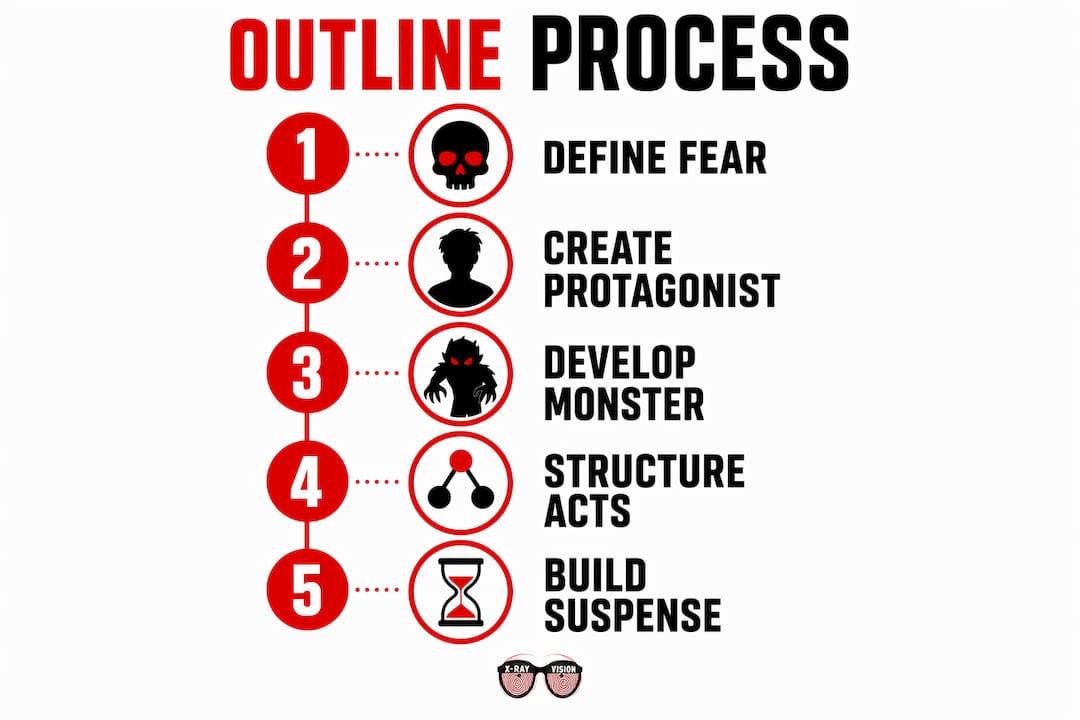
The classic three-act structure translates well to horror, but with one critical difference: the act breaks must be driven by your protagonist's choices, not by random external events. Here's how to apply it.
Act one: establish, then disturb
- Introduce your protagonist in their normal world, showing the relationships, habits, and emotional wounds that will later be weaponized.
- Establish the setting with specific sensory texture. The place needs to feel real before it can feel wrong.
- Introduce the inciting incident: the first contact with the horror. At this stage, it should be dismissible. A sound. A shadow. A piece of missing time.
- End Act One with a warning your protagonist actively chooses to ignore. This is where horror story structure diverges sharply from other genres. Act two begins when the protagonist willfully crosses a threshold despite a clear signal to stop. That choice makes them complicit, which deepens reader investment.
Act two: escalate relentlessly
This is the longest and most demanding section to outline. Think of it in two halves.
In the first half, your protagonist investigates. They gather evidence, question their own perception, and try rational explanations. Each discovery should be deniable early on. Outline when information surfaces carefully: early clues should convert "this is strange" into "this might be real," not "this is definitely supernatural." That creeping shift is where dread lives.
In the second half, rational explanations collapse. The horror becomes undeniable. Confrontations escalate. Something is lost — a relationship, a safe location, the protagonist's certainty about their own mind. Plan at least one major reversal that changes what the reader thought they understood about the threat.
Compare what each scene needs to accomplish:
| Scene type | Tension goal | Character cost |
|---|---|---|
| Discovery scene | Raise the possibility of real threat | Small loss of certainty |
| Confrontation scene | Force protagonist into direct contact | Physical or emotional wound |
| Reversal scene | Reframe what the reader knows | Loss of safety or ally |
| Relief beat | Allow reader to breathe | Temporary false hope |
Pro Tip: Attach a tension goal and time pressure to every scene in your outline. Ask: what does this scene reveal, cost, or complicate? If the answer is "nothing," cut or combine it.
Act three: pay off everything you built
Your climax must feel earned. Every fear you planted, every wound you exposed, every clue you seeded has to converge here. An effective horror ending doesn't always resolve neatly. In fact, a lingering ambiguity after the main threat is neutralized often makes the story haunt readers longer than tidy closure would. Plan the emotional state you want your reader in after the final page. Then build backward from that feeling.
Outlining dread, suspense, and character-driven fear
Dread is not the same as shock. Shock is a loud noise. Dread is the thirty seconds before the loud noise when you know it's coming. Your outline needs to engineer both, but dread is what sustains a novel.
Here are the core techniques for building it into your scene planning:
- Withhold the full picture. Describing sensory effects rather than the monster itself keeps reader imagination working in your favor. In your outline, mark scenes where the horror is implied rather than shown. The sound of something dragging. The smell of something wrong. The feeling that the room has changed.
- Use multi-sensory cues. Olfactory and auditory details create visceral dread that visual description alone cannot. When you outline a scare scene, ask yourself: what does this moment smell like? What does it sound like? These details pull readers into the scene at a physical level.
- Map your protagonist's blind spots. Every character has things they refuse to see. Build those refusals into your outline explicitly. When the protagonist rationalizes something terrifying, it's more frightening than if they panicked immediately, because readers recognize the self-deception.
- Consider an unreliable narrator. If your outline includes moments where the reader knows more than the protagonist (dramatic irony) or less (mystery), mark them. Both create suspense through different mechanisms. Deciding in advance which scenes use which technique gives your outline a psychological texture that most first drafts lack.
Pro Tip: Plan at least two scenes per act where the horror targets your protagonist's specific emotional wound, not just their physical safety. Readers aren't frightened by monsters; they're frightened by what the monster represents to a character they care about. The literary devices that make fear last are almost always rooted in character psychology.
Common pitfalls in horror novel outlining
You can have a solid concept and still produce a weak outline. These are the mistakes that appear most often, and each one is fixable once you recognize it.
- Plotting events without planning reveals. An outline that lists what happens without mapping when the reader learns it is incomplete. Outlines that neglect information timing produce flat horror where the reader is either confused or never surprised.
- Disconnected scare sequences. If each scary scene could be reordered without changing the story, your horror isn't structurally integrated. Each scare must escalate from the last and connect to the protagonist's wound.
- Cliché overload. The haunted house, the mysterious stranger, the basement no one should enter. These aren't forbidden, but they need to serve your specific core fear statement. If they don't connect to your protagonist's vulnerability, they're decoration.
- Ignoring pacing variation. Alternating tension with calm isn't optional in horror. It's structural. If every scene is at maximum intensity, readers go numb. Plan your breath moments as deliberately as your scares.
- Horror disconnected from character. This is the biggest one. If your protagonist could be swapped out for any generic character without changing the story, the fear has no anchor.
"Horror that doesn't stem from who the character is will always feel like a ride. Horror rooted in character feels like a wound."
When you finish a draft of your outline, go through it and highlight every scene where the horror directly exploits your protagonist's stated vulnerability. If fewer than half your scenes pass that test, revise before you write a word of prose.
Verifying and refining your outline for maximum impact
A finished outline draft isn't a finished outline. These steps will help you stress-test it before you start writing.
- Check your tension curve. Read through your scene list and mark each scene as High, Medium, or Low tension. You should see a general upward progression with deliberate dips for relief beats. If you see a long flat stretch of High scenes, your reader will fatigue. If you see too many Lows in Act Two, your pacing has stalled.
- Verify escalation of stakes. At each act break, what has your protagonist lost? The losses should compound. If your protagonist is in roughly the same emotional or physical position at the end of Act Two as they were at the start, the stakes haven't escalated.
- Test your climax against your setup. Every major element in your resolution should have been seeded earlier. If something saves the day in Act Three that was never mentioned before, revise. Horror readers remember setups. They notice when payoffs cheat.
- Seek a reader gut-check. Share your outline with another writer or a trusted reader before drafting. Ask them one question: "Does the ending feel earned?" Their answer will tell you more than any self-review.
- Use scene-tracking tools. Spreadsheets, Scrivener, or even index cards can help you track tension goals and character arcs across your outline at a glance. Seeing all your scenes in a single view makes pacing gaps obvious.
My honest take on outlining horror
I'll be direct: I've seen writers treat their horror outline like a strict contract, and it kills the story. Horror needs room to surprise even the person writing it. Some of the most terrifying moments I've written happened because a character did something my outline didn't predict, and I followed it.
That said, writing as an act of discovery only works if you have enough structure to return to when instinct runs dry. My approach is to outline the emotional beats tightly and leave the specific scene mechanics with some flexibility. Know what each scene must accomplish. Leave some room for how.
The most overlooked element in novel planning for horror is timing. Not pacing in the general sense, but the specific moment when the reader learns something critical. I've revised outlines three times just to shift one reveal from chapter eight to chapter eleven, and the effect on the dread curve was dramatic.
Horror also demands that you stay in discomfort longer than feels comfortable to write. Effective horror requires sitting with dread, not rushing to resolve it. Your outline should plan for that endurance, not just the climax.
And please, build your outline around your protagonist's fear first. The monster is a vehicle. The wound it targets is the story.
— Mark
Explore horror that shows the craft in action
If you're working through creating a horror novel outline and want to see how these techniques come alive on the page, there's no better study than reading horror that does it right.

At Markwatsonbooks, you'll find a growing collection of horror fiction built on exactly the principles covered here: character-rooted fear, deliberate dread, and stories that stick with you long after the final page. Browse the horror collection to discover titles that demonstrate escalating tension and psychological suspense in action. If you're drawn to the darker corners of internet storytelling, the Creepypasta books collection showcases how short-form horror masters the art of dread with minimal setup. Read like a writer, and your outlines will get sharper fast.
FAQ
What is the first step in the horror novel outline process?
Start by writing a one-sentence core fear statement that defines the emotional center of your story. This keeps every plot and character decision anchored to a single, focused source of dread.
How does horror story structure differ from other genres?
In horror, act breaks are typically triggered by the protagonist's deliberate choice to ignore a warning, rather than by external accidents. This gives the escalation a moral and psychological weight that deepens reader engagement.
How do I avoid flat scares in my horror outline?
Plan your information reveals separately from your plot events. Early evidence should be deniable, growing into unavoidable dread as the story progresses. Scares that don't connect to the protagonist's vulnerability will always feel generic.
How long should a horror novel outline be?
There is no fixed length, but your outline should cover every scene with a defined tension goal, character cost, and position in the information flow. A working outline for a 90,000-word horror novel might run 10 to 20 pages of scene descriptions and notes.
Do I need to outline every scene before writing?
Not necessarily. Outline the emotional arc and key structural beats tightly, then allow some flexibility in how individual scenes unfold. The goal is a framework strong enough to guide you and loose enough to let the story surprise you.