
TL;DR:
- Fiercely loyal horror readers demand high-quality, atmospheric storytelling, professional editing, and striking covers.
- Self-publishing success requires careful platform selection, early marketing efforts, and targeting specific horror sub-genres for reach and sales.
Horror readers are fiercely loyal. They binge entire series, leave passionate reviews, and hunt down obscure indie titles with the dedication of obsessives. If you're figuring out how to self-publish horror, you're stepping into one of indie publishing's most rewarding niches. But it's also one with specific demands: genre-savvy readers who spot weak covers instantly, dark atmospheric formatting expectations, and a marketing terrain that cuts across multiple sub-niches. This guide walks you through every step, from manuscript to launch, with the specificity that generic publishing advice never offers.
Table of Contents
- Key Takeaways
- How to self-publish horror: preparing your manuscript
- Design and formatting essentials for horror books
- Choosing platforms and pricing your horror book
- Launching and marketing your self-published horror book
- My honest take on self-publishing horror
- Explore horror that shows you what's possible
- FAQ
Key Takeaways
| Point | Details |
|---|---|
| Editing is non-negotiable | Developmental editing has the biggest impact on quality; budget $2,000–$5,000 for professional editing services. |
| Format for the genre | Use a 5x8 or 5.25x8 inch trim, cream paper, and tight line spacing to enhance horror atmosphere and pacing. |
| Platform choice drives royalties | Amazon KDP offers 70% royalties on ebooks, but wide distribution via aggregators expands your long-term reach. |
| Start marketing early | Build your author platform 3–6 months before launch and recruit 20–50 ARC readers to generate early reviews. |
| Email beats social media | An email list delivers higher reader engagement and long-term ROI than any social media platform you can build. |
How to self-publish horror: preparing your manuscript
Horror is an unforgiving genre. Readers know within the first two pages whether you understand the rules, and more importantly, whether you know how to break them with purpose. Before you think about platforms or pricing, your manuscript has to be ready. Not "pretty good." Ready.
Start with the craft. Strong horror builds dread through specificity, not vague menace. Stephen King didn't write "a scary thing happened." He wrote what the scary thing smelled like, what it did to the protagonist's stomach, and how the light changed in the room. Writing gripping horror stories starts with sensory precision and an understanding of your chosen sub-genre's conventions.
Once your draft is done, editing is where most self-published horror authors cut corners and pay for it later.
- Developmental editing addresses structure, pacing, and character arcs. For horror, this means checking whether your tension builds effectively, whether your scares land at the right moments, and whether the ending delivers or deflates.
- Copy editing cleans up grammar, continuity, and sentence-level issues.
- Proofreading is the final pass before formatting, catching anything that slipped through.
Editing for novel-length manuscripts typically costs $2,000–$5,000, with developmental editing carrying the most weight. If budget forces a choice, prioritize developmental over proofreading. You can fix a typo. You cannot easily fix a sagging second act after launch.
Pro Tip: Run your manuscript through a small group of beta readers who are actual horror fans before paying for editing. They will catch problems your editor might not flag because they read the genre obsessively, things like trope fatigue, predictable twists, and characters who behave unbelievably under pressure.
One common horror writing pitfall: relying on shock instead of dread. Gore without psychological weight loses readers fast. The most memorable horror makes you scared before anything happens. Make sure your manuscript is doing that work, and then let a professional editor confirm it.
Design and formatting essentials for horror books
This is where self-published horror authors either look professional or expose themselves instantly. Cover design and formatting are not afterthoughts.
For print, trim size affects page count and production feel. A 75,000-word horror novel runs approximately 320 pages at 5x8 inches or 290 pages at 5.25x8 inches. Both are industry-standard sizes for horror paperbacks. Use cream paper rather than white. Cream is warmer, easier on the eyes in extended reading sessions, and carries a slightly aged quality that suits the genre.
| Format element | Recommendation | Why it matters |
|---|---|---|
| Trim size | 5x8 or 5.25x8 inches | Industry standard; fits bookstore shelving expectations |
| Paper color | Cream | Warmer tone, easier to read; feels atmospherically appropriate |
| Line spacing | ~1.3x (tight) | Tight line spacing improves pacing and claustrophobic tension |
| Print file format | PDF/X-1a:2001 | Required for print-ready files with embedded fonts and grayscale color space |
| eBook format | ePub3 or MOBI | Clean reflowable text for compatibility across all devices |
Cover design deserves its own attention. Horror covers work through mood, not busyness. Dark atmospheric imagery, strong negative space, and minimal text. The font carries enormous weight in horror. Serif fonts with subtle distress, or clean modern fonts in high contrast, both work depending on sub-genre. What matters most is that cover fonts use commercial licenses. Confirm this with your designer before you publish. Font licensing violations post-publication create headaches that are entirely avoidable.
Pro Tip: Ask your cover designer to send you proof of license for every font used in your final file. Keep those documents. If a distributor or retailer ever flags your cover, you need that paper trail immediately.
If you plan to pursue indie bookstore placement, cream paper, 5x8 trim, and a 50–55% wholesale discount via IngramSpark gives you the best shot at physical shelf space. Bookstores need that discount margin to make stocking your book financially viable.
Choosing platforms and pricing your horror book
Platform choice shapes your visibility, your royalties, and your marketing options. There's no single right answer, but there are clearly better starting points.
Amazon KDP is the foundation for most indie horror authors. 70% royalties on ebooks priced between $2.99 and $9.99 make it the most financially attractive platform for digital sales. KDP Select, Amazon's exclusivity program, adds Kindle Unlimited access, which can significantly boost page-read income if your horror audience reads heavily in that ecosystem. The tradeoff is exclusivity. You cannot distribute that ebook elsewhere during the enrollment period.
Wide distribution is the alternative. Aggregators let you distribute to multiple retailers simultaneously without managing individual accounts. Going wide means reaching readers on platforms beyond Amazon, which matters more as your backlist grows and your audience diversifies.
Key considerations when choosing your distribution strategy:
- Amazon-exclusive (KDP Select): Higher visibility in Kindle Unlimited, promotional tools like Kindle Countdown Deals, but no presence on other ebook retailers.
- Wide distribution: Reaches readers across multiple platforms, builds long-term resilience, and reduces dependency on a single retailer's algorithm.
- Print distribution: IngramSpark gives you access to bookstores and libraries. Combine with KDP Print for Amazon print sales specifically.
For pricing, horror ebooks typically sell between $2.99 and $5.99 for debut authors. Paperbacks range from $12.99 to $16.99 depending on page count and production costs. Underpricing signals low quality to experienced genre readers. Price competitively with traditionally published horror paperbacks, not below them.
On metadata: your ISBN, book description, and keyword categories are your discoverability engine. Research which Amazon categories your book fits, and choose the most specific ones rather than the broadest. Getting into a sub-category bestseller list is far more achievable than competing in the general horror category, and it carries the same visual badge.
Launching and marketing your self-published horror book
Marketing is where the horror genre gets genuinely tricky. Self-published horror authors sit at the intersection of multiple sub-niches: supernatural, psychological, splatter, cosmic, gothic, and more. Each has its own reader communities, its own influencers, and its own expectations. Generic marketing does not work here.
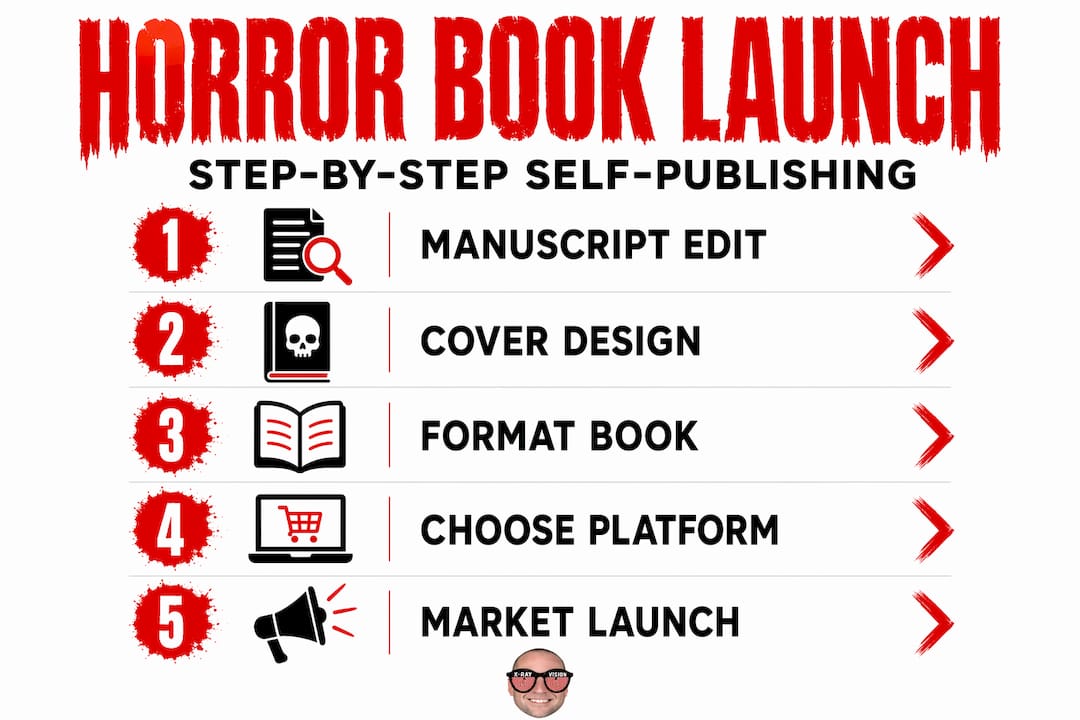
Here is a launch sequence that actually moves the needle:
- Build your author platform 3–6 months before launch. This means a professional author website, an email list (start collecting subscribers now), and at least one active social media presence where horror readers actually congregate. TikTok's BookTok community has made indie horror authors into overnight phenomena. Consider where your readers live online.
- Recruit ARC readers 4–6 weeks before your release date. A team of 20–50 ARC readers generates enough reviews to give your launch real social proof. Reach out to horror book bloggers, active Goodreads reviewers, and engaged members of horror reader communities on Reddit and Facebook.
- Optimize your book description for both readers and algorithms. Your description is not a plot summary. It is a piece of marketing copy. Lead with tension. Make the reader feel the dread before they've purchased. Include relevant keywords naturally in your Amazon description.
- Engage with horror communities authentically before you need anything from them. Comment on other authors' releases, participate in discussions, share your reading experiences. Communities notice when someone appears only to promote their own book.
- Set up a pre-order at least two weeks before launch. Pre-orders count toward your launch week sales rank, and they give readers who discover you early a way to commit immediately.
Building an author email list remains the highest-return marketing activity for indie authors. Social media followers can disappear when algorithms change. Your email list is yours. Offer a free short horror story, a prequel chapter, or exclusive content to incentivize sign-ups from day one.
Pro Tip: Reach out to horror-specific book bloggers and podcast hosts two to three months before launch, not two weeks before. Those with large audiences plan their content calendars far in advance. Early contact dramatically improves your chances of coverage.
For targeted strategies on engaging horror readers, focus on specificity. A reader of quiet cosmic horror and a reader of visceral splatter fiction are not the same person. Know which reader you wrote for, and go find exactly them.
My honest take on self-publishing horror
Writing horror is something I genuinely love. But I'll be straight with you: the process of getting that horror from manuscript to market is non-linear, sometimes demoralizing, and full of moments where you question whether the whole thing is worth it.
The two areas where I've seen authors (and where I've personally felt the pull to cut corners) are editing and cover design. You will be tempted to skip a round of editing because you've read the manuscript fifteen times and can't bear to look at it again. Don't. And you will be tempted to design your own cover because the budget is already stretched. Resist it. Readers judge horror covers with their gut in about half a second. A weak cover is an invisible book.
Marketing is genuinely the hardest part of self-publishing horror. Harder than writing the book. Harder than editing it. It requires a completely different set of skills, and nobody naturally has all of them. You'll need to learn some things, outsource others, and accept that your first launch will teach you more than any guide can.
What I'd tell every horror author considering this path: build your reader relationship before you need it. The authors who thrive in indie horror aren't just the best writers. They're the ones who showed up consistently, shared genuinely, and treated their readers like the obsessive, passionate horror fans they are.
Traditional publishing is still an option later, and a strong self-published track record with real sales data actually strengthens your case with agents. Self-publishing and traditional publishing are not mutually exclusive paths. They're different chapters of the same career.
— Mark
Explore horror that shows you what's possible
If you're working through the steps to publish horror and want to see what a well-crafted indie horror collection looks like up close, Markwatsonbooks is worth a visit.

The horror collection at Mark Watson Books spans horror thrillers, dark fiction, and internet horror anthologies that have built a genuinely passionate readership. For fans of internet-born horror specifically, the Creepypasta books collection showcases how niche horror sub-genres can find dedicated audiences when the writing and presentation are done right. Beyond the books themselves, the Markwatsonbooks blog covers storytelling techniques, genre-specific publishing strategies, and author insights you won't find in generic publishing guides. Whether you're looking for inspiration or a practical horror book publishing guide for your own launch, there's something worth bookmarking here.
FAQ
How long does it take to self-publish a horror novel?
From a finished manuscript to a live book, the process typically takes three to six months when you include professional editing, cover design, formatting, and a proper launch campaign. Rushing shortens that timeline but usually shows in the final product.
What is the best platform for self-publishing horror books?
Amazon KDP is the strongest starting point for most indie horror authors due to its 70% ebook royalties and access to Kindle Unlimited readers. Adding IngramSpark for print distribution expands your reach to bookstores and libraries.
How much does it cost to self-publish a horror book?
A professional launch typically requires $2,000–$5,000 for editing alone, plus additional costs for cover design, formatting, and marketing. Cutting these costs consistently produces books that underperform against professionally produced competition.
Do self-published horror books need an ISBN?
Yes. An ISBN is required for print distribution through IngramSpark and most major retailers. You can purchase your own ISBNs through Bowker in the United States, which gives you full publisher control over your book's metadata.
What horror sub-genres sell best for indie authors?
Psychological horror, supernatural thriller, and dark fiction with thriller crossover elements tend to perform well in indie markets because they overlap with large existing thriller and suspense readerships. Understanding horror sub-genres helps you position your book for the right audience from day one.