
TL;DR:
- Folklore in children's books serves as a vital tool for cultural education, moral development, and fostering empathy.
- Its traditional stories, including fairy tales and myths, are built on familiar structures and traits that aid memory and comprehension.
Folklore isn't just a collection of dusty old stories passed down through the ages. It's a living, breathing force inside children's literature that shapes how young readers see the world, understand right from wrong, and connect with cultures far beyond their own backyard. Many parents and educators overlook this power, assuming fairy tales and folktales are simply entertainment. But these stories are doing something much deeper. This guide explores what folklore really means in children's books, how it works as a storytelling tool, why it matters for cultural education, and exactly how you can bring it to life at home or in the classroom.
Table of Contents
- Defining folklore in children's books: Types and traits
- Storytelling mechanics: How folklore shapes young readers
- Folklore and cultural education: Teaching values and empathy
- Bringing folklore to life: Practical applications and activities
- Why folklore still matters: A modern perspective
- Explore folklore, inspire young minds
- Frequently asked questions
Key Takeaways
| Point | Details |
|---|---|
| Core genres explained | Folklore in children's books covers fairy tales, fables, myths, legends, and folktales with deep cultural roots. |
| Storytelling tools | Simple plots, archetypal characters, and repeated phrases help children engage and learn through folklore. |
| Cultural values taught | These stories teach honesty, empathy, courage, and more, supporting both personal and cultural growth. |
| Practical activities | Parents and educators can adapt folklore using storytelling, roleplay, and creative arts to bring lessons alive. |
Defining folklore in children's books: Types and traits
With the topic introduced, the next step is to clarify what folklore means and what it looks like inside children's books. The word "folklore" covers a wide range of traditional stories, and knowing the difference between types helps parents and educators choose the right stories for the right moments.
Folklore in children's books refers to traditional stories including fairy tales, folktales, fables, myths, and legends that are passed down orally across generations, often featuring magical elements, moral lessons, and cultural values. Each type carries its own personality and purpose.
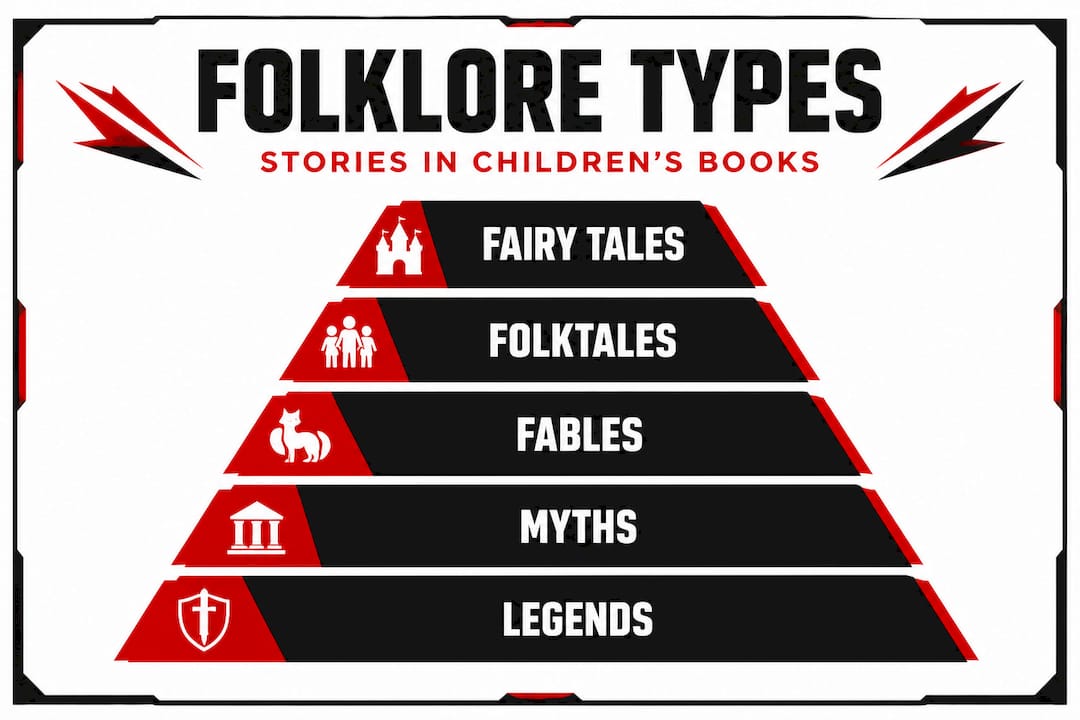
Here's a quick look at how the main types compare:
| Type | Key traits | Famous example |
|---|---|---|
| Fairy tale | Magic, transformation, good vs. evil | Cinderella |
| Folktale | Cultural wisdom, tricksters, community | Anansi the Spider |
| Fable | Animal characters, clear moral lesson | The Tortoise and the Hare |
| Myth | Explains natural events, gods, creation | How the Sun Was Made |
| Legend | Based on real or believed history | Johnny Appleseed |
Beyond the genre differences, all folklore shares a recognizable set of traits that make these stories instantly familiar to children:
- Magical or supernatural elements that stretch the imagination
- Clear moral lessons woven naturally into the plot
- Archetypal characters like the brave hero, the clever trickster, or the wicked villain
- Repetition of phrases, actions, or events in groups of three
- Simple, linear plots that are easy to follow and remember
These traits aren't accidental. They evolved over centuries of oral storytelling, shaped by what worked best when a story had to travel from mouth to ear without the help of a printed page. A wonderful example of modern children's literature drawing on this tradition is Hairy Fairy Tales, which plays with fairy tale conventions in a fresh, humorous way while keeping the magic alive.
Studies show that folklore titles consistently make up a significant portion of children's library collections and reading lists across the USA, reflecting just how central these stories remain to early literacy programs nationwide.
Storytelling mechanics: How folklore shapes young readers
Now that folklore has been defined, it's important to see how these stories are constructed to make them so memorable and effective for children. The architecture of a folklore story isn't random. It follows patterns that children's brains are wired to absorb.

Stories use simple narratives with archetypal characters like heroes and villains, repeated phrases like "once upon a time," and structures that teach through journeys of transformation and conflict resolution. These structural elements create a scaffold that helps young readers predict, process, and retain what they hear or read.
Here's how a typical folkloric story structure unfolds:
- The opening phrase sets the tone and signals that a special kind of story is beginning ("Once upon a time," "Long, long ago").
- The hero or central character is introduced with a clear problem or challenge to overcome.
- A series of three trials or events tests the character's courage, cleverness, or kindness.
- A helper or magical element appears to guide or support the hero.
- The climax brings direct confrontation with the villain or obstacle.
- The resolution rewards virtue and punishes wrongdoing, closing with a satisfying, memorable ending.
This pattern isn't just good storytelling. It mirrors how children naturally make sense of the world: cause and effect, fairness, and the idea that choices have consequences.
"The journey from 'once upon a time' to 'happily ever after' teaches children that problems can be solved, that courage is rewarded, and that the world has a moral order worth believing in."
Repeated phrases play a powerful role too. When children hear "I'll huff, and I'll puff" three times, they're not just enjoying a rhythm. They're building phonemic awareness, memory, and language fluency without even realizing it. The same applies to monsters and imagination in children's books, where vivid, slightly scary characters help kids process real fears in a safe, story-shaped space.
Pro Tip: When reading folklore aloud, slow down and emphasize the repeated phrases. Invite children to say them with you. This simple technique supercharges vocabulary retention and makes read-aloud sessions feel like an exciting, shared ritual.
Folklore and cultural education: Teaching values and empathy
Understanding storytelling structure sets the stage for seeing folklore's deeper impact: its role in shaping children's values and their sense of identity. This is where folklore becomes truly powerful.
Folklore preserves heritage, transmits values like honesty, courage, kindness, and justice, and fosters empathy, critical thinking, and intercultural understanding. These aren't abstract benefits. They show up in concrete ways every time a child roots for the underdog or feels the sting of a character's unfair treatment.
Key values that folklore consistently teaches include:
- Courage in the face of overwhelming odds
- Honesty as a path to reward and respect
- Kindness toward strangers and the vulnerable
- Cleverness as a tool for the powerless
- Perseverance when the journey gets hard
- Community and the strength of working together
Here's a look at how specific classic stories map to the values and skills they teach:
| Story | Cultural origin | Value/skill taught |
|---|---|---|
| The Tortoise and the Hare | African/Aesop | Patience, perseverance |
| Anansi the Spider | West African/Caribbean | Cleverness, resourcefulness |
| The Boy Who Cried Wolf | Greek/Aesop | Honesty, trust |
| Mulan | Chinese | Courage, family loyalty |
| Cinderella | European | Kindness, inner worth |
| Why the Sky is Far Away | Nigerian | Gratitude, responsibility |
When children encounter stories from cultures different from their own, something remarkable happens. They step inside a different world, feel what those characters feel, and start to understand that people everywhere share similar fears, hopes, and values. This is the foundation of genuine empathy, and it's exactly what children's book themes focused on social-emotional learning aim to build.
Folklore also gives families a shared language for discussing values. The benefits of family storytelling extend well beyond bedtime. When a child says "that reminds me of Anansi," they're connecting a real-life situation to a moral framework they've already internalized. That's a powerful cognitive and emotional skill.
For educators building diverse, inclusive classrooms, diversity and empathy through folklore is one of the most organic and engaging approaches available.
Pro Tip: After reading a folktale, ask children one open-ended question: "What would you have done differently, and why?" This simple prompt sparks critical thinking and helps children connect the story's values to their own choices.
Bringing folklore to life: Practical applications and activities
Having understood the educational power of folklore, readers can now explore direct, practical ways to bring these lessons to life at home or in the classroom. The good news? You don't need a formal curriculum or special training. You need curiosity and a few good tools.
Methodologies for using folklore in children's books and education include oral retelling, adaptation into illustrated books, story mapping, roleplay, read-alouds, and creating new stories based on traditional structures. Each of these approaches engages children at different learning levels, making folklore accessible to a wide range of ages and abilities.
Here are engaging activities to try right away:
- Oral retelling sessions: Ask children to retell a story they've just heard using only their memory and their own words. This builds narrative skills, sequencing ability, and confidence.
- Story mapping: Using Propp's action symbols or a simple drawn map, have children chart the hero's journey. Where does the story begin? Where is the obstacle? Where is the reward? Visual learners thrive with this approach.
- Roleplay and dramatic retelling: Assign characters, add simple costumes or props, and let children act out the story. Shy readers often bloom when they can become the character instead of just reading about them.
- Create-your-own folktale: Give children a simple template: a hero, a problem, three attempts to solve it, and a lesson at the end. Encourage them to set the story in their own city, neighborhood, or school.
- Cross-cultural comparison: Read two versions of the same tale from different cultures (Cinderella exists in over 500 versions worldwide) and ask children to spot similarities and differences. This activity is vivid, eye-opening, and genuinely fun.
- Illustrated retelling: Have children draw their favorite scene or create a short picture book version of a folktale. Combining visual art with narrative deepens comprehension and personal connection.
Helpful tools to support folklore activities include:
- Story cards with illustrated characters and settings for mix-and-match storytelling
- Puppet kits for bringing trickster characters to life
- Adaptation guides from school library resources
- Audio recordings of traditional oral storytellers from different cultures
- World folklore anthologies available in most school and public libraries
For deeper guidance on how to structure an engaging story for young readers, planning engaging stories is a rich resource worth bookmarking. And when you're ready to find curated stories that model these techniques beautifully, browse children's books to discover titles that bring folklore's magic into today's reading world.
Pro Tip: In a culturally diverse classroom, invite students to share folktales from their own family backgrounds. This validates their heritage and creates an instant, authentic multicultural curriculum that no textbook can replicate.
Why folklore still matters: A modern perspective
With practical approaches covered, it's worth reflecting on why folklore's presence in children's books continues to shape society, even as screens multiply and attention spans shift.
Here's an uncomfortable truth: many educators assume folklore is a "nice addition" to literacy programs, not a core tool. That assumption is worth challenging. In a world that moves faster every year, the slow burn of a well-told folktale teaches something algorithms can't: how to sit with uncertainty, trust a narrative process, and find meaning in a resolution that isn't instant.
For parents and educators, folklore in children's books is ideal for bedtime storytelling or classroom activities that build vocabulary, empathy, and cultural awareness while being adaptable for diverse USA audiences via global and American tales. The adaptability here is key. Folklore isn't frozen in time. It's meant to be retold, reshaped, and reimagined for each new generation.
The challenge today is balance. Some traditional tales carry values or portrayals that don't align with the inclusive, diverse world we're building. A heroine who only waits to be rescued. A villain defined entirely by physical difference. These elements deserve honest conversation, not erasure. Adapting folklore for modern readers means keeping the emotional core and moral weight while updating portrayals that no longer serve children well.
American folklore is a goldmine here. Tales from Indigenous nations, African American oral traditions, immigrant communities, and frontier legends offer a rich, home-grown palette that resonates deeply with USA readers while celebrating the country's diverse roots. Blending these with global stories creates a curriculum that feels both local and wide-open.
For educators committed to diversity in folklore books, the goal isn't to replace traditional tales. It's to expand the library so every child can find a story where someone who looks and sounds like them gets to be the hero.
Folklore, at its best, is not a museum exhibit. It's a living conversation across time, culture, and imagination. That's not outdated. That's essential.
Explore folklore, inspire young minds
Folklore has proven itself as one of the most powerful tools in children's literacy and cultural education. You've seen how it works, why it matters, and exactly how to use it. The next step is getting the right stories into young hands.

At markwatsonbooks.com, you'll find a curated selection of children's folklore books that bring these timeless storytelling traditions to life with vivid characters, bold imagination, and genuine heart. Whether you're a parent looking for bedtime magic or an educator building a richer classroom library, these books deliver the stories that stick. Ready to explore everything on offer? Browse the full book collections and find the perfect next read for the young storytellers in your life.
Frequently asked questions
What are the main types of folklore in children's books?
The main types include fairy tales, folktales, fables, myths, and legends, each with unique features and cultural origins. Folklore in children's books covers traditional stories passed down orally across generations, featuring magical elements, moral lessons, and cultural values.
How does folklore help teach values to kids?
Folklore preserves heritage and teaches values like honesty, kindness, courage, and empathy through relatable stories and memorable characters. Cultural upbringing research confirms that folklore also fosters critical thinking and intercultural understanding in children.
How can I use folklore stories at home or in the classroom?
You can use oral storytelling, read-alouds, illustrated books, role-playing, and story mapping to engage children with folklore in fun, memorable ways. Education methodologies also recommend having children create their own stories based on traditional folklore structures.
Why are repeated phrases like "once upon a time" used in folklore?
Repeated phrases help children anticipate storytelling patterns, which strengthens memory and makes stories more engaging and accessible. Folk tales research shows that these phrases, paired with archetypal characters, create a reliable narrative scaffold that supports early language development.