

TL;DR:
- Promotion requires targeted outreach to parents, grandparents, librarians, and teachers.
- Building an online presence and email list is essential for long-term success.
- Small, consistent actions and local engagement produce genuine buzz and sustained growth.
Getting a children's book noticed in the USA feels like shouting into a stadium. The market is packed, the competition is real, and most parents who've written or co-created a book for kids quickly discover that writing it was the easy part. Promotion is where the hard work truly begins. This guide cuts through the noise and delivers concrete, actionable strategies that help parents and guardians get their children's books in front of the right readers, generate buzz, and drive real results, whether that means more sales, more library shelves, or more young readers falling in love with your story.
Table of Contents
- Understanding your audience and promotional goals
- Essential tools and resources for book promotion
- Step-by-step guide: Actionable promotion strategies
- Measuring results and optimizing your approach
- Why most children's book promotion advice misses what parents really need
- Find more resources and books to inspire your journey
- Frequently asked questions
Key Takeaways
| Point | Details |
|---|---|
| Know your buyers | Target parents, grandparents, and educators as they make most purchasing decisions. |
| Build your toolkit | Use websites, social media, and review platforms to maximize your reach and ease of communication. |
| Follow actionable steps | Combine outreach, events, reviews, and collaborations for a balanced promotional strategy. |
| Track and adjust | Measure sales and engagement and refine your approach based on what works best. |
| Personalize your approach | Consistent, authentic connection is more effective than one-off, big campaigns for most parents. |
Understanding your audience and promotional goals
Before you spend a single dollar or hour promoting your book, you need to know exactly who you're trying to reach. This sounds obvious, but most first-time promoters skip it entirely and end up spreading themselves too thin.
Who actually buys children's books? The answer might surprise you. 80% of purchases are made by parents or grandparents. That means your promotional efforts should speak directly to adults, not the children themselves. Teachers and librarians are also powerful buyers and influencers, especially for books with educational themes or curriculum connections. School librarians, in particular, can order multiple copies at once and recommend a title to hundreds of families.
Understanding what drives these buyers is just as important. Parents want books that entertain AND teach. Grandparents gravitate toward nostalgic, warm storytelling with beautiful illustrations. Librarians look for diverse voices, accessibility, and books that spark conversation. Teachers want curriculum-aligned content or stories that tackle social-emotional learning. Knowing which of these audiences you're targeting shapes every decision you make next.
Setting measurable goals is the next critical step. Vague goals like "get my book out there" don't work. Instead, define what success looks like in specific terms:
- Sell 200 copies within the first six months
- Get stocked in five local library branches
- Earn 50 verified reviews on Amazon or Goodreads
- Build an email list of 300 parents before your next book launch
- Secure five school visits or author readings
These targets give you direction. They also help you decide which promotional tactics make sense. If your goal is library placement, you'll focus on pitching librarians with review copies. If your goal is online sales, you'll prioritize social media and paid advertising. Explore different children's book genres to understand where your book fits and how that shapes your audience targeting.
| Goal type | Primary tactic | Success metric |
|---|---|---|
| Brand awareness | Social media, press releases | Reach, shares, mentions |
| Direct sales | Email campaigns, paid ads | Units sold, revenue |
| Library placement | Librarian outreach, ARCs | Libraries stocked |
| Community engagement | Events, school visits | Attendance, feedback |
| Reviews and credibility | ARC campaigns, blogger outreach | Number of reviews |
Essential tools and resources for book promotion
With your goals locked in, it's time to build your promotional toolkit. Think of this as setting up your war room before the campaign begins. The US children's book market hit $1.38 billion in 2023, with print sales reaching 248 million units. There is real money and real readership here. The question is how you capture a slice of it.
Your book's online home is the foundation. This doesn't need to be expensive. A simple landing page or author website that includes your book's cover, a compelling description, purchase links, and your contact information is enough to start. Parents searching for your book need a place to land that feels professional and trustworthy. Without it, you lose sales before they happen.
Social media platforms are non-negotiable in 2026. Here's what works for children's book promotion:
- Facebook remains the best platform for reaching parents and grandparents, particularly through targeted groups and Facebook Ads
- Instagram excels for visual content, especially if your book has striking illustrations or a distinctive art style
- TikTok is rapidly growing as a discovery platform, with the #BookTok community driving significant sales for independent authors
- Pinterest works well for evergreen content like reading lists, activity sheets, and classroom resources tied to your book
Review platforms and book bloggers carry enormous weight. A positive review from a respected children's book blog can drive hundreds of sales. Reach out to book bloggers who specialize in your age group and genre. Offer them a free digital or print copy in exchange for an honest review. Sites like Goodreads also allow readers to follow authors and receive updates, making them a valuable long-term asset.

Email lists are your most powerful long-term tool. Unlike social media, you own your email list. Platform algorithms change. Email doesn't. Understanding the craft behind writing compelling children's books helps you create content that keeps subscribers engaged and eager for your next release.
Pro Tip: Start building your email list at least 90 days before your book launches. Offer something valuable in return, such as a free activity sheet, a sample chapter, or a printable coloring page tied to your book's characters. Early subscribers become your launch-day champions.
| Tool | Cost | Best for | Difficulty |
|---|---|---|---|
| Author website | Low to moderate | Credibility, purchase hub | Easy to moderate |
| Facebook page | Free (ads cost extra) | Parent outreach | Easy |
| Free | Visual storytelling | Easy | |
| TikTok | Free | Viral discovery | Moderate |
| Email platform | Free to low | Launch campaigns, retention | Moderate |
| Book bloggers | Free (send review copies) | Credibility and reach | Moderate |
Step-by-step guide: Actionable promotion strategies
Now the real action starts. Here's a sequenced blueprint you can follow, regardless of your budget or prior experience.
Step 1: Pitch local libraries and schools directly. This is the most underutilized and most effective tactic for parents promoting independently published children's books. Call your local library's children's department and ask who handles book acquisitions. Follow up with a personalized email that includes your book's summary, age range, themes, and a complimentary review copy. For schools, contact the librarian or literacy coordinator. Offer a free author visit, either in person or via video call. These visits generate authentic excitement among students and often lead to book orders.
Step 2: Build a consistent social media presence. Consistency beats virality every time. Post three to four times per week with content that genuinely serves your audience. Some powerful post types include:
- A short video of you reading the first page of your book aloud
- Behind-the-scenes looks at your illustration process or writing journey
- Fun facts about the characters or themes in your story
- Testimonials from kids or parents who've read the book
Step 3: Collaborate with other authors and influencers. The children's book community is surprisingly generous. Reach out to other independent authors in your genre and propose a cross-promotion. You promote their book to your audience; they promote yours to theirs. Similarly, parenting bloggers and family-focused content creators on Instagram or YouTube often welcome book recommendations for their audience.
Step 4: Run a giveaway or launch event. Giveaways generate excitement and expand your reach fast. On Instagram or Facebook, run a giveaway where entering requires following your page and tagging a friend who would love the book. This doubles your exposure with minimal cost. A virtual launch event via Facebook Live or Instagram Live lets you read a portion of the book, answer questions, and create a memorable moment that fans share with their networks.
Picture books make up 38 to 41% of all children's book sales, which means picture book authors have a particularly strong market to tap with visual social content and illustrated giveaway previews.
Step 5: Collect reviews and testimonials actively. Ask. Seriously, just ask. Most satisfied readers won't leave a review unless prompted. After someone buys or receives your book, send a personal note or email asking if they'd be willing to share their thoughts on Amazon, Goodreads, or your social media page. A few warm, genuine reviews can dramatically shift how new buyers perceive your book.
"The books that gain the most traction aren't always the most polished. They're the ones with the most enthusiastic, authentic advocates behind them." This is especially true in the children's book world, where word-of-mouth from a trusted parent in a school community can outperform any paid campaign.
For tips on writing for early readers that make your book more review-worthy and engaging, strong content always amplifies promotion. You can also browse successful children's books examples for inspiration on positioning and presentation.
Measuring results and optimizing your approach
Promotion isn't a one-time event. It's an ongoing cycle of action, observation, and adjustment. Once your campaign is running, you need to measure what's working and boldly cut what isn't.
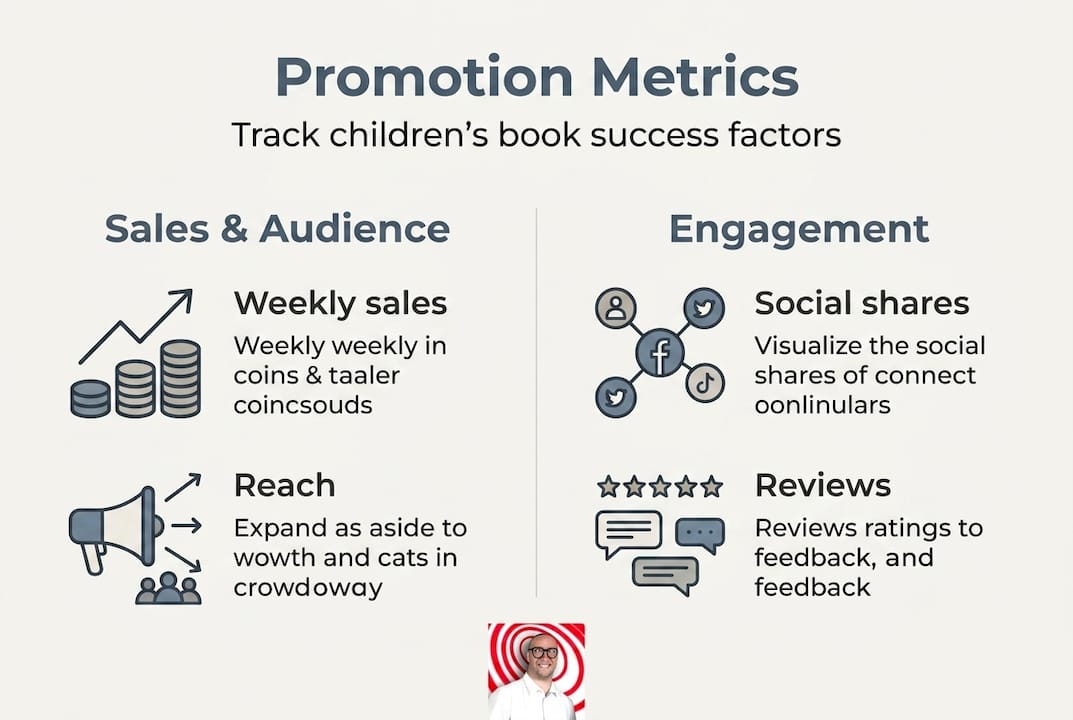
Setting up a simple tracking system doesn't require expensive software. A basic spreadsheet works perfectly. Track the following each week or month:
- Total books sold (by platform, if possible)
- Number of new email subscribers
- Social media follower growth
- Post engagement rates (likes, comments, shares)
- Website visits and where they came from
- Number of reviews received
- Event attendance figures
Key metrics to watch closely:
- Sales velocity: Are you selling more books this week than last? Spikes often point to what's working.
- Email open rates: If fewer people open your newsletters, your subject lines or content need refreshing.
- Review count: Growing review numbers signal that readers are engaging beyond the purchase.
- Event attendance: High attendance at a school or library reading is a strong sign of local interest worth expanding.
Parents spend about $100 per household annually on children's books, which tells you there is real purchasing power in your target audience. The goal is to become the book that gets recommended within their trusted circles, because that's how word-of-mouth momentum builds.
Adjusting your tactics based on results is where smart promoters separate themselves from frustrated ones. If your Instagram posts aren't generating engagement, try video instead of static images. If email open rates drop, experiment with more personal subject lines. If library pitches aren't converting, offer a free classroom activity guide alongside your review copy.
| Metric | What it tells you | Action if low |
|---|---|---|
| Weekly sales | Overall campaign health | Revisit messaging or run a promo |
| Email open rate | Subject line and list health | A/B test subject lines |
| Social engagement | Content relevance | Try new formats like video or polls |
| Review count | Reader satisfaction and trust | Actively request reviews post-purchase |
| Event attendance | Local community interest | Partner with schools or community groups |
For creative ways to keep your audience engaged between launches, ideas around creative engagement ideas can spark fresh approaches that keep readers returning.
Why most children's book promotion advice misses what parents really need
Here's an uncomfortable truth: most marketing guides are written for people with marketing budgets, marketing teams, and marketing time. Parents promoting a children's book have none of those things in abundance. So the advice falls flat.
The flashy tactics get all the attention. Paid advertising campaigns. PR agencies. Influencer deals. But for a parent working a full-time job and raising a family while trying to get a book noticed, those approaches feel out of reach and often are.
What actually moves the needle is direct, authentic, and consistent action at the local level. A single author reading at your child's school, organized personally by you, can generate more genuine buzz than a Facebook ad campaign. A handwritten note to a local librarian offering a review copy will get opened. A mass email pitch won't.
The guides that teach writing for young readers often do a better job of preparing authors for this reality than purely promotional resources. They remind you that connection with your audience starts in the writing and continues through every interaction you have as an author.
Another thing most advice misses: the power of small, repeated actions. One post a week for a year beats ten posts in a single launch week. One email to a librarian a month beats a single mass pitch. Momentum in children's book promotion is built slowly and then releases all at once. Parents who understand this and stay consistent, even when early results feel slow, tend to be the ones who look back six months later and realize the traction crept up on them quietly and then suddenly exploded.
Realistic expectations matter enormously here. You won't sell 10,000 copies in your first month. Almost no one does. But with focused effort and genuine engagement, building a real, loyal readership is absolutely achievable. That loyal readership then sells the next book for you. That's the real long game.
Find more resources and books to inspire your journey
Promoting a children's book takes passion, patience, and the right support around you. Whether you're searching for fresh ideas to sharpen your approach or looking for stories that show what great children's literature looks like in practice, Mark Watson Books has you covered.

Explore the curated children's books collection for a vivid look at what resonates with young readers and the parents who love reading alongside them. Each title offers a window into what makes a children's story truly memorable. Ready to go deeper? Browse the full book selection for resources, stories, and inspiration across genres that will fuel your own creative and promotional journey. Don't wait. Your book deserves to be found.
Frequently asked questions
Who are the biggest buyers of children's books?
Parents and grandparents account for 80% of children's book purchases, making them the primary audience for your promotional efforts. Teachers and librarians also play a significant purchasing and recommending role.
What budget should I expect to promote a children's book?
US parents spend around $100 per household annually on children's books, but your promotional budget can start as low as zero if you focus on direct outreach, social media, and community events. Paid advertising can be layered in as results grow.
What is the most effective way to get noticed by librarians and teachers?
A personalized pitch combined with a complimentary review copy and an offer for a free author visit dramatically increases your chances of getting a librarian or teacher's attention and buy-in.
How important are online reviews for children's book promotion?
Online reviews are critical. They build trust with parents who haven't heard of your book before, and platforms like Amazon and Goodreads use review count as part of their visibility algorithms, meaning more reviews equal more organic discovery.
How quickly can I expect results from my book promotion?
Most consistent promotional efforts begin generating noticeable traction within three to six months. Early results may feel slow, but the momentum compounds over time, especially when community relationships and email lists are actively growing.