

TL;DR:
- A character development workflow is a structured process that builds fictional characters from their core contradictions outward. It involves locking five foundational fields—want, need, contradiction, voice, and red lines—to create vivid and driven characters. Using AI support for tasks like generating wants and needs, the key to authentic growth lies in inventing the contradiction and pressure-testing it against plot challenges.
A character development workflow is a structured, repeatable process for building fictional characters from their core contradictions outward to their full story arc. Writers who skip this process often produce flat characters who react to plot rather than drive it. The most vivid characters share three qualities: a want they can name, a need they cannot see, and a contradiction that makes them feel alive. This guide walks you through every stage of that process, from locking your character's five load-bearing fields to pressure-testing their arc against your plot's hardest moments.
What does a character development workflow actually include?
A character development workflow covers five foundational fields before any scene gets written. Those fields are: want, need, contradiction, voice, and red lines. Want is what your character consciously pursues. Need is the internal truth they resist. Contradiction is the gap between those two, and it is the engine of every compelling character arc.
Most writers treat character building as static biography. They fill out eye color, childhood trauma, and favorite food, then wonder why the character still feels hollow. Effective workflows treat characters as contradictions in motion and focus writing effort on pressure-testing those contradictions against plot. That shift in focus changes everything.
Tools and inputs writers need before starting
Before you begin, gather three things: a blank character profile template, a clear sense of your story's central conflict, and at least one defining event from your character's past. You do not need a complete backstory. You need enough emotional history to locate the misbelief your character carries into the story.

| Workflow step | Required input |
|---|---|
| Lock the five fields | Story premise, character role, one formative event |
| Generate wants and needs | Core conflict, character's external goal |
| Invent the contradiction | Personal knowledge of the character's flaw |
| Draft character voice | Sample dialogue, emotional register |
| Set red lines | Story's moral stakes, genre expectations |
Pro Tip: Start with the contradiction before anything else. If you cannot name what your character believes that is false, you do not yet know your character.
How do you build a character step by step?
A seven-step AI-assisted workflow handles roughly 70% of the scaffolding work in about 30% of the typical time, producing a first-draft character in approximately one day. That speed matters because it frees your creative energy for the one task no AI can do: inventing the contradiction.
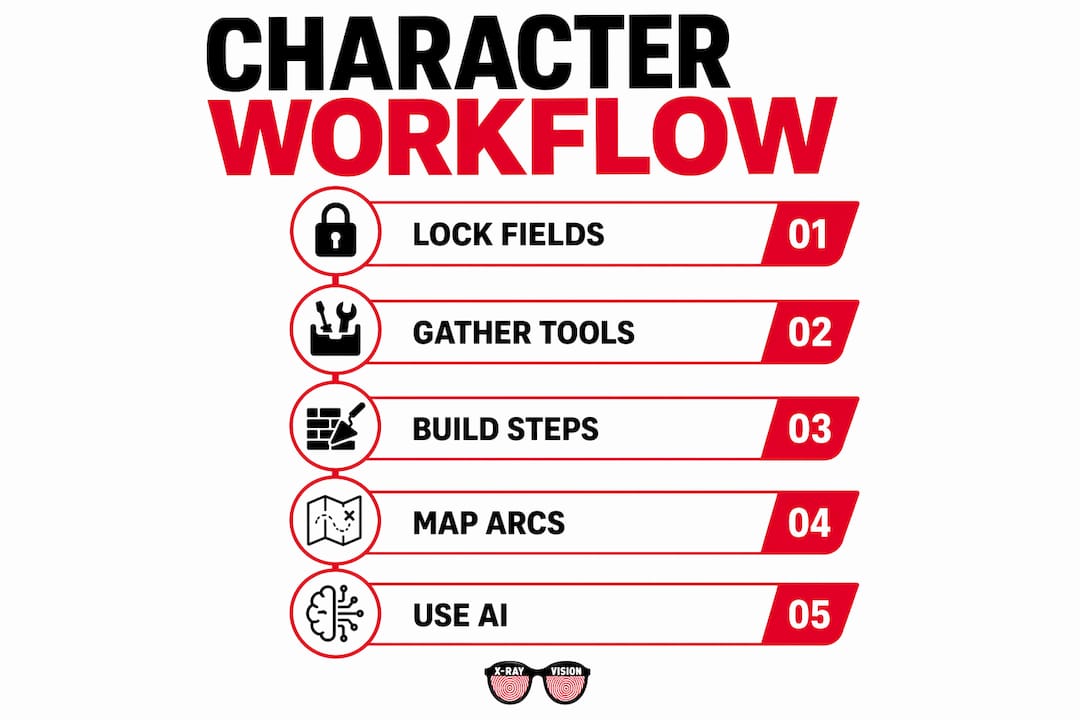
Here is the sequence that works:
- Lock the five fields. Write one sentence for each: want, need, contradiction, voice, and red lines. Do not move forward until all five are filled.
- Generate wants and needs with AI support. Feed your premise and character role into an AI tool. Ask it to suggest five possible wants and five possible needs. You choose, not the AI.
- Invent the contradiction yourself. This step belongs to you. The contradiction is the most personal and specific element. It cannot be outsourced.
- Draft character voice. Write three lines of dialogue in your character's voice. Then ask an AI to reflect back what emotional register it detects. Adjust until the voice matches your intention.
- Set red lines. Red lines are the actions your character will never take, no matter the pressure. They define moral boundaries and create genuine dramatic tension when the plot pushes against them.
- Pressure-test against plot demands. Map your three biggest plot events. Ask: does each one press directly on this character's contradiction? If not, revise either the plot event or the contradiction.
- Run the character through a sample scene. Write 300 words of a scene you have not planned yet. Watch how the character behaves under surprise. Inconsistencies here reveal gaps in the five fields.
Pro Tip: Step 6 is where most writers discover their plot and character are running on parallel tracks instead of colliding. That collision is the story.
The narrative character progression you build through this sequence feels earned because every step connects to the character's internal logic. You are not decorating a person. You are engineering a pressure system.
How do character arcs create meaningful growth?
Character arcs fall into three categories: Positive Change Arc, Flat Arc, and Negative Arc. Each one structures the transformation between who your character is on page one and who they become by the final scene. Choosing the wrong arc type for your story's tone is one of the most common structural mistakes writers make.
The Positive Change Arc follows a character who holds a misbelief, gets challenged by plot events, and eventually surrenders the misbelief for a harder truth. The Flat Arc features a character who already holds the truth and uses it to change the world around them. The Negative Arc tracks a character who doubles down on their misbelief until it destroys them.
Starting a character arc with trauma or misbelief rather than abstract theme produces more authentic development. That means your first question is not "what is this story about?" It is "what does this character believe that is costing them everything?"
Plot must actively pressure the character's specific flaw to create believable growth. Random hardship does not produce character change. Only hardship that targets the misbelief directly forces a character to confront it. This is why writing character backstory matters so much: the backstory is where the misbelief was born.
Character growth is non-linear. Spiral growth, including failures and regression under stress, makes transformation feel authentic. A character who moves cleanly from flaw to growth reads as a lesson, not a person. The zigzag pattern, where progress is followed by backsliding, is what readers recognize as real.
Common arc mistakes to avoid:
- Skipping the misbelief. Growth without a named false belief feels random.
- Resolving the arc too early. Change that arrives before the climax deflates the ending.
- Using external events as substitutes for internal pressure. A car crash does not change a person. A car crash that forces them to ask for help when they never ask for help does.
- Making growth linear. Real people regress. Your characters should too.
- Ignoring the role of resolution in sealing the arc. The final scene must confirm or deny the change.
Pro Tip: Map your character's misbelief on a timeline. Mark every scene where the plot presses on it. If you find gaps longer than three chapters, add a pressure scene or cut the gap.
How do interactive workflows and AI tools deepen character creation?
Interactive, question-based workflows unlock deeper character insights by guiding iterative discovery rather than static biography filling. The difference is significant. A static template asks "what is your character afraid of?" An interactive workflow asks that question, then follows up with "when did that fear first protect them?" and "what would they sacrifice to avoid facing it?" Each follow-up question pulls the character further from cliché.
A full guided character-building session typically takes 60 or more minutes to develop a comprehensive profile, moving from surface traits to deep emotional exploration. That time investment pays off in scenes that write themselves because the character's reactions are already known.
The key benefits of interactive question-based approaches:
- Progressive depth. Questions move from observable traits to emotional history to core misbelief, building a complete picture layer by layer.
- Follow-up reveals nuance. A single question rarely surfaces the most interesting answer. The second and third follow-up questions do.
- AI as organizer, not inventor. AI tools work best when they organize and reflect your answers back to you, not when they generate the character for you. The character's specificity must come from you.
- Richer profiles in less time. Writers who use iterative questioning consistently produce more emotionally grounded profiles than those who fill static forms.
The art of storytelling depends on characters who feel like they existed before page one. Interactive workflows create that sense of prior life because the questions force you to imagine scenes you will never write.
Key takeaways
A character development workflow works because it forces writers to name the contradiction at the center of every character before a single scene is written.
| Point | Details |
|---|---|
| Lock five fields first | Define want, need, contradiction, voice, and red lines before writing any scenes. |
| Contradiction is the engine | The gap between what a character wants and needs drives every compelling arc. |
| Plot must target the flaw | Only events that press on the character's misbelief produce believable growth. |
| Growth is non-linear | Build in setbacks and regression so transformation feels earned, not instructed. |
| Interactive Q&A beats static templates | Follow-up questions surface emotional depth that single-answer forms never reach. |
Why I treat every character as a pressure system
Most writing advice tells you to "know your character deeply." That sounds right but it points in the wrong direction. Knowing that your character loves jazz and hates their father is biography. What actually matters is knowing what false belief they are defending and what it would cost them to let it go.
I learned this the hard way. Early in my writing, I would build detailed backstories and then wonder why my characters felt like tourists in their own stories. They had history but no internal pressure. The moment I started building characters around a central contradiction, everything changed. Scenes became arguments between what the character wanted to do and what their misbelief told them they had to do.
The other thing I would tell any writer is this: do not let AI invent your character's contradiction. Use it for everything else. Use it to generate possible wants, to stress-test dialogue, to check whether your voice is consistent. But the contradiction is yours. It is the most personal and specific thing in the whole workflow, and specificity is what separates a memorable character from a forgettable one.
I also think writers underestimate how much plot pacing shapes character growth. The timing of when the plot presses on the flaw matters as much as the pressure itself. Press too early and the character changes before readers are invested. Press too late and the arc feels rushed. The workflow forces you to map that timing deliberately rather than discover it by accident in revision.
Treat your character as a pressure system. Know what they are holding together and what would happen if it broke. Write toward that breaking point. Everything else is detail.
— Mark
Character-driven stories worth reading from Markwatsonbooks
Writers learn character development fastest by reading authors who do it well across wildly different genres.

Markwatsonbooks offers a range of character-driven books spanning horror, children's fiction, and Creepypasta anthologies. Each genre demands a different kind of character pressure. Horror characters face external threats that expose internal fractures. Children's book characters navigate moral choices that define who they are becoming. Creepypasta characters often carry a misbelief that the horror of the story forces into the open. Browsing the full collections at Markwatsonbooks gives you a front-row seat to how character arcs function across genres. Reading widely is one of the fastest ways to internalize the patterns this workflow teaches.
FAQ
What are the five load-bearing fields in a character workflow?
The five fields are want, need, contradiction, voice, and red lines. Every other character detail builds from these five.
How long does a full character development session take?
A thorough guided session takes 60 or more minutes, moving from surface traits to deep emotional history. Rushing this stage produces shallow characters.
What is the difference between a character's want and their need?
Want is the external goal the character consciously pursues. Need is the internal truth they resist, usually the opposite of what they believe about themselves.
How do story character arcs connect to plot structure?
Plot events must directly target the character's misbelief to produce believable growth. Random hardship does not change characters. Targeted pressure does.
Can AI replace personal creativity in character development?
AI handles scaffolding efficiently, but the character's contradiction and emotional specificity must come from the writer. AI organizes. Writers invent.