
TL;DR:
- Allegory in children's books provides layered stories that entertain while teaching essential moral and emotional lessons. It fosters empathy, critical thinking, and abstract reasoning by presenting complex ideas safely through symbolism and characters. Using allegory effectively involves open-ended questions and encouraging children to interpret stories at their own pace, enhancing their developmental growth.
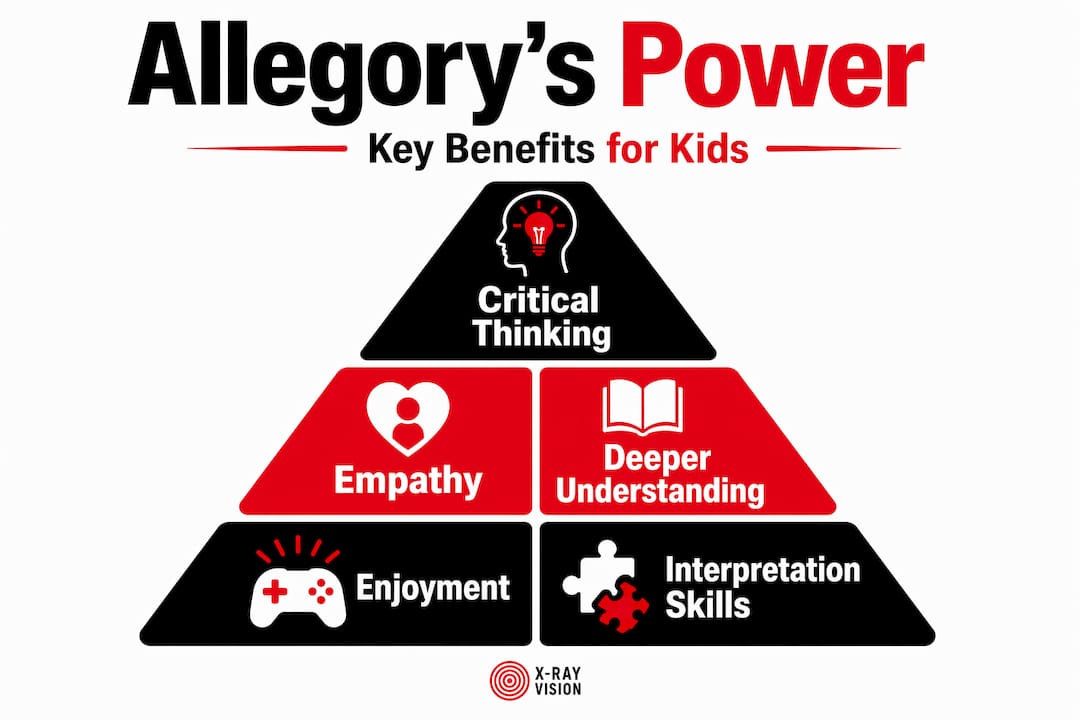
Allegory in children's books might sound like a subject for literature professors, not bedtime reading. But here's the thing: kids are natural symbolic thinkers. They already live in a world of pretend play, invented rules, and imagined worlds. So why use allegory in kids books? Because it meets children exactly where they are, wrapping real lessons inside stories they genuinely love. The benefits of allegory in children's literature go far beyond moral instruction. Allegory builds empathy, sharpens critical thinking, and helps kids process experiences too big for straightforward conversation.
Table of Contents
- Key Takeaways
- Why use allegory in kids books: what it actually means
- Cognitive and emotional benefits for young readers
- How allegory builds critical thinking and interpretive skills
- Practical ways to use allegory with children
- Common myths about teaching allegory to kids
- My take on allegory's power in children's stories
- Discover allegorical children's stories from Markwatsonbooks
- FAQ
Key Takeaways
| Point | Details |
|---|---|
| Allegory works on two levels | Stories entertain on the surface while quietly teaching values children absorb over time. |
| Safe emotional distance matters | Symbolic storytelling lets children explore loss, injustice, and fear without feeling overwhelmed. |
| Critical thinking grows naturally | Allegorical reading trains children to ask questions, spot patterns, and form personal interpretations. |
| Avoid rigid decoding | Forcing one-to-one symbol explanations kills enjoyment and reduces the story's lasting impact. |
| Creation deepens understanding | Having children write their own simple allegories builds both analytical and communication skills. |
Why use allegory in kids books: what it actually means
Allegory is not a puzzle box. It is a story that operates on two levels at once. On the surface, you have characters, plot, and setting. Underneath, you have ideas: courage, greed, justice, loss. The surface story entertains. The deeper layer teaches.
Think of The Lion, the Witch and the Wardrobe by C.S. Lewis. Children love it as an adventure in a magical world. But the story also carries themes of sacrifice, redemption, and renewal. A seven-year-old and a forty-year-old can read the same pages and walk away with different layers of meaning. That is the power of allegory. It grows with the reader.
It helps to understand how allegory differs from related devices:
- Metaphor compares two things directly in a sentence or phrase ("the world is a stage").
- Symbolism assigns meaning to a single object or character within a story (a white whale representing obsession).
- Allegory sustains symbolic meaning across an entire narrative, with characters and events standing in for abstract ideas throughout the whole story.
Aesop's fables are the clearest textbook examples of using allegory in children's stories. The tortoise is not really a tortoise. The race is not really a race. The story delivers its meaning through action and character, not lectures. That efficiency is exactly why allegory as a teaching tool for kids has endured for centuries.
Cognitive and emotional benefits for young readers
The benefits of allegory in children's literature are concrete and well-supported. Allegory serves as a vital bridge for children aged 5 to 12 to understand complex adult dilemmas through accessible symbolic narratives, letting them engage at an entertaining surface level while absorbing deeper values over time.
Here is what that actually looks like in practice:
- Emotional safety. Symbolic distancing helps children process intense emotions and societal issues safely. A child who has experienced loss can encounter it first through a fictional wolf or a withering tree before confronting it directly.
- Abstract thinking. Children's symbolic play builds cognitive flexibility needed for symbolic reading. When a child uses a cardboard box as a spaceship, they are already practicing the dual representation that allegory requires.
- Moral reasoning. Stories with deeper meanings for children do not hand out rules. They invite reflection. Moral endings in fables often complicate rather than simplify, with roughly 21.4% of Aesop's fables creating genuine ethical tension rather than just stamping a lesson on the ending.
- Empathy. When a child roots for a character who represents "the outsider" or "the overlooked one," they are practicing perspective-taking. That skill transfers directly to real social situations.
- Re-reading rewards. Allegorical books reveal new layers as children grow. A story they loved at age six will feel different at ten. That is a rare quality in any literature.
Pro Tip: When a child re-reads an allegorical book, ask them what feels different this time. Their answer will tell you a great deal about their current emotional and moral development.
The importance of allegory for kids is not abstract. It is developmental. Every layer of a good allegorical story builds something real in a growing mind.
How allegory builds critical thinking and interpretive skills
This is where the impact of allegory on child development gets genuinely exciting. Allegorical stories do not just teach lessons. They teach children how to think.
Introducing symbolic interpretation into reading fosters critical thinking by engaging logical, creative, and responsible modes of thought simultaneously. Research involving 1,730 pupils found that these modes do not develop on their own. They need guided engagement, and allegorical texts provide exactly that.
How allegory engages young readers as critical thinkers:
- Multiple valid interpretations. When children discover that Charlotte's Web is about friendship and also about mortality, they learn that a story can carry more than one truth. That is a profound shift in how they approach all communication.
- Reading between the lines. Allegorical texts reward the child who pauses and asks "but why would the author make the wolf wear a suit?" They learn that details are intentional.
- Ethical deliberation. Moral lessons in fables invite ongoing engagement rather than mere rule-following, developing judgment over time.
- Metacognitive awareness. Children start to notice their own thinking. "I think the witch represents fear" is a child stepping outside the story to analyze it. That skill is foundational to academic success.
Pro Tip: After reading an allegorical passage together, ask "What do you think the author was really trying to say?" rather than "What happened next?" The first question opens a conversation. The second closes it.
The role of conflict in children's books is deeply connected to this. Allegory works best when the conflict is not just action on a page but a mirror held up to something real in the child's world.
Practical ways to use allegory with children
Knowing that allegory is valuable is one thing. Actually using it well at home or in the classroom is another. Here is what works.
Choosing the right books. Not every children's book is allegorical. Look for stories where animals, objects, or fantastical settings carry obvious symbolic weight. Classic picks include The Velveteen Rabbit, Animal Farm (for older readers), and The Giving Tree. For more options, children's book themes offer a useful framework for identifying symbolic depth before you buy.
- Start with questions, not explanations. Ask "Why do you think the bear is always alone?" rather than explaining what the bear represents. Let the child arrive at meaning themselves.
- Connect to real life gently. After reading, you might say: "Does this remind you of anything that happened at school?" You are not forcing the connection. You are opening a door.
- Let wonder breathe. Not every reading session needs to end with a lesson extracted. Sometimes the best outcome is a child who says, "I want to read that again." That is the story working on them.
- Encourage simple creation. Have children write or draw their own short allegorical story. Creating allegories builds communication and analytical skills by making abstract ideas personal and concrete.
The mistake most adults make is treating allegory like a decoding exercise. You read the story, you extract the meaning, you move on. That kills the magic. The goal is an ongoing, living conversation with the text, not a one-time extraction of its lesson.
Common myths about teaching allegory to kids
There are a few persistent myths worth naming directly, because they stop parents and educators from getting the most out of allegorical reading.
Myth: Allegory is too hard for young children. It is not. Children engage in symbolic play naturally from a very young age. They are already equipped to hold dual meanings. What they lack is vocabulary for it, not the cognitive capacity.
Myth: You have to explain the allegory or it does not work. Wrong. A child who loves The Lion, the Witch and the Wardrobe without ever discussing its deeper themes is still absorbing those themes. The story works beneath conscious awareness.
- Pitfall: Forcing rigid decoding. Strict symbol-to-meaning mapping kills enjoyment and flattens the reading experience. The best approach uses open-ended questions, not answer keys.
- Pitfall: Applying allegorical reading to every book. Teaching children to hunt for hidden meaning in every story they read reduces pleasure from straightforward narratives. Some books are just adventures. Let them be.
- Pitfall: Rushing developmental readiness. A four-year-old and a ten-year-old need different entry points. Scaffold allegory exposure based on the child's current ability to hold abstract ideas.
The wisest approach treats allegory as a living conversation rather than a strict code. That means allowing children to wrestle with moral complexity on their own terms, at their own pace, without pressure for a "correct" interpretation.
My take on allegory's power in children's stories
I have spent years writing for children and watching how stories land. What strikes me most is not how much children understand allegory. It is how naturally they understand it.
Adults often overthink this. They assume children need allegory spelled out or it goes over their heads. But in my experience, children feel the deeper meaning of a story before they can name it. They do not say "the phoenix represents renewal." They say "I love that the bird came back." That is the same insight. It just wears different clothes.
What I have learned is that allegory serves as a living bridge between imaginative play and genuine moral reflection. A child who pretends their stuffed rabbit is a brave explorer is already practicing the logic allegory runs on. They hold two realities at once: the toy, and the hero. Great allegorical stories do the same thing at a larger scale.
My honest advice: stop worrying about whether children "get" the allegory. Give them a story with real symbolic depth, get out of the way, and trust the process. The lessons do not need to be explained. They need to be felt. Read stories with moral depth through villains and imaginative tension. Watch what happens. You will be surprised.
— Mark
Discover allegorical children's stories from Markwatsonbooks
If this article has you looking for stories that do more than entertain, you are in exactly the right place.

Markwatsonbooks brings together a carefully crafted collection of children's books that use symbolic storytelling to spark imagination and encourage moral thinking. These are the kinds of stories that children return to as they grow, finding new meaning each time. Whether you are a parent building a home library, a teacher looking for read-aloud material with real depth, or simply a reader who loves stories that reward attention, Mark Watson's children's book collection is worth exploring. Browse the full range of titles at Markwatsonbooks and find the story that will keep your child thinking long after the last page.
FAQ
What does allegory mean in a children's book?
Allegory in a children's book means the story operates on two levels at once: an entertaining surface narrative and a deeper layer of symbolic meaning, where characters or events represent abstract ideas like courage, loss, or justice.
Why is allegory good for kids?
Allegory helps children process difficult emotions, build empathy, and develop critical thinking skills by presenting complex ideas through characters and stories they can connect with emotionally.
At what age can children understand allegory?
Children as young as five can engage with allegorical stories through their natural symbolic play instincts, though deeper analytical understanding of allegory typically develops between ages eight and twelve.
How should parents introduce allegory to children?
Start with open-ended questions after reading rather than explanations. Ask what a character reminded them of or how the story made them feel, and let them arrive at deeper meanings on their own terms.
Can children create their own allegories?
Yes. Having children write or draw their own simple allegorical stories is one of the most effective ways to deepen their understanding of the concept while building both creative and analytical thinking skills.