
TL;DR:
- Conflict in children's stories is essential for fostering emotional growth, resilience, and empathy. Well-crafted conflict introduces tension that helps children learn moral reasoning, problem-solving, and social skills while connecting with relatable struggles. Age-appropriate conflicts, guided discussions, and stories addressing complex themes build moral courage and emotional vocabulary, preparing children for real-life challenges.
Think conflict belongs only in adult fiction? Think again. Many parents and educators instinctively want to shield children from struggle, but that protective instinct may actually limit what kids learn from stories. Research shows that shared reading of picture books can actively improve prosocial behavior, with empathy acting as a key mechanism. When a story includes genuine conflict, something powerful happens in a child's mind. This article walks you through why conflict is essential, how different conflict types serve different developmental purposes, and how you can use it wisely to help kids grow into more empathetic, resilient people.
Table of Contents
- Why conflict matters in children's stories
- Types of conflict kids encounter in books
- How conflict nurtures empathy and prosocial behavior
- Balancing conflict: age-appropriate and safe storytelling
- Why the best children's stories don't shy away from conflict
- Explore children's books that inspire growth
- Frequently asked questions
Key Takeaways
| Point | Details |
|---|---|
| Conflict builds empathy | Reading about conflict helps children develop empathy, especially when adults join the conversation. |
| Types suit each age | Certain types of conflict are better suited for different developmental stages and should match the child's readiness. |
| Supports problem-solving | Experiencing fictional conflict gives kids a safe way to learn critical problem-solving and emotional regulation skills. |
| Guided reading is key | Active discussion and support from adults make conflict in stories a learning opportunity, not a risk. |
Why conflict matters in children's stories
Let's clear something up right away. Conflict in children's literature is not violence, cruelty, or trauma. It is tension. It is the moment a character wants something and cannot get it easily. It is a problem that demands a solution. That distinction matters enormously, because once you see conflict that way, you realize it is the engine that makes every story worth reading.
Many adults assume children's books should be calm, cheerful, and entirely without friction. That assumption produces forgettable stories. Kids do not connect with characters who face no obstacles. They connect with characters who struggle, who feel afraid or confused or angry, and who eventually find a way forward. That emotional journey is where the real learning happens.
Understanding children's book themes makes it much easier to recognize how conflict drives those themes forward. Friendship, courage, fairness, identity, and belonging all require conflict to become vivid and real on the page.
Here are the core benefits that well-crafted conflict delivers to young readers:
- Moral reasoning: Children practice weighing right versus wrong as they follow a character's choices.
- Empathy: Readers step into someone else's feelings, especially when that character faces a hard situation.
- Problem-solving: Watching a character work through conflict models creative thinking and persistence.
- Resilience: Stories show kids that struggle does not mean failure. It means the story is not over yet.
- Emotional vocabulary: Conflict gives children language for feelings they may not yet know how to name.
Research strongly backs this up. Studies confirm that prosocial behavior improves when children engage with socially themed picture books alongside a parent or caregiver, with empathy directly mediating the effect.
"Conflict in a story is not the enemy of a child's comfort. It is the doorway to their growth."
Books that explore diversity and empathy in kids' books demonstrate just how transformative that doorway can be, particularly for children navigating a complex social world.
Types of conflict kids encounter in books
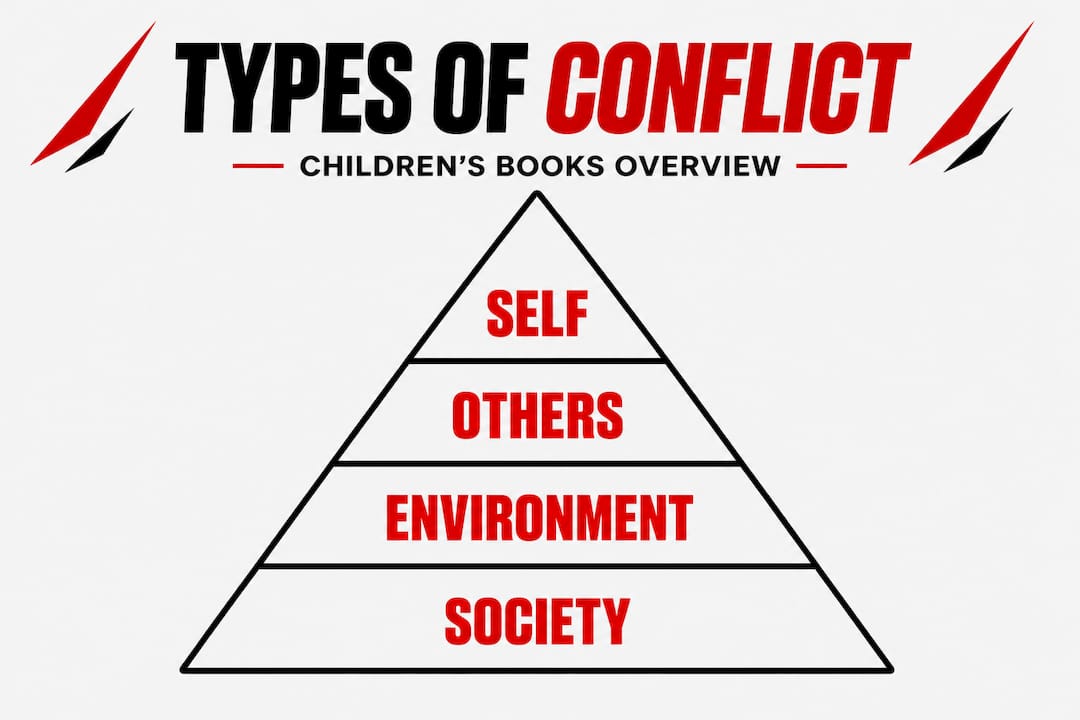
Not all conflict is created equal. Children's literature draws on several classic types, and each one teaches something different. Once you can identify these, you will spot their educational purpose instantly.
Character vs. self is internal conflict. A child character might battle fear, self-doubt, jealousy, or grief. Think of a shy character terrified to speak up in class. This type helps young readers recognize and name their own inner struggles.

Character vs. others is interpersonal conflict. Friends argue, siblings compete, bullies emerge. This category is especially rich because it mirrors situations kids face every day. It builds social problem-solving skills and shows that relationships can survive conflict.
Character vs. environment puts a character against nature or circumstance. A family lost in a storm, a child stranded somewhere unfamiliar. This type builds a sense of resilience and resourcefulness.
Character vs. society is broader and often appears in books for older children. A character might challenge an unfair rule, stand up against prejudice, or navigate belonging in a community that feels hostile. These stories plant early seeds of civic thinking and moral courage.
Here is a quick comparison to help you match conflict types to your child's or student's developmental stage:
| Conflict type | Best age range | Key skills developed | Classic example |
|---|---|---|---|
| Character vs. self | Ages 3 to 7 | Emotional regulation, self-awareness | Feeling nervous before a new experience |
| Character vs. others | Ages 4 to 10 | Empathy, social skills, conflict resolution | A falling-out between best friends |
| Character vs. environment | Ages 6 to 12 | Resilience, problem-solving, adaptability | Surviving a storm or long journey |
| Character vs. society | Ages 8 to 14 | Critical thinking, fairness, moral courage | Standing up against an unjust school rule |
Browsing examples of children's books across these categories can give you a vivid sense of how skilled authors deploy each conflict type to maximum effect.
Key themes addressed by each conflict type include:
- Self-conflict: Fear, identity, grief, self-worth
- Interpersonal conflict: Kindness, fairness, communication, forgiveness
- Environmental conflict: Courage, adaptation, teamwork
- Societal conflict: Justice, empathy, belonging, moral courage
Understanding moral strength through villains adds another layer here. An antagonist, whether a bully, a storm, or a rigid institution, sharpens a protagonist's character and gives young readers someone to root against and learn from.
Pro Tip: Match the conflict type to where your child is developmentally. A four-year-old thrives on "character vs. self" stories about emotions. A ten-year-old is ready to engage with "character vs. society" narratives. The sweet spot is a story that feels just slightly beyond comfortable, prompting real discussion without overwhelming the child. Research confirms that shared reading boosts prosocial outcomes most powerfully when adults actively engage alongside the child.
How conflict nurtures empathy and prosocial behavior
Here is where it gets genuinely exciting. Conflict is not just good for plot. It is a proven tool for building emotionally intelligent, prosocial children.
A landmark study found that empathy fully mediates the relationship between shared reading of socially themed books and improved prosocial behavior in preschoolers. In plain terms: stories with conflict and social themes boost a child's prosocial skills because they first boost empathy. That is a significant finding for anyone choosing books for young children.
Here is how that process unfolds in a child's mind during a story:
- The child meets the character. They begin to care about what happens to them.
- Conflict is introduced. The character faces a problem, threat, or difficult choice.
- The child feels the tension. They experience something close to the character's emotions.
- Empathy activates. The child starts to understand a perspective that is not their own.
- The conflict resolves. The child sees what coping, kindness, or courage can achieve.
- The lesson transfers. Children carry that emotional insight into their real-world relationships.
This sequence is the reason a well-told story with genuine conflict can change how a child treats a classmate the very next day. It is not accidental. It is the design of great storytelling working exactly as intended.
Look at this breakdown of how different conflict exposures connect to specific skill outcomes:
| Conflict scenario in book | Child skill outcome | How it transfers to real life |
|---|---|---|
| Character overcomes fear | Emotional bravery | Child tries something scary at school |
| Two friends repair a fight | Conflict resolution skills | Child practices apology and forgiveness |
| Character defends someone bullied | Moral courage | Child stands up for a peer |
| Family navigates hardship together | Resilience and teamwork | Child seeks support during stress |
| Character questions an unfair rule | Critical thinking | Child questions and discusses fairness |
Key statistic: Research shows that prosocial behavior in preschoolers improves significantly when parent-child shared reading focuses on socially themed picture books, with empathy playing a complete mediating role in that outcome.
Exploring how building empathy through diversity works in literature reveals that stories introducing characters from different backgrounds amplify this effect further. Conflict between culturally different characters, resolved through understanding, teaches children lessons no worksheet ever could.
Actionable steps for parents and educators:
- Pause before the resolution and ask, "How do you think the character feels right now?"
- Name the conflict explicitly: "It looks like Maya and her friend are having a disagreement. Have you ever felt that way?"
- Resist rushing to solutions. Let the child sit with the tension a moment. That discomfort is productive.
- Celebrate the resolution together. Make the positive outcome feel meaningful and memorable.
Balancing conflict: age-appropriate and safe storytelling
Conflict is powerful. That means it also requires care. There is a real difference between productive tension and content that overwhelms or traumatizes a child. Getting that balance right is a skill every parent and educator can develop.
Age-appropriateness is the starting point. Younger children, roughly ages three to six, do best with conflicts that are brief, clear, and resolved with warmth. The problem appears, the character feels something real, and by the end, things are better. That arc feels safe and satisfying. Older children, ages eight and up, can handle more ambiguity, slower resolutions, and even stories where the outcome is bittersweet rather than perfectly happy.
Understanding how to write engaging children's books reveals that skilled authors calibrate conflict intensity precisely for their target age group. It is a deliberate craft choice, not a random decision.
Signs that a story handles conflict in a healthy way:
- The conflict connects to real emotions children recognize.
- Characters respond to conflict with actions children can understand and even admire.
- The resolution, even if imperfect, offers some sense of hope or learning.
- The tone never wallows in cruelty, helplessness, or unresolved darkness.
- Adult characters model supportive behavior, not indifference.
- The conflict serves the story's message rather than existing for shock value alone.
Safe strategies for discussing tough themes after reading include staying curious rather than corrective. Do not immediately tell a child what they should think about a conflict. Ask what they noticed, what they felt, what they would have done. That conversation is where empathy actually grows.
If a story sparks anxiety, validate the feeling. "Yes, that part was scary. The character felt scared too. Let's talk about what helped them through it." That reframe teaches children that discomfort is survivable, which is one of the most important emotional lessons a story can offer.
Planning children's stories well means building in those moments of resolution deliberately. When you choose books with this in mind, you do the same for your child.
Pro Tip: After finishing a book with meaningful conflict, try these conversation starters: "What was the hardest moment for the character?" and "What do you think gave them the strength to keep going?" These prompts encourage reflection and help children articulate emotional insights they might otherwise keep internal. This approach directly mirrors what shared reading research identifies as the active ingredient in building prosocial behavior.
Why the best children's stories don't shy away from conflict
Here is an opinion worth sitting with. The impulse to protect children from conflict in stories does not actually protect them. It just leaves them unprepared.
Think about the children's stories that have lasted generations. Charlotte's Web is saturated with grief and the unfairness of death. Where the Wild Things Are is a story about rage and the need to be loved despite it. The Velveteen Rabbit is about loss and vulnerability. These books endure not in spite of their conflict, but because of it.
Adults who curate only frictionless stories for children are, with the best intentions, accidentally teaching them that struggle is something to avoid rather than navigate. That lesson is quietly dangerous. Real life, even a child's life, is full of conflict. What changes is whether a child has the emotional vocabulary and the inner models to handle it.
The mistake is not exposing children to conflict. The mistake is leaving them alone with it, without the guided discussion that transforms a difficult story moment into a genuine learning experience. Understanding what makes villains effective in children's literature makes it clear that even the scariest story element, handled with skill, becomes a tool for building moral courage, not a source of harm.
Advocacy for guided reading, not censorship, is the real takeaway here. Choose books thoughtfully. Read together when possible. Ask questions. Trust children to engage with difficult material when you are right there beside them. That is not overexposure. That is great parenting and great teaching.
Explore children's books that inspire growth
Ready to put these insights into action? The right books make all the difference, and finding stories that use conflict skillfully is easier when you know where to look.

Mark Watson's Children's Books collection brings together stories that don't shy away from the moments that matter. These are books with real stakes, vivid characters, and meaningful resolutions that leave young readers thinking long after the last page. Whether you're a parent building your home library or an educator stocking a classroom shelf, you'll find stories designed to spark conversation and build genuine empathy. Explore the full catalog of Mark Watson books and discover exactly the kind of purposeful, engaging storytelling that children deserve.
Frequently asked questions
Is conflict necessary in every children's book?
Not every story requires intense conflict, but some form of tension or challenge almost always makes a story more memorable and emotionally useful for young readers.
Can conflict in stories be harmful to young children?
When it is age-appropriate and read with adult guidance, conflict in stories is safe and beneficial. Research shows that guided shared reading of socially themed books actively promotes prosocial behavior, not harm.
How does conflict help build empathy?
Story conflict places children inside a character's emotional experience, and studies confirm that this empathy response directly drives improvements in real-world prosocial behavior when reading is shared with an adult.
How can parents and teachers discuss story conflict with kids?
Ask open-ended questions like "How do you think the character felt?" and encourage children to consider all sides of the conflict, drawing on real-life moments they have experienced to deepen the connection.