

TL;DR:
- Psychological horror causes fear through characters' mental and emotional states rather than external monsters.
- It relies on unreliable narration and ambiguity to create lasting dread by making the audience question reality.
Psychological horror is defined as a subgenre of horror that generates fear through characters' mental, emotional, and psychological states rather than external monsters or graphic violence. Where slasher films reach for the knife, psychological horror reaches for the mind. The internal fear sources that drive this genre, such as paranoia, guilt, and fractured identity, feel personal in a way no supernatural creature ever can. That intimacy is exactly what makes psychological horror so unsettling and so enduring.
What is psychological horror, and how is it defined?
Psychological horror focuses on fear arising from internal mental states rather than external threats alone. The genre often overlaps with the psychological thriller, but the key distinction is intent. Psychological thrillers build suspense around plot and danger. Psychological horror builds dread around the possibility that the protagonist's mind itself is the source of terror.

The genre does not require a monster. It requires a mind under pressure. Guilt, obsession, paranoia, and the slow erosion of reality are the genre's true weapons. When a character cannot trust their own perception, the audience cannot trust it either. That shared uncertainty is the engine of psychological horror.
The British Fantasy Society identifies unreliable narration as one of the genre's defining markers. When readers or viewers are forced to question whether what they are experiencing is real, the horror becomes participatory. You are not just watching someone lose their mind. You are losing your footing alongside them.
How does psychological horror differ from other horror genres?
The clearest way to understand psychological horror is to compare it directly with its closest relatives.
| Feature | Psychological horror | Supernatural horror | Slasher horror |
|---|---|---|---|
| Primary threat | The protagonist's mind | Ghosts, demons, or dark forces | A physical killer |
| Fear source | Internal mental states | External supernatural entities | Violence and physical danger |
| Key technique | Unreliable narration, ambiguity | Spectacle, mythology | Shock, gore, chase sequences |
| Monster present? | Rarely, or ambiguously | Yes | Yes |
| Lasting effect | Lingering dread and doubt | Immediate fright | Adrenaline spike |
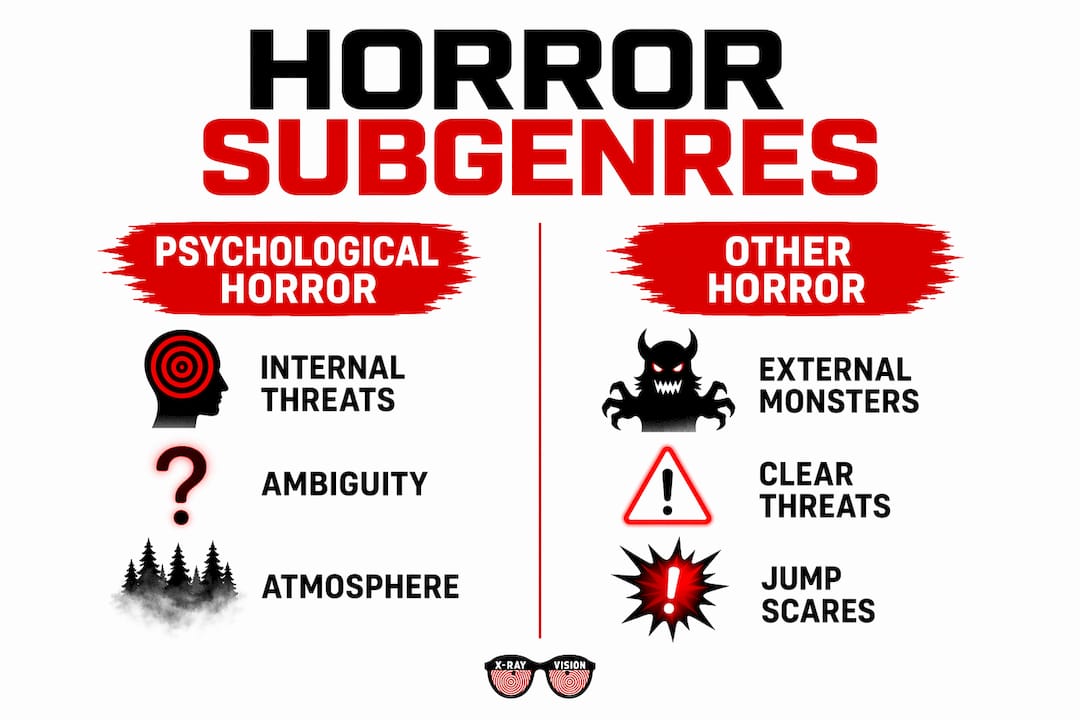
Psychological horror strips away the comfort of a visible enemy. In supernatural horror, you can identify the ghost. In slasher horror, you can run from the killer. In psychological horror, there is nowhere to run because the threat lives inside the character's head.
The genre also relies heavily on atmosphere over action. Silence, shadow, and suggestion replace jump scares and gore. The audience fills in the gaps with their own fears, which makes the experience uniquely personal. What terrifies one reader may not terrify another, and that variability is a feature, not a flaw.
Pro Tip: When comparing psychological thriller vs horror, ask one question: is the audience afraid of what might happen, or afraid of what the character might be? Thrillers fear events. Psychological horror fears the self.
What are the key themes and techniques in psychological horror?
Psychological horror returns to the same thematic territory again and again because those themes tap directly into universal human anxieties.
Core themes include:
- Mental deterioration: The gradual collapse of a character's grip on reality, often mirroring conditions like dissociation or psychosis without diagnosing them clinically.
- Paranoia: The conviction that something is wrong, that someone is watching, that the world cannot be trusted.
- Unreliable memory: Characters who cannot verify their own past, leaving both themselves and the audience without a stable foundation.
- Identity crisis: The question of who the protagonist actually is, often revealed to be more disturbing than any external threat.
- Guilt and madness: Unresolved guilt that metastasizes into hallucination, obsession, or self-destruction.
The narrative techniques that carry these themes are equally specific. Settings act as cognitive mirrors, converting familiar domestic spaces into sources of dread that reflect the character's fractured mental state. A childhood home becomes oppressive. A hotel becomes a prison. The space itself seems to breathe with the character's fear.
Symbolism replaces exposition. A recurring image, a sound that only the protagonist hears, a door that should not exist. These details accumulate into an atmosphere of wrongness that the audience feels before they can name it.
Pro Tip: The most effective psychological horror leaves one key question permanently unanswered. Ambiguity is not a weakness in this genre. It is the point. The audience's interpretation becomes part of the horror itself.
What are the best psychological horror examples in film and literature?
Concrete examples make the genre's techniques visible. These works are considered foundational for good reason.
-
Psycho (1960): Alfred Hitchcock's film dismantles audience sympathy and certainty simultaneously. Norman Bates is not a monster in the traditional sense. He is a fractured identity, a man whose mind has split under unbearable pressure. The horror is not the violence. It is the revelation of what a human mind can become.
-
The Shining (1980): Stanley Kubrick's adaptation of Stephen King's novel places Jack Torrance in the Overlook Hotel, a setting that functions as a direct reflection of his deteriorating mind. The film refuses to confirm whether the supernatural events are real or products of Jack's psychosis. That refusal is the film's most terrifying choice.
-
The Haunting of Hill House (1959): Shirley Jackson's novel is the literary benchmark for the genre. Eleanor Vance's mental state and the house's malevolence are so intertwined that separating them becomes impossible. Jackson never confirms what is real. The ambiguity is total and deliberate.
-
Rosemary's Baby (1968): Roman Polanski's film traps the audience inside Rosemary's perspective. Her paranoia may be justified or may be delusion. The film withholds certainty until the final moments, and even then, the psychological damage is the lasting impression.
These works share one defining quality. The audience is forced to re-evaluate the protagonist's perspective continuously, which makes the mind's own interpretation part of the terror. That is the genre's signature move.
How does psychological horror affect audiences, including children?
Horror fiction does more than entertain. Oxford Brookes University research shows that horror builds emotional resilience by allowing people to simulate challenging experiences in a safe context. Readers and viewers who engage with horror fiction may be better prepared for real-world stressors because they have already practiced emotional regulation through fiction.
The psychological effects of horror extend to identity and social connection. Horror fiction helps shape identity and build social bonds by giving audiences shared experiences of fear and survival. That is why horror communities are so tight-knit. The genre creates genuine emotional solidarity.
For children, the picture is more complex. The American Academy of Pediatrics notes that children are drawn to scary content through morbid curiosity and sensation-seeking, which are normal developmental impulses. However, exposure to violent or intensely frightening media can be linked to nightmares and persistent fear responses in younger children.
Parental awareness of children's curiosity about horror is essential for guiding their media consumption to support healthy emotional development. — American Academy of Pediatrics
Pro Tip: For parents wondering about psychological horror for kids, age-appropriate spooky content that emphasizes mystery over graphic fear can satisfy morbid curiosity without triggering lasting distress. The genre's themes are powerful. Match the intensity to the child's emotional readiness.
What practical advice helps creators and consumers engage with the genre?
For writers building psychological horror, the craft priorities are clear.
- Lead with uncertainty. Never confirm what is real too early. The audience's doubt is your most powerful tool.
- Build character before dread. Fear only lands when readers care about the mind that is unraveling. Invest in your protagonist's inner life before you start dismantling it.
- Use setting deliberately. Every location should reflect or amplify the character's mental state. A tidy room can feel as threatening as a haunted house if the character's perception frames it that way.
- Resist explanation. Psychological horror loses its power the moment it over-explains. Leave the final interpretation to the audience.
For readers and viewers, engaging with horror fiction thoughtfully means paying attention to your own emotional responses. The genre is designed to provoke. Noticing what specifically disturbs you reveals something real about your own psychology.
For parents and guardians, the guidance from the American Academy of Pediatrics is practical. Monitor content, discuss what children watch or read, and treat their curiosity as an opening for conversation rather than a problem to suppress. A parent's guide to spooky stories can help identify age-appropriate entry points into the genre.
Key Takeaways
Psychological horror is the most intellectually demanding horror subgenre because it makes the audience's own mind the site of terror.
| Point | Details |
|---|---|
| Core definition | Psychological horror generates fear through characters' mental states, not external monsters. |
| Defining technique | Unreliable narration forces audiences to question reality alongside the protagonist. |
| Genre distinction | Unlike slasher or supernatural horror, psychological horror rarely confirms what is real. |
| Audience impact | Oxford Brookes research shows horror fiction builds emotional resilience and shapes identity. |
| Children and horror | The American Academy of Pediatrics advises mindful, age-matched exposure to scary content. |
Why psychological horror is the genre that stays with you longest
I have written across horror, thriller, and Creepypasta, and nothing lingers the way psychological horror does. A jump scare fades in minutes. A well-placed moment of ambiguity can stay with a reader for years. That staying power comes from a specific mechanism. Psychological horror targets uncertainty, and the human brain is wired to keep processing unresolved threats long after the book is closed or the credits roll.
What I find most compelling about the genre is that it respects the audience. It does not hand you the monster. It trusts you to construct your own version of dread from the materials provided. That is a genuinely collaborative act between writer and reader, and it produces a more personal, more visceral result than any amount of explicit horror ever could.
The internal monsters, guilt, paranoia, fractured identity, are more terrifying than anything supernatural precisely because they feel possible. They feel like something that could happen to you. That is the genre's real power, and it is why psychological horror endures when so many other subgenres date quickly.
If you are new to the genre, start with Shirley Jackson or Alfred Hitchcock. If you are a writer, study how they withhold information. The restraint is the craft.
— Mark
Markwatsonbooks and the psychological horror you need to read next
Psychological horror works best when you find the right story at the right moment. Markwatsonbooks brings together a curated collection of horror, thriller, and Creepypasta titles that put character psychology at the center of every scare.

Whether you are looking for adult horror fiction that plays with perception and dread, or age-appropriate spooky stories for younger readers, Markwatsonbooks has a collection built for you. The Creepypasta books collection delivers internet horror at its most psychologically unsettling, with stories that blur the line between real and imagined. For younger readers, the children's book collection offers spooky stories calibrated to curiosity without crossing into distress. Browse the full horror collection and find your next unforgettable read.
FAQ
What is the definition of psychological horror?
Psychological horror is a subgenre that generates fear through characters' mental and emotional states rather than external monsters or graphic violence. The genre relies on ambiguity, unreliable narration, and internal dread.
How is psychological horror different from a psychological thriller?
A psychological thriller builds suspense around plot and physical danger, while psychological horror focuses on the protagonist's deteriorating mental state as the primary source of fear. The distinction lies in whether the audience fears what might happen or fears what the character might be.
What are the most recognized psychological horror films?
Psycho, The Shining, Rosemary's Baby, and The Haunting of Hill House are widely recognized as defining psychological horror films. Each uses unreliable perception and ambiguous reality to generate lasting dread.
Is psychological horror appropriate for children?
The American Academy of Pediatrics notes that children's morbid curiosity is normal, but intense or violent horror content can cause nightmares and persistent fear. Age-appropriate spooky stories that emphasize mystery over graphic fear are a better fit for younger readers.
What makes horror psychological rather than just scary?
Horror becomes psychological when the source of fear is internal to the character's mind rather than an external threat. Techniques like unreliable narration, ambiguous reality, and settings that mirror mental states are the markers that separate psychological horror from other subgenres.