

TL;DR:
- Allegory in horror involves a story with a surface fright and a hidden moral or social meaning. It relies on consistent symbolism throughout the narrative to reveal deeper truths.
Allegory in horror is defined as a narrative that runs on two parallel planes: a surface horror story and an underlying symbolic meaning that reveals moral, political, or psychological truths. This dual structure is what separates allegorical horror from simple scary fiction. Where a single creepy image is a symbol, a story where every character, setting, and event maps to a larger hidden meaning is an allegory in literature. Horror is uniquely suited to this technique because monsters, dread, and the unknown give writers cover to say things that would feel too raw or confrontational in realistic fiction.
What is allegory in horror, and how does it work?
Allegory in horror is a storytelling method where the entire narrative carries a second, symbolic meaning beneath the surface plot. The surface story must work as a standalone horror experience. Readers should feel genuine fear, tension, and suspense without needing to decode anything. The deeper meaning rides underneath, available to those who look for it.
This dual structure is what makes allegorical horror so powerful. Genre conventions create permission structures where supernatural or grotesque horror lowers audience defenses. A monster on screen is frightening. That same monster as a symbol of addiction, systemic oppression, or grief becomes something readers carry home with them. The horror does the heavy lifting so the message lands without feeling like a lecture.
The key requirement is that the symbolic layer must be pervasive. It cannot appear in one scene and vanish. Characters, settings, and events all need to carry symbolic weight that sustains from the opening page to the final line. That consistency is what distinguishes allegory from a story that simply uses a few horror story symbols for atmosphere.
How does allegory differ from symbolism in horror stories?
Symbolism and allegory are related but not the same thing. Symbolism enriches individual elements of a story. A cracked mirror suggests broken identity. A locked door suggests repression. These images add texture, but they do not carry the whole narrative. Allegory, by contrast, structures the entire story around a hidden meaning.
Think of it this way: symbolism is a single instrument playing a note. Allegory is the full orchestra playing the same song on two levels at once. Every section contributes to both the surface melody and the deeper one.
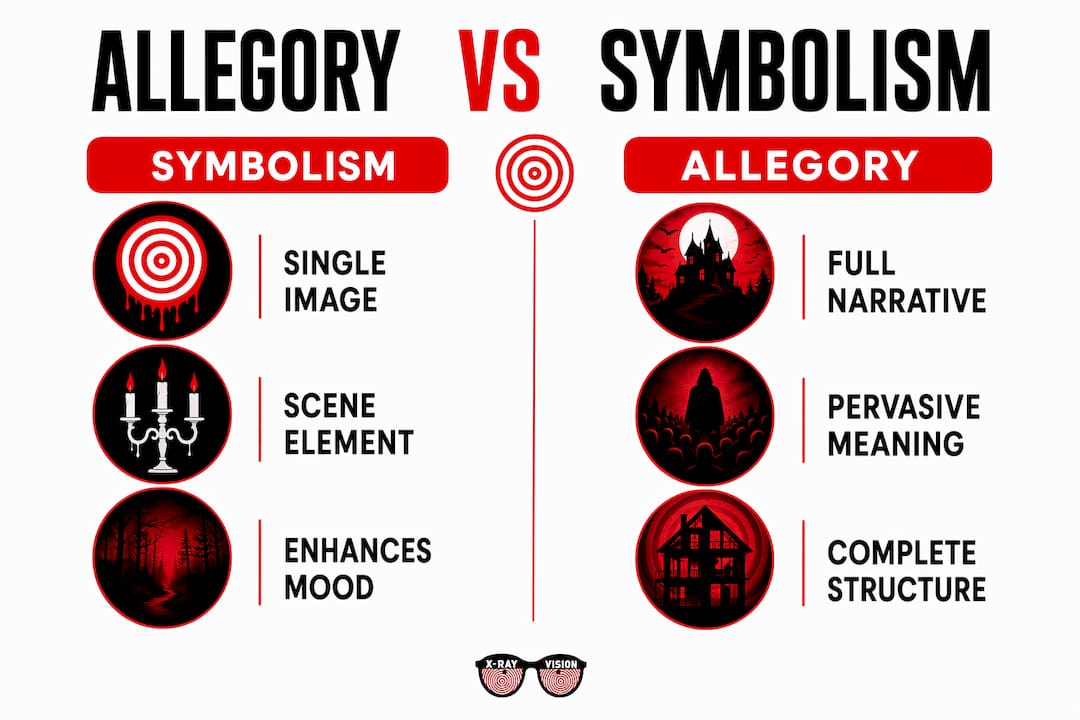
| Feature | Symbolism | Allegory |
|---|---|---|
| Scope | Single image or element | Entire narrative structure |
| Function | Adds texture and mood | Carries a parallel meaning throughout |
| Narrative role | Decorative or atmospheric | Structural and thematic |
| Reader experience | Enriches specific moments | Reframes the whole story |
| Example | A vulture eye suggesting paranoia | A plague story representing class denial |
Pro Tip: When reading a horror story, ask whether the symbolic meaning you detect applies only to one scene or to the entire plot. If it threads through every major event, you are likely reading allegory, not just symbolism.
The distinction matters for writers too. You can add symbols to any story at any stage of drafting. Building allegory requires planning from the ground up, because the symbolic layer must be woven into plot structure, character arcs, and setting choices from the start.
What themes and symbols appear most often in allegorical horror?
Allegorical horror gravitates toward themes that societies find difficult to confront directly. Trauma, systemic racism, addiction, class struggle, political repression, and the fear of death all appear repeatedly across the genre. These themes benefit from the narrative distance horror provides, letting audiences engage with painful truths through the safer frame of fiction.
Recurring symbols in horror allegories include:
- Clocks and time: Represent mortality and the inevitability of death. Edgar Allan Poe's ebony clock in "The Masque of the Red Death" stops the party cold every time it chimes, forcing the revelers to confront what they are trying to ignore.
- Eyes: Suggest surveillance, paranoia, or judgment. Poe's "vulture eye" in "The Tell-Tale Heart" carries the narrator's guilt and psychological collapse.
- Monsters: Function as symbolic ciphers for social fears. The monster externalizes what a society cannot name directly.
- Confined spaces: Represent psychological entrapment, social immobility, or repression.
- Plague and disease: Symbolize moral corruption, class inequality, or collective denial.
| Symbol | Common allegorical meaning |
|---|---|
| Ebony clock | Inevitable mortality |
| Vulture eye | Paranoia, guilt, judgment |
| Monster | Externalized social fear |
| Locked room | Repression or denial |
| Plague | Moral corruption or class inequality |
Identifying allegory involves detecting patterns of recurring symbols whose significance extends beyond single scenes to inform the entire narrative structure. One clock is a prop. A clock that chimes at every turning point in the plot is allegory at work.
What are the best examples of allegory in horror literature and film?
Classic and contemporary horror both offer vivid case studies in allegorical storytelling. These examples show how the technique adapts across centuries and cultural contexts.
Edgar Allan Poe's "The Masque of the Red Death" (1842) is one of the most tightly structured Gothic allegories in American literature. Poe uses allegory to explore mortality, time, and the denial of death through symbolic setting and character behavior. Prince Prospero seals himself and his court inside an abbey to escape a plague ravaging the countryside. The seven colored rooms represent the stages of life. The ebony clock represents death's approach. The Red Death itself represents the truth that no wealth or walls can keep mortality out. The surface story is a Gothic horror tale. The allegory is a philosophical argument about human denial.
Jordan Peele's Get Out (2017) demonstrates how contemporary horror uses the same technique to address systemic racism and the commodification of Black bodies. Get Out uses horror conventions to make its social critique visceral rather than abstract. The Armitage family's procedure is not just a plot device. It is a direct metaphor for the way Black excellence is extracted, consumed, and erased by white institutions. The horror works on its own terms. The allegory makes it unforgettable.
- Poe's Gothic settings carry philosophical weight about class and mortality.
- Peele's suburban horror reframes systemic racism as a literal body horror threat.
- Modern horror films sometimes resist a single fixed reading, inviting plural allegorical interpretations that different audiences bring to the same story.
- Cultural context shapes how allegorical readings evolve. Contemporary audiences often read older works through the lens of current social issues like trauma or systemic injustice.
Pro Tip: When analyzing a horror film or novel for allegorical content, identify the central threat first. Then ask what real-world fear, social condition, or psychological state that threat could represent. If the answer fits consistently across the whole story, you have found the allegory.
The social meaning of film moments is rarely accidental in horror. Directors and authors who work in the genre understand that the monster is always a mirror.
How do you craft effective allegorical horror without losing tension?
Writing allegorical horror well requires discipline. The most common failure is prioritizing the message over the story. When the allegory becomes too obvious, the horror deflates and the narrative feels like a pamphlet with monsters in it.
Follow these principles to keep both layers working:
- Build the surface story first. The horror plot must stand completely on its own. If removing the allegorical layer would leave a broken story, the foundation is not strong enough. Write the scary story first, then layer meaning in.
- Avoid rigid one-to-one mapping. Heavy-handedness destroys tension. If every character is a labeled stand-in for a political position, readers stop feeling and start decoding. Let the symbolic layer breathe.
- Use genre conventions as cover. Horror's supernatural elements create distance. A ghost story about grief works because the ghost is real within the story's world. The allegory operates underneath without breaking the surface.
- Embrace multiple interpretations. The strongest allegorical horror resists a single fixed reading. Different readers bring different experiences, and a story that speaks to all of them has more reach and longevity.
- Maintain horror tension throughout. The scares cannot stop to make room for the message. Both layers must advance simultaneously. Every scene should serve the horror plot and the allegorical meaning at the same time.
The themes in horror films that endure longest are almost always the ones where the allegory is felt rather than explained. Readers and viewers should sense the deeper meaning without being told what it is.
Key Takeaways
Allegory in horror works because the genre's surface scares create the psychological distance needed for deeper symbolic truths to land without resistance.
| Point | Details |
|---|---|
| Allegory vs. symbolism | Allegory structures the entire narrative; symbolism enriches individual elements only. |
| Pervasive symbolic weight | The allegorical layer must run through characters, settings, and events from start to finish. |
| Horror as social commentary | Genre conventions lower audience defenses, making horror ideal for exploring trauma, racism, and class. |
| Classic and modern examples | Poe's "Masque of the Red Death" and Peele's Get Out both demonstrate allegory sustaining across a full narrative. |
| Craft principle | Build a strong standalone horror plot first, then layer allegory without rigid one-to-one mappings. |
Why allegory in horror still surprises me after years of writing it
I have spent years writing horror across multiple formats, from thriller novels to internet horror anthologies, and the thing that still catches me off guard is how allegory sneaks up on both the writer and the reader. You can plan the symbolic layer carefully, map it out before you write a single scene, and still find that the story reveals meanings you did not consciously intend. That is not a flaw. That is allegory working the way it is supposed to.
What I have learned the hard way is that the moment you feel proud of your allegory, you have probably made it too obvious. The best allegorical horror I have written is the work where readers finish the story feeling unsettled without being able to say exactly why. The dread lingers. Then, days later, something clicks. That delayed recognition is the whole point.
The cultural context piece is real and it shifts constantly. Stories I wrote years ago get read through entirely different lenses now, shaped by events and conversations that did not exist when I wrote them. That is not a problem to solve. It is proof that horror reveals truths that outlast the moment they were written in. The genre has that kind of staying power precisely because allegory is built into its DNA.
My honest caution for writers: do not let the allegory become the reason you write the story. Write the horror first. Make it genuinely frightening. The meaning will find its way in, and it will be stronger for not being forced.
— Mark
Horror with depth: explore Markwatsonbooks' collections
If the idea of horror that operates on two levels excites you, the horror collection at Markwatsonbooks is worth your time. These are stories built with the kind of thematic weight this article describes, where the scares are real and the meaning runs deeper than the surface.

Markwatsonbooks also curates a Creepypasta anthology series that draws on internet horror traditions, many of which carry strong allegorical undercurrents about isolation, identity, and the fears of a connected world. Whether you are a reader looking for your next unsettling read or a writer studying how allegory functions in practice, the full books catalog offers a range of titles worth exploring.
FAQ
What is the simplest definition of allegory in horror?
Allegory in horror is a story that works on two levels at once: a surface horror narrative and an underlying symbolic meaning that represents social, political, or psychological truths. Both layers must function throughout the entire story, not just in isolated scenes.
How is allegory different from a horror story that uses symbols?
Symbolism adds meaning to individual images or moments. Allegory structures the whole narrative around a hidden meaning, with characters, settings, and events all carrying symbolic weight from beginning to end.
What are the most common themes in allegorical horror?
The most common themes include trauma, systemic racism, addiction, class struggle, political repression, and the denial of death. These topics benefit from horror's narrative distance, which lets audiences engage with difficult truths through the frame of fiction.
Can a horror story have allegory without the author intending it?
Yes. Cultural context shapes how readers interpret stories, and contemporary audiences often read older works through modern lenses like trauma or social injustice. Meaning can emerge from a text that the author did not consciously place there.
How do I spot allegory in a horror film or novel?
Identify the central threat, then ask what real-world fear or social condition it could represent. If that interpretation fits consistently across the entire story rather than just one scene, the work is likely allegorical.