

TL;DR:
- Anthology horror is a format featuring 3 to 5 self-contained stories connected by a framing device or theme, providing variety and emotional range. It allows multiple voices and styles within one project, capturing the true texture of fear through diverse storytelling means. Its rich history spans from Dead of Night to modern digital anthologies like Creepypasta, establishing it as a dynamic and influential genre form.
Anthology horror is a storytelling format built from multiple self-contained horror narratives, each complete on its own, unified by a framing device or shared theme. Unlike a single-narrative horror film or novel, the anthology structure typically presents 3 to 5 independent stories within one project, letting each tale deliver its own punch before the next one begins. The format rewards both casual viewers and obsessive fans. You can drop into one story, feel the dread build, and then get hit with something completely different before the credits roll. That variety is exactly what makes anthology horror one of the most exciting and underappreciated corners of the genre.
What is anthology horror and how is it defined?
Anthology horror is defined as a horror format in which several independent stories share a single project, connected by a framing device, a recurring narrator, or a unifying theme. The term "portmanteau film" is the recognized industry term for the cinematic version. The word "portmanteau" comes from the French word for a traveling bag, which captures the idea perfectly: one container carrying multiple distinct items.
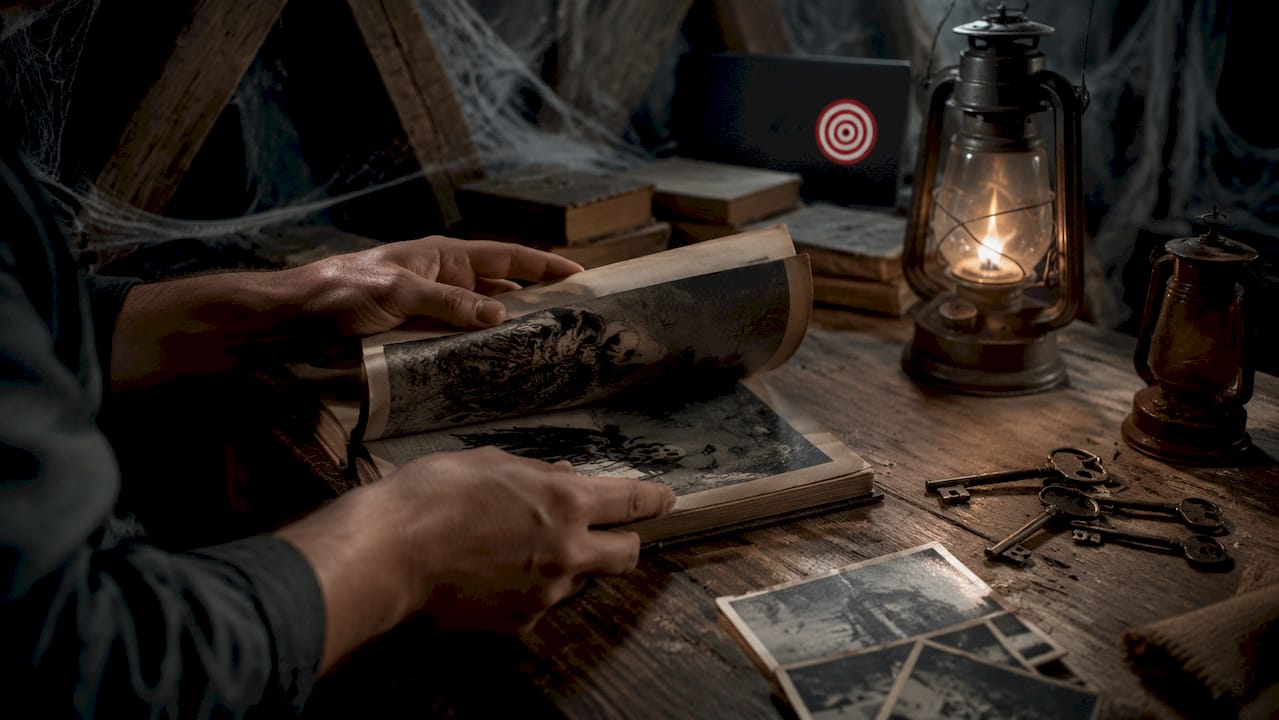
The framing device is the structural glue. It might be a sinister host reading from a book of cursed tales, a mysterious object passing between characters, or a single night where strange events unfold across different households. Without a framing device, you just have a collection of short films. With one, you have an anthology. The difference matters because the frame shapes tone, pacing, and the emotional experience of the whole.
Anthology horror stories stand alone but also speak to each other. A strong anthology creates a cumulative effect where each story adds weight to the next. By the final segment, you feel the full force of the project's central theme, whether that is guilt, grief, the supernatural, or the darkness hiding in ordinary life.
How does anthology horror differ from other horror formats?
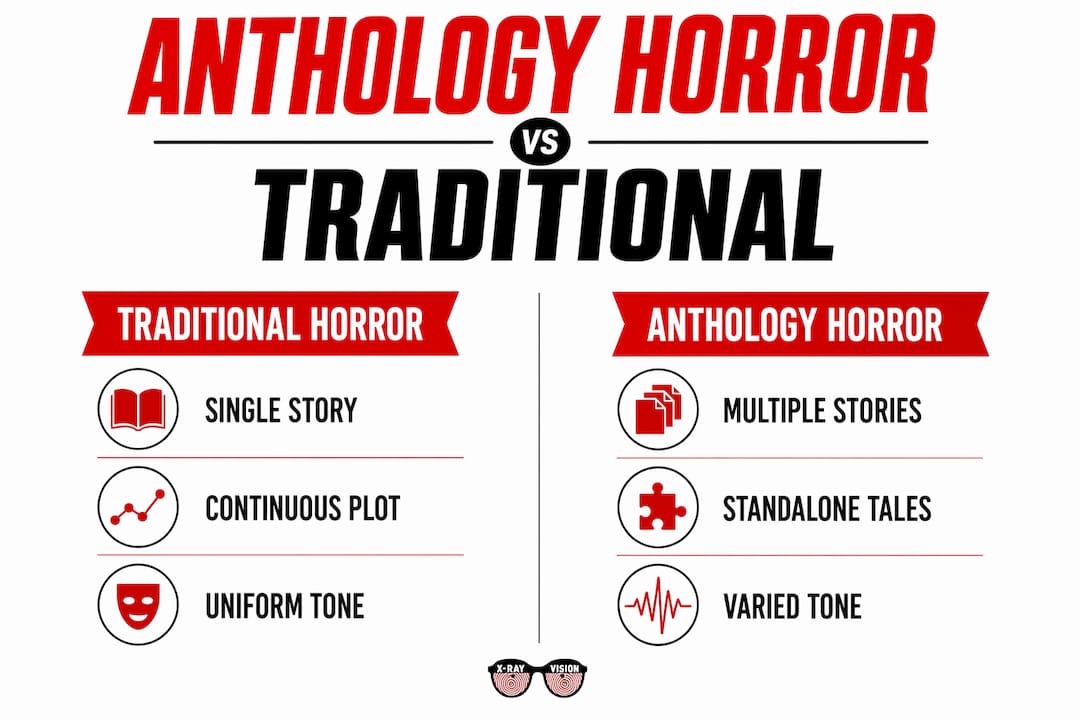
Traditional horror films follow one narrative thread from setup to resolution. Anthology horror abandons that single thread entirely. Each segment introduces new characters, a new setting, and a new type of fear. This is the format's greatest strength and its most obvious structural departure from conventional horror.
Here is how the two formats compare directly:
| Feature | Traditional horror | Anthology horror |
|---|---|---|
| Narrative structure | Single continuous story | Multiple self-contained stories |
| Character continuity | Same characters throughout | New characters per segment |
| Tonal range | Usually consistent | Varies widely across segments |
| Framing device | Rarely used | Central to the format |
| Pacing risk | Slow burn possible | Must hook quickly per story |
| Creative voices | Typically one director/author | Often multiple creators |
The tonal variety is what separates anthology horror from nearly every other format in the genre. One segment might deliver psychological dread in the style of a slow-burn thriller. The next might go full visceral gore. A third might lean into dark comedy. Horror anthologies allow exploration of diverse fears and styles within one project, creating a multi-faceted portrait of horror that no single narrative can match.
Television anthology series add another layer. Shows like American Horror Story reset their entire narrative at the season level. Since 2011, long-form anthology TV has redefined the format, with American Horror Story accumulating 114 or more episodes across completely separate seasonal storylines. That model proves the format scales far beyond a single film.
What is the history and evolution of anthology horror?
Anthology horror has a longer history than most fans realize. Its roots trace back to early 20th-century German Expressionism, where fragmented, dreamlike storytelling first gave horror its visual and narrative vocabulary. The format found its cinematic footing with Dead of Night in 1945, a British film widely credited as the first major anthology horror film. It set the template that dozens of productions would follow.
The evolution of the format moved through four distinct phases:
-
The British golden era (1940s to 1960s). Amicus Productions became the defining studio of anthology horror cinema, producing films like Tales from the Crypt (1972) and Vault of Horror (1973). Anthology horror roots in this period were also shaped by Black Sabbath (1963), directed by Mario Bava, which brought European sensibility to the format.
-
The EC Comics and television era (1950s to 1980s). EC Comics introduced the horror host tradition through characters like the Crypt-Keeper, who narrated twisted tales with gleeful menace. The Twilight Zone, premiering in 1959, translated that energy to television and proved anthology storytelling could carry profound social commentary alongside pure fright.
-
The modern horror anthology revival (1980s to 2000s). Creepshow (1982), written by Stephen King and directed by George Romero, brought the EC Comics aesthetic to mainstream cinema. Trick 'r Treat (2007) wove its stories together through a single Halloween night, demonstrating how a framing device could be a character in itself.
-
The found footage and digital era (2010s to present). V/H/S (2012) introduced chaotic, fragmented narrative styles that reflected modern media consumption. Its multi-director structure and loose thematic connections felt genuinely new. Recent anthologies have also become platforms for marginalized filmmakers, bringing fresh voices and perspectives to the format.
Pro Tip: If you want to trace the full arc of anthology horror history, start with Dead of Night (1945), then jump to Creepshow (1982), and finish with V/H/S (2012). Those three films show exactly how the format absorbed each era's fears and filmmaking tools.
The history of horror literature also runs parallel to this cinematic timeline. Oral storytelling traditions, folklore collections, and Gothic short story anthologies all fed the same impulse: gathering multiple dark tales under one roof.
What are the key features and storytelling techniques of anthology horror?
The craft behind a great anthology horror project is more demanding than it looks. Each story must work independently, but the whole must feel greater than the sum of its parts. That balance requires deliberate structural choices.
The core features that define the format include:
- The framing device. A successful framing device must maintain internal consistency throughout the project. Weak or disjointed framing breaks audience immersion and makes the anthology feel like a random collection rather than a curated experience.
- The horror host. The horror host tradition connects audiences to disparate stories, bridging the gap between segments. The Crypt-Keeper from Tales from the Crypt, Cain and Abel from DC Comics, and similar figures serve as emotional anchors. They set tone, deliver irony, and remind you that someone is in control of the chaos.
- Story count and pacing. Three to five stories is the optimal range. Fewer than three and the anthology feels thin. More than five and viewer fatigue sets in before the final segment lands. Each story must hook the audience quickly because there is no time for a slow build across multiple acts.
- Tonal arc. Effective anthologies craft a deliberate tonal arc, mixing styles and intensities to maintain engagement across segments. You might open with something unsettling and psychological, shift to something darkly comic in the middle, and close with the most visceral or emotionally devastating story of the set.
- Thematic cohesion. The best anthologies share a unifying theme even when their stories look nothing alike. Creepshow is unified by its EC Comics aesthetic. Trick 'r Treat is unified by Halloween itself. That thematic thread gives the audience something to hold onto as the stories shift.
Pro Tip: When writing or evaluating an anthology, ask whether each story could stand alone as a short film or short story. If the answer is yes for every segment, the anthology has structural integrity. If a story only works because of what came before it, the format is broken.
The literary devices in horror that make individual stories memorable, such as unreliable narrators, dramatic irony, and sensory imagery, become even more powerful in the anthology format because each story gets a fresh start with a fresh set of tools.
What are the most influential examples of anthology horror?
Recognizing the format is easier when you have specific works to anchor your understanding. Anthology horror spans film, television, literature, and digital media.
Film landmarks:
- Dead of Night (1945): the British portmanteau film that established the format's cinematic grammar
- Black Sabbath (1963): Mario Bava's Italian anthology that brought European Gothic style to the format
- Creepshow (1982): Stephen King and George Romero's love letter to EC Comics, still the gold standard for horror anthology tone
- Trick 'r Treat (2007): a modern classic that uses a single Halloween night as its framing device with surgical precision
- V/H/S (2012): the found footage anthology that proved the format could absorb new technologies and still terrify
Television:
- The Twilight Zone (1959): Rod Serling's anthology series that used horror and science fiction to deliver social commentary with a sting
- American Horror Story (2011 to present): the long-form anthology series that reset its entire world each season, reaching 114 or more episodes across completely separate storylines
Literature and digital media:
Anthology horror in print ranges from classic Gothic collections to modern Creepypasta. Creepypasta represents the internet's native anthology horror format: short, self-contained horror stories shared across platforms like Reddit's r/nosleep, each one designed to unsettle and spread. The format mirrors the portmanteau film structure but operates at the speed of social media. Classic horror books in the anthology tradition include works by Shirley Jackson, H.P. Lovecraft, and Roald Dahl, all of whom mastered the short horror story as a standalone unit.
Despite this rich history, anthology horror remains misunderstood by some critics who treat its nontraditional structure as a weakness rather than a deliberate formal choice. Scholars now recognize it as a distinct cultural phenomenon with its own narrative logic and thematic richness.
Key takeaways
Anthology horror is the most structurally flexible format in the genre, capable of delivering psychological dread, visceral terror, and dark comedy within a single project through the disciplined use of framing devices and tonal arcs.
| Point | Details |
|---|---|
| Core definition | Anthology horror presents 3 to 5 self-contained stories unified by a framing device or shared theme. |
| Framing device is critical | A weak or inconsistent frame breaks immersion and undermines the entire project's cohesion. |
| History spans a century | The format traces from Dead of Night (1945) through Creepshow (1982) to V/H/S (2012) and beyond. |
| Tonal variety is a strength | Mixing horror styles across segments creates emotional range no single-narrative film can replicate. |
| Digital media extended the format | Creepypasta and found footage anthologies brought the format into the internet age with new urgency. |
Why anthology horror is the format I keep coming back to
I have written across multiple horror formats, and anthology horror is the one that never stops surprising me. The format forces a kind of discipline that single-narrative horror does not demand. Every story has to earn its place. There is no room for a slow second act that you plan to redeem in the third. Each segment lives or dies on its own terms.
What I find most compelling is how anthology horror captures the actual texture of fear. Real fear is not one sustained note. It shifts. A childhood memory of something in the dark feels nothing like the creeping dread of a relationship turning wrong, which feels nothing like the raw shock of sudden violence. Anthology horror is the only format that can hold all of those registers at once. A single project can move you from existential unease to visceral horror to dark laughter and back again, and that range is closer to how fear actually works in a human life.
The format also creates space for multiple voices. A single anthology film can carry the visions of four or five different directors or writers, each bringing their own obsessions and aesthetics. That collaborative energy produces something genuinely unpredictable. You never know which segment will be the one that stays with you for weeks.
The cultural depth of horror storytelling is most visible in anthology work. When you read or watch a great anthology, you are not just experiencing one person's nightmare. You are experiencing a chorus of them.
— Mark
Explore horror anthologies at Markwatsonbooks
If this breakdown of anthology horror has you hungry for more, Markwatsonbooks has you covered with collections built exactly for this appetite.

The Creepypasta Omnibus One collects 150 self-contained horror stories in one volume, making it a pure anthology experience in book form. Each story stands alone, each one delivers its own chill, and the cumulative effect is genuinely unsettling. For fans who want to go deeper, the full horror collection at Markwatsonbooks spans multiple volumes and styles. Browse the complete books catalog and find your next obsession. Do not wait. The next story that keeps you up at night is already there.
FAQ
What is the definition of anthology horror?
Anthology horror is a format presenting multiple self-contained horror stories within one project, unified by a framing device, shared theme, or recurring narrator. The cinematic version is also called a portmanteau film.
How many stories does an anthology horror typically include?
Most anthology horror projects contain 3 to 5 stories. Fewer than three feels incomplete, while more than five risks viewer or reader fatigue before the final segment lands.
What are the best examples of anthology horror films?
Dead of Night (1945), Creepshow (1982), Trick 'r Treat (2007), and V/H/S (2012) are the most influential examples, each representing a different era and approach to the format.
Why is anthology horror popular with horror fans?
Anthology horror delivers tonal variety, multiple creative voices, and a range of fear types within a single project, giving fans more variety and surprise than any single-narrative horror film can offer.
Is Creepypasta a form of anthology horror?
Yes. Creepypasta functions as a digital anthology horror format, presenting self-contained horror stories designed to stand alone and circulate independently, mirroring the structure of classic portmanteau films in an internet-native form.