
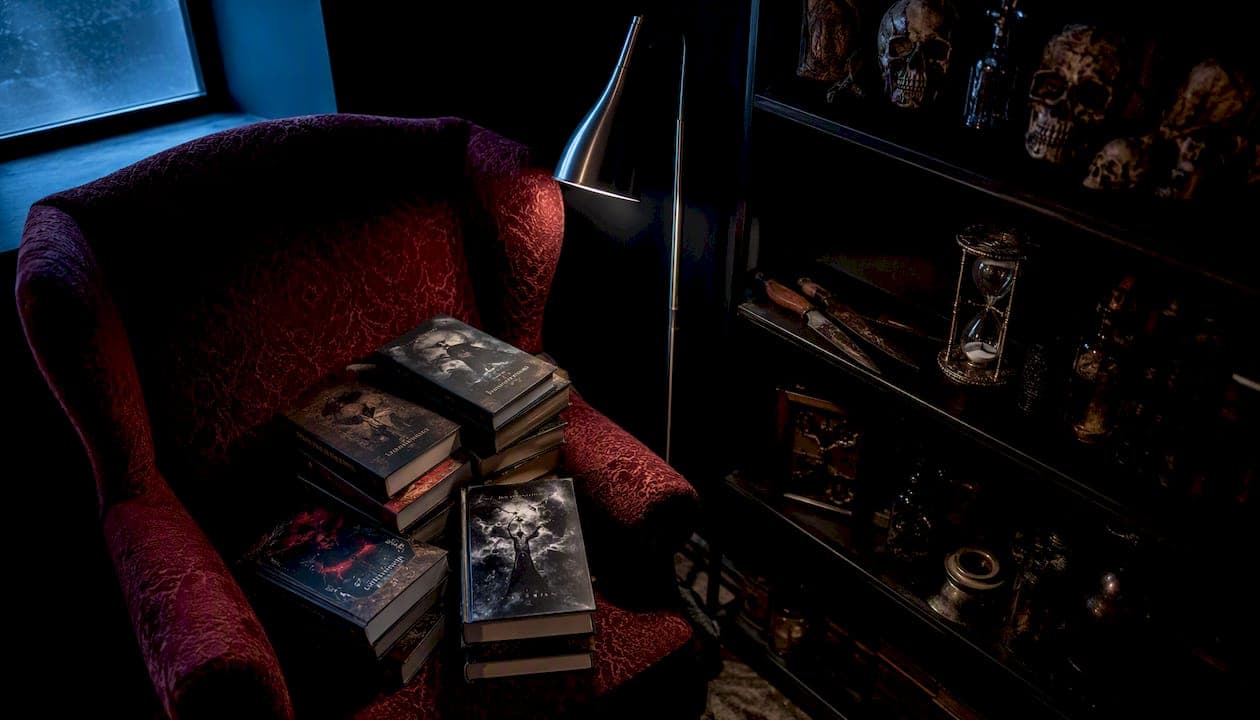
If you want to start reading right now, here are the eight titles that belong on every American horror fan's shelf:
- The Shining by Stephen King — Slow-burn psychological dread inside an isolated hotel; perfect for readers who want atmosphere over gore.
- The Haunting of Hill House by Shirley Jackson — The gold standard for eerie, character-driven ghost stories; ambiguity is the weapon.
- Pet Sematary by Stephen King — Grief weaponized as horror; emotionally devastating and genuinely hard to shake.
- House of Leaves by Mark Z. Danielewski — Experimental, labyrinthine, and deeply unsettling; for readers who want horror that challenges the page itself.
- Interview with the Vampire by Anne Rice — Lush, literary, and immortal; the rare horror novel that reads like a confession.
- Witchcraft for Wayward Girls by Grady Hendrix — The 2025 Goodreads Choice Award winner with 59,603 reader votes, socially charged and compulsively readable.
- House of Bone and Rain by Gabino Iglesias — A 2025 Bram Stoker finalist that fuses Hurricane Maria's aftermath with brutal supernatural revenge.
- I Was a Teenage Slasher by Stephen Graham Jones — A stream-of-consciousness slasher told from inside the killer's head; darkly funny and genuinely frightening.
Pro Tip: If you gravitate toward dread that builds slowly and leaves you questioning reality, start with Jackson or Danielewski. If you want visceral, propulsive fear with emotional gut-punches, go straight to King's Pet Sematary or Iglesias's House of Bone and Rain.
Table of Contents
- Which modern American horror novels stand out right now?
- How do you pick horror by mood? A subgenre guide
- How were these recommendations chosen?
- How do you choose your next horror novel?
- Where do these lists come from?
- Key Takeaways
- What the horror genre gets wrong about fear
- Markwatsonbooks horror collections: curated reads ready to buy
Which modern American horror novels stand out right now?
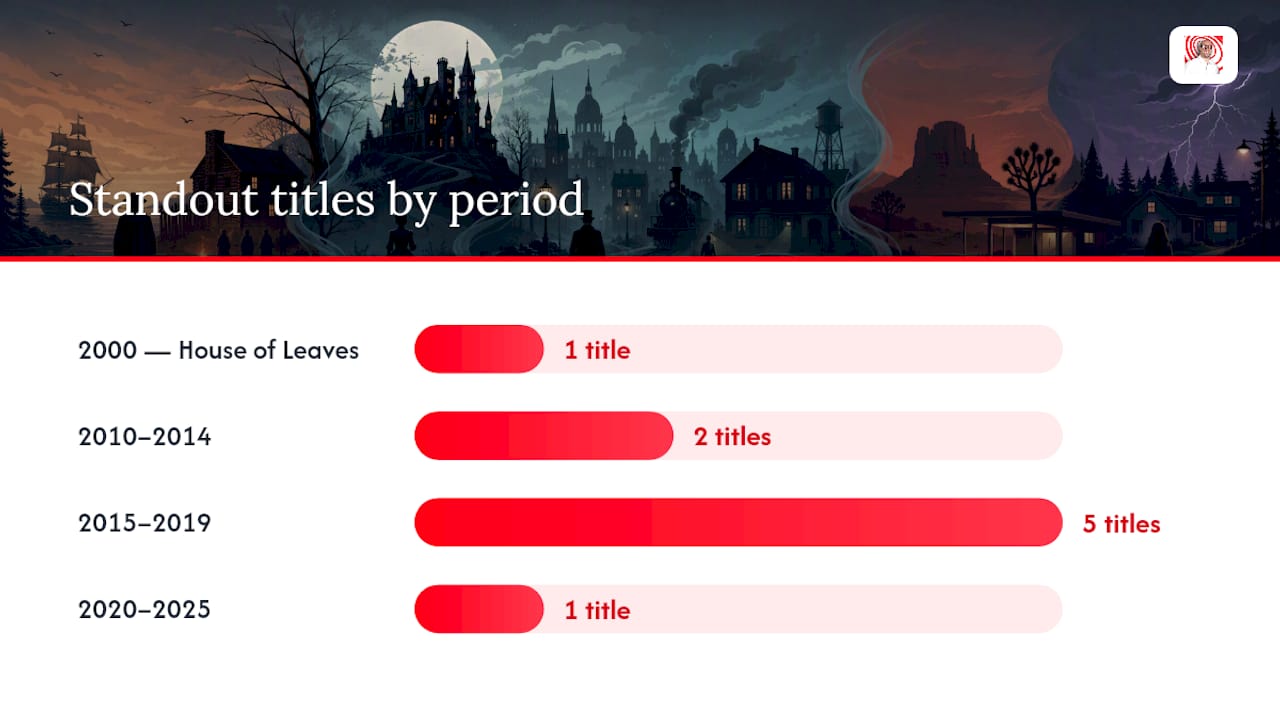
Contemporary American horror has expanded dramatically since 2010, spotlighting a wider range of authors and tackling subjects — grief, race, gender, social collapse — that earlier decades largely avoided. The Bram Stoker Awards shortlist functions as one of the most reliable filters for quality in new horror fiction, and the LitReactor decade list captures the critical consensus for the 2010–2020 window. Here are the standout titles from 2010 to 2025:
- Witchcraft for Wayward Girls — Grady Hendrix (2025). Set in a sinister group home for pregnant teens, this novel weaponizes witchcraft as a tool of power reclamation. It won the 2025 Goodreads Choice Award for Favorite Horror, receiving strong reader support — the clearest crowd signal of the year.
- House of Leaves — Mark Z. Danielewski (2000). Technically straddling eras, but its influence on 21st-century horror is so pervasive it belongs here. A house that is larger on the inside than the outside; a novel that uses typography as a horror device.
- A Head Full of Ghosts — Paul Tremblay (2015). A reality TV crew films a family's alleged demonic possession. Tremblay plays the media-horror angle with precision; the ambiguity is the point.
Several other titles from this era have built strong reader followings: Feed (Mira Grant, 2010), Broken Monsters (Lauren Beukes, 2014), The Fisherman (John Langan, 2016), The Rust Maidens (Gwendolyn Kiste, 2019), Certain Dark Things (Silvia Moreno-Garcia, 2016), and Bones & All (Camille DeAngelis, 2015) each represent distinct corners of contemporary horror worth exploring.
How do you pick horror by mood? A subgenre guide
Not every horror reader wants the same kind of fear. Understanding which subgenre matches your mood is the fastest way to find your next read. Here's how the major categories break down, with targeted picks for each:
Cosmic and weird horror
Horror rooted in the idea that the universe is indifferent and humanity is insignificant. Best for readers who want existential dread rather than jump scares.
- House of Leaves — Danielewski
How were these recommendations chosen?
Every title on these lists passed through a three-source filter: award recognition, critic consensus, and crowd validation. No single signal is enough on its own — a book can win awards and bore general readers, or dominate Goodreads without satisfying serious critics. The combination is what matters.
The specific trust signals used:
- Bram Stoker Awards (Horror Writers Association) — the genre's most respected peer-reviewed award. The 2025 shortlist provided the primary filter for contemporary picks.
- Goodreads Choice Awards — the largest reader-voted award in publishing. Witchcraft for Wayward Girls winning with 59,603 reader votes in 2025 is a genuine crowd signal, not a niche one.
- FiveBooks expert lists — V. Castro's curated 20th-century American horror list provided the critical framing for the classics section.
- LitReactor decade list — critic-curated for the 2010–2020 window, useful for identifying titles that landed with both readers and reviewers.
- Audible's Top 100 horror essentials — signals which titles perform strongly in audio format, a useful secondary check for accessibility and staying power.
Editorial choices: the modern picks section focuses on 2010–2025 and prioritizes American authors or authors writing within the American horror tradition. Non-American titles (The Loney, The Ritual, Dracula) appear where they are genuinely influential on American readers and the genre, but the core list skews U.S.-authored. Why horror books matter as a genre — culturally, emotionally, and literarily — informed the decision to include socially charged contemporary titles alongside canonical classics.
How do you choose your next horror novel?
Work through this checklist before you buy:
- Decide your gore threshold. Can you handle graphic body horror, or do you prefer dread that stays in your head? If you want psychological over visceral, start with Jackson, Tremblay, or Malerman. If you want full-throttle body horror, go to Cutter or Blatty.
- Pick your pace. Slow-burn atmospheric novels (The Haunting of Hill House, House of Leaves) reward patience. Fast, propulsive reads (Bird Box, NOS4A2, I Was a Teenage Slasher) are better for binge sessions.
- Choose your era. Classic American horror (pre-2000) tends toward singular, iconic voices. Contemporary horror (2010–2025) tends toward greater diversity of perspective and social awareness.
- Match your mood to a subgenre. Use the subgenre buckets above: psychological, supernatural, cosmic, slasher, or folk/social horror.
- Check the format. Many of these titles are available as audiobooks — The Shining, Pet Sematary, and NOS4A2 are particularly strong listens. Audible's horror essentials list is a reliable guide for audio-friendly picks.
Three reading paths by reader type:
- Beginner to horror: Start with The Shining (atmospheric, iconic, not gratuitously gory), then move to A Head Full of Ghosts (shorter, contemporary, deeply unsettling).
- Horror veteran: Go straight to House of Leaves for structural experimentation, then I Was a Teenage Slasher for voice-driven contemporary horror.
- Film-horror fan: Horror Movie (Tremblay) is built for you — it's a novel about a cursed film production that rewards every horror-cinema reference you bring to it.
Where do these lists come from?
The recommendations above draw from a combination of award shortlists, critic-curated lists, and reader-voted rankings. For deeper exploration:
- Goodreads Best Horror Novels — the community-ranked master list; thousands of votes, updated continuously.
- 2025 Goodreads Choice Awards — Horror — the annual reader-voted winner and shortlist.
- Bram Stoker Awards via FiveBooks — expert commentary on the 2025 shortlist with critic descriptions for each finalist.
- FiveBooks — 20th Century American Horror — V. Castro's expert-curated classics list with critical framing.
- LitReactor — Best Horror of the Last Decade — critic consensus for 2010–2020 standouts.
- Audible Top 100 Horror Essentials — cross-era list with strong audiobook availability; useful for format planning.
- A History of Horror Novels in America — contextual overview of the genre's evolution from the 1800s to the 2020s.
For U.S. readers, all titles listed are available through major retailers (Amazon, Barnes & Noble, Bookshop.org) in print, ebook, and audiobook formats. Paperback editions of King, Jackson, and Rice are widely stocked in physical bookstores. For newer titles like House of Bone and Rain and Witchcraft for Wayward Girls, ebook and audiobook formats are often the fastest route.
Key Takeaways
The single most reliable way to find your next great American horror novel is to cross-reference Bram Stoker shortlists with Goodreads crowd rankings and match the result to your preferred subgenre.
| Point | Details |
|---|---|
| Start with the shortlist | The eight titles in the opening section cover every major horror subgenre and reading preference. |
| Use award signals | The 2025 Bram Stoker shortlist (five finalists) and the Goodreads Choice winner (59,603 votes) are the strongest filters for contemporary quality. |
| Match subgenre to mood | Psychological, supernatural, cosmic, slasher, and folk/social horror each deliver a different kind of fear — pick the bucket before the book. |
| Classics still hold | Jackson, King, Blatty, and Rice remain the foundational American voices; every modern title on this list is in conversation with them. |
| Markwatsonbooks horror collection | For curated horror bundles and creepypasta anthologies, the Markwatsonbooks horror collection offers a direct, themed route to your next read. |
What the horror genre gets wrong about fear
The conventional wisdom in horror publishing is that readers want escalation: more gore, more monsters, more spectacle. The books that actually stay with you prove the opposite. The Haunting of Hill House contains almost no violence. Pet Sematary is terrifying because of what it understands about grief, not because of what it depicts. The most effective horror novels work by making you care about someone first, then threatening everything you care about.
The recent Bram Stoker shortlist reflects this. Incidents Around the House is terrifying because Malerman filters the horror through a child who doesn't fully understand what she's seeing. I Was a Teenage Slasher is disturbing because Jones gives the monster interiority — you understand the killer, which is far more unsettling than fearing him from a distance. The shift in contemporary American horror toward social awareness isn't a departure from fear; it's a deepening of it. When the horror reflects something real — a hurricane's aftermath, a group home's power dynamics, a neighborhood's racial history — the dread has nowhere to hide.
The best reading advice for horror is also the simplest: read in the dark, alone, and don't stop when it gets uncomfortable. That discomfort is the point. For readers who want to track where the genre is heading, the modern horror trends reshaping the genre are worth following closely.
Markwatsonbooks horror collections: curated reads ready to buy
Sorting through hundreds of horror titles to find the right read takes time most readers don't have. Markwatsonbooks cuts that process short with a curated horror collection built for readers who want themed, ready-to-buy picks without the search overhead.

Beyond the horror collection, Markwatsonbooks publishes creepypasta anthologies that deliver short-form internet horror in bulk — the Creepypasta Omnibus One collects 150 stories featuring Slenderman, Jeff the Killer, and other iconic internet horror figures in a single volume. For readers who prefer binge-format horror over novel-length commitments, it's a direct alternative to the novel picks above. Browse the full books catalog to find the format and subgenre that fits your reading mood right now.