

TL;DR:
- A good plot twist is built by planting subtle clues that foreshadow the reveal and change the story's emotional meaning.
- Limiting a novel to one major twist and ensuring it feels both surprising and inevitable creates a satisfying reading experience.
Decide your twist first, then work backward so every scene quietly seeds the clues that make the reveal feel inevitable. That single discipline separates a satisfying twist from a cheap "gotcha." Before you write another word, run your idea through this quick checklist:
- Is the twist foreshadowed at least three times before the reveal?
- Does it change the emotional stakes, not just the facts?
- Could a careful reader have deduced it on a second read?
- Does it avoid breaking any established rule of your story world?
- Does it reshape character goals, desires, or meaning?
Your immediate next step: pick one concrete twist, then mark three specific scenes where you can bury a clue inside action that appears to be about something else entirely.
Table of Contents
- What exactly is a plot twist?
- Why do plot twists matter so much to readers?
- What types of plot twists can you use?
- What makes a twist feel satisfying rather than cheap?
- How do you build a plot twist step by step?
- How do you plant clues without telegraphing the twist?
- How do you map scenes backward from your twist?
- Where should you place a twist, and how many is too many?
- What mistakes make twists feel cheap?
- How do you test and revise a twist with readers?
- Practice exercises, templates, and a sample excerpt
- Key Takeaways
- The twist that almost broke the book
- Twist-driven fiction from Markwatsonbooks
- Useful sources and further reading
What exactly is a plot twist?
A plot twist is a sudden shift in a story that forces the reader to reinterpret everything that came before. It isn't just a surprise event. The best twists change the meaning of earlier scenes, not merely the facts on the table.
Two distinctions matter here:
- Fact-reordering twists reveal that something the reader accepted as true was wrong (the detective was the killer all along).
- Meaning-reshaping twists keep the facts intact but reframe their significance (the character's lifelong sacrifice turns out to have been unnecessary, which recolors every scene of devotion).
A quick pair of archetypes: in Gone Girl by Gillian Flynn, the twist reorders facts so dramatically that the entire first half of the novel reads like a different book on a second pass. In The Sixth Sense, the reveal doesn't change a single event but flips the emotional meaning of every interaction between the two leads. Both are satisfying because the clues were always there, hiding in plain sight.
Why do plot twists matter so much to readers?
A well-executed twist does three things at once: it surprises, it rewards, and it haunts. Readers who feel that electric "oh no" moment tend to flip back through earlier chapters, hunting for the clues they missed. That re-read impulse is one of the most powerful things a novelist can engineer.
The structural and emotional roles a twist serves:
- Engagement: Twists spike tension and force readers to stay alert, because they now know the story can pull the rug out at any moment.
- Thematic depth: A twist that connects to the story's central theme lands harder than one that exists purely for shock. When the reveal proves the theme rather than contradicting it, the whole novel clicks into focus.
- Heightened stakes: A good twist raises the cost of failure for the protagonist, often retroactively. Suddenly, earlier scenes feel more dangerous than they did on first read.
The art of storytelling is largely the art of managing what readers know and when they know it. Twists are the sharpest tool in that kit.
What types of plot twists can you use?
Knowing the category of twist you're building helps you choose the right clue strategy and the right emotional target. Here are five core types, each with a compact example and a case note.
-
The revelation twist: Hidden information surfaces and reframes the story. Example: "The Murder of Roger Ackroyd" by Agatha Christie. The narrator is the killer. Works best in mysteries and thrillers where the reader trusts a single point of view.
-
The reversal twist: A character's role, loyalty, or identity flips. Example: "Knives Out." The apparent victim and apparent villain trade positions. Works best at the midpoint or climax when the reader has invested in a clear moral map.
-
The perspective shift: The same events are revealed through a new lens that changes their meaning entirely. Example: "Gone Girl." Works best when the story has been told from a single, unreliable point of view for long enough that the reader has fully committed to that version of events.
-
The false ending (penultimate twist): A neat apparent resolution is delivered, then a second, deeper reveal pulls the floor away. False endings lull readers into a sense of closure before delivering a second shock. Example: "The Wonderful Wizard of Oz" stacks three consecutive reveals in its final act. Works best in the last quarter of a novel when readers think they've already survived the worst.
-
The structural twist: The story's form itself is the surprise. The reader discovers the narrative has been unreliable at the level of structure, not just character. Example: "House of Leaves" by Mark Z. Danielewski. Works best in literary or experimental fiction where the reader is already primed to question the text.
Match your twist type to your theme. A reversal twist in a story about betrayal hits harder than the same twist in a story about grief, because the theme and the mechanism reinforce each other.
What makes a twist feel satisfying rather than cheap?
The anatomy of a satisfying twist has three components that must coexist: surprise, inevitability, and emotional logic. Remove any one of them and the twist collapses.
Surprise means the reader didn't see it coming on the first pass. Inevitability means they absolutely should have. These two qualities sound contradictory, but they coexist when clues are hidden inside scenes that appear to be about something else entirely. The reader's attention was elsewhere, not because you cheated, but because you gave them something more immediately interesting to focus on.
Emotional logic is the component most writers underestimate. A twist must be traceable through causal and emotional chains to feel earned. If you cannot write a sequence of "because" statements that link earlier character decisions to the reveal, the twist will feel unearned. Ask yourself: does this reveal change what the protagonist wants, fears, or believes? If the answer is no, you likely have a gimmick, not a twist.
Use these diagnostic questions as a fair-play audit before you draft the reveal scene:
- Can a careful reader find at least three clues on a second read?
- Does each clue also serve an immediate narrative purpose (advancing plot, developing character)?
- Does the twist change the protagonist's emotional situation, not just the plot facts?
- Does it remain consistent with every established rule of your story world?
Pro Tip: The best hiding place for a clue is a scene that appears to be about something else entirely. Bury the hint inside a moment of high emotion or action, and the reader's attention will be too occupied to register it consciously — until the reveal makes it impossible to miss.
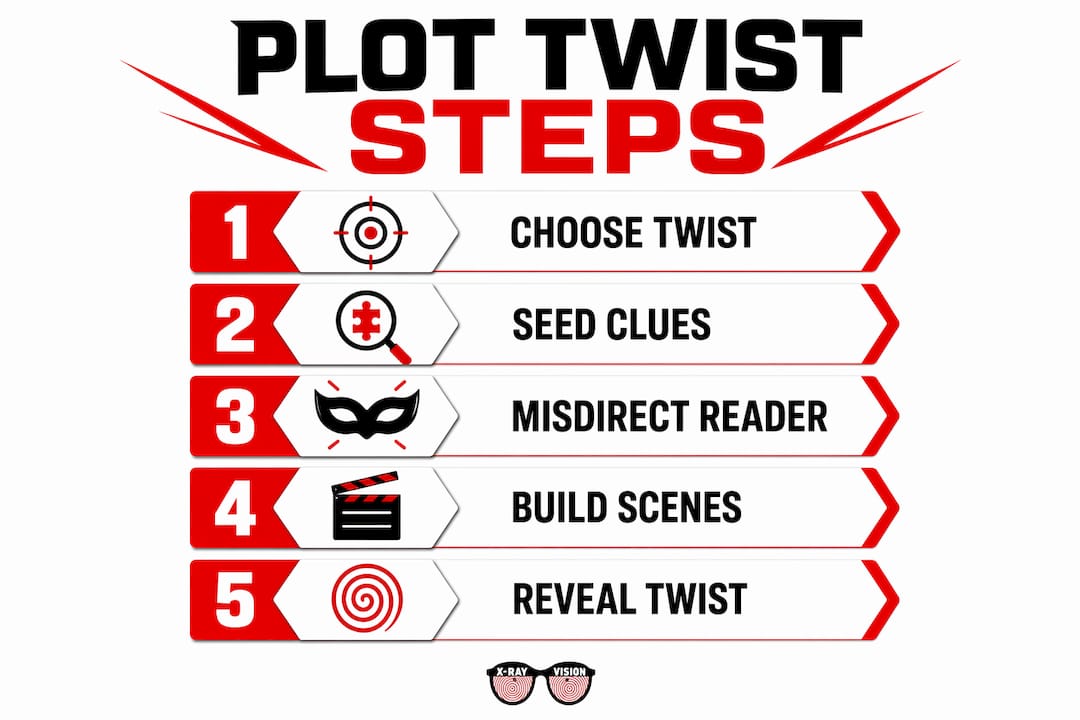
How do you build a plot twist step by step?
Treat the twist as a structural tool from page one, not a surprise you drop in during revision. Plotting from the start and reverse-engineering your scenes lets you seed breadcrumbs naturally rather than retrofitting them awkwardly.
-
Brainstorm twists that matter to character and theme. Ask: what is the one revelation that would most devastate or transform my protagonist? What truth, if exposed, would recolor every relationship in the story? Write ten candidates. The right one usually connects directly to the story's central question.
-
Choose the moment and work backward. Once you know the reveal, outline the causal chain in reverse. What must be true in the scene before the twist? What must be true three chapters earlier? Keep asking until you reach chapter one. Every required prior condition is a potential clue placement.
-
Plant breadcrumbs that serve surface functions. A clue that also advances plot or develops character won't draw attention to itself. If your twist hinges on a character's hidden profession, show them performing a skill that reads as a personality quirk before the reveal. The clue works twice: once as texture, once as evidence.
-
Design misdirection without cheating. Mix two plausible narrative tracks and let the dominant one mislead while the other contains the truth. Effective misdirection invites attention away from the real clues without withholding facts a careful reader would need to deduce the twist. Red herrings are fair; lying to the reader is not.
-
Revise with a clue audit and a beta-reader plan. After the first draft, mark every clue in your manuscript. Test whether each one serves a surface purpose. Then send specific questions to beta readers (more on this in the revision section below).
Exercise: Map one twist across three scenes. In Scene A (early), hide a clue inside a character argument. In Scene B (midpoint), plant a second clue inside a description of setting. In Scene C (late), let a piece of dialogue carry the third clue as apparent small talk. Read all three scenes aloud before the reveal. If any clue feels too obvious, bury it deeper in the surrounding action.
Pro Tip: When you're stuck on where to hide a clue, look for your story's most emotionally charged scenes. Readers are so focused on feeling the moment that they rarely analyze the background details. That's exactly where your best clues belong.

How do you plant clues without telegraphing the twist?
Foreshadowing without telegraphing is a craft skill that comes down to one principle: every clue must earn its keep in the scene where it lives, independent of its role in the twist. Clues that serve immediate narrative purposes blend in naturally; clues placed solely to foreshadow stick out like a sore thumb on re-read.
Concrete techniques:
- Background detail: A significant object sits in the corner of a scene description, mentioned once, never emphasized. On re-read, it's obviously the murder weapon. On first read, it's furniture.
- Double-meaning dialogue: A line that reads as small talk before the reveal becomes a confession afterward. "I've always known how to disappear" means something very different once the reader knows the character's real identity.
- Character micro-behaviors: A nervous habit, an avoidance pattern, a specific word a character never uses. These read as personality texture until the twist reframes them as evidence.
- Objects with immediate plot purpose: If the clue object also drives a scene forward (a letter that causes a fight, a key that opens a door), readers accept it as plot machinery rather than foreshadowing.
For misdirection, mix two conflicting narratives so the reader follows the wrong but plausible path. Emotional distraction works especially well: drop a clue during a scene of high tension or grief, when the reader is too invested in the characters' feelings to notice the background detail you just slipped in.
The fair-play rule from Curtis Brown Creative is worth memorizing: misdirection must not prevent a careful reader from deducing the twist. You're a magician, not a con artist. The coin was always in your left hand. You just made sure they were watching your right.

Pro Tip: Avoid repeating a clue object or phrase more than twice before the reveal. Once is invisible. Twice is texture. Three times is a neon sign. If you've mentioned the same detail three times, cut one instance or vary the context so it reads differently each time.
How do you map scenes backward from your twist?
Working backward from the reveal is how you build a twist that feels retroactively inevitable rather than conveniently timed. Experienced authors recommend deciding the twist before or early in drafting, then reverse-engineering earlier beats so clues are embedded naturally.
Here's a practical reverse-outline process:
- Write the twist in one sentence: "The mentor has been the antagonist's informant since chapter two."
- Ask: what must be true in the scene immediately before the reveal? (The mentor must have access to the antagonist's location.)
- Ask: what must be true three chapters earlier? (The mentor must have had an unexplained absence that the protagonist accepted without question.)
- Ask: what must be true at the story's opening? (The mentor must have a stated motivation that, in retrospect, aligns with the antagonist's goals.)
- For each required prior condition, write a "because" statement: "The mentor helps the protagonist because it keeps them close enough to monitor their progress."
That causal chain is your outline. Each link in the chain is a scene function. Each scene function is a clue placement opportunity.
A quick outline checklist for scene functions:
- Does this scene establish a fact the twist will later reframe?
- Does it develop a character behavior that will read differently after the reveal?
- Does it introduce an object or location that will carry new meaning post-twist?
- Does it advance the misdirection track without breaking the fair-play rule?
If a scene doesn't fulfill at least one of these functions, it may not be earning its place in the causal chain.
Where should you place a twist, and how many is too many?
Placement determines what a twist accomplishes structurally. An early twist (end of act one) raises the stakes and resets the protagonist's goal. A midpoint twist shifts the story's direction and deepens the central conflict. A climactic twist delivers the emotional payoff the entire novel has been building toward.
A few rules of thumb:
- One major twist per novel is the professional standard. Experienced authors advise limiting major reveals to avoid contrivance and protect reader trust. Multiple smaller reversals are fine; multiple jaw-dropping reveals tend to cancel each other out.
- The penultimate twist (a false ending followed by a deeper reveal) works best in the final quarter. It delivers apparent closure, then pulls it away, leaving the reader with a second, more resonant shock.
- Early reveals work when the twist resets the protagonist's goal rather than resolving the story's central question. Revealing the villain's identity at the midpoint, for instance, shifts the story from "whodunit" to "how do we stop them."
After a major reveal, pacing slows deliberately. Give readers a scene to absorb the new reality before the story accelerates again. For thriller structure specifically, the aftermath scene is where the emotional consequences of the twist land. Skip it and the twist feels weightless.
What mistakes make twists feel cheap?
Even a well-conceived twist can collapse under execution errors. Here are the most common pitfalls and a one-line fix for each.
- Cheating the reader: The twist depends on information the reader had no access to. Fix: add earlier evidence, or change the reveal so it reframes available facts rather than introducing hidden ones.
- Telegraphing: The clues are so obvious that readers guess the twist chapters early. Fix: bury each clue inside a scene with a stronger surface purpose, or vary the context so the same detail reads differently each time.
- Twist for twist's sake: The reveal changes plot facts but not meaning or stakes. Fix: ask whether the twist forces the protagonist to change. If not, redesign it so the reveal directly challenges their core belief or desire.
- Breaking established rules: The twist contradicts a fact the story presented as reliable. Fix: either change the earlier fact (with a revision pass) or change the twist so it works within the established story logic.
- Weak aftermath: The story moves on too quickly after the reveal, leaving the emotional consequences unexplored. Fix: add a scene where the protagonist processes the new reality before the plot accelerates. The role of resolution in any story is to let the emotional weight land.
A note on when to rebuild rather than patch: if fixing a twist requires changing more than three earlier scenes, you likely have a structural problem, not a clue problem. The twist may not fit the story you actually wrote. In that case, consider whether a different twist type would serve the same thematic purpose with less retrofitting.
How do you test and revise a twist with readers?
Revision is where a twist goes from clever to devastating. A clue audit and targeted beta-reader questions are the two tools that matter most.
Clue audit steps:
- Read the full manuscript and highlight every clue in yellow.
- For each highlighted passage, ask: does this clue also serve an immediate narrative purpose (plot, character, atmosphere)?
- If a clue serves no surface purpose, revise the scene so it does, or cut the clue and replace it with one that earns its place.
- Count your clues. Fewer than three makes the twist feel arbitrary. More than six risks telegraphing.
- Check that the causal chain holds: can you write "because" statements connecting each clue to the reveal?
Beta-reader questions to ask:
- Can you explain the twist in your own words?
- Which clue felt strongest in retrospect?
- Was there any moment that felt impossible or that broke the story's logic?
- Did you guess the twist before the reveal? If so, when?
- Did the aftermath feel emotionally complete?
Final pass checklist:
- Continuity: does every scene before the twist remain consistent with the new information?
- Emotional consequences: does the protagonist's reaction to the reveal feel proportionate and specific?
- Pacing of aftermath: is there at least one scene after the reveal where the emotional weight settles before the story moves on?
- Fair-play check: could a careful reader have deduced the twist from available clues?
- Thematic alignment: does the twist prove or complicate the story's central theme?
Practice exercises, templates, and a sample excerpt
These three drills are designed for 30–60 minute sessions. Each targets a specific craft skill.
Exercise 1: Seed the clue (30 minutes) Write a scene in which a character argues with a friend. Somewhere in the background of that scene, hide a single object that will later prove the friend is lying. The object must serve an immediate purpose in the argument (it's thrown, referenced, or noticed by the protagonist for an unrelated reason). Read the scene aloud. If the object feels planted, revise until it feels like furniture.
Exercise 2: Misdirect without cheating (45 minutes) Write two versions of the same scene. In version one, the scene points clearly toward Suspect A. In version two, the same scene points clearly toward Suspect B. Now merge them: write a third version where both readings are simultaneously plausible. The reader should finish the merged scene convinced of one interpretation. The truth is the other.
Exercise 3: Revise a weak twist (60 minutes) Take a twist you've already drafted (or invent one in five minutes). Write the "because" chain backward from the reveal to the opening scene. If any link breaks, that's your revision target. Rewrite the broken scene so the causal chain holds, then check that the new scene also serves a surface narrative purpose.
Template 1: Three-scene clue map
| Scene | Surface purpose | Hidden clue | Post-twist meaning |
|---|---|---|---|
| Scene A (early) | Character establishes routine | Object/behavior X is introduced | X proves the character's secret |
| Scene B (midpoint) | Conflict escalates | X appears in a new context | X deepens the evidence |
| Scene C (late) | Apparent resolution | X is mentioned in dialogue | X becomes the smoking gun |
Template 2: Five-step revision checklist
- Mark every clue in the manuscript.
- Verify each clue serves a surface narrative purpose.
- Write the "because" chain from opening to reveal.
- Ask beta readers the five questions listed in the revision section.
- Check continuity, emotional aftermath, and thematic alignment.
Sample excerpt demonstrating a buried clue:
Sarah set the kettle on and watched Daniel sort through the mail. He always opened envelopes from the left corner, never the right. She'd noticed it the first week they met and filed it away as a quirk. "Anything interesting?" she asked. "Bills," he said, without looking up.
After the twist reveals Daniel is left-handed despite performing every visible task with his right hand, that single line of mail-sorting becomes the moment a careful reader missed. The clue was always there, doing nothing but characterization. Until it did everything.
For more on building scary, character-driven tension into your scenes, the Markwatsonbooks blog has detailed craft guides that pair well with these exercises. Writers working in serialized or visual formats may also find the perspective on narration in immersive media useful for understanding how perspective shifts create twist-like effects across different storytelling formats.
Pro Tip: After you finish the three-scene clue map, read only the three clue scenes back to back, without the surrounding chapters. If the twist feels obvious in that stripped-down sequence, your clues are too concentrated. Spread them further apart, or vary the contexts so they don't rhyme.
Key Takeaways
A satisfying plot twist requires three things working together: surprise, inevitability, and emotional logic — and the only way to achieve all three is to decide the twist early and build the story backward from it.
| Point | Details |
|---|---|
| Decide the twist first | Plan the reveal before drafting so every scene can seed clues naturally rather than retrofitting them. |
| One major twist per novel | Limiting major reveals protects reader trust and prevents the story from feeling contrived. |
| Every clue needs a surface job | A clue that also advances plot or character won't draw attention to itself on first read. |
| Fair-play misdirection only | Redirect reader attention without withholding facts a careful reader would need to deduce the twist. |
| Markwatsonbooks for twist-driven fiction | Mark Watson's horror thrillers and Creepypasta anthologies model short and long-form twist construction across multiple genres. |
The twist that almost broke the book
Most craft guides on how to write plot twists treat the reveal as the destination. After years of writing horror thrillers and Creepypasta anthologies, I'd argue the reveal is actually the beginning of your hardest work, not the end of it.
The twist that taught me the most was one I was convinced was brilliant. It was a revelation twist: a character the reader had trusted completely turned out to be the source of every catastrophe in the story. Structurally, it worked. Causally, it held. But when the first readers came back, the reaction wasn't "I never saw it coming." It was "I didn't care."
The problem wasn't the surprise. The problem was that the twist didn't change anything the protagonist felt. The facts shifted, but the emotional stakes stayed flat. I had engineered a puzzle and forgotten to write a story underneath it.
The fix was brutal: I went back and rewrote the relationship between the protagonist and the betraying character from chapter two onward. Every scene of trust, every moment of warmth, had to be real enough that the reader had genuinely invested in it. Only then did the reveal hurt the way it was supposed to.
The lesson I'd pass on: trust your readers enough to make them care before you break their hearts. A twist that lands on an emotional vacuum is just a plot mechanic. A twist that lands on genuine attachment is the kind of thing readers talk about for years.
Keep practicing. The first ten twists you write will probably be too obvious or too arbitrary. That's normal. The craft is in the revision, not the inspiration.
Twist-driven fiction from Markwatsonbooks
If you want to study plot twists in action, reading widely in the genre is the fastest shortcut. Markwatsonbooks offers a range of titles that put these techniques to work across horror, suspense, and short-form internet horror.

Mark Watson's horror thrillers and collections are built around the kind of revelation and reversal twists this guide covers. For writers studying short-form twist construction specifically, the Creepypasta anthologies are particularly useful: each story is compact enough to map the entire clue-to-reveal structure in a single sitting, making them ideal for the three-scene clue map exercise above. The children's titles show how twist intensity can be calibrated for younger readers without losing the essential surprise-and-inevitability structure.
Sign up for the Markwatsonbooks mailing list to receive a free book offer and updates on new releases. It's the fastest way to get more twist-driven fiction in your hands while you're building the craft.
Useful sources and further reading
The following sources informed this guide and are worth bookmarking for deeper study.
- Writer's Digest: How to Plot a Plot Twist covers the five-step process for planning and reverse-engineering a twist, with emphasis on early planning and clue placement.
- Writer's Digest: Misdirection Is the Secret Sauce focuses on the mechanics of mixing two narrative tracks and the penultimate twist technique.
- Chapter Blog: How to Write a Plot Twist offers craft-level guidance on hiding clues in background detail and the distinction between gimmick twists and meaning-reshaping reveals.
- Curtis Brown Creative: 5 Tips for Engineering the Twist is the clearest articulation of the fair-play rule and ethical misdirection available online.
- Writers.com: Better Endings covers causal chains and emotional logic, with practical "because" statement methodology for testing whether a twist is earned.
- Jerry Jenkins: Plot Twists addresses the professional standard of limiting major twists per novel and the reader-trust implications of overuse.
- Jericho Writers: How to Write a Compelling Plot Twist provides a comprehensive overview of twist types and the three rules every twist must follow: plausibility, surprise, and foreshadowing.
When you're running a clue audit or revision pass, use this source list as a reference checklist. Each source covers a different component of the twist-building process, and reading them in sequence mirrors the workflow laid out in this guide.