

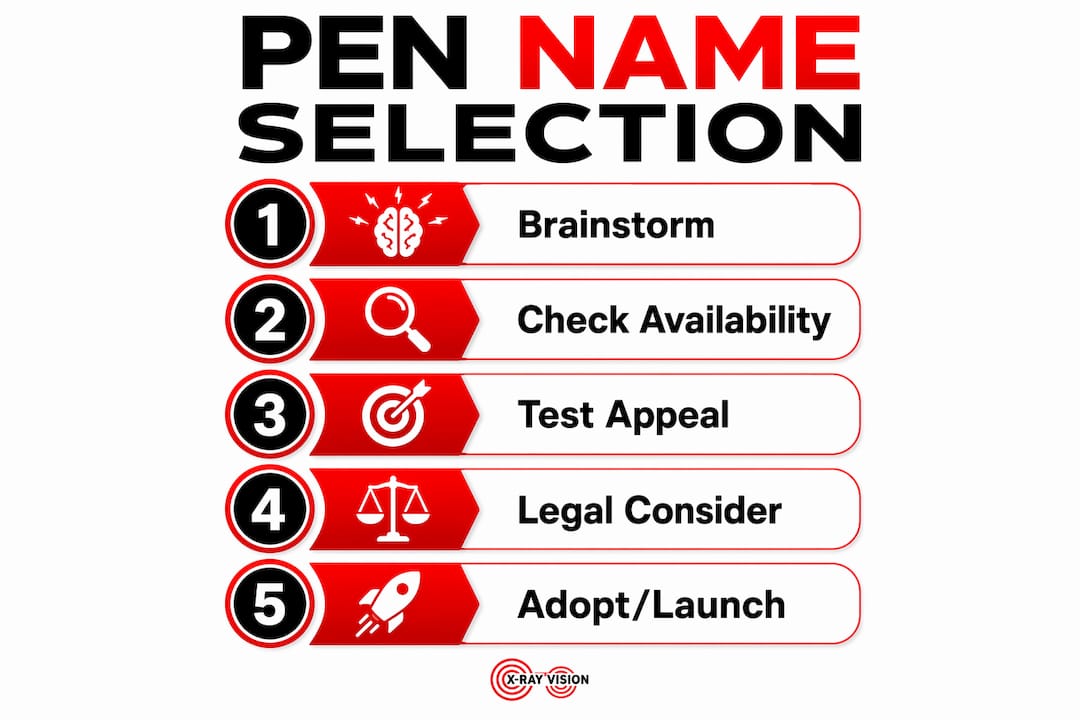
Pick a short, genre-fit name that's easy to spell, then validate availability across Amazon, Google, social platforms, and the USPTO trademark database before committing. That's the core of how to choose a pen name that actually works. A viable pen name must do three things: signal your genre at a glance, roll off the tongue without a second thought, and exist nowhere else in your category. Right now, brainstorm 10 candidates, then run a quick search on Amazon and Google for each. Save the top 3 that pass both tests. Everything below sharpens that shortlist into a name you can build a career on.
Table of Contents
- How do you pick a pen name that fits your genre and goals?
- Where and how do you check availability before committing?
- What tests tell you if a pen name will actually work?
- What can famous pen names teach you?
- When should you adopt, change, or retire a pen name?
- Key Takeaways
- What I've learned from writing across multiple genres
- Practical sources and tools for your pen name search
How do you pick a pen name that fits your genre and goals?
Before you generate a single name, decide what job the pseudonym must do. Genre signal, searchability, brand expansion, or anonymity each pull the name in a different direction. A thriller writer needs something crisp and authoritative. A romance author needs warmth and approachability. Nail the job first, and the candidate list almost writes itself.
Work through this checklist for every name on your shortlist:
- Genre signal: Does the name feel at home on a shelf next to your category's bestsellers? Genre naming trends shape reader expectations before they read a single word of your blurb.
- Syllable count: Two syllables for a first name, one or two for a surname, tends to hit the sweet spot for memorability. Romance leans softer ("Cara Lane"); thrillers lean punchy ("Cole Vance").
- Spelling and pronunciation: If someone hears your name at a bookstore event and can't spell it to search later, you've lost a sale. Avoid unusual letter combinations that break phonetic logic.
- Gender signaling: Decide deliberately. A gender-neutral name opens more doors in some genres; a clearly gendered name sets sharper expectations in others.
- Emotional resonance: Say the name out loud. Does it feel like someone you'd trust to tell you a great story? That gut reaction is real.
- Flexibility for genre-hopping: A name like "D.R. Stone" works across thrillers, sci-fi, and horror. "Scarlett Rosewood" is harder to transplant. Choosing a name too genre-specific can force a costly rebrand if you expand later.
Score each candidate 0–3 on genre fit, readability, and availability. Any name scoring 7 or higher across all three is worth pursuing. Below 5, cut it without sentiment.
Pro Tip: Marketability and authenticity aren't opposites. A name that feels authentic to you is far easier to sustain across a multi-book career. If you cringe slightly every time you sign it, that's a signal worth heeding.
| Name trait | What it signals to readers |
|---|---|
| Short, punchy surname | Authority, speed, tension (thrillers, action) |
| Soft, flowing sounds | Warmth, emotion, intimacy (romance, women's fiction) |
| Initials for first name | Gender ambiguity, literary seriousness |
| Unusual or invented spelling | Fantasy, sci-fi, dark fiction |
| Classic, familiar construction | Trust, accessibility, mainstream appeal |
Where and how do you check availability before committing?
Run these searches in order, and don't skip any of them.

Google: Search the exact name in quotes. Look at the first two pages. An established author, a public figure, or a brand using that name is a red flag.
Amazon and Goodreads: Search the author name directly. Even a single active author with the same name creates confusion in search results. Complicated spellings and name collisions are among the most common and costly mistakes new authors make.
Domain check: Use a WHOIS tool (Namecheap, GoDaddy, or Google Domains) to see if the .com is available. Grab it even if you don't need a website yet. Domain squatters move fast once a name gains traction.
Social handles: Check Instagram, X (formerly Twitter), Facebook, and TikTok. Consistent handles across platforms make you findable. Mismatched handles fragment your discoverability.
USPTO TESS: Search the USPTO trademark database for your candidate name in Classes 16 (printed matter) and 41 (entertainment/education). A live trademark on your chosen name, even one held by a non-author, can block merchandising and brand expansion later.
Before you fall in love with a name, spend 20 minutes on these five checks. Finding a conflict after you've built an audience is far more painful than finding it now.
U.S.-specific legal note: Publishers and agents will require your legal name for contracts, tax forms (W-9), and royalty payments. If you want to receive payments directly under a pen name, file a DBA (Doing Business As) or Fictitious Business Name with your county or state. This is a straightforward process in most U.S. states and costs a small filing fee.
For privacy, build a separate digital ecosystem under the pseudonym: a dedicated email address, social profiles in the pen name only, and WHOIS privacy protection on your domain registration. Mixing personal and pen-name accounts is the fastest way to accidentally unmask yourself.
Pro Tip: Author names are indexable on Amazon and influence search results. A unique name combination with clean spelling outperforms a common name in category searches. Think of your pen name as a keyword, not just a label.
What tests tell you if a pen name will actually work?
Availability checks tell you a name is clear. These tests tell you it's strong.
- Mock cover test: Drop your candidate name onto a genre-appropriate cover template (Canva works fine) and place it next to three category bestsellers at thumbnail size. If it visually fits the shelf, it passes. If it looks out of place, readers will feel that mismatch before they consciously register it.
- Read-aloud test: Say the name in a noisy room, then ask someone nearby to spell it back. If they get it wrong, readers will too.
- Phone test: Call a friend and say only the name. Ask them to search for it. Watch where they land.
- Domain/handle mockup: Type out a full author URL and social handle using the name. Does it look clean? Does it read as one word or a confusing string?
For feedback, ask 10–15 readers in your genre, not just friends and family. Show them a mock cover, not just the name in isolation. Ask: "Would you pick this up based on the cover and author name?" You're looking for instinctive reactions, not considered opinions.
When feedback conflicts, favor the objective checks. If the name passes availability and the mock cover test, a few people saying "it sounds a bit plain" is not a reason to abandon it. Plain and memorable often overlap.
Pro Tip: The mock cover thumbnail test next to category bestsellers is the single most predictive check you can run. Readers make purchase decisions in seconds at that size. If your name disappears or clashes, fix it before launch.
What can famous pen names teach you?
A handful of well-known cases make the principles concrete.
Stephen King as Richard Bachman. King used Bachman to test whether his success was tied to his name or his writing. The experiment worked until a bookstore clerk noticed the similarities and went public. Lesson: a pen name built purely for anonymity has a shelf life. Plan for the possibility of disclosure.

J.K. Rowling as Robert Galbraith. Rowling adopted a male-sounding name to publish crime fiction without the weight of Harry Potter expectations. The name signaled genre credibility in a category where readers skew toward male authors. Lesson: gender signaling is a deliberate tool, not an accident.
Nora Roberts as J.D. Robb. Roberts uses Robb exclusively for her futuristic police procedural series, keeping it cleanly separate from her romance catalog. The two brands don't bleed into each other. Lesson: multiple pen names work when each one owns a distinct genre lane.
Mark Twain (Samuel Clemens). Twain is short, punchy, and impossible to forget. It also carries a riverboat connotation that suited his American storytelling voice. Lesson: a name with texture and sound beats a forgettable real name every time.
Each of these names did a specific job. Before you finalize yours, write one sentence describing what job your pen name must do. That sentence is your filter.
When should you adopt, change, or retire a pen name?
Use a pen name when privacy is non-negotiable (a day job that conflicts with your writing, a genre your personal network would find uncomfortable), when you're crossing into a genre where your real name sends the wrong signal, or when your legal name is genuinely difficult to spell or search.
Don't use one when the operational cost outweighs the benefit. Every pen name is a separate author business: separate social accounts, separate email lists, separate marketing budgets. That overhead compounds fast, especially across a full book launch cycle.
Signals a name should change:
- A trademark conflict surfaces after publication.
- The name is so genre-specific it blocks a strategic expansion you now want to pursue.
- A relaunch or rebrand makes the old name a liability rather than an asset.
Transition checklist when changing a pen name:
- Announce the change to your email list first, before any public update.
- Update your Amazon Author Central page and Goodreads profile simultaneously.
- Set up redirects from the old domain to the new one.
- Add a note on existing book pages linking the old and new names.
- Cross-promote for at least two release cycles so existing readers follow you across.
Gradual transitions work better than hard cuts. Readers who discover your old name in a search should land somewhere that explains the change, not a dead end.
Managing two active pen names simultaneously is possible, but treat each as a full author business. The resource cost of running separate author brands is real. Most authors find that one strong name, built deliberately, outperforms two diluted ones.
Key Takeaways
A pen name works when it signals genre, survives availability checks, and feels authentic enough to sustain across a full writing career.
| Point | Details |
|---|---|
| Genre fit comes first | Match your name's sound and style to your category's reader expectations before anything else. |
| Readability is non-negotiable | If readers can't spell or pronounce it after hearing it once, discoverability suffers. |
| Run all five availability checks | Google, Amazon, Goodreads, domain WHOIS, and USPTO TESS before committing to any name. |
| Test with a mock cover | Place the name on a genre cover at thumbnail size next to bestsellers; instinct reveals fit faster than opinion. |
| Plan for the long term | A name that feels authentic to you is easier to sustain and reduces the risk of author fatigue over a multi-book career. |
What I've learned from writing across multiple genres
The advice most authors ignore is this: don't choose a pen name in isolation from your cover design. The name and the cover work as a single visual unit on a thumbnail. A name that looks bold and clean at full size can dissolve into noise at 80 pixels wide. Test them together from day one.
Genre-hopping is where pen names earn their keep. Writing children's books and horror under the same name creates real friction. Readers who find you through one genre carry expectations the other genre will violate. A second name isn't vanity; it's audience management.
The other thing worth saying plainly: don't overthink it to the point of paralysis. A good name chosen in a week beats a perfect name chosen never. Run the checklist, run the tests, pick the strongest candidate that clears availability, and start building. The name becomes powerful because of the work you put behind it, not the other way around.
Experiment. Try a name on a mock cover. Share it with a few readers in your genre. See what sticks. Drop a question in the comments or reach out directly. The best pen name decisions I've seen came from authors who tested fast and committed with confidence.
Practical sources and tools for your pen name search
Bookmark these before you start your validation stage. Each one does a specific job in the process.
- USPTO TESS: Search trademark registrations in Classes 16 and 41 to catch conflicts before they become legal problems.
- Amazon Author Central: Search existing author pages to confirm no active author is already using your candidate name in your genre.
- Goodreads: Author search reveals catalog overlap and reader associations with similar names.
- Namecheap WHOIS: Fast domain availability check with WHOIS privacy options built in.
- ALLi Pen Name Guide: The Alliance of Independent Authors' guide covers genre conventions, gender signaling, and operational setup in depth.
- Reedsy Pen Name Generator: A brainstorming tool to generate name candidates by genre and style when your shortlist feels thin.