

Memorable characters share one fundamental structure: a clear external want pulling them forward, an internal need they resist, a contradiction that makes them human, a voice you can hear without a dialogue tag, and at least one sensory detail that lodges in the reader's mind like a splinter. Build those five elements and you have the engine. Everything else, the backstory, the arc, the relationships, is fuel.
The 5 essentials at a glance:
- Want — the concrete goal driving every scene
- Need — the internal truth the character avoids
- Contradiction/flaw — the quality that creates tension and empathy
- Voice — a speech pattern and worldview no other character shares
- Sensory anchor — one specific detail readers picture instantly
Pro Tip: Apply the Iceberg Principle from the start: know ten times more about your character than you ever put on the page. Readers feel that hidden depth even when they can't name it.
Table of Contents
- How to create memorable characters: a step-by-step process
- What do your characters want, and what do they actually need?
- Why contradictions and flaws make characters impossible to forget
- How do you give a character a voice readers can hear?
- How backstory and sensory detail create depth without info-dumps
- How do you design a character arc that actually changes someone?
- Practical exercises to develop and test your characters
- A working author's workflow: from idea to tested scene
- How do you know if a character is actually memorable?
- What drives characters beyond wants and needs?
- Key Takeaways
- The thing most writers get wrong about character depth
- Keep writing characters that haunt readers
- Useful sources for going deeper
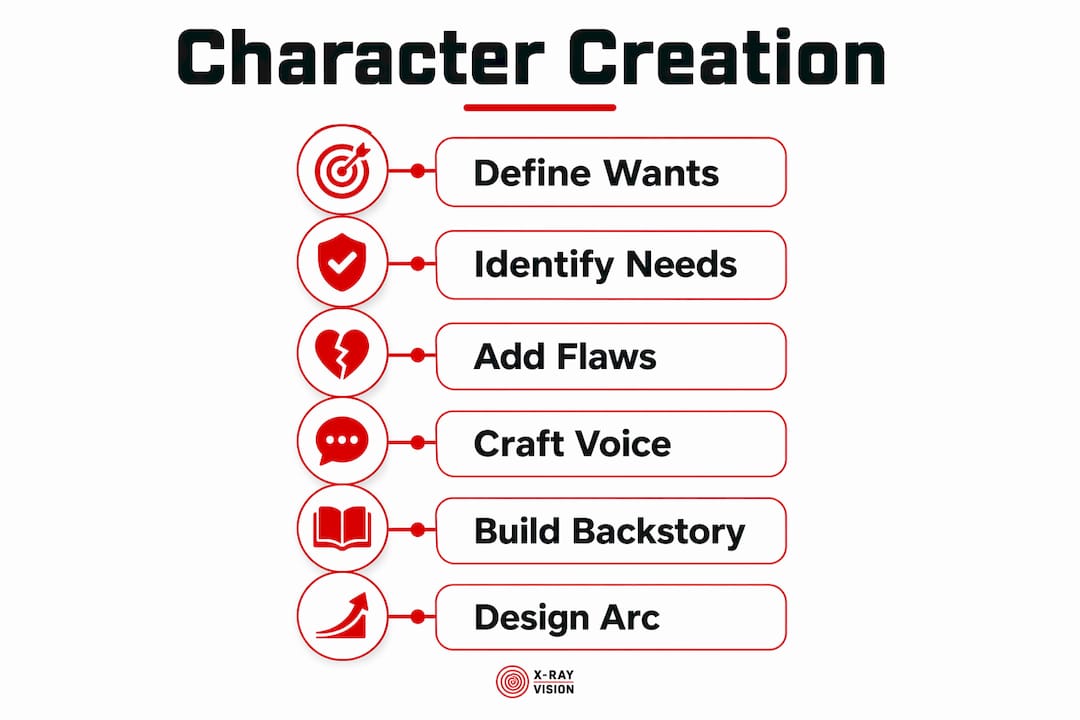
How to create memorable characters: a step-by-step process
A repeatable process beats inspiration every time. Run through these steps for any new character, and you will never stare at a blank profile sheet again.
- Seed concept. Write one sentence: who is this person and what is their defining tension? ("A burned-out paramedic who saves strangers but can't ask for help herself.")
- Map wants and needs. External want in one line. Internal need in one line. They should conflict.
- Name the contradiction. Pick one quality that fights another. Brave but terrified of intimacy. Generous but deeply envious.
- Draft the voice. Write three lines of dialogue this character would say in a crisis. Read them aloud. Could any other character in your story say the same words? If yes, revise.
- Build backstory as scaffolding. List five formative events. You will use maybe one on the page. The rest shape every choice the character makes.
- Map the arc. Where does the character start emotionally? Where do they end? What forces the change?
- Run a scene test. Drop the character into a high-pressure scene with no setup. Watch what they do. Their choices will tell you more than any questionnaire.
- Iterate. Revise the profile based on what the scene revealed. Repeat the scene test with a different pressure.
Mini exercise: Pick one character you are currently developing. Set a timer for 20 minutes and run steps 1 through 4 right now. Don't edit. Just write fast and see what surfaces.
Writer's Digest's 6-point character-building process confirms that a simple profile structure, covering identity, origin, job, family, backstory, and motive, is enough to break through early-draft paralysis and get a character moving.
What do your characters want, and what do they actually need?
The want is what your character chases. The need is what they are missing. These two forces, pulling in opposite directions, are what generate plot and produce genuine change.
- External want: a concrete, visible goal (win the case, escape the city, find the killer)
- Internal need: an emotional truth the character resists (learn to trust, accept loss, stop punishing themselves)
Wants produce plot. Every scene can be built around a character pursuing their want and hitting an obstacle. Needs produce the arc. The character only changes when the cost of avoiding their need becomes unbearable.
Scene prompts that force a want/need clash:
- The character can get what they want, but only by betraying the one thing they need to learn.
- Someone offers the character exactly what they need. They refuse it. Why?
- The character achieves their want in the final act. Show the hollow feeling that follows.
Two micro-examples:
A detective wants to close the case (external). She needs to stop blaming herself for her partner's death (internal). She closes the case brilliantly, but the self-blame intensifies because she did it alone. She got the want, not the need.

A grieving father needs to reconnect with his surviving daughter (internal). He wants to find the man responsible for his son's death (external). He abandons the hunt when his daughter calls in crisis. He sacrifices the want, and for the first time, starts moving toward the need.
Why contradictions and flaws make characters impossible to forget
Flat characters feel flat because every trait points in the same direction. Real people contain multitudes, and so should your characters. A contradiction is not a flaw list; it is two genuine qualities in friction.
Common memorable flaw patterns:
- Courage that tips into recklessness (the hero who never retreats, even when retreat is wisdom)
- Loyalty that shades into enabling (the friend who covers for someone they should confront)
- Intelligence weaponized as cruelty (the character who is always right and never kind about it)
- Generosity rooted in control (giving as a way to keep people indebted)
The trap is the one-note flaw: the character who is simply "too trusting" or "too stubborn." Those are costume jewelry. A real flaw costs the character something they value and forces a genuine choice.
Before: Marcus is brave, loyal, and occasionally hot-headed. He charges into danger to protect his team.
After: Marcus is brave and charges into danger, but his courage is partly performance. He is terrified of being seen as weak, so he takes risks that endanger the people he is trying to protect. His loyalty is real. His need to be admired is real. They are on a collision course.
Pro Tip: For horror and thriller writers, the antagonist's motivation demands the same depth as the protagonist's. A villain whose logic makes sense, even if their actions are monstrous, is far more unsettling than one who is simply evil. Explore horror villain archetypes to see how this plays out across subgenres.
How do you give a character a voice readers can hear?
Voice is the sum of how a character thinks, speaks, and filters the world. It is not accent or catchphrase. It is the specific rhythm and logic of a mind. When voice is working, you can strip the dialogue tags from a scene and still know who is speaking.
Four practical voice tests:
- Dialogue-only scene. Write a full scene using only dialogue, no action beats, no tags. If you can't tell who is speaking, the voices are too similar.
- Read-aloud check. Read the character's lines out loud. Anything that trips your tongue is probably not how this person speaks.
- Minimal-tag challenge. Remove every dialogue tag except "said" and "asked." Does the scene still work? If not, the voice is not doing its job.
- Worldview filter. Put the character in a neutral situation (a traffic jam, a grocery store). Write three sentences of their internal monologue. Their specific irritations, observations, and assumptions reveal their worldview faster than any backstory paragraph.
Dialogue prompts to reveal character:
- Ask the character to explain something they love to someone who doesn't care. Watch how they handle the indifference.
- Put them in an argument they are losing. Do they double down, deflect, go quiet, or get mean?
- Have them lie. The specific lie a character tells reveals more than the truth.
Voice trait checklist:
- Sentence length (terse vs. elaborate)
- Vocabulary range (formal, street-level, technical, poetic)
- Rhythm (staccato bursts vs. long, winding clauses)
- What they never say (avoidances are as revealing as word choices)
- Recurring images or comparisons (a carpenter thinks in wood; a nurse thinks in symptoms)
Avoid caricature by grounding each voice trait in a reason. A character who speaks in clipped sentences does so because they learned early that words get people in trouble, not because "they're the quiet type."
How backstory and sensory detail create depth without info-dumps
The Iceberg Principle is simple: know far more than you show. The hidden nine-tenths of a character's history is what readers feel as weight and authenticity on the page. You do not need to share it. You need to have it.
Dos and don'ts for backstory and sensory detail:
- Do reveal backstory in fragments tied to a present-tense trigger (a smell, a sound, a phrase someone uses).
- Do let physical details carry emotional information (a character who always sits with their back to the wall has a reason).
- Do use one hyper-specific sensory detail per scene rather than a catalog of descriptions.
- Don't open a chapter with a backstory recap. Readers skip it.
- Don't use physical description as a character introduction. Show the character doing something first.
- Don't explain what a sensory detail means. Trust the reader.
Sensory prompts:
- What smell makes your character's stomach drop? When did that association form?
- What object do they carry that has no practical use?
- What sound do they hear in silence?
Example: She always ordered black coffee, even when she wanted cream. Old habit from the years when wanting anything extra felt dangerous.
That single line implies a backstory, a psychology, and a current behavior. No explanation needed.
How do you design a character arc that actually changes someone?
An arc is not a character becoming "better." It is a character being forced to confront their need, and either growing, falling, or holding firm at great cost.
Four arc types and when they serve memorability:
- Growth arc: the character moves toward their need. Most satisfying for readers who want hope.
- Fall arc: the character refuses their need and pays for it. Powerful in tragedy and horror.
- Flat arc: the character's core belief is tested but holds. They change the world around them instead. Works for iconic, mythic characters.
- Transformation arc: the character becomes something fundamentally different, for better or worse. High-stakes, demands careful setup.
Simple arc timeline:
| Stage | What happens | What it reveals |
|---|---|---|
| Setup | Character pursues want, avoids need | Core wound and desire |
| Inciting choice | First real test of values | What they prioritize under pressure |
| Tests | Escalating obstacles attack the wound | Contradictions surface |
| Crisis | Want and need collide directly | True character under maximum pressure |
| Climax | Character chooses | Growth, fall, or flat resolution |
| Consequence | The cost or reward of that choice | Thematic statement |
Escalation that reveals character:
- Raise the stakes by threatening what the character loves, not just what they want.
- Force choices where both options cost something real.
- Let the character's flaw cause the crisis, not external bad luck.
Readers remember characters who make choices under pressure. The pressure is the point. For a deeper look at how protagonist constraints shape these moments, the role of protagonists in horror is worth studying even if you write outside the genre.
Practical exercises to develop and test your characters
These tools are reproducible across every draft and every genre. Use them in order for a new character, or jump to the one that targets your current gap.
Character questionnaire (compact version):
- What does this character want more than anything?
- What do they need that they won't admit?
- What is their greatest fear?
- What do they believe about the world that is wrong?
- What is the contradiction at their core?
- What is the one thing they would never do? (Now figure out what would make them do it.)
- What do they smell, hear, or see that takes them back to their worst memory?
- How do they speak when they are nervous? When they are angry? When they are in love?
- What lie do they tell themselves every day?
- What does their body do when they are hiding something?
- Who do they love? Who do they resent? Who do they fear?
- What would they sacrifice everything for?
- What would they never sacrifice, even if it cost them everything else?
- What is the first thing someone notices about them?
- What do they notice first about other people?
For a full character development workflow with templates, Markwatsonbooks has a detailed guide that walks through each stage.
Scene prompts that test one trait at a time:
- Voice: Write the character ordering food at a diner when the order comes out wrong.
- Fear: Put them alone in the dark with the thing they dread most. No rescue.
- Loyalty: Someone they love asks them to do something wrong. Write the conversation.
- Moral limit: They can solve their problem by hurting someone innocent. What do they do?
Iteration cycle:
- Write a scene using the character.
- Test it (dialogue-only read, voice check, recall test with a beta reader).
- Collect specific feedback: what did the reader remember? What confused them?
- Revise one element at a time. Don't overhaul everything at once.
- Repeat the scene test with the revised version.
A comprehensive character chart pairs basic profile fields with deeper questions that connect backstory directly to plot choices, and it is a useful companion to the questionnaire above.
A working author's workflow: from idea to tested scene
Here is how the process looks in practice, with realistic time budgets.
Mark's workflow:
- Ideation (15–30 minutes): Write the one-sentence concept and the want/need pair. Don't overthink it. The character will correct you later.
- Micro-profile (1–2 hours): Fill the compact questionnaire. Focus on the contradiction and the fear. Everything else flows from those two.
- Voice test (30 minutes): Write three scenes of dialogue with no action beats. Read them aloud. Adjust until the voice feels distinct.
- Scene test (30–60 minutes): Drop the character into a high-pressure situation with no setup. Write without stopping. The character's choices in that scene are data.
- Beta feedback: Share the scene test with one or two readers. Ask them: what do you think this character wants? What do they fear? If the answers match your intent, the character is working.
- Revision checklist: After feedback, revise only what the feedback reveals as unclear. Don't sand away the rough edges that make the character interesting.
The Writer magazine emphasizes observation and layered development as the path away from stock characters. The scene test is where that layering gets stress-tested.
Before/after excerpt:
Before: "Jake was a tough cop who didn't take any nonsense. He walked into the room and immediately sized everyone up."
After: "Jake counted exits before he counted faces. Old habit. The room had two, which was one more than he trusted."
The second version shows the same wariness but grounds it in a specific behavior, implies a history, and gives Jake a voice. Same character, completely different presence on the page.
Pro Tip: Stop polishing and start beta readings earlier than feels comfortable. The feedback you get after one draft is more useful than the improvements you make in isolation over three.
How do you know if a character is actually memorable?
Testing memorability is not subjective if you use the right prompts. Run this checklist after your first complete draft.
12-point memorable character checklist:
- Can a reader summarize this character in one sentence without using their job title?
- Can they imitate the character's voice in three words?
- Do they remember one specific physical detail without being prompted?
- Can they name what the character wants and what they need?
- Can they identify the character's central contradiction?
- Do they feel something when the character is in danger?
- Can they predict what the character would do in a new situation?
- Does the character make at least one choice that surprises the reader but feels inevitable in hindsight?
- Is there a moment where the character's flaw directly causes a problem?
- Does the character change, resist change, or pay a price for refusing to change?
- Is there one scene the reader mentions unprompted when discussing the character?
- Would the story be fundamentally different if this character were replaced?
Beta-reader questions:
- What do you think this character wants most?
- What do you think they are afraid of?
- Describe this character in three words.
- What is one moment you won't forget?
- Was there any point where the character's behavior felt inconsistent or false?
Mini-experiments:
- A/B scene test: Write the same scene twice with two different emotional states for the character. Show both to a reader and ask which felt more true.
- Excerpt recall test: Share a single scene with no context. Ask the reader to describe the character 24 hours later. What stuck?
- Voice-only read: Strip all action beats from a dialogue scene. Can the reader identify the character from voice alone?
Practical tests like dialogue-only scenes and recall experiments reliably reveal whether a character's voice and image are landing, and they take less than an hour each.
What drives characters beyond wants and needs?
Wants and needs are the surface layer. Beneath them sit psychological drives and fears that operate below the character's conscious awareness. These are the forces that make a character's behavior feel inevitable rather than convenient.
Think of it this way: a character might want to win an argument (want) and need to feel respected (need). But the deeper drive could be a terror of being invisible, rooted in a childhood where their voice was consistently ignored. That fear shapes every interaction, even when the character is not consciously aware of it.
Core psychological drives to consider:
- Fear of abandonment: drives clinginess, people-pleasing, or preemptive rejection of others
- Fear of powerlessness: drives control, manipulation, or compulsive self-reliance
- Shame: drives overachievement, self-sabotage, or the need to expose others' flaws
- Longing for belonging: drives conformity, code-switching, or desperate loyalty to groups that don't deserve it
- Survivor's guilt: drives self-punishment, recklessness, or compulsive caretaking
The most memorable characters act from these deeper drives without ever naming them. A character who is terrified of being invisible does not announce that fear. They just always speak a little too loudly in group settings, always make sure they are the one who pays the bill, always volunteer for the dangerous task. The reader feels the pattern before they understand it.
This is where archetypal character structures become useful: archetypes carry built-in psychological drives that readers recognize instinctively, giving you a foundation to subvert or deepen. Pair an archetype with a specific, personal fear and you have a character who feels both universal and utterly singular.
Key Takeaways
Memorable characters are built on a want/need engine, sharpened by contradiction, tested through scene work, and deepened by psychological drives the character never fully articulates.
| Point | Details |
|---|---|
| Want/need engine | Every character needs a concrete external want and a conflicting internal need to generate plot and arc. |
| Contradiction over flaw lists | One genuine internal contradiction creates more tension and empathy than a list of surface flaws. |
| Iceberg Principle | Know far more about your character than you show; hidden depth is what readers feel as authenticity. |
| Scene testing | Drop characters into high-pressure scenes without setup to reveal choices that no questionnaire can predict. |
| Markwatsonbooks workflow | Mark Watson's micro-profile, voice test, and scene test process gives writers a repeatable, time-budgeted path from concept to tested character. |
The thing most writers get wrong about character depth
Here is an opinion that might sting a little: most writers spend too long on backstory and not long enough on contradiction. A 10-page character history does not make a character feel real. One genuine internal conflict, played out in a single scene, does more work than any biography.
The writers who struggle with memorable characters are usually trying to explain their characters rather than reveal them. They want the reader to understand why the character is the way they are, so they front-load the history. But readers don't need to understand a character to feel invested. They need to feel the friction. The contradiction. The gap between what the character says and what they do.
The other mistake is confusing relatability with likeability. You do not need readers to like your character. You need them to understand the drive, even when the choices are wrong. A character who makes a terrible decision for a completely understandable reason is more gripping than a character who always does the right thing. That is true in horror, in children's books, in literary fiction, in every genre.
The Iceberg Principle is not just a craft tip. It is a discipline. When you know your character's deepest fear, their specific shame, the lie they tell themselves every morning, that knowledge changes how you write every line they speak. The reader never sees the iceberg. They feel the cold.
Keep writing characters that haunt readers
If you have worked through this guide, you already have the framework. The next step is practice, and the best practice is reading fiction that does this brilliantly and then writing your own.

Markwatsonbooks is where that practice gets real. Mark Watson's horror and thriller titles are built on exactly the character principles in this guide: want/need engines, moral contradictions, voices you can hear without tags, and psychological drives that make antagonists as compelling as protagonists. Reading them with a writer's eye is one of the fastest ways to see these techniques in action.
For writers who want to go further, the complete books collection spans horror, Creepypasta anthologies, and children's titles, each genre demanding a different approach to character voice and memorability. Pick the genre closest to your own work and study how the characters are built from the ground up.
The character development workflow, the questionnaire, and the scene test templates are all waiting. Start with one character. Run the process. See what you find.
Useful sources for going deeper
These resources complement specific sections of this guide and are worth bookmarking.
-
How to Create Memorable Characters in a Story | The Writer — Covers layered development and observation as the foundation of empathy. Best paired with the development process and backstory sections above.
-
My 6-Point Character-Building Process | Writer's Digest — A structured profile method that works for both protagonists and antagonists. Use it alongside the compact questionnaire in the exercises section.
-
Creating Proactive, Relatable, and Capable Characters | Brandon Sanderson — Sanderson's lecture framework on proactivity, relatability, and capability. Directly relevant to the contradictions and arc sections.
-
Character Development Guide | ProseEngine — The clearest explanation of the Iceberg Principle and why hidden detail creates palpable depth. Use with the backstory and sensory detail section.
-
Comprehensive Character Chart | WikiHow — A full character chart that pairs surface profile fields with deeper plot-connected questions. Useful as a downloadable companion to the exercises section.
-
Create Memorable Characters: Novel Advice | Scriptum Writer Studio — Strong guidance on fragmented backstory reveal and avoiding info-dumps. Pairs with the backstory and sensory detail section.
-
How to Write Memorable Characters | Writing Cooperative — Practical diagnostics including voice-only reads and recall tests. Best used alongside the testing and feedback section.
-
Crafting Unique Characters from Scratch | Behind The Draft — Covers archetypes, personality types, and authentic dialogue as building blocks. Useful for writers starting from zero.
-
Types of Book Characters: The Complete Guide | Markwatsonbooks — A reference for archetypes and role types that complements the development process section.