

TL;DR:
- A successful book launch is a multi-month process that promotes visibility, reviews, and sales over time.
- Authors must plan at least 8 to 12 weeks in advance, focusing on preparation, audience building, pre-orders, and post-launch efforts.
A step by step book launch is a coordinated, multi-month campaign designed to maximize visibility, reviews, and sales by timing activities across several phases to build and sustain reader momentum. Most first-time authors treat launch day as the finish line. It is actually the midpoint. Industry standards call for a minimum 8–12 week lead time, with six months recommended for significant impact. That gap between what authors plan and what publishing actually requires is where most launches quietly fail. A well-built launch plan covers advance reader copies (ARCs), metadata, pre-orders, coordinated marketing, and post-launch optimization. Get each phase right and your book does not just launch. It lands.
What are the essential phases of a step by step book launch?
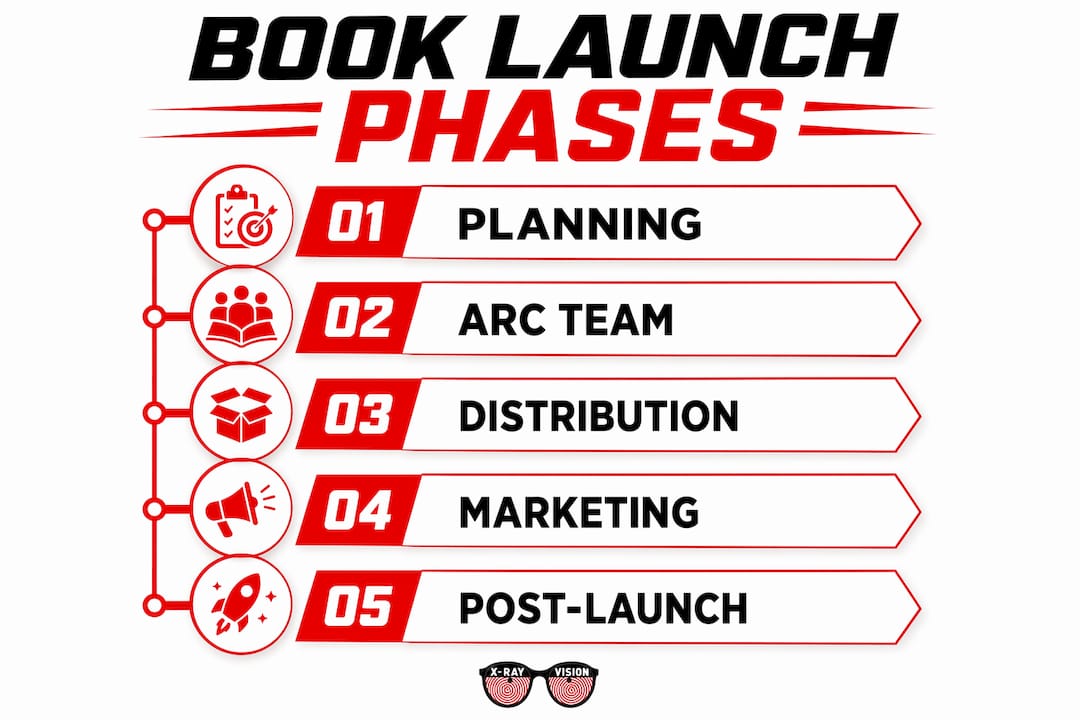
The industry-standard launch timeline has five distinct phases. Each one builds on the last. Skip one and the whole structure weakens.
-
Pre-launch preparation (weeks 12–9). This is where the foundation gets built. Complete your manuscript, finalize cover design, and write metadata that includes strong keywords for your genre. Run a marketing asset audit at this stage: check your author website, email list, and social profiles. Gaps found now are fixable. Gaps found on launch day are not.
-
Audience building and ARC distribution (weeks 8–5). Start publishing content that warms up your audience. Share behind-the-scenes posts, cover reveals, and early excerpts. Recruit your ARC team and send copies 4–6 weeks before your release date. This window gives reviewers enough time to read and post.
-
Pre-order and anticipation phase (weeks 4–2). Set up pre-orders on your key platforms. Pre-orders signal demand to algorithms and give you a sales baseline before launch day. Keep publishing content and send your email list a countdown sequence.
-
Launch day push. Send your launch email, post across social channels, and ask your ARC team to go live with reviews. The goal is concentrated activity in a tight window. Algorithms reward velocity.
-
Week-one review acceleration and month-one optimization. Keep the pressure on. Send follow-up emails, engage every comment, and monitor your sales rank daily. Paid ads work best when you already have social proof, so week one is the right time to start them.
Pro Tip: Write your launch day email sequence at least three weeks in advance. Scrambling to write copy on launch day kills momentum before it starts.
How do you build and manage an effective ARC team?
ARC reviewers are the engine behind early social proof. Securing 20–50 dedicated ARC reviewers and distributing copies 4–6 weeks before launch gives you the best chance of reviews hitting within the first 72 hours. Those early reviews directly influence Amazon's algorithm and buyer confidence.
Here is how to build and run that team effectively:
- Recruit from your existing audience first. Email subscribers and social followers already trust you. They are more likely to follow through than cold contacts.
- Use genre-specific reader communities. Facebook groups, Reddit communities, and Goodreads groups focused on your genre contain readers actively looking for early access.
- Send a clear ARC package. Include the book file, a short briefing on your launch date, and a direct link to where you want the review posted. Remove any friction.
- Set a reminder sequence. Send an initial email when ARCs go out, a check-in at the two-week mark, and a final reminder one week before launch.
- Follow up after launch. Send a social proof email 12–24 hours after launch day. Share early positive reviews and thank your team. This nudges anyone who has not yet posted.
The reviewers who feel genuinely included in your launch will promote it without being asked. Treat your ARC team like collaborators, not a task list.
Pro Tip: Never ask ARC reviewers to leave only positive reviews. Ask for honest ones. Authentic mixed reviews build more reader trust than a wall of five-star ratings.

What platforms and distribution strategies should authors use?
Relying on a single platform is the fastest way to cap your reach. Diversifying with IngramSpark and Draft2Digital puts your book in front of readers who never shop on Amazon. Each platform serves a different part of the market.
| Platform | Format | Key Reach |
|---|---|---|
| Amazon KDP | Ebook, print | Largest single retail audience |
| IngramSpark | Print, ebook | Bookstores, libraries, global retail |
| Draft2Digital | Ebook | Apple Books, Kobo, Barnes & Noble, library systems |
IngramSpark is the tool that gets your print book onto bookstore shelves and into library catalogs. Draft2Digital handles ebook distribution to Apple Books, Kobo, and library platforms like OverDrive and Hoopla. Using both means a reader can find your book whether they shop at an indie bookstore, borrow from their local library, or read on a Kindle.
Multi-channel presence also protects you. If one platform changes its algorithm or terms, your income does not collapse overnight. For horror authors, Markwatsonbooks demonstrates this approach across its genre collections, reaching readers through multiple discovery points rather than a single storefront.
Paid ads work best layered on top of organic distribution. Start Amazon Ads in week one when you have reviews to support the click. Use social ads to drive traffic to your author website and email list, not just to a single retailer.
How can you sustain momentum and optimize sales after launch?
The week after launch is when most authors go quiet. That is exactly the wrong move. Sustaining momentum post-launch requires active monitoring and continued outreach across multiple channels.
- Track Kindle Unlimited page reads daily in week one. Page read velocity tells you whether readers are finishing your book, which predicts word-of-mouth growth.
- Run Amazon Ads with your best reviews as ad copy. A short pull quote from a five-star review outperforms generic ad text every time.
- Pitch yourself to podcasts in your genre. Podcast guesting puts you in front of warm, engaged audiences who already love the type of book you wrote. For genre-specific guidance, the Markwatsonbooks blog covers marketing horror books to passionate readers in detail.
- Engage book clubs actively. Offer a free Q&A session for any book club that picks up your title. Book clubs generate word-of-mouth that no ad budget can replicate.
- Plan your next promotion before momentum fades. A price promotion or limited-time bundle in month two keeps your sales rank from dropping off a cliff.
Owning your reader list is the single biggest advantage you can build over time. A platform can change its algorithm tomorrow. Your email list cannot be taken away. Every post-launch activity should push readers toward your list, not just toward a buy button.
Key takeaways
A successful book launch is a multi-month campaign, not a single event, and the authors who treat it that way consistently outsell those who do not.
| Point | Details |
|---|---|
| Start at least 12 weeks out | Build your foundation early: cover, metadata, email list, and ARC team before anything else. |
| Recruit 20–50 ARC reviewers | Send copies 4–6 weeks before launch to secure reviews within the critical first 72 hours. |
| Diversify your distribution | Use IngramSpark and Draft2Digital alongside Amazon to reach bookstores, libraries, and multiple ebook stores. |
| Sustain activity post-launch | Monitor page reads, run ads with review copy, and pitch podcasts to keep sales moving in month one. |
| Own your reader relationships | Build your email list at every stage so your next launch starts with a warm, ready audience. |
Why I think most authors misread what a launch actually is
Every author I have spoken with who struggled at launch made the same mistake. They treated the release date as the destination. They spent months writing and weeks editing, then expected the world to notice on a single Tuesday.
A launch is not a day. It is a signal fire you build over months and keep burning for weeks after. The coordinated pre- and post-launch activity is what creates the sustained visibility that actually moves books. One spike on launch day fades within 48 hours if nothing feeds it.
The other thing most guides skip: platform algorithms do not care how good your book is. They care about velocity and social proof. That means reviews, clicks, and sales happening in a concentrated window. You manufacture that window by doing the work months in advance.
What I have found most valuable across multiple launches is building the reader relationship before the book exists. An email list of 500 people who are genuinely excited about your work is worth more than 5,000 social media followers who barely remember your name. Niche validation and keyword research done months out shapes everything from your cover copy to your ad targeting. Authors who skip that step are guessing. Authors who do it are aiming.
The self-publishing world rewards patience and preparation more than talent alone. That is uncomfortable to hear. It is also the most useful thing I can tell you.
— Mark
What Markwatsonbooks offers authors at every stage
Markwatsonbooks has built a catalog across horror, children's literature, and Creepypasta that shows what a sustained, multi-genre publishing presence looks like in practice. Whether you are preparing for your first release or planning a backlist push, seeing how a working author structures a full books collection gives you a real reference point beyond theory.

The Markwatsonbooks blog also covers genre-specific launch and promotion strategies, including a detailed self-publishing horror guide and children's book promotion tactics. These are practical resources written from direct publishing experience, not generic advice. If you are serious about your launch, use every resource available to you.
FAQ
How long before launch should I start planning?
A successful book launch requires a minimum 8–12 week lead time, with six months recommended for the strongest results. Starting earlier gives you time to build your audience, recruit ARC reviewers, and set up distribution properly.
How many ARC reviewers do I need?
Aim for 20–50 ARC reviewers and send copies 4–6 weeks before your launch date. Reviews that post within the first 72 hours of launch have the greatest impact on Amazon's algorithm.
Should I publish only on Amazon?
No. IngramSpark and Draft2Digital extend your reach to bookstores, libraries, Apple Books, Kobo, and Barnes & Noble. Multi-channel distribution protects your income and expands your discoverability.
What is the most important post-launch activity?
Monitoring Kindle Unlimited page reads and running Amazon Ads with review copy in week one keeps your sales rank active. Pitching podcasts and engaging book clubs sustains visibility beyond the initial launch window.
Do I need an email list before my first launch?
Yes. Owning your reader list gives you direct access to your audience that no platform algorithm can remove. Start building it before your book is finished, not after it is published.