

To build suspense, you control what the reader knows, raise clear stakes, and manage pacing so readers stay locked in, waiting for the answer. Those three levers — information control, stakes, and pacing — drive every page-turner ever written. Put them to work with these six high-impact techniques:
- Ticking clock: Give the character a deadline that shrinks with every scene.
- POV and information control: Decide exactly what your narrator reveals and when.
- Cliffhangers: End scenes on an unanswered question or unresolved threat.
- Foreshadowing and misdirection: Plant clues that point one way, then pull the rug.
- Sensory detail: Ground dread in what characters hear, smell, and feel.
- Escalating stakes: Make each setback cost more than the last.
Quick example: a character finds a note that reads "I know what you did." You don't reveal who sent it. That single withheld fact pulls the reader forward for chapters. Lee Child calls this engine "controlling what the reader knows, what they fear, and what they're waiting for."
Pro Tip: Write the answer to your central question on a sticky note and hide it from your reader for as long as the story can bear. That gap between question and answer is where suspense lives.

Table of Contents
- What does suspense actually do to a reader?
- How suspense works: the three core levers
- Ten techniques to write suspenseful scenes
- How is suspense different from surprise?
- How should you use cliffhangers and chapter endings?
- Practice exercises to sharpen your suspense writing
- Common pitfalls that kill suspense
- Key Takeaways
- The technique most writers underestimate
- Markwatsonbooks: read suspense the way it's meant to work
- Useful sources for further reading
What does suspense actually do to a reader?
Suspense is the emotional state of waiting for a known threat to land. It is not the same as shock or surprise. A reader in suspense knows something bad is possible, or even probable, and cannot stop reading because they need to know how it resolves. MasterClass describes it as a combination of withholding, dramatic irony, and structured anticipation.

That distinction matters for craft. Surprise is a single beat. Suspense is a sustained emotional state you engineer across pages, scenes, and chapters. Readers who are in suspense are emotionally invested, attentive, and willing to forgive slower passages because they are waiting for something.
How suspense works: the three core levers
Every suspenseful scene runs on three mechanics working together.
Information control is about the gap between what the reader knows and what the character knows. You can give the reader more than the character (dramatic irony: the reader sees the killer enter the house while the protagonist makes coffee) or less (the reader and character discover the threat together). Both create tension. Structured withholding — where the reader senses the answer is approaching — works far better than random withholding, which just feels evasive.
Stakes are what can be lost. Experts consistently stress that vivid description alone cannot create tension if the reader cannot see what is at risk and why it matters. A chase scene with no emotional investment is just choreography.
Pacing is the tempo at which you release information and action. Short sentences, fragmented paragraphs, and compressed timelines accelerate tension. Longer, atmospheric passages create the breathing space that makes the next pressure point hit harder. Spreading micro-tension across scenes rather than saving it all for a single climax keeps the story moving without exhausting the reader.
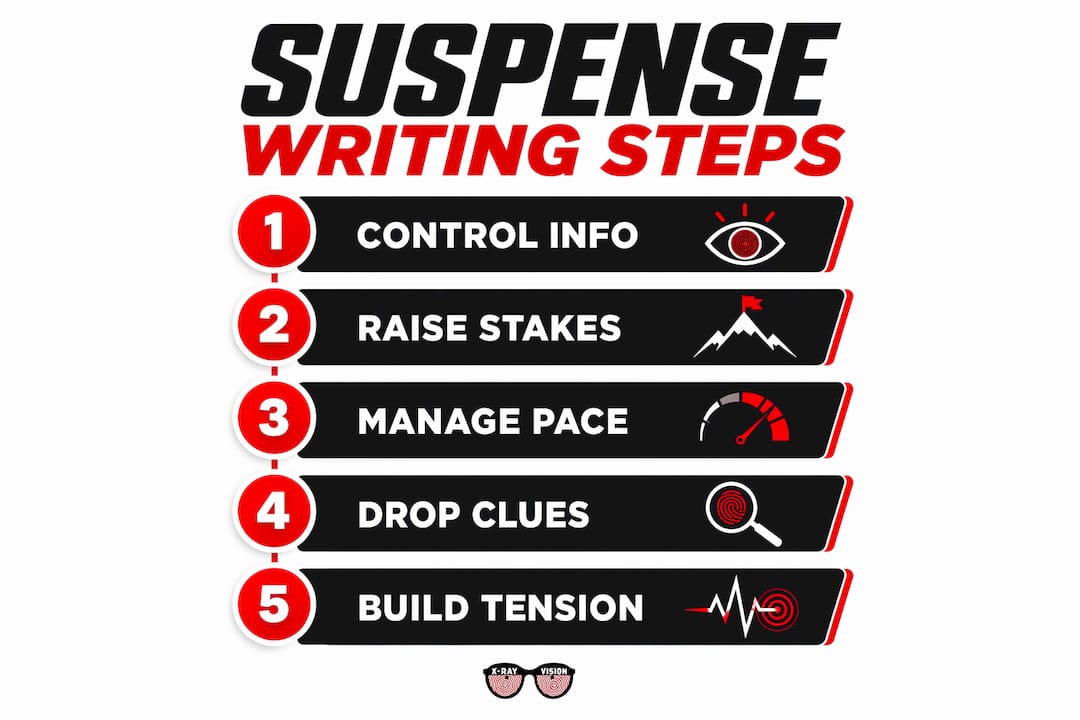
Sketch this for your own manuscript: draw a horizontal timeline of your story. Mark where clues drop, where stakes rise, and where reveals land. If your stakes curve stays flat for long stretches, or if a major reveal comes too early, you can see the problem before you rewrite.
Pro Tip: Audit one scene by asking three questions: What does the reader know that the character doesn't? What can the character lose right now? Is the sentence length matching the tension level? If you can't answer all three, the scene needs work.
Ten techniques to write suspenseful scenes
These are the tools thriller writers reach for most. Use them in combination for maximum effect.
-
Start the clock. Introduce a deadline early. It can be literal (a bomb timer) or figurative (a dying phone battery, an approaching storm). A ticking clock shared between reader and character creates measurable urgency. Scene example: "She had four minutes before the ferry left. The envelope was still sealed." Two sentences, one clock, instant pressure. Mini-exercise: Write a 10-minute scene where a character has exactly 15 minutes to do something ordinary — but the stakes of failing are enormous.
-
Control your POV. Choose what your narrator notices, and what they miss. A first-person narrator who doesn't realize they're being followed creates unbearable dramatic irony for the reader who does.
-
Use cliffhangers at scene and chapter breaks. End on an unanswered question, a new threat, or a revelation that reframes everything. James Patterson's notoriously short chapters function as mini-deadlines — each one ends before the reader is ready.
-
Plant foreshadowing, then misdirect. Set up a plausible expectation, then subvert it. Blake Crouch and similar authors use this to maintain engagement without breaking narrative logic. The reader thinks they're a step ahead — then they're not. Scene example: Every chapter mentions the protagonist's fear of water. The final confrontation happens in a drought-cracked field. The reader's assumption becomes the misdirection.
-
Escalate stakes progressively. Each setback should cost more than the previous one. If the character loses their job in chapter two, losing their house in chapter five needs to feel worse, not just different. Mini-exercise: List your protagonist's three most important things. Remove one per act. Write the scene where the second one disappears.
-
Use sensory detail to anchor dread. The smell of something burning before the character sees smoke. The sound of a door that shouldn't be opening. Atmosphere and ambiguity — small unsettled moments — build slow-burn tension more effectively than constant shocks. Explore how setting shapes atmosphere for deeper guidance on this technique.
-
Slow down at the worst moment. When tension peaks, resist the urge to rush. Stretch the moment with physical detail, internal thought, and short declarative sentences. The reader's pulse follows your prose rhythm. Scene example: "She reached for the handle. Stopped. The shadow under the door was wrong."
-
Give characters impossible choices. Force your protagonist into a fork where both options carry real cost. The reader becomes torn alongside the character, which deepens emotional investment.
-
Introduce constraints. Limit what the character can do: they can't call for help, they can't leave, they can't tell the truth. Constraints compress the story's oxygen and make every action feel consequential.
-
Make the reader care before the threat arrives. Stakes only work when readers are invested in the character. Spend time on what the character loves and fears before you put those things at risk. For children's stories specifically, age-appropriate suspense pairs clear problems and sensory cues with reassuring resolutions so young readers feel dread without being overwhelmed.
How is suspense different from surprise?
The distinction is timing and reader knowledge.
- Suspense: The reader knows a threat exists. The character may or may not. The tension lives in the wait.
- Surprise: The reader and character discover the threat simultaneously. The impact is immediate but brief.
- Emotional payoff: Suspense builds investment over time; surprise delivers a single sharp jolt.
- Best use of surprise: A sudden reversal that reframes what the reader thought they understood, used sparingly so it retains power.
- Best use of suspense: Any scene where you want the reader to keep turning pages rather than just react.
Subverting reader expectations — letting them think they're ahead, then pulling the reveal — combines both effects. The rule of thumb: use surprise to punctuate, use suspense to sustain.
How should you use cliffhangers and chapter endings?
A cliffhanger is not a cheap trick. It is a promise to the reader that the story is still moving.
Do:
- End on an unanswered question that the next scene will eventually answer.
- Use an emotional revelation (a character learns something that changes everything).
- Introduce new information that recontextualizes what came before.
- Vary cliffhanger types: physical threat, moral dilemma, unexpected arrival, overheard secret.
Don't:
- End every chapter the same way — readers adapt and the effect dulls.
- Withhold information arbitrarily just to delay; the reader will feel cheated.
- Resolve a cliffhanger in the first paragraph of the next chapter — let the tension breathe a little longer.
James Patterson's short-chapter technique treats every chapter break as a mini-deadline. Each chapter ends before the reader is satisfied, which makes starting the next one feel involuntary. You don't have to write chapters that short, but the principle holds: leave a door open at every exit. For a deeper look at structuring a thriller around these breaks, the Markwatsonbooks craft blog has a full guide.
Practice exercises to sharpen your suspense writing
Three timed drills you can run today.
5-minute micro-tension rewrite. Take a flat scene from your current draft. Add one sensory detail that signals something is wrong, cut two sentences of explanation, and end the scene one beat earlier than you originally did. Read it back. The unease should be immediate.
15-minute ticking-clock scene. Write a scene where a character has exactly 12 minutes to do something before a consequence lands. Don't name the consequence until the final paragraph. Keep sentences short. Let the clock dominate.
30-minute POV swap. Take a scene you've already written. Rewrite it from the perspective of a character who knows more than your protagonist. Notice how the dramatic irony changes the reader's experience entirely.
Scene prompt: A woman returns to her childhood home to collect one item before it's demolished. She finds the item missing. She hears footsteps upstairs. She knows the house is supposed to be empty. Use dramatic irony (you, the writer, know who is upstairs) and a ticking clock (the demolition crew arrives in 20 minutes).
Revision checklist:
- Information control: What does the reader know that the character doesn't, and vice versa?
- Sensory cue audit: Is there at least one physical detail that signals dread before the threat is named?
- Stakes check: Can you state in one sentence what the character will lose if this goes wrong?
Pro Tip: After any exercise, read the scene aloud. Where you rush or stumble, the pacing is off. Where you slow down naturally, you've found the tension.
Common pitfalls that kill suspense
Knowing what wrecks tension is as useful as knowing what builds it.
Overstating stakes without emotional setup. Telling the reader "everything was at risk" means nothing if they don't yet care about the character. Build attachment first, then threaten it.
Random withholding. Keeping secrets from the reader without a plan feels evasive, not mysterious. Structured withholding — where partial answers arrive on a schedule — keeps curiosity alive. Arbitrary gaps just frustrate.
Constant high tension with no breathing room. A story that never lets up becomes numbing. Peaks and valleys in tension rhythm are what make each pressure point land harder. Give readers a moment to exhale before the next threat arrives.
Resolving tension too quickly. If every cliffhanger is answered in the next paragraph, the reader stops feeling urgency. Let consequences sit. Let the character (and reader) stew.
Telegraphing the outcome. If the reader can see exactly where the story is going, suspense evaporates. Misdirection and subverted expectations keep the destination genuinely uncertain.
Key Takeaways
Suspense is built by controlling information, raising clear stakes, and managing pacing so readers stay locked in across every scene and chapter.
| Point | Details |
|---|---|
| Three core levers | Control information, raise stakes, and manage pacing — every suspenseful scene runs on all three. |
| Structured withholding wins | Plan your reveal cadence; partial answers on a schedule sustain curiosity far better than arbitrary gaps. |
| Micro-tension across scenes | Spread pressure throughout the manuscript so each peak lands harder after a moment of breathing room. |
| Cliffhangers need variety | Rotate emotional revelations, physical threats, and unanswered questions so readers never adapt to the pattern. |
| Markwatsonbooks craft resources | The Markwatsonbooks blog and horror/thriller titles offer published examples of these techniques in action. |
The technique most writers underestimate
Most craft advice focuses on the big moments: the twist, the climax, the killer cliffhanger. Those matter. But the writers who consistently produce page-turners tend to obsess over something quieter: the micro-tension between the big beats.
A scene where a character simply drives to the store can carry real dread if the information is controlled carefully. What does the reader know that the driver doesn't? What sensory detail signals something is wrong? What small constraint limits the character's options? Those questions, applied to even the most mundane scene, are what separate a story that readers finish from one they abandon at chapter three.
The other thing worth saying plainly: suspense is a craft skill, not a personality trait. You don't have to be a dark, brooding writer to build tension. You have to be a deliberate one. Plan your reveals. Map your stakes curve. Read your scenes aloud and notice where the rhythm goes slack. The techniques in this article are repeatable and learnable. The writers who use them consistently — Lee Child, Blake Crouch, Hitchcock in his screenplays — aren't working from instinct alone. They're working from a system.
For genre-specific application, children's suspense requires a lighter touch: compact settings, clear problems, and resolutions that reassure. The suspense in children's books guide at Markwatsonbooks breaks that down in detail.
Markwatsonbooks: read suspense the way it's meant to work
The fastest way to internalize these techniques is to read them in action. Markwatsonbooks publishes horror thrillers, Creepypasta anthologies, and children's spooky titles that put every technique in this article to work across different lengths and audiences.

The Creepypasta collections are particularly useful for writers studying micro-tension: each story is compact, the stakes are immediate, and the information control is tight. For children's fiction writers, the children's books collection shows how age-appropriate dread works in practice, with sensory cues and reassuring resolutions built into every story. Browse the full range, pick a title in your genre, and read it with a writer's eye. You'll spot the techniques at work on every page.
Useful sources for further reading
-
How to Build Suspense: Tips from Thriller Authors — Practitioner-level advice from thriller writers including Lee Child on information control, ticking clocks, and structured withholding. Supports the three-levers model and the techniques list throughout this article.
-
How to Create Suspense in Writing — MasterClass — Covers withholding, dramatic irony, plot compression, and puzzles as repeatable devices. Useful for the definition section and the techniques overview.
-
How to Build Suspense in Fiction — Writer Magazine — Focuses on expectation subversion and misdirection; supports the suspense-vs.-surprise section and the foreshadowing technique.
-
How to Write Tension — 11PlusWritingCoach — Practical guidance on stakes, micro-tension, and the limits of description without consequence. Backs the stakes and pacing sections.
-
Writing Slow-Burn Suspense — Writer's Digest — Recommends ambiguity and gradual momentum over constant shocks; supports the sensory detail and pacing techniques.
-
How to Build Tension in a Story — Novela Studio Blog — Explains peaks-and-valleys rhythm and the value of breathing space between pressure points. Supports the pacing lever and the pitfalls section.
-
The Anatomy of a Spooky Tale for Kids — FriesenPress — Covers age-appropriate suspense for children: compact settings, sensory cues, and reassuring resolutions. Relevant for the children's fiction notes in the techniques section.
-
3 Narrative Writing Mini-Lessons to Build Suspense — TeachWriting.org — Classroom-tested mini-lessons using the Rule of Three, sensory description, and mystery-building. Useful for writers working on children's fiction or teaching suspense craft.