
TL;DR:
- Suspense transforms passive reading into active problem solving, enhancing inference, emotional resilience, and comprehension in young readers. It creates engagement by requiring children to track clues and justify predictions, which naturally develops critical thinking skills and resilience through safe, resolved tension. Research confirms that narrative structures with suspense significantly improve understanding and motivation, especially for struggling readers.
Suspense is defined as the narrative tension that compels a reader to keep turning pages because the outcome is unknown. Research confirms that why suspense benefits young readers goes far beyond entertainment. Suspense transforms passive reading into active problem solving, sharpening inference skills, building emotional resilience, and deepening comprehension in ways that straightforward storytelling rarely achieves. A 2026 Springer study of 166 third and fourth graders found that narrative text structures significantly improved understanding for low-achieving readers. Giggle Academy and Puzzlebooks.cloud have each documented how tension-driven stories push children to read with purpose, not just pace.
Why suspense benefits young readers: engagement and attention
Suspense works because it creates a reason to read carefully. When a story plants a question in a child's mind, that child cannot afford to drift. Every sentence might hold the clue that solves the mystery. Giggle Academy describes this as suspense demanding close attention to clues, actively preventing the mind from wandering and supporting genuine comprehension rather than surface-level word recognition.
This is the core distinction between suspenseful reading and passive reading. A child reading a flat narrative can zone out and still follow the plot. A child reading a suspenseful story must stay present, because missing one detail means missing the answer. That cognitive demand is not a burden. It is a skill being built in real time.
The role of tension in children's literature is to make reading feel urgent. Urgency produces focus. Focus produces retention. That chain reaction is why suspenseful books for young readers consistently outperform non-suspenseful texts in classroom engagement studies.
Here is what that active engagement looks like in practice:
- Children predict outcomes before turning the page, activating prior knowledge
- They revise predictions when new clues contradict earlier assumptions
- They ask questions spontaneously, without prompting from a teacher
- They reread passages to check whether a clue was missed
- They discuss the story with peers because the unresolved tension demands an audience
Pro Tip: When reading aloud with a child, pause before a key reveal and ask, "What do you think happens next, and why?" That single question turns a read-aloud into a critical thinking exercise.
How does suspense develop inferential reading skills?
Inferential reading is the ability to draw conclusions from evidence that is not stated directly in the text. It is one of the most important and most difficult reading skills to teach, and suspense is one of the most effective vehicles for developing it. Puzzlebooks.cloud documents how mystery-driven tasks create knowledge gaps that motivate careful reading and promote evidence-based discussion.
When a child reads a suspenseful story, they are not just following events. They are building a mental case. They collect details, weigh possibilities, and eliminate options that do not fit the evidence. That process mirrors the kind of reasoning required in science, history, and mathematics. The advantages of suspense in stories extend well beyond the reading classroom.
"The best suspense for children is not vague atmosphere. It is a clear clue trail that rewards careful readers with the satisfaction of being right." — Giggle Academy
Here is the inferential reasoning sequence that suspense naturally activates in young readers:
- Notice the clue. The reader identifies a detail that feels significant.
- Form a hypothesis. The reader proposes an explanation for what the clue means.
- Test against new evidence. Subsequent pages either support or challenge the hypothesis.
- Revise the theory. The reader updates their thinking when new information arrives.
- Reach a conclusion. The reader arrives at an answer supported by accumulated evidence.
This five-step process is not taught explicitly in most classrooms. Suspense teaches it implicitly, through the pleasure of the story itself. That is the quiet power of the importance of suspense for kids: it delivers critical thinking instruction disguised as entertainment.
What is "safe danger" and why does it build emotional resilience?
Safe danger is the term educators and child development researchers use to describe the calibrated mild fear that well-crafted suspenseful stories provide. It is distinct from horror. Horror aims to disturb. Safe danger aims to excite, then resolve. Giggle Academy's research explains that children's scary stories create manageable fear with safe endings, with the presence of trusted adults and predictable resolutions keeping anxiety within productive limits.
The emotional benefit here is real and measurable. A child who feels the pulse of suspense and then experiences the relief of a happy ending is practicing emotional regulation. They learn that fear is survivable. They build the vocabulary to describe courage, dread, relief, and triumph. That vocabulary does not come from calm stories about friendly animals. It comes from stories that make the heart race a little.
Choosing the right type of story matters enormously. The table below shows how suspense, horror, and non-suspenseful stories differ in their emotional impact on young readers:
| Story type | Emotional tone | Resolution style | Best outcome for children |
|---|---|---|---|
| Suspense | Tension with hope | Clear, satisfying resolution | Builds resilience and inference skills |
| Horror | Dread and unease | Often ambiguous or dark | Can cause anxiety; better suited to older readers |
| Non-suspenseful | Calm or predictable | Gentle and expected | Supports comfort but limits emotional growth |
Pro Tip: Look for suspenseful books where the stakes feel real to a child but the resolution is clearly positive. Series like Goosebumps by R.L. Stine or A to Z Mysteries by Ron Roy hit that balance well for ages 7 to 12.
How does narrative structure improve comprehension and retention?
The 2026 Springer study of 166 third and fourth graders is one of the clearest pieces of evidence available on this question. Narrative text structures improved comprehension for low-achieving readers compared to informational texts. The reason is cognitive load. Narrative structure provides a built-in scaffold: character, problem, rising tension, resolution. Children already understand this shape from oral storytelling before they can read. Suspenseful narratives use that familiar shape and add urgency to it.
A separate study from Ecuador, published in 2025 and 2026, found that a six-week narrative immersion program using short stories produced a large effect size (d≈1.95) for vocabulary and grammar retention compared to traditional methods. That effect size is striking. It means the narrative group did not just do slightly better. They did dramatically better. The impact of suspense on young minds compounds when the story structure itself supports memory formation.
The data below summarizes what research shows about narrative versus informational text for young readers:
| Measure | Narrative text | Informational text |
|---|---|---|
| Comprehension (low achievers) | Significantly higher | Lower, more cognitive load |
| Vocabulary retention | Large effect size gains | Moderate gains |
| Reader motivation | Higher engagement reported | Lower engagement reported |
| Inference skill development | Strong, especially with suspense | Weaker without narrative context |
How suspense aids reading skills is not a theory. It is documented across multiple studies, grade levels, and language contexts. The pattern is consistent: narrative structure reduces the effort required to understand, freeing mental resources for deeper processing.
Practical strategies for parents and educators
Knowing the benefits of suspense is one thing. Knowing how to use them is another. The most effective classroom results come when children track evidence and justify predictions through clue-based reading rather than vague atmospheric tension. The story needs a clear trail. The discussion needs structure.
Puzzlebooks.cloud recommends that teachers structure questions like "What clue supports that?" rather than "What do you think?" The first question demands evidence. The second allows guessing. That distinction separates suspense-as-entertainment from suspense-as-comprehension-tool.
A 2026 gamified reading study found that structured story engagement with feedback mechanisms produced significant improvements in young readers' motivation and self-regulation. This means the format around the story matters as much as the story itself.
Here are the best practices for parents and educators using suspenseful stories:
- Choose books with identifiable clues, not just creepy atmosphere
- Ask prediction questions before, during, and after reading
- Encourage children to keep a "clue journal" while reading longer mysteries
- Discuss what evidence supports each theory, not just what feels right
- Avoid books where the resolution relies on coincidence rather than logic
- For younger children, read aloud and model your own thinking process
Common pitfalls to avoid:
- Selecting books that are too frightening for the child's age or temperament
- Skipping the discussion phase and treating suspense as pure entertainment
- Choosing stories where the mystery is never explained, leaving children frustrated
- Overloading a reluctant reader with long suspenseful texts before building stamina
For a deeper look at how tension is constructed in children's books, the techniques behind suspense are worth exploring before you build a reading list.
Pro Tip: Pair a suspenseful read with a simple prediction chart. Three columns: "What I think will happen," "Clues that support it," and "What actually happened." Children who complete these charts show measurably stronger recall and inference skills.
Key takeaways
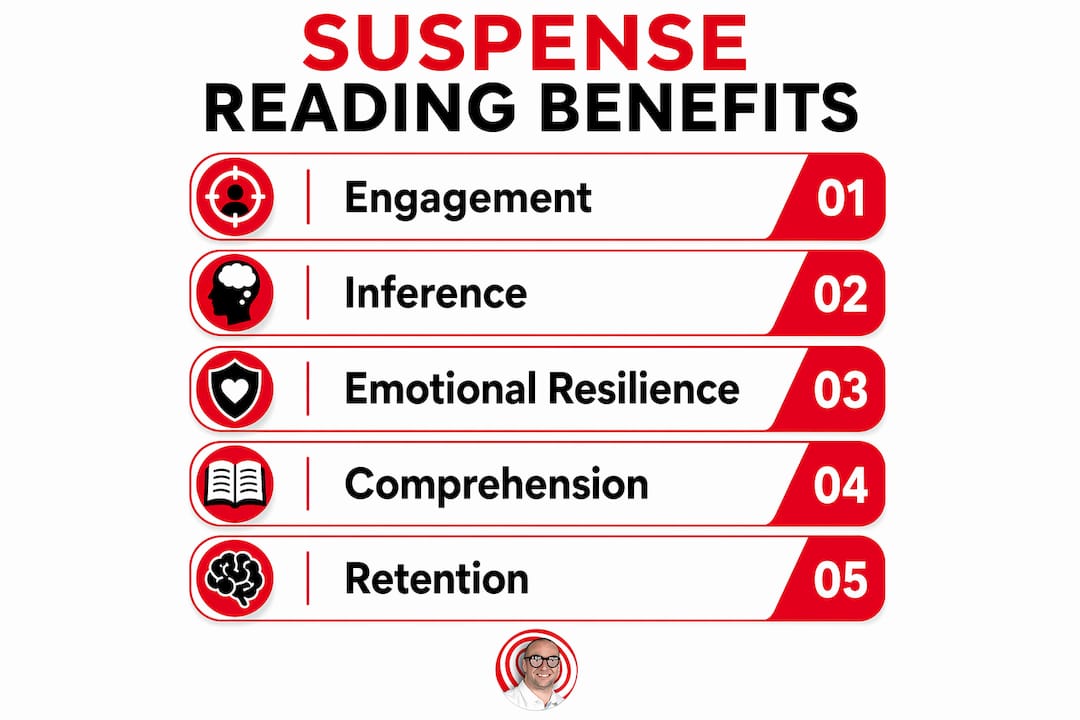
Suspense benefits young readers by converting passive reading into active reasoning, building inference skills, emotional resilience, and long-term retention simultaneously.
| Point | Details |
|---|---|
| Suspense demands active attention | Children must track clues to resolve tension, preventing passive reading and improving comprehension. |
| Inferential skills develop naturally | Suspense teaches evidence-based reasoning through the pleasure of the story, not explicit instruction. |
| Safe danger builds resilience | Calibrated fear with clear resolutions helps children practice emotional regulation and expand courage vocabulary. |
| Narrative structure reduces cognitive load | Research shows narrative texts significantly improve comprehension for low-achieving readers compared to informational formats. |
| Discussion unlocks the full benefit | Asking "What clue supports that?" transforms suspense into a structured comprehension and inference exercise. |
Why suspense changed how I think about children's reading
I have spent years writing stories that are meant to make readers feel something. When I turned my attention to children's books, I noticed something that surprised me. The kids who connected most deeply with stories were not the ones reading the calmest, most reassuring narratives. They were the ones gripping a book because they genuinely did not know what would happen next.
That tension is not accidental. It is the engine. A story without stakes is a story without a reason to read carefully. And careful reading is where every other skill, inference, vocabulary, emotional intelligence, gets built. I have seen children who struggled with reading suddenly become invested the moment a story gave them a mystery to solve. The book had not changed. Their reason to read had.
What I find most overlooked in conversations about children's literacy is the emotional resolution piece. Parents sometimes worry that suspense will frighten their child. The research, and my own experience, says the opposite. A child who feels real tension and then experiences a satisfying resolution learns something profound: hard things end well. That lesson is worth more than any vocabulary list.
If you want to understand how mystery deepens engagement for young readers, the connection between curiosity and literacy is worth your time.
— Mark
Discover suspenseful children's books from Markwatsonbooks

Markwatsonbooks offers a curated collection of children's titles built around exactly the kind of purposeful tension this article describes. These are stories with real clues, real stakes, and satisfying resolutions that leave young readers feeling capable rather than anxious. If you are a parent or educator looking to put these benefits into practice, the children's book collection at Markwatsonbooks is a strong place to start. Each title is selected to engage young minds, reward careful reading, and spark the kind of discussion that turns a story into a learning experience. Browse the full range and find the right fit for your reader today.
FAQ
What is the main educational benefit of suspense for children?
Suspense requires children to track clues and form predictions, which directly builds inferential reading skills and active comprehension. Research from Giggle Academy confirms that this clue-based attention prevents passive reading and supports deeper understanding.
At what age can children benefit from suspenseful stories?
Children as young as five or six can benefit from age-appropriate suspense, particularly through read-alouds with a trusted adult present. The key is choosing stories with manageable stakes and clear, positive resolutions rather than open-ended or disturbing outcomes.
How is suspense different from horror in children's literature?
Suspense creates tension with hope and resolves it clearly, while horror aims to disturb and often ends ambiguously. For young readers, suspense builds resilience and courage vocabulary; horror can cause anxiety and is better suited to older, more experienced readers.
How can educators use suspense to improve reading comprehension?
Teachers get the strongest results by asking evidence-based questions like "What clue supports that?" rather than open-ended opinion questions. Structured prediction activities and clue journals further deepen the comprehension gains that suspenseful reading naturally produces.
Do suspenseful stories help struggling readers specifically?
A 2026 Springer study of 166 students found that narrative text structures significantly improved comprehension for low-achieving third and fourth graders compared to informational texts. Suspenseful narratives reduce cognitive load by using a familiar story shape, freeing mental resources for deeper processing.